

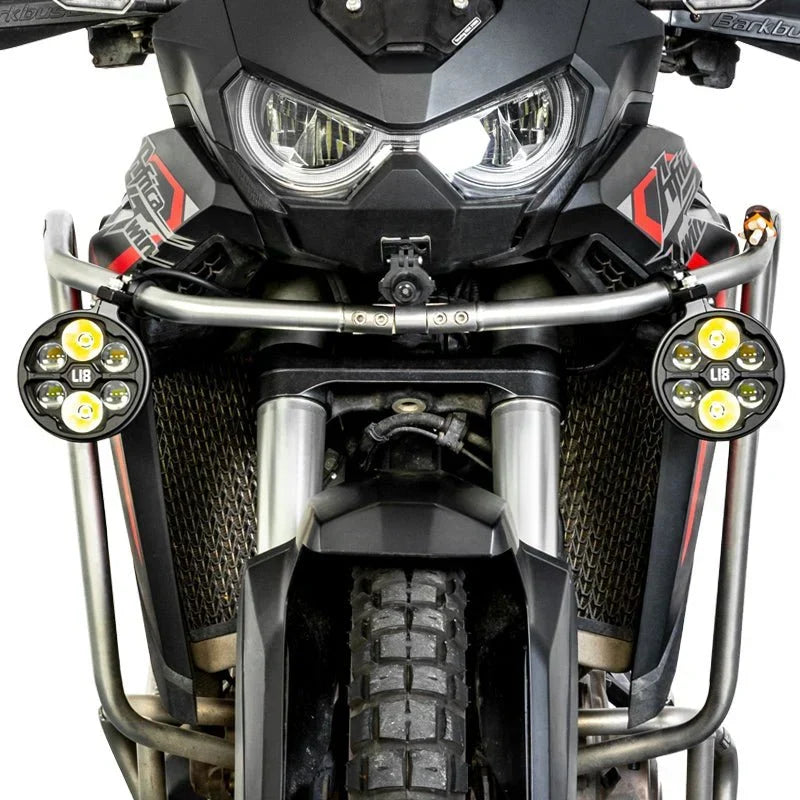
Buying guide · Endurrad
Best motorcycle lights 2026: comparison, prices and buying guide
Nineteen auxiliary lights in the catalogue, normalized lumens per pair, ECE approval numbers verified against the certificates, and the difference almost no one explains: auxiliary high beam or approved dipped beam. No declared instrumental testing, because we have not conducted any.
BeamApprovalPower consumption
In brief. In 2026, the most well-balanced motorcycle light in the Endurrad catalogue is the LOBOO L7S: €261.00 per pair, ECE R149.00 Class C approved, with both dipped and high beams approved, 15,000 lumens across eight levels adjustable from the handlebar, IP68 and wiring included.
Those looking for the maximum should choose the LOBOO L18S: 21,000 lumens and variable colour temperature from 3000 to 6000 K by turning the bezel, without filters. Those who want to integrate the original high beam with a modular system will find the DENALI DL-9 the most robust choice, at €459.00 per pair.
The three answers are different because they answer three different questions. This guide will help you understand which one applies to you.
TL;DR: which motorcycle lights to choose
If you are short on time, these eight cases cover most situations. Each choice is explained later in the article.
THE BEST OVERALL CHOICE
LOBOO L18S — €895.50. 21,000 lm, Class B, variable 3000-6000 K colour adjusted via the bezel.
BEST VALUE FOR MONEY
LOBOO L7S — €261.00. Complete approved pair, wiring included, under €270.
ADVENTURE TOURING
LOBOO L16 — €603.00. 19,000 lm and variable colour, at a lower price than the L12T.
THE MOST ROBUST MODULAR SYSTEM
DENALI DL-9 — €459.00 per pair. ECE R149 driving beam, IP68 and IP69K, CANsmart integration.
BE SEEN RATHER THAN SEE
DENALI DL-2 — €203.00 per pair. Wide flood beam designed for daytime conspicuity.
THE MOST COMPACT SOLUTION
DENALI DM — €165.00 each. Focused optics in a tiny housing.
THE INTEGRATED DRL
LOBOO L7X — €261.00. Two-colour DRL synchronized with the original indicators.
A PLUG-AND-PLAY KIT FOR BMW GS
DENALI D7 PRO + CANsmart Kit — from €1,483.00. Lights, mounts and controller in one part number.
Comparison table of the best motorcycle auxiliary lights 2026
All luminous-flux values are normalized per pair, because that is how auxiliary lights are used. Where the manufacturer states the figure for a single light, we doubled it. Prices recorded on Endurrad when the article was updated: they may vary depending on promotions and availability.
| Model | Package contents | Power | Lumens per pair | Beam | IP | Approval | Price | Ideal for |
|---|---|---|---|---|---|---|---|---|
| DENALI DL-2 | Single or pair | 16 W/light | 3.400 | Wide flood | IP68 + IP69K | ECE R149 driving beam | 106,00 € / 203,00 € | Being seen in traffic |
| DENALI DM | Single | n.d. | 2.190 | TriOptic spot + flood | n.d. | E-Mark on flood lens | 165,00 € | Minimal size |
| DENALI S4 | Single | n.d. | 6.132 | Sealed-lens hybrid | n.d. | Not specified | 171,00 € | Medium-sized motorcycles, limited budget |
| DENALI DL-4 | Single or pair | 32 W/light | 6.800 | Hybrid | IP68 + IP69K | ECE R149 driving beam | 138,00 € / 267,00 € | Small and medium-sized motorcycles |
| DENALI D2 | Single | n.d. | 2.190 | Spot 160 m / flood 50 m | n.d. | E-Mark on flood lens | 219,00 € | Low-mounted auxiliary light |
| DENALI D3 fog light | Single | 40 W | 5.600 | Fog light | IP67 | To be confirmed | 235,00 € | Fog and rain |
| DENALI DL-6 | Single or pair | 48 W/light | 10.200 | Hybrid | IP68 + IP69K | ECE R149 driving beam | 187,00 € / 363,00 € | Maxi enduro, low profile |
| DENALI DR1 | Single | n.d. | 2.190 | Narrow spot | IP68 | n.d. | 240,00 € | Pure throw |
| DENALI D3 | Single | 36 W | 4.200 | Spot or hybrid | IP67 | ECE R112 | 248,00 € | For those who want to choose the optics |
| LOBOO L7S | Pair + wiring | 80 / 150 W | 15.000 | Low beam with cutoff + high beam | IP68 | ECE R149.00 Class C | 261,00 € | The best entry point |
| LOBOO L7X | Pair + wiring | 120 W | 12.000 | Low beam with dedicated lens + high beam | IP67 | Not documented | 261,00 € | For those who want DRL |
| DENALI DL-9 | Single or pair | 72 W/light | 15.300 | Hybrid, 421 m per light | IP68 + IP69K | ECE R149 driving beam | 235,00 € / 459,00 € | Maximum performance on a budget |
| DENALI D4 | Single | n.d. | 8.760 | Hybrid, 2 flood + 2 spot | n.d. | E-Mark on spot lens | 291,00 € | Custom configurations |
| LOBOO L7 VOGE DS525X | Dedicated pair | n.d. | 15.000 | Low beam + high beam | IP68 | ECE R149.00 Class C | 297,90 € | VOGE DS525X |
| LOBOO L7 CFMOTO 800MT | Dedicated pair | n.d. | 15.000 | Low beam + high beam | IP68 | ECE R149.00 Class C | 306,00 € | CFMOTO 800MT |
| DENALI D7 | Single | 70 W | 7.665 | Full spot, 366 m | IP67 | E-Mark on spot lens | 395,00 € | Maximum range in the D series |
| LOBOO L11 | Pair + wiring | 25-80 / 45-150 W | 15.000 | Low beam + high beam | IP68 | ECE R149.00 Class B | 454,50 € | More structured body |
| LOBOO L16 | Pair + wiring | 50-168 / 58-190 W | 5.800-19.000 | Low beam + high beam | IP68 | ECE R149.00 Class B | 603,00 € | Adventure Touring |
| LOBOO L12T | Pair + wiring | 80 / 150 W | 15.200 | Independent optics | IP68 | ECE R149.00 Class C | 606,90 € | For those who want a sharp cutoff |
| LOBOO L18S | Pair + wiring | 50-165 / 65-210 W | 6.500-21.000 | Cup reflector | IP68 | ECE R149.00 Class B | 895,50 € | The maximum available |
Scroll the table sideways to see all columns.
Legend. “n.d.” means data not published by the manufacturer in a verifiable form: we did not estimate it. Two honest notes about the DENALI figures: the manufacturer states lumens per pair for the D series, but its own official pages are inconsistent about the D7, which appears as 7,665 lm per pair in one place and per single pod in another. We chose the per-pair value, the more conservative one. For the DR1, the figure does not appear to be published in a verifiable form: 2,190 lm is the value listed in the catalog and should be taken as indicative.
How we made this comparison
Let's say it straight away, because it is the part that almost nobody writes about: we did not carry out any instrumental tests. There are no lux meters, no candela measurements, and no timed night tests. Anyone publishing a «tested» comparison without showing their method and equipment is telling you something else.
This comparison is based on four sources:
- The ECE approval certificates for the LOBOO lights, issued by the Approval Authority of the Republic of San Marino and downloadable as PDFs from the respective product pages. They are public documents, with a certificate number and test report.
- The official LOBOO user manuals and catalogue, which provide the power ratings, tightening torques, wiring diagrams, and package contents.
- The official DENALI Electronics technical data sheets for lumens, watts, dimensions, IP rating, and beam certifications.
- The editorial experience of those who sell these products in Italy, which helps interpret the data rather than replace it.
We compared the models using five criteria: what is actually approved (device, beam type, class), what really arrives in the package, how much current the system draws, how controllable the light is while riding, and how much it costs to get a functioning system, not how much the individual component costs.
Where a data point could not be verified, we left it blank. It is less spectacular than a full table, but it is the only way to help you spend your money wisely.
How to choose motorcycle lights
Lumens: how many do you really need?
Short answer: between 8,000 and 15,000 lumens per pair will adequately cover the vast majority of road and mixed-use applications. Above 19,000 lumens, the limiting factor is no longer the light, but the electrical system and adjustment.
The lumen measures the total luminous flux emitted, not where that light ends up. Two 15,000-lumen lights can behave in completely opposite ways: one concentrates everything into a narrow cone 300 metres away, while the other spreads the same amount across 40 metres of width. The first lets you spot the roe deer sooner; the second lets you read the roadside while cornering.
Then there is the question of measurement units. Many manufacturers state raw lumens, meaning the theoretical sum of the LEDs before optical losses: the light coming out of the lens is always lower. And as you saw in the table, some state figures per pair while others state them per individual light. Before comparing two figures, always check that they refer to the same thing.
The practical benchmark: a stock low beam on a modern maxi-enduro produces around 1,000-1,500 lumens. A well-adjusted pair rated at 8,000 lumens is already a different class. Beyond that, useful depth increases, not the feeling of «a lot of light».
Wattage and electrical consumption
It is the constraint that almost nobody checks before buying, and the only one that can leave you stranded.
The catalog's actual figures: the L7S draws 80 W on dipped beam and 150 W with both beams active. The L16 reaches 190 W. The L18S reaches 210 W, the highest figure in the range. A pair of DENALI DL-9 lights draws around 144 W.
Now calculate it with what you already have installed: heated grips (30-50 W), a heated jacket (50-90 W), a CarPlay display and a USB charger. On a large adventure bike, the alternator has some margin, but that margin is not infinite, and it is used up especially at idle or in slow traffic, when the engine speed does not help.
Operating rule: add up the load of all accessories and compare it with the alternator's stated surplus on your motorcycle. If you do not know it, ask the dealer before ordering, not afterward.
Spot, flood and combo beam
This is where almost all perceived quality is determined.
- Spot: narrow, long-range beam. It is useful on fast main roads and during nighttime transfers. On its own, it leaves the sides dark and causes eye strain.
- Flood: wide, short-range beam. It illuminates the edges, slow bends and narrow dirt roads. On its own, it does not add range.
- Combo or hybrid: both together, in a single housing or with one light of each type.
DENALI's TriOptic system, found on the D2, D3, D4 and DM, takes this logic to its fullest: each light has one spot lens installed and one flood lens included, so with a pair you can use spot+spot, flood+flood, or one lens of each type. It is real flexibility, paid for in configuration complexity. The DL series, on the other hand, has non-interchangeable lenses: you choose the beam when you buy.
Dipped beam and main beam: the difference that changes everything
Short answer: an “auxiliary main beam” light is designed to switch on together with the motorcycle's main beam. A light with an approved dipped beam can remain on during normal riding. They are two different products, not two levels of the same product.
It is the most important distinction in the entire article, and the one catalogs do not explain.
The DENALI lights (D3, D4, D7, DL series) are approved as an driving beam, meaning an auxiliary main beam, under ECE R112 or R149 regulations. They work alongside the motorcycle's original main beam: they switch on with it and off with it.
The LOBOO lights in the L series are approved under ECE R149.00 with both dipped and main beam approved. The L7S has a true cutoff line on the dipped beam, that horizontal step that prevents the light from rising toward the eyes of oncoming traffic.
This does not make LOBOO «better» and DENALI «worse». It makes the two systems suited to two different ways of using a motorcycle. If your problem is seeing far when the road is clear, an auxiliary high beam is the correct answer. If your problem is having more useful light even when you encounter traffic, you need an approved low beam.
Color temperature, white light, and yellow light
Cool white at 6000 K always seems more powerful. In the garage, it is; to the eye, it is not.
On wet asphalt, in fog, suspended dust, or snow, very cool white light produces glare: suspended particles reflect the light back and create a bright wall in front of your helmet. A warmer tone, around 3000 K, cuts through better and causes less fatigue on a long journey.
A small technical clarification: selective yellow does not «see through» fog. No light does. It reduces backscatter, meaning how much the fog reflects back toward you. The practical result is an image with less haze and more contrast, which the eye interprets as «seeing better».
The traditional way to achieve this is a yellow lens cover, included with the L7S and L7 variants. But with a filter, you lose some of the light output because it is a filter and absorbs light. The elegant way is to change the LED's color temperature directly: L16 and L18S range from 3000 to 6000 K by turning the ring, without filters and without taking anything apart, across eight levels. On a rainy night in the Apennines, this is the feature that makes the biggest difference, and it is the technical difference that justifies their higher price.
DRL and daytime running lights
DRL is not for seeing; it is for being seen. The catalog has only one product that integrates it into the auxiliary light: the LOBOO L7X, with switchable white/amber DRL synchronized with the original turn signals. When you activate the turn signal, the DRL flashes with it, making your silhouette much easier for people at the intersection to recognize.
There is, however, one restriction to know before ordering, and it is stated on the product page: the ECE certificate covering L7S, L7, L7-800MT, and L7-DS525X does not cover the L7X. It is a different type, and the specific document has been requested from LOBOO; until it arrives, that light should not be considered approved. If approval is a requirement for you, choose the L7S.
Intensity adjustment: ring or dimmer
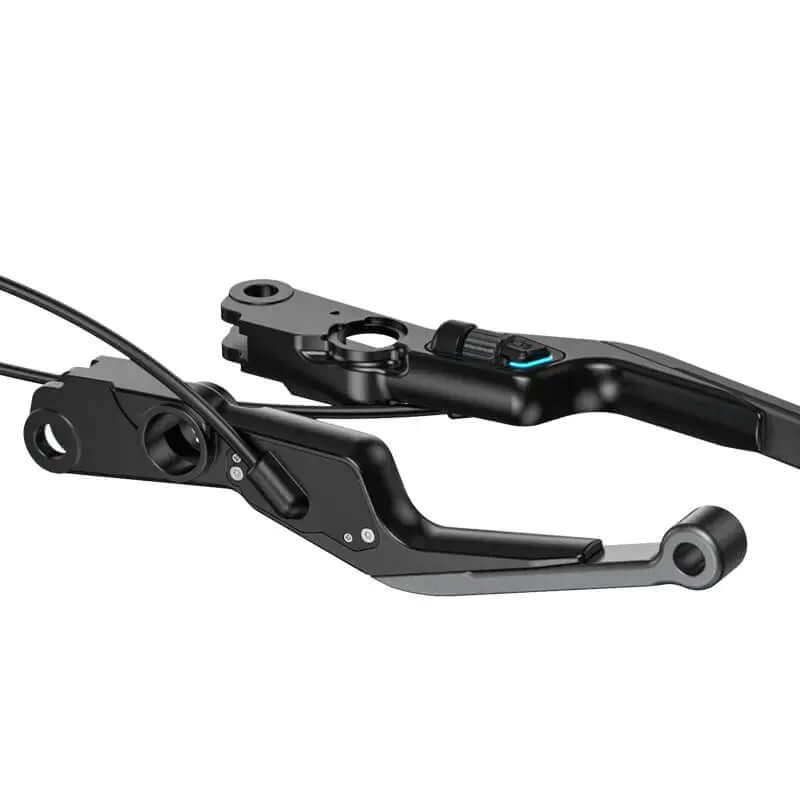
Across the entire LOBOO L series, you get eight levels of intensity adjustable while riding via an aluminum ring mounted near the clutch control, operated with your thumb without taking your hands off the handlebars. It is a feature that seems like a detail until you use it: low level behind a car, full power as soon as the road clears.
DENALI achieves the same result electronically with DataDim: the lights automatically change intensity in response to the original high-beam control. However, a module or controller is required: either the universal DialDim at €331.00 or a specific CANsmart. With DialDim, you also get functions that LOBOO does not offer: a horn-activated strobe, automatic turn-signal shutoff, an electronic fuse, and a battery voltmeter.
The key difference: LOBOO builds the control into the product, while DENALI sells it as a module. The first approach costs less and works immediately; the second costs more but grows with the motorcycle.
IP rating, heat dissipation, and vibrations
The two digits of the IP rating indicate protection against dust and liquids. IP67 means temporary immersion up to one meter, IP68 means continuous immersion at greater depths, and IP69K means resistance to high-pressure, high-temperature water jets.
Regarding the catalog: IP68 across the entire LOBOO L series except the L7X, which is IP67. IP67 on the DENALI D3 and D7. IP68 and IP69K across the entire DL series, which states that it uses robotic lens sealing and internal potting at the cable entry, the point where these products actually fail. In real life, an auxiliary light does not drown; it fills with condensation. And condensation almost always enters through the cable, not the lens.
Regarding heat: a hot LED produces less light, which is why an inexpensive auxiliary light seems incredibly bright for two minutes and then dims. The entire LOBOO L series features automatic thermal control that reduces power when the temperature rises too high, favoring less light over a burned-out LED. Practical consequence for installation: do not recess the lights in a niche without airflow.
Regarding vibrations: auxiliary lights do not fail because of the light; they fail because of shaking. The entire LOBOO range features CNC-machined aluminum alloy housings, while the brackets are 4 mm painted steel with a stated rating of 21 grms in the DENALI DL series. The weak point is almost always the mounting hardware: LOBOO specifies threadlocker, precise torque settings (10 N·m for the M6 screws and 18 N·m for the M8 screws on the L7S), and rechecking after the first few miles. This is not bureaucracy: a screw that loosens on a washboard road can take the light off in half an hour.
Brackets, collars, and tube diameters
The light is almost always universal. What changes from one motorcycle to another is how you attach it.
LOBOO includes collars for 22, 25, and 28 mm tubes as standard. For 32 and 38 mm tubes, the collars are sold separately. Before ordering, measure the diameter at the exact point where you want to mount the light: an engine guard can change cross-section along its length.
If you frequently remove and reinstall the lights, the LOBOO Q7 quick-release light mount at €93.33 solves the problem and is compatible with the L7S, L11, L16 and L18S. For dedicated mounting, Endurrad offers mounts and brackets for auxiliary lights for the most common platforms.
LOBOO auxiliary lights: the complete range
Eight models, all sold in pairs with wiring included. LOBOO's philosophy is to put everything into the product: approved low beam, adjustment dial, flashing modes, electronic protection. Buy it once and it works.

Best value for money
LOBOO L7S
261,00 € 290,00 €
In brief. It is the smartest entry point in the category. ECE R149.00 Class C-approved pair, certificate E57*149R00/06*1142, with both low and high beams approved and the marking stamped on the body. 15,000 lumens total, eight intensity levels from the dial, three flashing modes that can be paired with the horn, IP68, CNC aluminium body and glass lens. Yellow lens cover included: white 6000 K or yellow 3000 K.
Limitations. Yellow is produced with a filter, so there is some light output loss, rather than by varying the LED as on the L16 and L18S. At 150 W at full power, the system's available capacity margin should be checked. The manufacturer does not state the packed weight and dimensions.
When to choose it. If you want a complete, working, approved setup for less than €270, and you do not need variable colour temperature or DRL. It is the right choice for most motorcyclists.

The only one with an integrated DRL
LOBOO L7X
261,00 € 290,00 €
In brief. Same price as the L7S, different function. Two genuine beams with a dedicated low-beam lens, 12,000 lumens per pair across eight levels, 120 W maximum power draw, IP67, CNC aluminium. Its exclusive feature is the white/amber two-colour DRL synchronized with the original turn signals: no other light in the range offers it.
Limitations. ECE certificate E57*149R00/06*1142 covers the L7S and the L7 variants, but not the L7X: it is a different type, and the specific document has been requested from LOBOO. Until it is available, this light must not be described as approved. IP67 instead of IP68.
When to choose it. If your priority is visibility to other road users, you do a lot of riding in urban and busy extra-urban areas, and approval is not an immediate requirement for you.

ECE-approved · 8 levels
LOBOO L11
454,50 € 505,00 €
In brief. ECE-approved pair ECE E57*149R00/06*1186 under UN Regulation R149.00 in Class B, with both low and high beams approved. 15,000 lumens, eight levels from the dial, three warning-flash modes, IP68 with automatic adjustment for heat protection, CNC aluminum housing. Power draw from 25 to 80 W on low beam and from 45 to 150 W with both beams. Compatible with the Q7 quick-release mount and the LC081 CAN-Bus controller for BMW.
Limitations. At the same rated lumens, it costs €193.50 more than the L7S. The weight is not stated by the manufacturer.
When to choose it. If you want a more substantial housing than the L7 and integration with the BMW Multi-Controller, but do not need the L16's variable color temperature.

Independent optics
LOBOO L12T
606,90 € 673,81 €
In brief. It is the only one in the range with physically independent lens and light source for low and high beam: four LEDs per light, two separate optical groups. ECE E57*149R00/06*1143 Class C approval, which also covers the L12, L12U, L12Q and L12H variants. 15,200 lumens, eight levels, 80 W on low beam and 150 W with both beams, IP68, three mounting holes on the housing and a multi-axis rotating bracket.
Limitations. It costs €3.90 more than the L16, which offers more lumens and variable color. It is a pricing anomaly and should be said: on paper, the L16 outperforms it in almost every respect.
When to choose it. If you specifically value the sharp low-beam cutoff produced by a dedicated optic rather than a shared reflector. It is a real technical reason, but the only one that justifies this price.

Best for Adventure Touring
LOBOO L16
603,00 € 670,00 €
In brief. This is where the range steps up. ECE E57*149R00/06*1187 Class B approval for right-hand traffic, which also covers the L16T, L16Pro, L16S, L16Q and L16K. Five LEDs per light, 5,000-16,800 lm on low beam and 5,800-19,000 lm with both beams, 50-168 W and 58-190 W. The feature that makes the difference: variable color temperature from 3000 to 6000 K using the same dial, without filters, across eight levels. Ø 97.9 mm, depth 88.5 mm, height 139.3 mm with bracket. IP68.
Limitations. 190 W is a substantial load. The L16 user manual is not yet available, so the exact package contents and the collars actually included remain to be confirmed.
When to choose it. If you really travel, encounter changing weather conditions, and want to switch from white to yellow while riding. At this price, it is the best compromise in the range.

The top of the range
LOBOO L18S
895,50 € 995,00 €
In brief. The top of the range. ECE E57*149R00/08*1206 Class B approval, issued on February 26, 2025 based on test report ATS-SM-IR-149-11036, extended to the L18, L18Pro, L18Q, and L18D variants. Six LEDs per light with a cup reflector, 5,000-16,500 lm in low beam and 6,500-21,000 lm with both beams, 50-165 W and 65-210 W. Eight brightness levels and eight color-temperature levels from the same dial. Overtaking flash mode in addition to the three warning modes. Ø 108.4 mm, depth 86.5 mm, height 154.8 mm. IP68.
Limitations. 210 W is the highest load in the range and must be checked carefully. The declared output is 21,000 lm in the brochure, but some documents report 23,000: we used the more conservative value. It is also the largest light.
When to choose it. If you ride many nighttime miles on unlit roads and want the best available without compromises, with an electrical system that can handle it.

Dedicated CFMOTO kit
LOBOO L7 for CFMOTO 800MT
306,00 € 340,00 €
In brief. Specific kit for CFMOTO 800MT from 2021, covered by the same ECE E57*149R00/06*1142 Class C certification as the L7S. Up to 15,000 lm declared, 6500 K white and 3000 K yellow with lens covers, IP68, thermal and reverse-polarity protection. The real advantage: it is controlled via the motorcycle's original fog light switch, without adding handlebar controls.
Limitations. It is not universal: outside the 800MT, it makes no sense. Wattage, dimensions, and weight are not declared.
When to choose it. If you have a CFMOTO 800MT and want clean installation integrated with the original controls.

Dedicated VOGE kit
LOBOO L7 for VOGE DS525X
297,90 € 331,00 €
In brief. Kit for VOGE DS525X from 2023, with the same ECE R149.00 Class C certification, up to 15,000 lm, 6500 K white and 3000 K yellow, IP68, controlled via the original fog light switch. The kit includes the LOBOO switch.
Limitations. Compatibility with the DS900X is listed as to be confirmed in the technical documentation: contact us before ordering if you have that model. Wattage and dimensions are not declared.
When to choose it. If you have a VOGE DS525X and want the same optical quality as the L7S with dedicated mounting.
The complete range is collected in the LOBOO lighting collection, with more details in the LOBOO auxiliary lights guide.
DENALI lights: the complete range
Opposite philosophy. DENALI sells components that work together: the light, the wiring, and the controller. It costs more to build the complete system, but that system grows with the motorcycle and integrates functions that LOBOO does not have. Pay attention to the packaging: the D series is sold individually, while the DL series is available both individually and as a pair.
DL DataDim series: the range to compare with LOBOO
It is the newest line and the one with the most complete and verifiable specifications. The entire series states ECE R149 driving beam certification, IP68 and IP69K, 6000 K, 9-32 V DC voltage, EMC R10, CISPR 25, CE, and UKCA compliance. DrySeal construction robotically seals the lens and uses internal potting at the cable entry. The lenses are not interchangeable: choose the beam when purchasing.

Best for visibility
DENALI DL-2
€203.00 per pair €106.00 each
The smallest in the series: 3x2-inch pod, 2 LEDs, 16 W and 1,700 lm per light, 3,400 lm per pair. It is the only model in the range with a visibility beam: a wide flood beam at night, designed to appear as bright as possible to other drivers during the day.
Limitations. This is not a long-range light: do not expect depth. When to choose it: commuting, small motorcycles, or as the lower pair in a two-level setup on a maxi enduro.

The all-rounder of the series
DENALI DL-4
€267.00 per pair €138.00 each
3x3-inch pod, 4 LEDs, 32 W and 3,400 lm per light, 6,800 lm per pair, hybrid beam. DENALI itself identifies this as the main light for small and medium-sized motorcycles, and it is compact enough to fit in a low position even on a large Adventure bike.
Limitations. Without wiring and a controller, it remains a component, not a system. When to choose it: if you want a balanced beam without going oversized, or as a pair to combine with a more powerful set.

Low profile, high output
DENALI DL-6
€363.00 per pair €187.00 each
4.5x3-inch rectangular pod, 6 LEDs, 48 W and 5,100 lm per light, 10,200 lm per pair. The rectangular profile makes it one of the most discreet over-5,000-lumen lights to mount, and DENALI recommends it as the main light on medium-to-large motorcycles.
Limitations. The rectangular shape does not suit every aesthetic. When to choose it: if you want lots of light without two large round lights visible on the front.

The most powerful DENALI in the range
DENALI DL-9
€459.00 per pair €235.00 individually
4.5 x 4.5-inch square pod, 2 inches deep, 9 LEDs, 72 W and 7,650 lm per light, 15,300 lm for the pair. Claimed range of 421 meters per light and 560 as a pair, 110-meter width. IP68 and IP69K, 6000 K, ECE R149 driving beam.
Limitations. The square housing is large and suits maxi-enduro bikes only. No approved low beam: it is an auxiliary high beam. When to choose it: if you want the maximum amount of DENALI light and have or want a CANsmart.
D and S series: individually sold lights
These are the classic lines. They are sold individually and configured with separate lenses and wiring. On the D2, D3, D4 and DM, the TriOptic system includes one fitted spot lens and one included flood lens.

The most compact
DENALI DM
€165.00 each
2,190 lm for the pair concentrated in a tiny optic designed to be very bright to look at. 120-meter spot beam as a pair, with the included flood lenses certified with E-Mark and approximately 45 meters wide. When to choose it: when space is extremely limited and visibility is the primary goal.

More light per euro
DENALI S4
€171.00 each
6,132 lm for the pair, using the same LEDs as the D series but with a one-piece optic and sealed lens to reduce costs. Fixed hybrid beam with two flood optics and two spot optics. Limitations: DENALI does not state an approval for this model, and the lens is not replaceable. When to choose it: if you want the most lumens per euro in the DENALI range and don't need a certificate.

TriOptic · compact
DENALI D2
€219.00 each
2,190 lm for the pair from one 10 W Cree LED per light. The fitted spot lenses project approximately 160 meters, while the included flood lenses create a beam approximately 50 meters wide. This is the light designed to balance nighttime distance and daytime conspicuity. When to choose it: as the lower pair in a two-level setup, or on motorcycles where the D4 would be too much.

The most certified
DENALI D3
€248.00 each
Ø 90 mm x 65 mm, three 11 W Cree XP-P LEDs, 36 W power consumption, 2,100 lm per light and 4,200 for the pair, IP67, DataDim. It's the only model in the range with dual certification: SAE/DOT J581 hybrid lens and ECE R112, spot lens ECE only because it's too powerful for US regulations. Both included.
When to choose it: if you want to be able to choose the optics after purchase and you're interested in documented beam certification.

Dedicated fog light
DENALI D3 fog light
€235.00 per unit
Same housing as the D3 driving light, but with four 11 W Cree XP-P LEDs, 40 W draw, 2,800 lm per light and 5,600 per pair, IP67, DataDim. Optic designed for a low, wide beam, exactly what is really needed in fog.
Limitations: Its specific approval as a fog light does not appear to be declared in verifiable form. When to choose it: if you often drive in the Po Valley in winter and want a second level of light below the low beam.

Pure spot
DENALI DR1
€240.00 per unit
The classic round light with a deep reflector and clear lens, built around a single 10 W Cree LED for a very narrow beam of around 10 degrees. Powder-coated aluminium housing, IP68.
Limitations: the catalogue figure of 2,190 lm does not appear to be published by the manufacturer in verifiable form. The very narrow beam is unusable on its own. When to choose it: as a range-only light to pair with a flood pair.

TriOptic · the most versatile
DENALI D4
€291.00 per unit
Four Cree XPL-HI LEDs delivering 8,760 lm per pair. The fitted hybrid lens combines two elliptical flood optics and two spot optics in the same housing: very wide close-range flood and a central spot in a single unit. The included spot lenses project approximately 245 metres and carry E-Mark certification.
Limitations: DENALI does not publish verifiable IP and wattage figures for this model. When to choose it: if you want to build a custom system and are interested in being able to change the optic according to the season.

Maximum range in the D series
DENALI D7
€395.00 per unit
Seven 10 W LEDs behind a single-piece optic that produces a full spot beam with a claimed range of over 366 metres at 1 lux. Ø 111.76 mm, depth 73.66 mm, 816.67 g, IP67, DataDim, E-Mark-approved spot lens.
Limitations. It is the most expensive DENALI light per unit, and the manufacturer's official pages are inconsistent about the output, listed as 7,665 lm sometimes per pair and sometimes per single pod: we report the value per pair. A complete system with two units and wiring exceeds €800. When to choose it: if your absolute priority is range and you are building a DENALI system.
Complete DENALI kits for BMW GS

If you have a BMW GS and want to skip the entire configuration process, DENALI sells packages that include lights, dedicated mounts and a CANsmart controller under a single code. It is the most expensive and simplest route.
The top of the range is the D7 PRO, which in the Endurrad catalog is available only in kits: seven 14 W Cree XML3 LEDs per pod, 98 W power consumption, 11,900 raw lumens per pod, a claimed spot beam at 380 meters and flood beam at 75 meters, IP68 and IP69K, and a spot lens homologated to E-Mark ECE R112. It has a dual independent circuit that allows the central optic to be managed separately as a DRL or as a full-power flood, and to flash it in sync with the turn signals.
The available packages range from €1,006.00 (R 1250 GS with D4 and CANsmart) to €1,585.00 (R 1300 GS Adventure with D7 PRO). In between: R 1250 GS with D7 at €1,236.00, R 1250 GS ADV with D7 at €1,302.00, R 1300 GS with D7 PRO at €1,483.00, R 1250 GS with D7 PRO at €1,491.00 and R 1250 GS ADV with D7 PRO at €1,582.00.
The entire range is in the DENALI Electronics LED lighting collection, which also includes SoundBomb horns, CANsmart controllers, wiring and dedicated mounts.
LOBOO vs DENALI lights: which should you choose?
There is no universal winner, and anyone who points you to one has not looked at the certificates. These are two product philosophies built around two different problems.
| Aspect | LOBOO L series | DENALI |
|---|---|---|
| Philosophy | Everything integrated into the product | Modular system to configure |
| What is homologated | Low beam and high beam (R149.00 Class B or C) | Auxiliary high beam only (R112 or R149 driving beam) |
| Package contents | Pair with wiring and dial | D series as single units, DL series also as a pair. Wiring sold separately |
| Adjustment | 8 mechanical levels from the included dial | Electronic DataDim, requires a module or controller |
| Color temperature | Variable 3000-6000 K on the L16 and L18S | Fixed 6000 K, optional amber and yellow lenses |
| Maximum IP rating | IP68 | IP68 and IP69K on the DL series |
| Motorcycle integration | LC081 CAN-Bus controller for BMW with cable included, €112.50 | CANsmart for the model, universal DialDim €331.00 |
| Complete system cost | From €261.00 turnkey | From €203.00 plus wiring, up to over €1,500 in kits |
| Documentation | ECE certificates downloadable as PDFs | Complete for the DL series, more limited for the D series |
LOBOO may be preferable if...
- You want a homologated low beam, not just an auxiliary high beam, so you also have useful light when meeting oncoming traffic.
- You want a single purchase that works: pair, wiring, control and certificate in the same box.
- Are you interested in color temperature that can be varied from the dial, which DENALI does not offer on any model?
- You want the approval document available for download before buying, not a generic statement.
- Budget matters: €261.00 for a complete, approved pair has no equivalent in this comparison.
DENALI may be preferable if...
- You are building a layered lighting system with multiple pairs of lights serving different functions, and you want to control them independently.
- You want interchangeable lenses to change the beam or color depending on the season (D series with TriOptic).
- You have or want a CANsmart and are interested in features such as strobing with the horn, cancellation with the turn signal, an electronic fuse, and a voltmeter.
- You need the highest available protection rating: IP68 and IP69K on the DL series.
- You want a single kit for a BMW GS without having to choose anything, and the budget allows it.
The honest price comparison. A LOBOO L7S costs €261.00 and arrives ready to use. A DENALI D7 costs €395.00 per unit: two units plus the wiring harness come to approximately €826.00. A pair of DENALI DL-9s costs €459.00 plus the wiring harness, and at 15,300 lm it is the DENALI closest to the LOBOO models in terms of light-to-price ratio. If the criterion is "how much do I spend to have two lights on and controllable," LOBOO wins. If the criterion is "how far can I expand the system," DENALI wins.
Direct comparisons between models
LOBOO L7S vs L7X: approval or DRL?
The price is the same, €261.00, and the choice comes down to a single question. The L7S has 15,000 lm, IP68, and an ECE certificate already available. The L7X has 12,000 lm, IP67, no certificate published yet, but a two-color DRL synchronized with the turn signals.
Buy the L7S if you want more light and the documented certainty of approval. Choose the L7X if your main goal is to be seen and the DRL matters more to you than 3,000 lumens and a certificate that does not yet exist.
LOBOO L7S vs L11
Both claim 15,000 lm, both are R149.00 approved, and both have eight levels and IP68. The price difference is 193,50 €. The L11 has a more substantial body, is Class B rather than Class C, and its manual specifies pairing it with the LC081 CAN-Bus controller for BMW.
Buy the L7S if you are looking at the performance-to-price ratio: on paper, it delivers the same light for much less. Choose the L11 if you have already seen both in person and are convinced by its construction.
LOBOO L11 vs L12T
The L12T adds 200 lumens and, above all, physically independent optics for low beam and high beam: four LEDs per light and two separate optical groups, compared with the L11's shared architecture. The L12T is Class C, while the L11 is Class B. It costs €152.40 more.
Buy the L12T if low-beam cutoff quality matters to you. Choose the L11 if that detail does not make a difference to you and you want to save money.
LOBOO L12T vs L16: why the more expensive one is not the better one
This is the most awkward comparison in the catalogue, and it should be stated as it is. The L16 costs €3.90 less than the L12T and offers more lumens (19,000 versus 15,200), a higher approval class (B versus C), five LEDs per headlight versus four, and above all variable 3000-6000 K colour temperature without filters, which the L12T does not have.
Buy the L16 in almost every case. Choose the L12T only if you specifically want separate lenses and light sources for the two beams: this is the only real technical argument in its favour, because it produces the low-beam cutoff from a dedicated optic rather than a shared reflector.
LOBOO L16 vs L18S
The L18S adds 2,000 lumens (21,000 versus 19,000), one more LED per headlight (six versus five), a cup reflector for more even distribution, and an overtaking flash mode. It costs €292.50 more and draws 20 W more at maximum (210 versus 190). Both have variable colour temperature across eight levels and Class B.
Buy the L16 if you are looking for the best compromise: the difference in lumens is 10%, while the price difference is 48%. Choose the L18S if you drive a lot at night on unlit roads and want the top of the range.
DENALI D4 vs D7
The D4 claims 8,760 lm per pair with a hybrid beam that combines elliptical flood and spot in the same lens, and it is the most versatile thanks to the TriOptic. The D7 claims 7,665 lm per pair but concentrates them in a pure spot reaching over 366 metres, so it is deeper and narrower. The D7 costs €104.00 more per unit.
Buy the D4 if you want an all-round headlight and the option to change the optics. Choose the D7 if your problem is seeing far on open roads and you already have a wide light source.
DENALI D series vs DL series
The DL series is newer, has more complete and verifiable specifications, IP68 and IP69K versus IP67, ECE R149 driving beam certification declared across the entire range, and is also available as a pair. It costs less for the same light output: the DL-9 delivers 15,300 lm per pair at €459.00, while two D7s deliver 7,665 lm at €790.00.
Buy the DL series if you are starting from scratch. Choose the D series if you need the interchangeable lenses of the TriOptic, which the DL series does not have.
LOBOO L7S vs DENALI DL-9
The most significant comparison between the two worlds, because the two products have comparable light output: 15,000 lm versus 15,300.
The L7S costs €261.00, comes as a pair with wiring and bezel, and is approved with both a dipped beam and a main beam. The DL-9 costs €459.00 per pair, requires separate wiring, is certified only as an auxiliary main beam, but has IP68 and IP69K ratings, a claimed range of 560 meters per pair, and integrates natively with CANsmart and DialDim.
Buy the L7S if you want the lowest total cost and a type-approved dipped beam. Prefer the DL-9 if you are building a DENALI system, want the highest environmental resistance, and care about pure range.
Ranking: the best motorcycle auxiliary lights of 2026
Each category is assigned only where verified data supports it. Some categories you would find in other rankings are not included here because the catalog does not allow us to substantiate them.
Best overall
LOBOO L18S
21,000 lumens, Class B, six LEDs per light, color temperature adjustable across eight levels, cup reflector, and overtaking flash. No other product in the catalog combines this amount of light with a type-approved dipped beam and color control. It wins because there is no single parameter in which another model surpasses it.
Best value
LOBOO L7S
€261.00 for an ECE R149.00 Class C-approved pair, 15,000 lumens, IP68, wiring, and bezel included. It wins because it is the only product in the comparison that provides a functioning, certified setup for under €300.
Adventure Touring
LOBOO L16
19,000 lumens and switching from white to yellow without filters while riding, at a lower price than the L12T. It wins because long journeys mean changing conditions, and this is the only range that lets you adapt the light without stopping or taking anything apart.
Night riding
LOBOO L18S
The highest output in the comparison, combined with eight intensity levels and eight color levels. It wins because at night, you need to be able to continuously increase and decrease the power, not always run at maximum.
Modular system
DENALI DL-9
15,300 lumens per pair, IP68 and IP69K, ECE R149 driving beam, a claimed range of 560 meters per pair, native CANsmart and DialDim integration. It wins because it offers the best balance of light output, environmental resistance, and price in the DENALI range.
Be seen
DENALI DL-2
€203.00 per pair for a beam explicitly designed to appear as bright as possible to other drivers during the day. It wins because it is the only product in the comparison optimized for conspicuity rather than vision.
Compact solution
DENALI DM
€165.00 for a tiny housing that concentrates 2,190 lumens per pair in an extremely compact optic, with E-Mark flood lenses included. It wins because when space is the main constraint, there are no alternatives in the catalog.
BMW GS
DENALI D7 PRO Kit + CANsmart
From €1,483.00, it includes lights, dedicated mounts, and a control unit under a single code, with dual independent circuits and DRL Boost. It wins because it is the only solution in the catalog where you do not have to choose or verify anything. The LOBOO L16 with the LC081 controller remains the alternative at about one third of the price.
Unassigned categories. We have not assigned a «best for off-road» category because no product in the catalog is specifically designed or certified for off-road use, nor a «best for rain» category because no verifiable data allows the models to be ranked by that criterion.
Which auxiliary lights to choose based on use
Adventure touring and long trips
You need adaptable light more than maximum light, because you encounter everything on a trip. The L16 is the most complete answer: 19,000 lumens when needed, reduced power when following a car, and yellow when it rains. Alternatively, the L7S with the yellow lens cover, it handles the same situations at one third of the cost, with a manual changeover instead of using the ring.
Night riding on unlit roads
Here, depth and uniformity matter. L18S for its output and bowl reflector, DL-9 if you prefer the DENALI approach and are interested in the claimed 560-meter range as a pair. Always adjust the beam before your first serious trip: more poorly aimed light is less effective than less well-aimed light.
Mountain roads and slow curves
A narrow beam is counterproductive: in a curve, it illuminates empty space. A broad flood component is better, so choose the DL-6 or DL-4 as a pair, or the LOBOO lights in low-beam mode, which by design have a wider, more controlled distribution.
Mixed road and dirt riding
L7S if you are looking for the best value, DL-9 if environmental durability is your priority: IP69K means resistance to pressure washing, which is no theory after a day in the mud. In both cases, the mounting bracket matters as much as the light, and the Q7 quick-release light mount lets you remove them when you leave the motorcycle.
Urban commuting
You do not need 20,000 lumens in the city; you need shape and visibility. DL-2 as a pair for €203.00, or L7X if you also want the DRL that flashes with the turn signals. In urban areas, the feature that saves you is being noticed at intersections, not illuminating 400 meters ahead.
Frequent rain and fog
The D3 fog light is the only product in the catalog with optics specifically designed for this purpose, but its approval as a fog light does not appear to be declared. Alternatively, setting L16 or L18S toward 3000 K reduces backscatter without adding a third light, and they remain approved.
One safety clarification is worth making explicit: no auxiliary light guarantees safety. Additional lighting, if installed and adjusted correctly, can help improve the perception of obstacles and the vehicle's visibility. It does not compensate for inappropriate speeds or riding conditions beyond your limits.
Auxiliary lights for your motorcycle: what changes from model to model
Remember the principle: the light is universal, but the bracket is not. These sections explain the selection criteria by platform; they do not state compatibility. For final confirmation, always check the product page or contact us.
Auxiliary lights for BMW GS: R 1300 GS, R 1250 GS, R 1200 GS
It is the best-served platform in the catalog, and the only one with a genuine choice between two complete ecosystems.
LOBOO option: any light from the L series plus the LC081 CAN-Bus controller at €112.50 with the cable included, allowing you to control the lights from the original Multi-Controller. Choose the cable based on the motorcycle: 4-pin for R 1200 GS and R 1250 GS, including Adventure, R, RT, and RS, and for F 850 GS; 5-pin for R 1300 GS and GS Adventure; 8-pin for F 750 GS, F 900 GS, F 900 GS Adventure, F 900 XR, and K 1600. For mounting, there is the auxiliary light bracket for R 1300 GS at €22.50 and the bracket for R 1250 GS Adventure at €45.00.
DENALI option: complete kits with CANsmart, from €1,006.00 to €1,585.00 depending on the model and lights. No configuration required, at three times the cost.
Auxiliary lights for Honda Africa Twin
On a CRF1100L, the main constraints are the space on the crash bars and electrical management, because it is a motorcycle on which many accessories are installed. LOBOO L-series lights work with standard 22, 25, and 28 mm clamps. If you already have power-hungry accessories, the 150 W L7S is a safer choice than the 210 W L18S.
Auxiliary lights for Yamaha Ténéré 700
A lightweight motorcycle with a less generous electrical system than a large-displacement twin-cylinder maxi enduro. Here, the sensible choice is the less power-hungry models: L7S or DL-4 as a pair. Before ordering an L16 or an L18S, check the alternator's available capacity.
Auxiliary lights for KTM Adventure
On the 790 and 1290, the most commonly used mounting position is the crash bar. Endurrad has the auxiliary light bracket for KTM 790 Adventure at €114.90 and the bracket for KTM 1290 Super Adventure R at €62.00. On the headlight, the 1290 can also handle the more power-hungry models without problems.
Auxiliary lights for Ducati Multistrada and DesertX
Platforms where aesthetics matter as much as function. The rectangular profile of the DL-6 integrates better than the large round one, and the DL series has the highest protection rating. Always check the available space: on these motorcycles, the front end is more crowded than it appears.
Auxiliary lights for Triumph Tiger
The general criteria apply: if you travel a lot, the L16's variable colour temperature is the feature you will notice most. If you are looking for discretion, the DENALI DL series has the lowest profile.
Auxiliary lights for CFMOTO 800MT and VOGE DS525X
These are the two platforms for which a dedicated kit is available: the LOBOO L7 for CFMOTO 800MT at €306.00 and the LOBOO L7 for VOGE DS525X at €297.90, both controlled by the original fog-light switch. If you have one of these two motorcycles, they are by far the cleanest choice.
How to install and adjust motorcycle auxiliary lights correctly
01 · Position
Where to mount them
Crash bars or dedicated brackets are the best solutions on adventure bikes. Mount the two lights symmetrically relative to the motorcycle's centreline and at the same height: an asymmetrical beam is the most common cause of illumination that feels «not quite right». Check that they do not obstruct the steering at full lock in either direction.
02 · Height
High or low
Lower means more contrast on uneven surfaces and less risk of dazzling, but less useful depth. Higher means greater range and greater risk. The most common compromise is at the height of the original headlight or slightly below it. Never mount them above the headlight.
03 · Wiring
Follow your manual
There is no single wiring diagram. For L7S and L12T, LOBOO requires direct connections to the battery for positive and negative, the yellow wire to the ACC line, and the white sheath to the horn's positive terminal. For L11, L16 and L18S, a relay with a dedicated fuse is required, never a tap-in connection. Route the cables away from the ignition coil.
04 · Check
Tightening and load
Apply the supplied threadlocker and follow the manufacturer's specified torque settings, checking the fasteners again after the first few kilometres. Before setting off, check the total current draw with all accessories switched on and the engine idling.
How to adjust auxiliary lights without dazzling
This is the most important check, and the one most often skipped. More light does not automatically mean better illumination: it means more responsibility.
Position the motorcycle on level ground in front of a wall, several metres away, with the rider's weight on the seat. Mark the height of the auxiliary lights' centres on the wall. The centre of the beam must fall below that line: the light should point towards the road, not the horizon. Then check it on the road at night, ideally with someone watching the motorcycle approach from the opposite direction.
This governs the overlap with the original headlight: the auxiliary lights must supplement the dipped beam, not create a separate, disconnected pool of light. If you see a very bright halo in front of the wheel, the beam is too low and your pupil constricts, making it harder to see into the distance. It has the opposite effect to what you were looking for.
Approval concerns the device. The installation and use conditions on your vehicle remain subject to the Highway Code. If you are not familiar with electrical systems, have the installation carried out by a qualified technician.
Approved motorcycle auxiliary lights: what you really need to know
This is the topic surrounded by the most approximate information. Let us put it in order, without offering legislative interpretations that are beyond our remit.
Three different things that are often confused
- Device approval. This certifies that the product, having undergone laboratory testing, complies with the photometric limits of a regulation. It has a number, an issuing body, and a test report.
- Installation. This concerns where and how you mount the device on the vehicle: position, height, symmetry, number of devices, and electrical connection.
- Use. This concerns when you can switch it on and under what conditions. It is governed by the Highway Code, not by the product certificate.
An approved light that is poorly installed and used incorrectly remains a problem. A non-approved light does not become legal because it is installed correctly. These are two independent aspects.
Class B and Class C: what is the difference?
The certificates for LOBOO auxiliary lights indicate the class under UN Regulation R149.00. In the Endurrad catalogue: Class C for the L7S, the L7 variants, and the L12T; Class B for the L11, L16, and L18S, with right-hand traffic indicated. The classes correspond to different photometric requirements for the dipped-beam pattern set out in the regulation.
Downloadable certificates: the only verification that matters
This is the practical difference between saying "approved" and proving it. For LOBOO auxiliary lights sold on Endurrad, the certificate is downloadable as a PDF directly from the product page, with the number, issuing body, and test report:
| Model | Certificate number | Regulation | Covered variants |
|---|---|---|---|
| L7S | E57*149R00/06*1142 | R149.00 Class C | L7, L7-800MT, L7-DS525X |
| L11 | E57*149R00/06*1186 | R149.00 Class B | L11T, L11Pro, L11S, L11Q, L11K |
| L12T | E57*149R00/06*1143 | R149.00 Class C | L12, L12U, L12Q, L12H |
| L16 | E57*149R00/06*1187 | R149.00 Class B | L16T, L16Pro, L16S, L16Q, L16K |
| L18S | E57*149R00/08*1206 | R149.00 Class B | L18, L18Pro, L18Q, L18D |
| L7X | Not yet available | — | Requested from the manufacturer |
For DENALI, the stated certification concerns the auxiliary high-beam pattern: ECE R112 driving beam on the D3, D4, D7, and D7 PRO, and ECE R149 driving beam across the entire DL series. On the D2 and DM, the E-Mark certification is stated on the included flood lens. We have not found a verifiable stated approval for the S4 and DR1.
The brand must be stamped on the light housing. If it is not there, the certificate does not apply to that part. Always ask for the number, never just the word.
10 mistakes to avoid when buying motorcycle auxiliary lights
- 1. Choosing based only on lumens. It is the most heavily advertised number and the least informative. Always check whether it is stated per light or per pair, and whether it refers to actual lumens or raw lumens.
- 2. Ignoring the beam pattern. Two pairs with identical lumen ratings can give you completely opposite experiences. First ask yourself whether your problem is seeing far or seeing wide: they are two different purchases.
- 3. Buying unnecessary power. If you mainly commute in the city, 21,000 lumens is money poorly spent and an electrical load you do not need. A pair producing 3,400 lumens, properly aimed, is more useful.
- 4. Not checking power consumption. This is the mistake that can leave you stranded. Add up the auxiliary lights, heated grips, heated jacket, and electronic devices, and compare the total with the alternator's available surplus before ordering.
- 5. Confusing «approved» with «approved for what». An approved auxiliary high beam and an approved low beam are not the same thing. If you do not ask for the certificate number and class, you have verified nothing.
- 6. Not checking what is in the box. A price of €165.00 that seems like a great deal may be for a single light without wiring: two lights and a wiring harness take you over €370.00.
- 7. Using unsuitable brackets. Auxiliary lights break because of vibration, not use. An undersized mount or a collar with the wrong diameter is a failure waiting to happen. Measure the tube at the exact mounting point.
- 8. Mounting them too high. This increases range and the risk of dazzling oncoming traffic. Above the height of the original headlight is almost always the wrong choice.
- 9. Not adjusting the beam. It is the most common mistake of all, and it costs nothing to avoid. Twenty minutes in front of a wall can change the result more than a €200 price difference between products.
- 10. Buying based only on price. An inexpensive system with poor wiring and non-weatherproof connectors becomes an electrical problem on a motorcycle already loaded with accessories. The point where these products fail is almost always where the cable enters the light housing, not the LED.
Frequently asked questions about motorcycle auxiliary lights
What are the best motorcycle auxiliary lights in 2026?
It depends on the problem you want to solve. The LOBOO L18S is the most complete product in the Endurrad catalogue: 21,000 lumens, ECE R149.00 Class B type approval, and a colour temperature variable from 3000 to 6000 K. The LOBOO L7S offers the best value for money at €261.00 per pair, is type-approved and includes wiring. The DENALI DL-9 is the best choice for anyone who wants a modular system, with 15,300 lumens per pair, IP68 and IP69K ratings, and CANsmart integration.
How many lumens should a good motorcycle light have?
Between 8,000 and 15,000 lumens per pair provide good coverage for most road and mixed-use applications. Below 4,000, you mainly improve visibility to other road users rather than lighting range. Above 19,000, the limiting factor is no longer light output but the electrical system and beam adjustment. Always check whether the stated value is per light or per pair: this is the most common source of confusion in this category.
Are spot or flood lights better?
Spots concentrate the beam for long-range illumination and are useful at higher speeds on open routes, but on their own they leave the sides dark. Floods spread the light widely and help close to the motorcycle, on slow bends and narrow dirt tracks, but they do not increase range. For most Adventure and Touring riders, the best choice is a combo configuration, or a light with an approved low beam, which by design has a wider, more controlled distribution.
What does combo beam mean?
This refers to a beam that combines a long-range spot component with a wide flood component, achieved in two ways: with a hybrid lens that integrates both optics in the same housing, as on the DENALI D4 and throughout the DL series, or by mounting one spot light and one flood light on each side. The DENALI D4 combines two elliptical flood optics and two spot optics in the same lens.
Do motorcycle lights need to be type-approved?
Type approval applies to the device and certifies that it complies with the photometric limits of the applicable regulation. The vehicle's installation and usage conditions, however, remain subject to the Highway Code, which governs lighting devices. If you use the motorcycle on public roads, choose products with documented type approval and check the requirements applicable to your vehicle. For LOBOO lights sold on Endurrad, the ECE certificate can be downloaded as a PDF from the product page.
What is the difference between an auxiliary high beam and an approved low beam?
An auxiliary high beam, such as the ECE R112 or R149-approved DENALI driving beam, is designed to switch on together with the motorcycle's high beam and switch off with it. A light with an approved low beam, such as LOBOO's L series certified to R149.00 with both beams approved, has a cutoff line that prevents the light from shining upward toward oncoming traffic. These are two products designed to solve two different problems, not two levels of the same product.
Which auxiliary lights should you choose for the BMW GS?
There are two complete options for the BMW GS. With LOBOO, you can pair any light from the L series with the €112.50 CAN-Bus LC081 controller, with the cable included, allowing you to control the auxiliary lights from the original Multi-Controller: the cable has 4 pins for the R 1200 and R 1250 GS and F 850 GS, 5 pins for the R 1300 GS, and 8 pins for the F 750 GS, F 900 GS, F 900 XR, and K 1600. With DENALI, there are complete kits with CANsmart, priced from €1,006.00 to €1,585.00, including the auxiliary lights, mounts, and control unit under a single code.
Which auxiliary lights should you choose for the Africa Twin, Ténéré 700, or KTM Adventure?
On all three, the light is universal and only the mount changes. On the Ténéré 700, which has a less powerful electrical system than a large-displacement maxi enduro, it is advisable to choose less power-hungry models such as the LOBOO L7S or the DENALI DL-4. On the Africa Twin and KTM Adventure, the main limitation is the available space on the engine guard bars. Dedicated brackets are available on Endurrad for the KTM 790 Adventure and 1290 Super Adventure R, priced at €114.90 and €62.00.
What is the difference between the LOBOO L7S and L11?
They claim the same output, 15,000 lumens as a pair, and both are R149.00 approved with eight intensity levels and IP68. The main difference is the price: €261.00 versus €454.50. The L11 has a more structured housing, is Class B rather than Class C, and its manual specifies pairing it with the LC081 controller for BMW.
What is the difference between the L12T and L16?
The L16 costs €3.90 less than the L12T and outperforms it in almost every respect: 19,000 lumens versus 15,200, Class B approval versus Class C, five LEDs per light versus four, and an adjustable color temperature from 3000 to 6000 K without filters, which the L12T does not have. The only technical argument in favor of the L12T is that its lens and light source are physically independent for the dipped and high beams.
What is the difference between the L16 and L18S?
The L18S adds 2,000 lumens (21,000 versus 19,000), one more LED per light, a cup reflector for more uniform distribution, and a passing-flash mode, but it costs €292.50 more and draws 210 W versus 190. Both have Class B approval and an adjustable color temperature with eight levels. The difference in lumens is about 10%, while the price difference is 48%.
LOBOO or DENALI: which auxiliary lights should you choose?
LOBOO integrates everything into the product: a pair of lights, wiring, adjustment ring, and approval, with both dipped and high beams approved, starting at €261.00. DENALI sells a modular system that grows with the bike, with certification for the auxiliary high-beam pattern only, IP69K on the DL series, and CANsmart or DialDim integration. If the criterion is the cost of having two lights that can be switched on and controlled, LOBOO is more convenient. If the criterion is the ability to expand the system, DENALI offers more room to grow.
Better white or yellow light?
White light at 6000 K performs better on dry asphalt and renders more natural colors. Yellow light around 3000 K reduces backscatter in fog, rain, and suspended dust: it does not see through fog, but limits how much the fog reflects back at you, producing a more contrast-rich image. On the LOBOO L7S and L7 variants, yellow is achieved with an included lens cover, which acts as a filter and therefore absorbs part of the light output. On the L16 and L18S, the color temperature is adjusted directly using the ring, without filters.
Do LED auxiliary lights consume a lot of battery power?
It depends on the model. A LOBOO L7S draws 80 W in low-beam mode and 150 W with both beams active, an L16 reaches 190 W, an L18S reaches 210 W, and a pair of DENALI DL-9 lights draws around 144 W. Add the other accessories to these figures: heated grips 30-50 W, heated jacket 50-90 W. Check your motorcycle alternator's stated surplus before ordering, because the margin is used up especially at idle and in slow traffic.
Is a relay required?
There is no single rule: it depends on the model, and the product manual must be followed. On the LOBOO L7S and L12T, the manufacturer requires direct connection to the battery for positive and negative, with the yellow wire connected to an ACC line, and explicitly prohibits connection to any other motorcycle wires. On the L11, L16, and L18S, connection through a relay with a dedicated fuse is required instead, never tapped into an existing circuit.
Where should the auxiliary lights be mounted?
The most common mounting positions are crash bars and dedicated brackets. The two lights should be mounted symmetrically with respect to the motorcycle's centerline and at the same height. Lower mounting means more contrast over bumps and less risk of dazzling, but less useful range; higher mounting has the opposite effect. The most common compromise is at the height of the original headlight or slightly below it. Check that they do not obstruct the steering at full lock in either direction.
How can I avoid dazzling other road users?
Place the motorcycle on level ground in front of a wall with the rider's weight on the seat, mark the height of the center of the auxiliary lights, and check that the center of the beam falls below that line. Then check on the road at night, if possible with someone watching the approaching motorcycle. The auxiliary lights should supplement the original low beam, not create a separate, disconnected pool of light: if you see a very bright halo in front of the wheel, the beam is too low, your pupils constrict, and you see less well into the distance.
Are the auxiliary lights compatible with my motorcycle?
In almost all cases, yes, because auxiliary lights work on any motorcycle with a 12 V electrical system: the part that needs to be compatible is the mount, not the light. LOBOO includes clamps for 22, 25, and 28 mm tubes, while those for 32 and 38 mm are sold separately. The only exceptions are the two kits dedicated to the CFMOTO 800MT and VOGE DS525X, which are tied to those models because they use the original fog light switch.
How much do good motorcycle auxiliary lights cost?
At Endurrad, prices start at €203.00 for a pair of DENALI DL-2 lights and €261.00 for a pair of approved LOBOO L7S lights complete with wiring. The mid-range is between €400 and €620, with the LOBOO L11, L16, and DENALI DL-9. At the top of the range is the LOBOO L18S at €895.50. Complete DENALI kits for BMW GS models range from €1,006.00 to €1,585.00.
Is it worth installing supplementary lights?
The standard low beam on a modern maxi enduro produces around 1,000-1,500 lumens: a well-adjusted pair producing 8,000 lumens is a whole new category in terms of available light. When installed and adjusted correctly, supplementary lighting can help improve the perception of obstacles and enhance the vehicle's visibility. It does not compensate for inappropriate speeds and does not guarantee safety: the benefit largely depends on the quality of the beam adjustment.
Which features should you check before buying?
Six things, in order: what the package contains (a pair or a single unit, wiring included or not), which beam is approved and under which certificate number, power consumption in watts compared with the alternator's available margin, the beam type in relation to your actual use, the tube diameter at the exact mounting point, and the IP rating, with particular attention to the construction of the cable entry.
Where can you buy approved motorcycle auxiliary lights in Italy?
At Endurrad, you will find the LOBOO range with ECE certificates downloadable as PDFs from the product pages, as well as the DENALI Electronics range, together with mounts, brackets, CAN-Bus controllers, and wiring harnesses. Tracked shipping throughout Italy and the 24-month legal guarantee of conformity provided to consumers.
Conclusion: what I would buy based on how you use your motorcycle
No ranking can replace the right question, which is not “which is the best auxiliary light?” but “what is my problem?”
If you are an adventure traveller and spend weeks in the saddle crossing different climates and surfaces, the LOBOO L16 is the most rational choice: 19,000 lumens, Class B approval, and the ability to switch from white to yellow with your thumb while riding, without stopping or fitting filters. It costs less than the L12T and does more.
If you are a touring motorcyclist who makes long road journeys with a few nights on the move, the LOBOO L7S solves the problem at €261.00. Pair, wiring, bezel, certificate: nothing is missing, and the yellow lens cover helps on difficult days.
If you use the motorcycle mainly on the road, in mixed urban and extra-urban settings, your main problem is being seen rather than seeing. The pair of DENALI DL-2 lights at €203.00 or the LOBOO L7X with DRL synchronized with the indicators are more useful than an oversized system.
If you often ride at night on unlit main and secondary roads, the LOBOO L18S is the top option available, provided you verify that the electrical system can handle 210 W. Alternatively, the pair of DENALI DL-9 lights at €459.00 offers a claimed range of 560 metres with the highest environmental protection rating in the comparison.
If you're looking for value for money without compromising on type approval, the L7S is the answer, and there are no close alternatives in the catalogue.
If you want advanced features and are building a system that will grow over time, DENALI is the way to go: the DL series for the light-to-price ratio, DialDim or CANsmart for control, and the option to add a second pair with a different function without redoing anything.
Whatever you choose, the factor that matters most isn't in the table: it's twenty minutes of beam adjustment in front of a wall. That changes the result more than a €300 difference in the product.
Don't know which light is right for you?
Tell us the make, model and year of your motorcycle, the electrical accessories you have already installed and how you actually use it. We'll tell you which light, mount and wiring diagram are right for you before you spend a penny.
- Free shipping in Italy over €100
- Free shipping in Europe over €250
- Returns within 14 days
- 24-month legal warranty
- Downloadable ECE certificates
Prices recorded on Endurrad when the article was updated: they may vary depending on promotions and availability. Technical specifications come from the manufacturers' official documentation and type-approval certificates, which can be verified on the product pages. This comparison is not based on instrumental testing.
Related insights: motorcycle lighting guide · LOBOO motorcycle LED lights · DENALI Electronics LED lighting · light mounts and brackets · LOBOO light guide



Share:
How to choose motorcycle panniers: aluminum or semi-rigid
Motorcycle touring gear for safe travels