ECE R149 Class B

Type approval

19.000lm

Luminous flux

3000–6000K

Color temperature

IP68

Protection

Type approval

ECE certificate

R149.00 Class B RHT

E57*149R00/06*1187*00 dated 19/06/2024, marking 149R-001187 on the body. It also covers L16T, L16Pro, L16S, L16Q, and L16K

Color

White

The colorimetric measurements in the test report are based on white; the dossier states the type as white/yellow

Performance

Luminous flux

19.000

Low beam 5,000–16,800 lm, with high beam up to 19,000 lm

Measured target flow

1.412 / 2.536

Low beam and high beam according to the test report, against a required minimum of 1,000 lm

Power consumption

50–168 / 56–190

With dipped beam and both beams together, from the first to the eighth level

Lighting

Color temperature

3000-6000

Variable from the dial, with no filters to apply

Construction

Light source

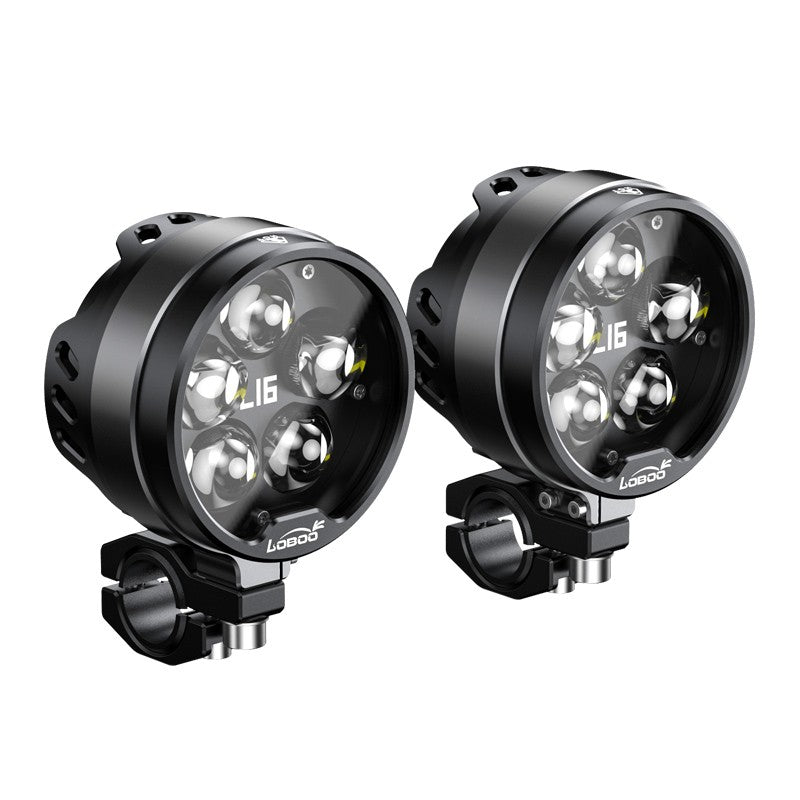
5 LEDs per headlight

Non-replaceable; transparent glass lens and black aluminum alloy body

Protection

IP68

CNC aluminum, automatic thermal control

Features

Mode

Five

Low beam, high beam, and three warning flashes

Command

Ring included

8 levels

Made of aluminum, with adjustable brightness and color temperature

Package

Headlights included

2

Sold as a pair, with wiring, control unit, and control ring

Assembly

Pipe diameters

22, 25 and 28

Four 22 mm bushings and four 25 mm bushings included; on 28 mm bars, the clamp mounts without a bushing. For 32 and 38 mm, the clamps must be purchased separately.

Torque pairs

5 / 10 / 18

Four M4×10 to 5, four M6×16 to 10, and two M8×20 from the accessory kit to 18 N·m

Included tools

3, 5, and 6 mm hex keys

With threadlocker, ten 150 × 3.6 mm cable ties, and a pair of work gloves

System

Power supply

12–15 V

Direct to the battery with ACC positive; combustion motorcycles only

Data from official LOBOO documentation. Code: L16.

High-intensity auxiliary lighting for improved night and poor-condition visibility.

All you need to know before ordering

Technical specifications, equipment, delivery, and warranty: find every detail, verified against official LOBOO documentation, below.

Description Approved auxiliary motorcycle lights with 19,000 lumens, adjustable white or yellow light

On all other auxiliary spotlights, yellow light is achieved with a lens cover that is applied manually: you stop, install it, and put it in your pocket when the fog clears.

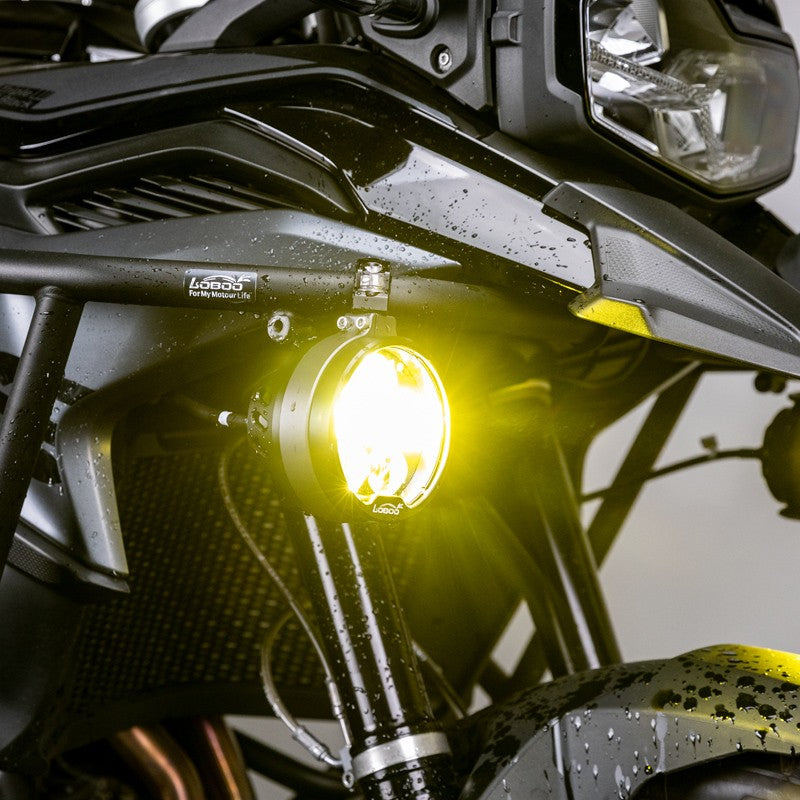
The LOBOO L16 changes color temperature electronically, from 6000 K white to 3000 K yellow, by rotating the same dial that adjusts brightness. While riding, with gloves on, without stopping.

ECE R149 Homologated

Certified E57*149R00/06*1187, UN Regulation R149.00 Class B for right-hand traffic, with both dipped and main beam approved and a stamped mark on the body. Almost all aftermarket spotlights are sold with the clause "for off-road use only."

Nineteen thousand lumens, manageable

The dipped beam alone covers from 5,000 to 16,800 lumens; with both main and dipped beam together, it reaches 19,000. For comparison, a motorcycle's original LED stops around 1,500.

The eight levels are what makes this power usable: in the city or behind a car, you can lower it to the minimum instead of turning it off. Power consumption follows the intensity, from 50 to 168 W for dipped beam and from 58 to 190 W with both beams.

The sharp cut-off of the dipped beam

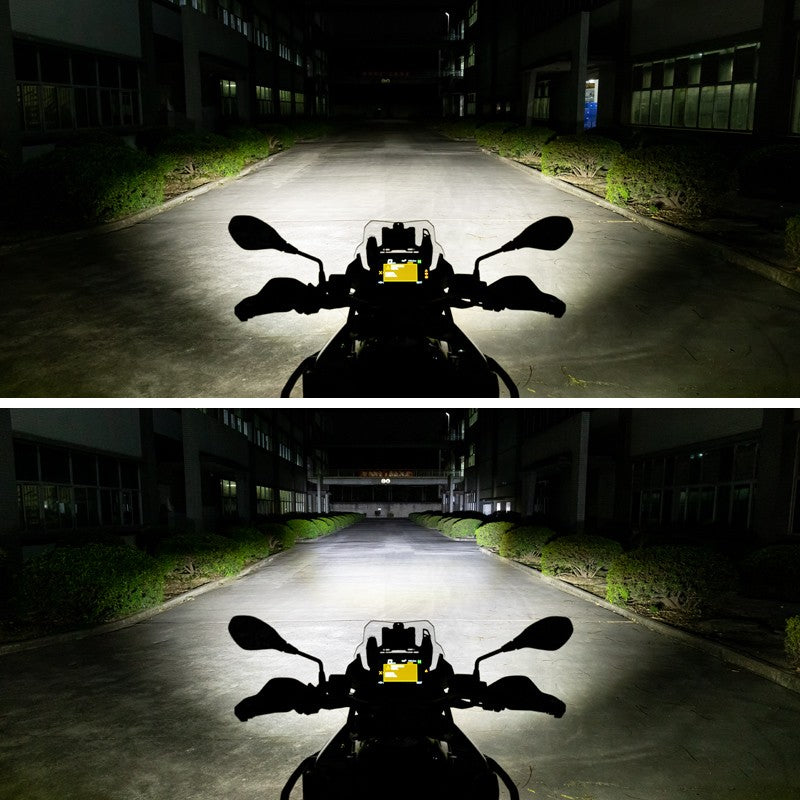
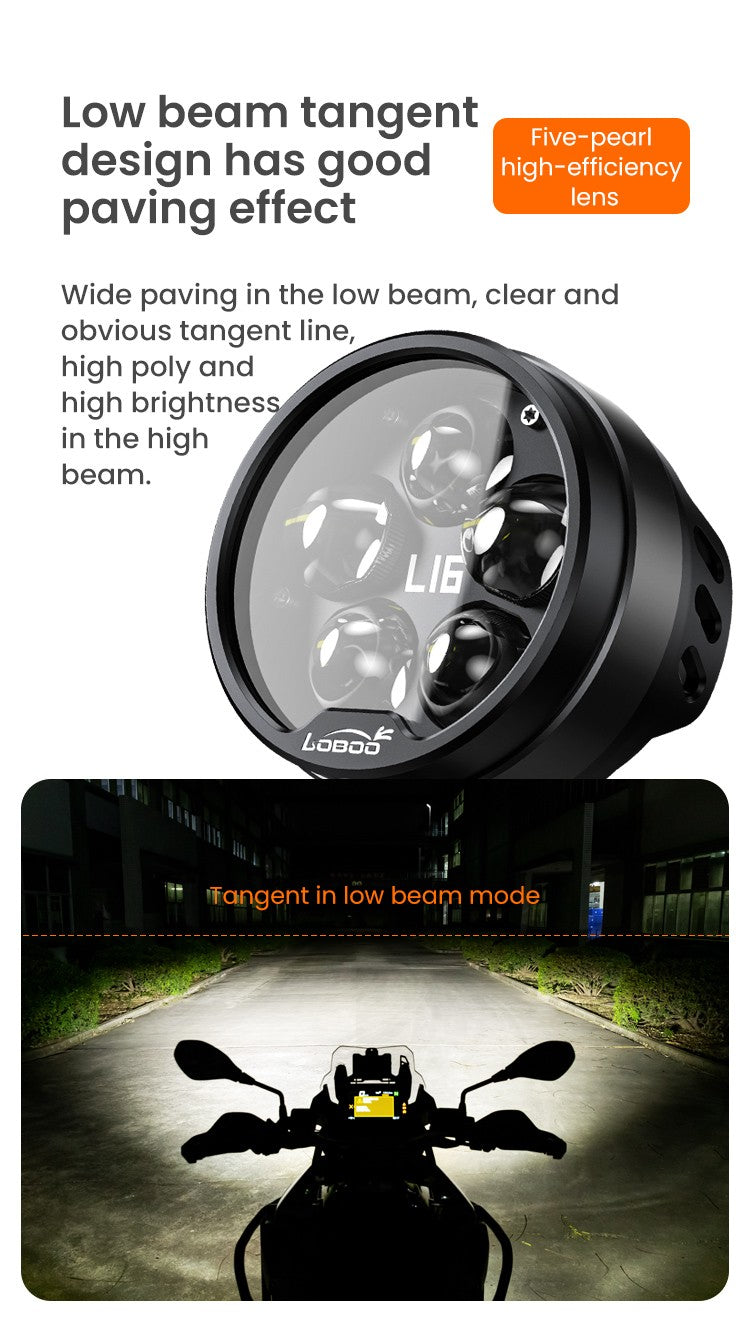
Five LEDs per headlight behind a high-efficiency lens generate a wide beam with a defined cut-off line: it illuminates the edges of the road without blinding oncoming drivers. This is the difference between a powerful headlight and a usable headlight.

One dial for everything

The aluminum alloy dial is installed on the clutch control: your thumb can reach it without letting go of the grip. With the same control, you adjust intensity and color temperature, eight levels for each.

A tap of the horn activates the warning flash, in addition to the three autonomous strobe modes.

Construction

Body entirely CNC machined from aluminum alloy with dissipation fins, glass lens, and IP68 rating. At 190 W, heat management is not a detail: the system automatically reduces power if the temperature rises, and the circuit is protected against reverse polarity and overvoltage.

Mounting

Multi-axis adjustable bracket, compatible with tubes from 22, 25, 28, 32 and 38 mm: narrow handlebars, cruisers, adventure bars, and large diameter engine guards. Compact size, with a diameter of 97.9 mm.

Why choose it
  • White or yellow from the bezel:from 6000K to 3000K on the fly, no lens covers to apply. This is the feature that no other headlight in the range offers.
  • ECE R149.00 approved:low beam and high beam both approved, certificate downloadable.
  • 19,000 lumens on eight levels:low beam from 5,000 to 16,800 lm, up to 19,000 with high beam.
  • Sharp cut-off lens:illuminates the edges of the road without dazzling oncoming traffic.
  • Flash with horn:plus three autonomous strobe modes.
  • IP68 and CNC aluminum:with automatic thermal control and reverse polarity protection.
Who is it recommended for

L16, L12T or L11?

These are three ECE R149 approved headlights, all with low beam, high beam, and an eight-level halo ring. The yellow light and power differ.

  • L16: 19,000 lumens and electronically variable color temperature. If you often drive in fog or variable rain, this makes a noticeable difference.
  • L12T and L11: 15,200 and 15,000 lumens, with a yellow lens cover to be applied manually.

The two accessories worth considering

  • Q7 Quick Release Mount— remove the headlights without tools, with a key lock and waterproof connector. Compatible with L7S, L7Q, L11, L16, and L18S.
  • LC081 CAN-Bus Controller— controls the L16 from the original BMW Wonder Wheel. Each version already includes the dedicated cable for your motorcycle.

Check the diameter of the tube at the exact mounting point: the bracket covers 22, 25, 28, 32, and 38 mm.

Documents and manufacturer

Type Approval Certificate

ECE Approval E57*149R00/06*1187, extension 00, UN Regulation R149.00 Class B for right-hand traffic, with both low beam and high beam approved and mark stamped on the headlamp body. Issued on June 19, 2024, by the Type Approval Authority of the Republic of San Marino, based on test report ATS-SM-IR-149-0168. The approval covers type L16 and variants L16T, L16Pro, L16S, L16Q, and L16K.

Download the complete type approval certificate (PDF)

Installation and Use

  • Connect via a relay with a dedicated fuse, never by tapping into an existing circuit.
  • Check the margin of your electrical system: up to 190 W in high beam mode is a significant load, especially if you already use heated grips or a heated vest.
  • Adjust the beam inclination so that it does not dazzle oncoming drivers: this is the most important check and the one most often skipped.
  • The approval concerns the device. The conditions for installation and use on the vehicle remain subject to the Highway Code.

How does it work, in detail?

Nineteen thousand lumens, and a ring to control them

Nineteen thousand lumens, and a ring to control them

The L16 is the most powerful light in the range after the L18S: true low and high beams, eight intensity levels and, unlike the others, eight color-temperature levels ranging from white to yellow. It is sold as a pair, with the wiring, control unit, and control dial already included in the box.

Below you will find the manufacturer's technical panels, one by one: how the control works, the difference between the two beams and the two colors, what happens when the electronics heat up, how it is controlled from the original BMW wheel, and which tubes it fits.

Nineteen thousand lumens, managed across eight levels

Nineteen thousand lumens, managed across eight levels

The low beam alone ranges from 5,000 to 16,800 lumens; with the high and low beams together, it reaches 19,000. For comparison, a motorcycle’s original LED tops out at around 1,500.

The eight levels aren’t a gimmick: they’re what makes this power usable in the city or behind a car without having to turn it off.

From white to yellow without touching the headlight

From white to yellow without touching the headlight

On all other spotlights, yellow light is achieved with a lens cover that must be fitted by hand. That means stopping, removing it, putting it in your pocket, and refitting it when the fog has cleared.

The L16 changes the color temperature electronically, from 6000 K white to 3000 K yellow, by turning the same ring that controls brightness. While riding, with gloves on, without stopping.

The quick-release mechanism is a separate accessory.

The quick-release mechanism is a separate accessory.

LOBOO produces a quick-release mount that lets you remove and reinstall the lights without tools, with a waterproof connector and an anti-theft lock. It is intended for those who leave their motorcycle parked on the street or load it into a van, and for those who want to remove the lights for washing or servicing.

It is not included in the package and must be purchased separately. With the standard mount, the lights remain secured to the clamp, which is the more rigid solution and the one we recommend if you do not need to remove them often.

The low-beam cutoff line

The low-beam cutoff line

The high-efficiency lens produces a wide low beam with a defined cutoff line: it illuminates the edges of the road without shining into oncoming drivers’ eyes.

It’s the difference between a powerful headlight and a usable one: power without a cutoff only results in angry flashes from other drivers.

Five ways to use them, in white or yellow

Five ways to use them, in white or yellow

The control cycles through low beam, high beam, and three warning flash modes, each available in white or yellow light. In low-beam mode, the optics keep the beam low and the cutoff line sharp so as not to disturb oncoming traffic; with both beams together, the illuminated cone extends far beyond that of the motorcycle’s original headlight.

The three warning modes are alternating right-left flashing, simultaneous flashing, and rotating flashing. They help you be seen at a blind intersection, while parked at the roadside, or in front of a stationary queue after a bend. They do not replace the hazard lights, but they are noticed much sooner.

A tap of the horn and they flash

A tap of the horn and they flash

The wiring includes a dedicated wire to connect to the original horn. Once that optional connection is made, pressing the horn button sounds the horn and flashes the headlights at the same time: in traffic, a white flash is more effective than a sound no one can hear inside the cabin.

When you release the button, the headlight automatically returns to the mode you were using before. If you do not connect that wire, the horn remains the horn, and the headlights are controlled only by the dial.

Controls with BMW Wonder Wheel

Controls with BMW Wonder Wheel

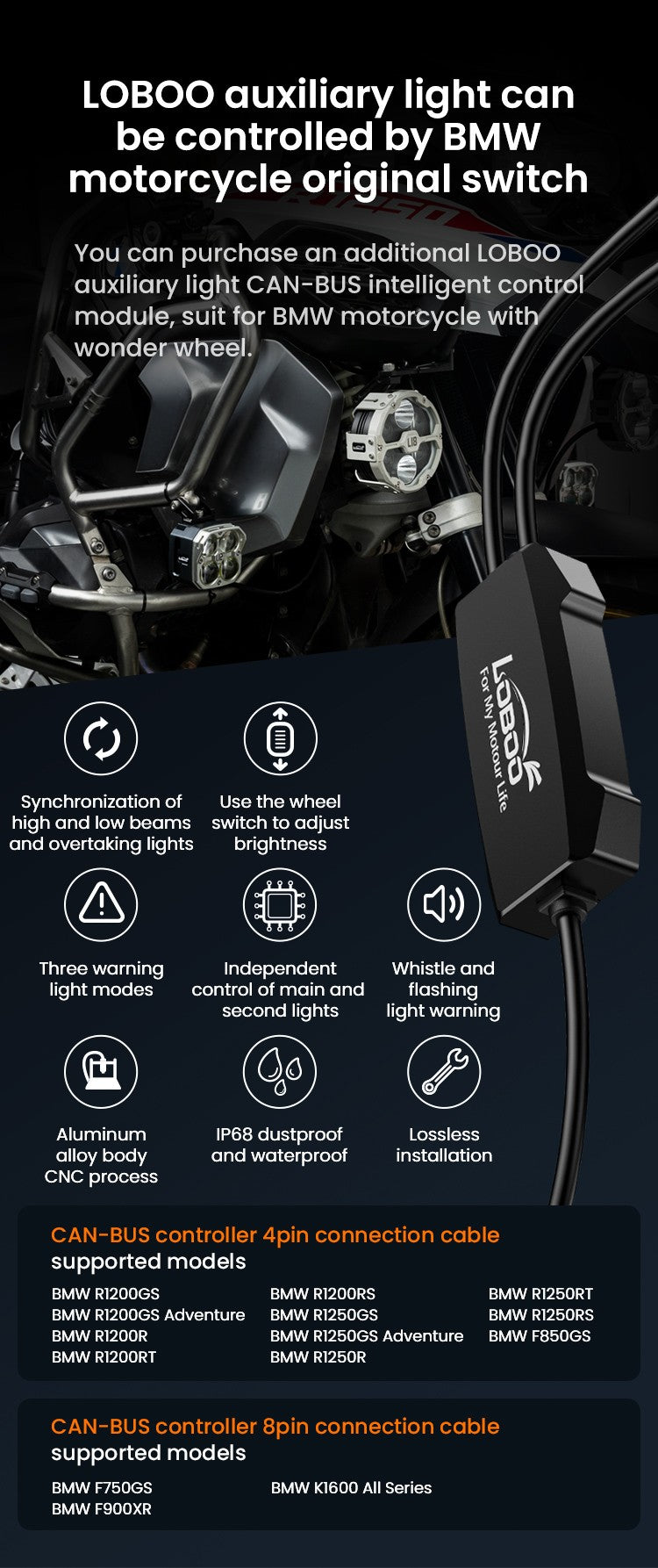
With the LOBOO LC081 CAN-Bus controller and the dedicated cable for your motorcycle, the L16 is controlled using the original BMW Wonder Wheel—no additional handlebar switch required.

A tap of the horn also activates the warning flash, in addition to the three independent strobe modes.

IP68: driving rain, dust, fording_depth

IP68: driving rain, dust, fording_depth

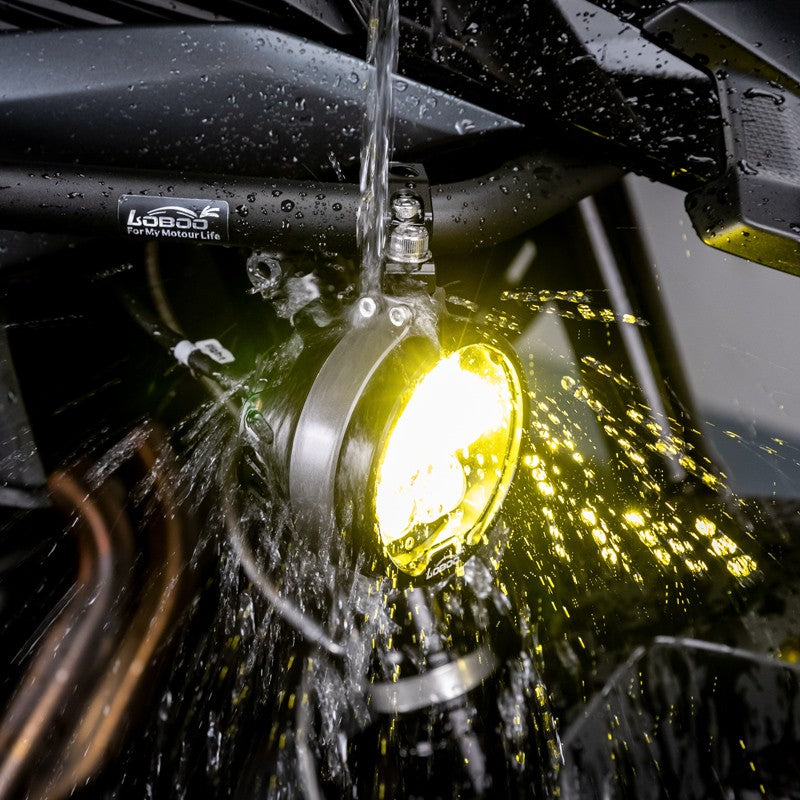
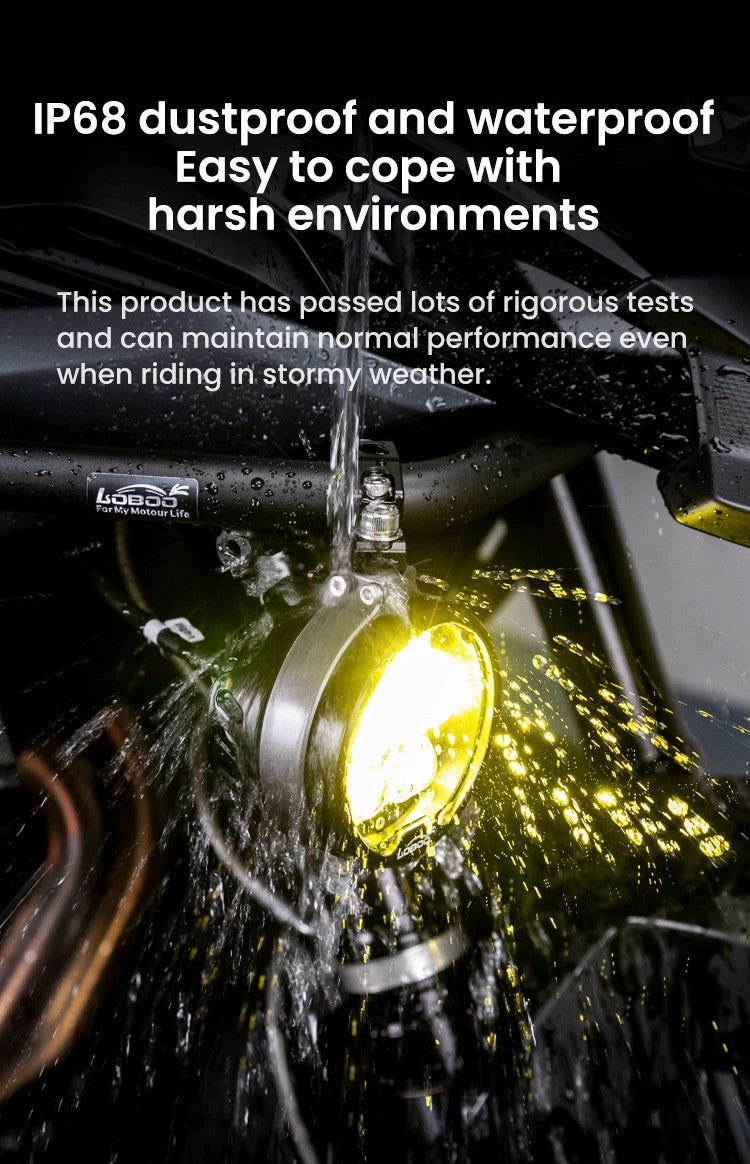
IP68 is the highest rating on the scale: complete protection against dust and resistance to continuous immersion. Heavy rain, mud, and crossing a ford are no problem for the light housing, and the motorcycle can be washed without any special precautions.

The weak point of any auxiliary light is not the housing but the connections: take care of the connectors and route the cable away from hot parts. The manufacturer states that the product has passed repeated tests in bad weather while maintaining normal operation.

When it heats up, it lowers by itself

When it heats up, it lowers by itself

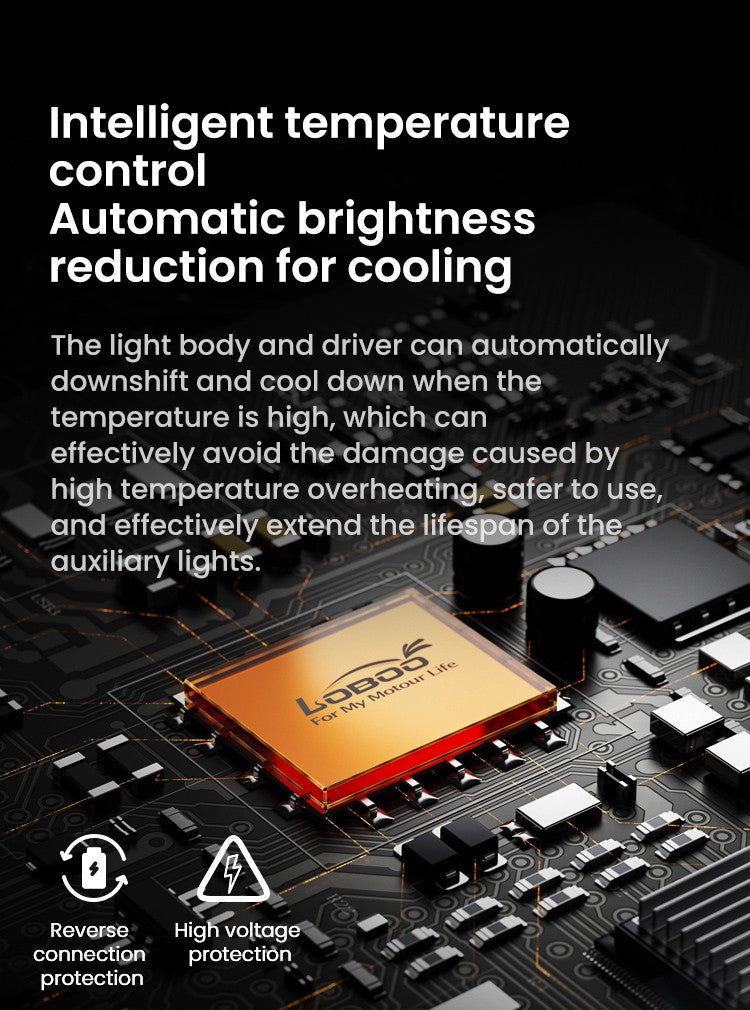
At 190 W at full power, heat is the real adversary. The light housing and driver have thermal control that automatically reduces power when the temperature rises—during summer in stationary traffic, where there is no airflow to cool them. It is a momentary loss of light that prevents permanent LED damage: as soon as you start moving again, everything returns to normal.

The electronics also include protection against reverse polarity, the most common installation error, and protection against overvoltage, which is not merely a theoretical possibility in a motorcycle's electrical system.

Aluminum isn’t about aesthetics; it’s about heat dissipation.

Aluminum isn’t about aesthetics; it’s about heat dissipation.

The body is made of aluminum alloy with cooling fins machined into the piece. In a 190 W LED light, the light you see depends on how much heat can escape: if it stays inside, the driver reduces the current and the illumination decreases. Aluminum conducts and dissipates heat much better than a casting or an engineering polymer, and withstands sunlight, vibration, and washing without becoming brittle.

That is also why a light like this weighs and costs more than a generic one with the same claimed output: it maintains over time the light it promises on the first day.

Machined from solid, not assembled

Machined from solid, not assembled

The body is made entirely by CNC machining. This isn’t a catalog detail: tight tolerances are what keep water out of the lens and cable-gland seats—the points where an exposed light begins to fail after a couple of winters.

They navigate where needed, not wherever they happen to be.

They navigate where needed, not wherever they happen to be.

The bracket rotates and allows you to mount the light above or below the bar, facing forward or slightly outward. It is more useful than it may seem: crash bars are never perfectly horizontal, and the position allowed by the frame is almost never where the beam needs to be aimed.

A practical tip: aim the lights while stationary, with the motorcycle on level ground and someone seated on it, checking where the beam cutoff falls about twenty meters away. If you do it by eye in the garage with the motorcycle on its stand, the result on the road is always aimed too high.

What pipe are they mounted on?

What pipe are they mounted on?

The included clamps fit 22, 25, and 28 mm tubes, covering nearly all crash bars and small frames currently on the market. The 22 and 25 mm bushings are included in the box; on 28 mm bars, the clamp tightens directly without a bushing.

For 32 and 38 mm tubes, different clamps are required, which LOBOO sells separately and are not included. Before ordering, measure the exact point where the clamp would sit with a caliper: on many bars, the cross-section changes along their length.

The stated quotes and numbers

The stated quotes and numbers

The manufacturer's dimensioned drawing shows the headlight housing and the overall dimensions with the bracket and clamp installed: these are the figures that determine whether the headlight fits between the crash bar and the fairing without touching anything when the handlebars are turned fully.

The table specifies a 12–15 V DC power supply for combustion-engine motorcycles, an aluminum-alloy housing, IP68 protection, a color temperature of 3000 to 6000 K, and a maximum luminous flux of 19,000 lumens, with 50–168 W on low beam and 56–190 W with both beams on. The dimensions were measured manually, so minor tolerances are normal.

Where do they end up on real motorcycles?

Where do they end up on real motorcycles?

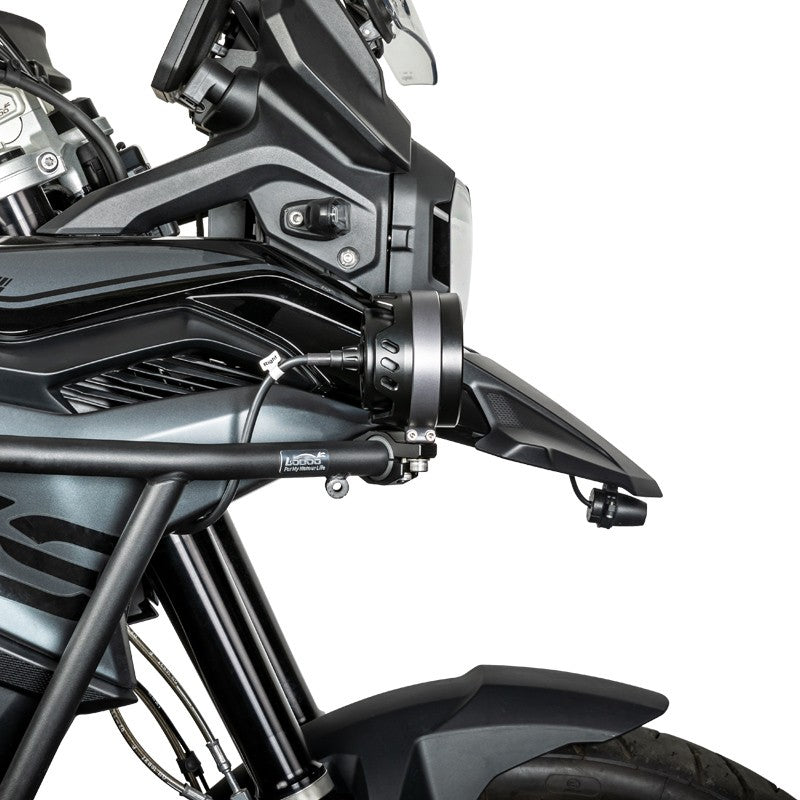
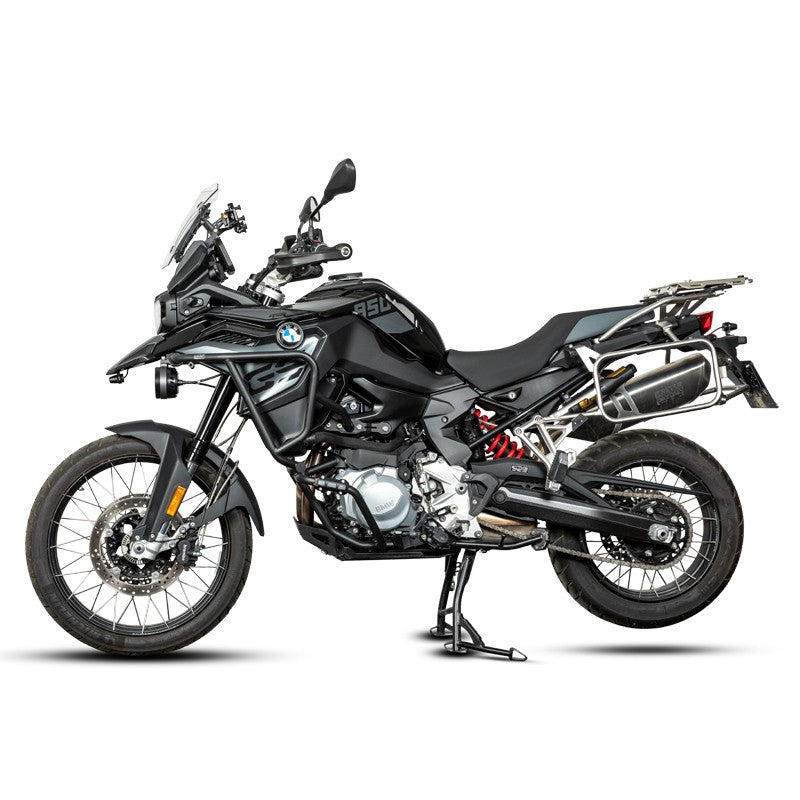
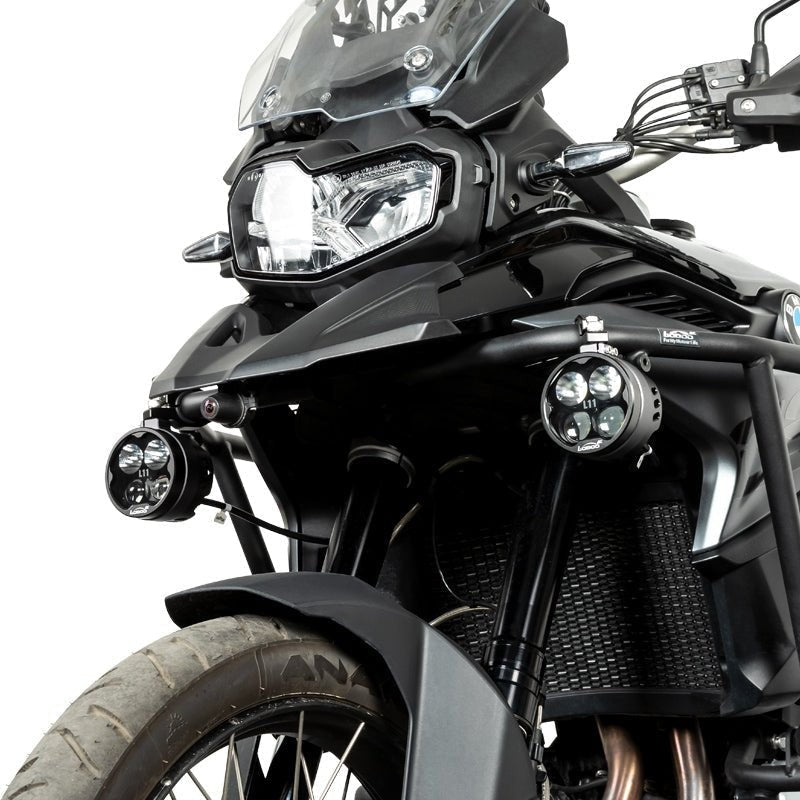
The installation photos show the most common position on large adventure bikes: on the crash bars, level with or slightly below the original headlight, one on each side. This position provides the widest beam spread and keeps the lights out of the path of stones.

The manual specifies mounting to the frame or crash bars. If you are unsure about the mounting point on your motorcycle, send us a photo of the area and we’ll tell you whether it can support them.

Do you have a BMW? Control them with the original dial

Do you have a BMW? Control them with the original dial

The LOBOO LC081 CAN-Bus controller connects the auxiliary lights to the motorcycle’s electronics. Three reasons why it changes everyday use:

  • No additional buttons on the handlebar: turn the auxiliary lights on and off and adjust them using the original Multi-Controller wheel, with your thumb and without letting go of the grip.
  • They follow the motorcycle’s lights: low beam, high beam, and passing flash remain synchronized with the factory controls, as if the auxiliary lights were original equipment.
  • Installation without cutting: it plugs into the original connector with the dedicated cable, with no wire taps and without touching the motorcycle’s wiring harness.

And it does more: independent control of the two lights, warning and flash modes activated from the original controls, and memory of the last setting. Choose the controller based on the cable: 4-pin for the R 1200 and R 1250 GS and K 1600 series, 5-pin for the R 1300 GS and GS Adventure, and 8-pin for the F 750, 800, 850, and 900 GS and F 900 XR.

View the LC081 CAN-Bus controller and choose the cable for your BMW

FAQs

For more information, please see our FAQ.

Is it approved for road use?

Yes. The L16 has ECE type approval E57*149R00/06*1187 under UN Regulation R149.00, with both the low beam and high beam approved and the marking stamped on the housing. The full certificate can be downloaded from the product page.

You are responsible for verifying the installation requirements set out in the Highway Code for your vehicle.

What exactly does the type-approval certificate say?

The L16 is type-approved under number E57*149R00/06*1187*00, issued by the Type Approval Authority of the Republic of San Marino on June 19, 2024, based on test report ATS-SM-IR-149-0168. The declared class is R149.00 Class B RHT, meaning for right-hand traffic, and the marking 149R-001187 is engraved on the housing.

The type approval covers the L16 type and the L16T, L16Pro, L16S, L16Q, and L16K variants. The file declares five non-replaceable LEDs per lamp, a clear glass lens, and a black aluminum-alloy housing. The report’s colorimetric measurements refer to white light.

How does the color temperature change work?

It is electronic, not optical: turning the ring on the clutch control gradually shifts the light from 6000 K white to 3000 K yellow. There are no filters to attach or remove.

It is genuinely useful: yellow penetrates fog and rain better, where white creates glare from suspended water droplets. With the L16, you can change it while driving as conditions change.

Is the yellow light approved?

We prefer to be precise: the L16 changes its color temperature using the ring, from the white light’s 6000 K to the yellow light’s 3000 K, without any filters to attach. However, the colorimetric measurements in the test report on which the approval is based refer to the white light, and yellow does not appear among the tested configurations.

In practice: use yellow where it is genuinely needed—namely in dense fog, heavy rain, or snow—where it reduces glare and makes the roadside edge easier to see. Simply turn the ring to switch back to white, so it is not a permanent choice.

Are the 19,000 lumens a real figure?

They are the commercial value declared by the manufacturer: the pair's total theoretical LED output at the eighth level, with both beams switched on together. In low-beam-only mode, the headlight operates between 5,000 and 16,800 lumens, consuming 50 to 168 W.

The type-approval test report measures a different quantity: the effective target output projected onto the road—1,412 lumens for the low beam versus a required minimum of 1,000, and 2,536 for the high beam. The two figures are not comparable, and neither is false: the first indicates how much light the LEDs produce, while the second indicates how much reaches where it is needed.

What’s the difference compared with L11 and L12T?

All three are ECE R149-approved and feature low beam, high beam, and an eight-level beam ring. The difference lies in the yellow light and output.

L11 and L12T achieve the yellow light with a lens cover that you apply by hand and reach 15,000 and 15,200 lumens, respectively. The L16 changes color temperature electronically while driving and reaches 19,000 lumens. If you often drive in fog or changing rain, that's the difference you notice.

Which motorcycles is it compatible with?

There is no list of motorcycles because the light is universal: what matters is where you mount it. The included clamps fit 22, 25, and 28 mm tubes, so they work with engine guards, subframes, and mounts of those diameters. For 32 and 38 mm, the clamps are purchased separately.

The motorcycle's only requirement is its electrical system: 12–15 V DC, so it must be a combustion-powered motorcycle. If you're not sure whether you have a suitable mounting point, send us a photo of the area where you would like to install them.

Which pipes does it fit?

For 22, 25, 28, 32, and 38 mm tubes: clip-ons, cruiser bars, adventure bars, and large-diameter engine guard tubes. The bracket is adjustable, so you can set the angle after installation.

Measure the diameter at the exact point where you want to mount the light: on many bars, the cross-section changes along their length.

How is it installed? Does the motorcycle require any modifications?

No drilling or cutting: the lights clamp onto an existing tube, and the only connection is electrical, directly to the battery terminals, with a wire to an ACC positive so they switch off with the key. The horn wire is optional.

The specified torque settings are 5 N·m for the four M4×10 screws on the light housing, 10 N·m for the four M6×16 screws, and 18 N·m for the two M8×20 screws in the accessory kit. The 3, 5, and 6 mm Allen keys and threadlocker are included. The manual says not to tighten fully right away and to recheck after the first few miles.

What do I find in the package?

The pair of headlights, two clamps, four 25 mm bushings and four 22 mm bushings, the complete wiring harness with the control ring, four M4×10 screws, four M6×16 screws and, in the accessory kit, two M8×20 screws with washers and threadlocker.

There are also three 3, 5, and 6 mm Allen keys, ten 150 × 3.6 mm cable ties for the wiring, and a pair of work gloves. The quick-release mount and the clamps for 32 and 38 mm tubes are not included.

How much power does it draw? Can the motorcycle’s electrical system handle it?

Up to 190 W in high-beam mode: that’s a significant load. On motorcycles whose alternator is already burdened by heated grips, a heated jacket, and USB accessories, the margin is quickly reduced.

Always connect through a relay with a dedicated fuse, never by tapping into an existing circuit. Remember that the eight levels mean you can almost always operate well below maximum.

Can I control it using the motorcycle’s original controls?

On BMW motorcycles, yes—with the LOBOO LC081 CAN-Bus controller and the cable dedicated to your model, you can control the L16 using the original Wonder Wheel, without adding switches to the handlebars.

The connection to the horn for the warning flash, however, works on any motorcycle using the dedicated cable included.

Didn't find the answer you were looking for?

Do not hesitate to contact us

Buying guides, technical comparisons, and news on adventure motorcycle accessories

Before choosing

View all

Borsa posteriore impermeabile per moto in PVC nero con chiusura roll-top

Motorcycle tail bag: 40, 50, 66, or 90 liters?

Liters don’t measure the luggage; they measure the container. What matters is the number of nights away and the tent: the selection chart, what IPX6 really means, and how it’s secured.

Read moreabout Motorcycle tail bag: 40, 50, 66, or 90 liters?

Gamma completa di valigie in alluminio per moto, versioni nera e argento affiancate

Aluminum motorcycle cases: it’s the frame that matters, not the case

The cases are always the same, but the frames aren’t: the frame determines whether the system fits your motorcycle. Actual measurements, nine-point mounting, maximum load, and the frame chart for BMW GS.

Read moreabout Aluminum motorcycle cases: it’s the frame that matters, not the case

Motociclista che sgancia la borsa serbatoio dalla moto con una sola mano

Magnetic tank bag: why it won’t stay on your motorcycle and how to fix it

Magnets do not stick to modern tanks. The solution is a fastening ring screwed onto the cap: how to choose one, the complete compatibility chart, and the two measurements to check before ordering.

Read moreabout Magnetic tank bag: why it won’t stay on your motorcycle and how to fix it