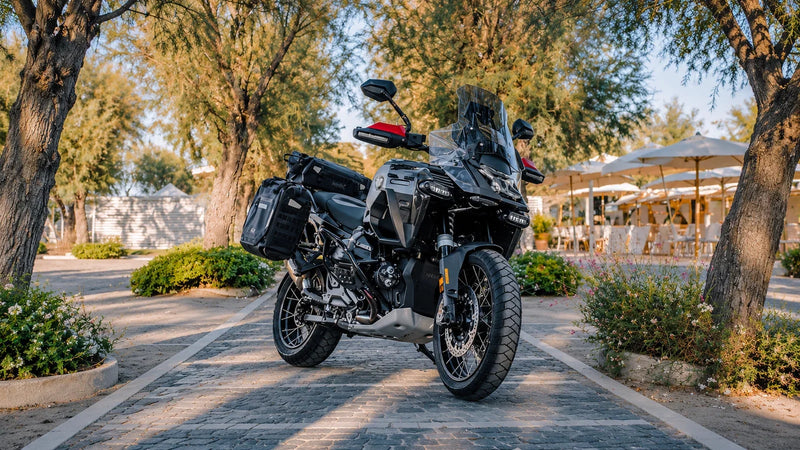



In mid-October 2026, many Alpine passes are still open, but closures are coming one after another. According to TCS (updated October 16), Great St Bernard closes from Monday, October 19, at 08:00; Furka can only be driven from 08:00 to 18:00; and there is still no official date for Stelvio: over the last three years, it has closed between October 31 and November 7.
Here you'll find pass conditions, closure history, what changes on the bike at 2,000 meters when the valley is still warm enough for a light jacket, and what to pack so you don't regret it halfway up the climb.
In brief
- Status as of October 16: Grimsel, Furka, Klausen, Albula, Flüela and Great St Bernard are listed as open; Julier, Bernina, Ofen, Maloja and Lukmanier have no seasonal closure scheduled (source: TCS).
- Great St Bernard: Winter closure announced from Monday, October 19, at 08:00.
- Stelvio: No official date found for 2026; closed on 31/10/2023, 4/11/2024 and 7/11/2025.
- Cold: about 6.5 °C less for every 1,000 m climbed (theoretical value): at the pass, start from zero, not from the valley temperature.
- Rule of thumb: Check the status the evening before and again in the morning, set off mid-morning and bring one more layer than you think you'll need.
Which passes are open today, and which are about to close
The Swiss overview is the most complete one available online, because TCS publishes the elevation, status and usual winter closure period for every pass.
The table shows TCS data as of October 16, 2026, at 09:37. “Usual closure period” is when the pass is normally closed, not a guaranteed date: snow can bring it forward, while a mild autumn can push it back.
| Pass | Elevation | Status as of 16/10/2026 | Usual closure period | Note |
|---|---|---|---|---|
| Grimsel | 2.164 m | Open | November - June | - |
| Furka | 2.429 m | Open, 08:00-18:00 | November - June | Closed at night for safety |
| Klausen | 1.948 m | Open | November - May | - |
| Great St Bernard | 2.469 m | Open | October - June | Closure announced from Monday 19/10 at 08:00 |
| Albula | 2.312 m | Open | December - May | - |
| Flüela | 2.383 m | Open | January - May | - |
| Julier | 2.284 m | Open | Open year-round | - |
| Bernina | 2.328 m | Open | Open year-round | - |
| Ofen (Forno) | 2.149 m | Open | Open year-round | - |
| Lukmanier | 1.914 m | Open | Open year-round | May be inaccessible due to bad weather |
| Maloja | 1.815 m | Open | Open year-round | - |
Source: TCS, Swiss Passes page, consulted on October 17, 2026 (data as of October 16 at 09:37). Susten, Gotthard, Nufenen, San Bernardino, Splügen, Umbrail and Simplon were not listed in the text consulted: check the portal directly for these.
Stelvio closes when the snow and official orders say so, not the calendar
Italy’s most searched-for pass among motorcyclists has no fixed date: in recent years, it has always fallen between late October and early November.
Valtellina Mobile reviews recent winter closures and notes that the relevant authorities agree on fixed dates, “weather permitting.” The table lists them in order: the date shifts by a week, and when late-October snowfalls come early, there’s no leeway.
| Year | Stelvio winter closure | Note |
|---|---|---|
| 2023 | October 31 | On both sides, brought forward due to heavy snowfall |
| 2024 | November 4 | On both sides |
| 2025 | November 7 | Could be brought forward due to weather; the South Tyrol side remained closed until October 31 |
| 2026 | Not announced | No official date found as of October 17 |
Source: Valtellina Mobile, “Official winter closing date for Stelvio” (published October 30, 2025, updated February 18, 2026). The article doesn’t specify which authority orders the closure. For 2026, as of October 8, the same publication reported that Stelvio, Gavia, and Spluga were open and that no official road closure date had been announced.
How to read these dates without getting caught out
The “official” closure is usually announced by ANAS for the Lombardy side (SS38) and by an order from the Province of Bolzano for the South Tyrol side: in the past, for example, ANAS closed the SS38 from Bagni Vecchi di Bormio up to the pass on November 7 at 4:00 p.m. (a 2013 article from montagna.tv). But a heavy snowfall can bring the closure forward by days, and sometimes the pass stays closed for hours or even a full day before the order is issued.
If you’re planning a multi-day trip with Stelvio as a stop, think in reverse: not “I should be able to make it before October 31,” but “if it closes, I’ve already chosen my alternative.” From now on, every sunny day is a gift, not a given.
At 2,000 meters, it’s not October: it’s a month later
The temperature drops with altitude, the wind from riding takes away even more warmth, and your bike, whether stopped or climbing, doesn’t produce the heat your hands need.
In the standard atmosphere, temperature drops by about 6.5 °C for every 1,000 meters. This is a theoretical average: actual air temperatures, with inversions and clear or cloudy weather, can vary considerably. Still, it's enough to understand the change you face during a two-hour climb.
| Example | Elevation gain | Theoretical drop | If it's 12 °C in the valley |
|---|---|---|---|
| Valley at 500 m, pass at 1,950 m (Klausen 1,948 m) | about 1,400 m | about 9 °C | around 3 °C at the summit |
| Valley at 500 m, pass at 2,430 m (Furka 2,429 m) | about 1,900 m | about 12 °C | around 0 °C at the summit |
| Valley at 500 m, pass above 2,700 m (Stelvio) | over 2,200 m | over 14 °C | below zero at the summit |
Endurrad calculation based on a standard lapse rate of 6.5 °C per 1,000 m: this is an estimate, not a forecast. Elevations for Swiss passes are those published by TCS; the elevation for the Stelvio is given as a rounded figure.
- the forecast for the elevation shows no precipitation in the last 24 hours
- you've checked the pass conditions that same day, not the day before
- you have extra layers in your bag and an electrical system that can handle heated gear
- it has just snowed above 2,000 meters and the sun hasn't melted the ice on the road yet
- the tires are worn or cold from a long night outdoors
- less than an hour until sunset, and the pass has a set opening time
Warm hands: the first battle is lost on the handlebars
On long descents through hairpin bends, your hands stay on the levers, exposed to the wind, and are the first to stop responding.
When your fingers go numb, braking becomes less precise and your focus shifts to the discomfort: that's when it's better to stop, not grit your teeth. There are two solutions, and they aren't mutually exclusive: heat the grip or shield your hand from the wind. To choose the right gloves, see the guide to heated motorcycle gloves, and for grip measurements, the page on heated grip covers: sizing and installation.


- Grip diameter
- 29-35 mm
- Levels
- 4: 38, 45, 52 and 59 °C
- Power supply
- 12-15 V DC
- Power consumption
- 10-28 W depending on the level
- Protection
- IP67 rated
- Product price
- 81 €
Temperature readings for each setting are LOBOO lab measurements taken with the motorcycle stationary at an ambient temperature of 5 °C: the actual temperature while riding is lower. The manual specifies use on fuel-powered motorcycles with a 12-15 V electrical system. Stock as of October 17 is limited: if the product page shows it's sold out, find alternatives in the LOBOO motorcycle accessories collection.
Wind protection is the other half of the job. Barkbusters BBZ-001 winter handguards are made of semi-rigid fabric lined with a waterproof membrane and wrap around the hand: they pair with heated grips or replace them where the electrical system can't handle the extra load.


- Material
- Semi-rigid fabric with waterproof membrane
- Color
- Black
- Product price
- 110 €
Layers, neck, and head: don't forget the rest of your body
Cold on a mountain pass doesn't creep up from your hands: it gets in through your neck, sleeves, and knees, where your jacket and pants don't close properly.
The easiest way to get it right is to dress in layers and take layers off, not the other way around. Wear a technical base layer next to your skin, a warm mid-layer, and a windproof or waterproof shell on top: if the sun comes out, open one layer; if fog rolls in, close it back up. If you plan to make mountain passes part of your autumn routine, the guide to heated motorcycle gear: where to start explains what to heat first, and the heated motorcycle gear collection brings together everything in the catalog.

- Material
- Recycled polyester
- Features
- Soft, lightweight, windproof
- Use
- Unisex, all seasons
- Product price
- 9 €
A six-point checklist before setting off
- Pass conditions: check TCS, valtellina.it or ANAS the night before and in the morning.
- Fuel: fill up before setting off; fuel stations may be far apart at high altitudes.
- Tires: check the pressure when the tires are cold, because cold weather lowers it.
- Battery and electrical system: with heated gear and lights on, the electrical system works harder; learn how to maintain your battery in winter.
- Tools and kits: see the motorcycle tool kit: what to bring.
- Time: With the end of daylight saving time on October 25, it gets dark earlier; see riding a motorcycle in the dark after the clocks go back.
Planning a day of mountain passes in autumn
A successful day at altitude is above all a well-organized day: just a few decisions made the night before.
- The night before. Check the status of the passes you'll need and choose an alternative for each one. If a change in the weather is forecast, shorten your route.
- In the morning. Check again. Set off mid-morning, when the sun has cleared the slopes, and don't head up at seven just because “there's less traffic then.”
- On the way up. Keep the bike steady through the turns, avoid braking hard while leaned over, and slow down on shaded stretches. Stop if your hands can no longer feel the levers.
- At the pass. Take a short break and add a layer before descending: the wind on the descent is colder than on the way up.
- The return trip. Plan your return so you don't find yourself riding after sunset: remember that from October 25, it gets dark earlier.
If you're planning a longer trip north, the article on preparing your GS for Northern Europe covers many of the same topics for even colder conditions.
Frequently asked questions about riding Alpine passes in autumn
The most frequently asked questions, with sources cited in the notes.
Which Alpine passes are still open in mid-October 2026?
When does the Stelvio close in 2026?
Who decides when a pass closes for winter?
Is a pass marked “open all year” always passable?
Where can I check the latest pass conditions before setting off?
When does the Great St Bernard Pass close?
How cold is it at 2,000-2,700 meters in late October?
Can you encounter ice even when there’s no snow?
Are heated grips really useful on mountain passes?
What should I wear for an Alpine pass in October?
Is it better to set off early or late for a mountain pass in autumn?
If the pass is closed, is there an alternative?
Read next
Prepare your motorcycle for the last pass season
Planning your final passes before the snow arrives? At Endurrad, you'll find a selection of cold-weather accessories: heated handlebar muffs, winter hand guards and neck warmers. If you have a maxi enduro or an adventure bike (BMW GS, KTM Adventure, Honda Africa Twin, Yamaha Ténéré, Triumph Tiger), message us with the model and year and we'll tell you what's compatible with your electrical system.
Take Endurrad with you: download the Endurrad app for iPhone.
TCS, Swiss passes: opening and closure (data from October 16, 2026, 09:37).
Valtellina Mobile, Stelvio winter closure date officially announced (October 30, 2025, updated February 18, 2026).
Valtellina Mobile, Alpine passes closure 2026 (updated October 12, 2026, status as of October 8; not an official source).
ANAS, announcement about the seasonal closure of the Stelvio along SS38; montagna.tv, Winter closure of Alpine passes: it's the Stelvio's turn (November 5, 2013).
bluewin.ch, Gotthard Pass is completely closed from Friday (November 6, 2025); worldradio.ch, Passes close for winter (November 12, 2024).
LOBOO H80 product specifications, Barkbusters BBZ-001 and Endurrad Adventure Neck Warmer: Endurrad catalog, specifications declared by manufacturers, verified on October 17, 2026. Temperature gradient of 6.5 °C per 1,000 m: standard atmosphere value, Endurrad estimate.