


In brief. Motorcycle camping is built around three things: where you sleep (tent, tarp, or bivy), how you stay warm (a sleeping bag and pad chosen for the actual temperature, not the optimistic one), and where you put everything on the motorcycle without compromising its balance. Endurrad does not sell tents, sleeping bags, sleeping pads, or stoves: they are general outdoor gear. It sells the waterproof bags, onboard charging, and accessories needed to transport that equipment safely and keep it operational at camp. In Italy, wild camping is generally prohibited, while overnight bivouacking with a tent is often tolerated in remote areas: the difference, along with the rules actually in force, is explained below.

Build the kit around the load, not the wish list
The right question is not "what can I carry?" but "what fits my motorcycle properly and lets me ride the way I want?" Three variables determine everything else.
The three variables that really matter
Trip duration. For a weekend, you can accept a few more compromises in comfort and weight. On a journey lasting several weeks, every unnecessary accessory becomes repeated effort when loading and unloading each day.
Expected climate. A 15-20 °C temperature swing between day and night, typical at altitude even in summer, by itself changes the choice of sleeping bag and sleeping pad. You should not size your sleep system for the starting temperature, but for the coldest plausible temperature along the route.
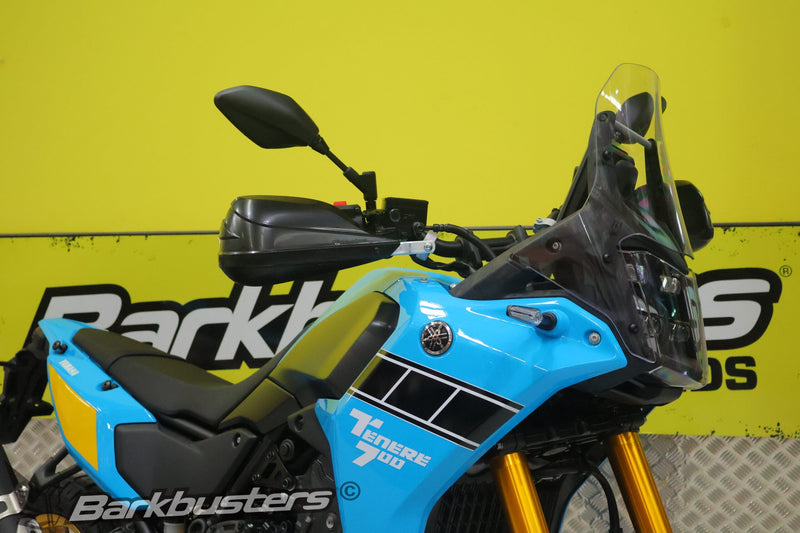
Type of route. The more off-road riding is involved, the more compactness, secure attachment, and vibration resistance matter. A BMW R 1300 GS with aluminum panniers can accommodate different volumes than a Yamaha Ténéré 700 or a Royal Enfield Himalayan prepared for dirt riding.
Tent, tarp, or bivy changes the kind of trip you can take
There is no universally best system: it depends on what you are willing to trade off among weight, protection, and setup time.
| System | Packed size | Protection | Setup | Suitable for |
|---|---|---|---|---|
| Compact tent | Medium, must be calculated into the main luggage | High: wind, heavy rain, insects | 5-15 min, even in wind if well designed | Solo travelers and couples, any season |
| Tarp | Very low | Medium: provides overhead protection, not lateral protection | Requires experience with guylines and anchors | Stable seasons, for those who already know how to manage it |
| Bivy bag | Minimal | Low: no space to change clothes or store luggage | Immediate | Specialized use, lightweight single-night stops |
Why the tent remains the most balanced choice
For most motorcycle travelers, a tent wins because it provides an orderly space to change clothes, keep wet clothing separate from dry clothing, and protect open luggage overnight. A tarp is worthwhile only if the weather is stable and you already know how to manage guylines and ground protection: arriving tired and finding unexpected rain with a poorly pitched tarp is a real scenario, not an exception. A bivy is the most compact option but also the most limiting when the trip lasts more than one night in a row.
Choose a sleeping bag based on the lower limit temperature, not the comfort temperature
The European EN 13537 standard, now incorporated into ISO 23537-1:2016, is the standard manufacturers cite to label sleeping bags with four temperature values tested on a sensor-equipped mannequin.
| EN 13537 value | What it measures | How to read it while traveling |
|---|---|---|
| Comfort | Temperature at which a standard woman sleeps relaxed all night | The value to use as a guide for an uncompromised night |
| Lower limit | Temperature at which a standard man sleeps curled up for 8 hours without waking | Margin, not a target: below this threshold, sleep quality worsens |
| Extreme | Temperature at which a standard woman is protected from hypothermia for 6 hours, uncomfortably | Safety threshold, never a comfort rating: do not plan a night around this value |
| Maximum comfort | Highest temperature at which a standard man sleeps without sweating | Useful for summer trips in the lowlands |
Synthetic or down: the practical choice for motorcycle touring
A synthetic sleeping bag withstands intensive use and occasional moisture better, and is the simplest choice to manage in a waterproof bag. Down offers the best warmth-to-volume ratio, but loses much of its insulation when wet and requires more care in daily handling: in motorcycle luggage, where condensation and unexpected weather are normal, it is the choice for those already accustomed to treating it carefully.
The sleeping pad determines how you feel the next day, not how much space it takes up
The value that matters for insulation from the ground is the R-Value, measured according to ASTM F3340-18: the higher it is, the less heat you lose to the ground through conduction.
| Season | Recommended R-Value | Example of use |
|---|---|---|
| Summer, above 10 °C | 1.0 – 2.0 | Coastal or lowland tours in midsummer |
| Mid-season, down to 0 °C | 2.1 – 3.9 | Most motorcycle trips in Italy and the Alps, spring-autumn |
| Winter or snowy altitude | Above 4.0 (recommended 4.5-5.0) | High-mountain or off-season trips |
R-Value is additive: two sleeping pads add up
By placing a foam pad (for example, R 2.0) under an inflatable mattress (for example, R 3.2), you obtain approximately R 5.2, which is useful on cold or snowy ground. The foam should always be in contact with the ground: it protects the inflatable pad from stones and branches and, if the inflatable pad is punctured during the trip, still provides a minimum level of insulation for the following night. This system is bulkier and should be reserved for trips where the actual nighttime temperature may fall well below freezing.
Overnight bivouacking is often tolerated; wild camping is not
In Italy there is no single national law on wild camping: since Legislative Decree No. 112 of March 31, 1998, responsibility has been transferred to the Regions, and where there is no explicit regulation, the principle applies that what is not regulated is prohibited.
- Tent pitched from dusk to dawn, for one night only
- Remote or high-altitude area, during a multi-stage trek or motorcycle trip
- No explicit prohibition sign on site
- No fire, no waste left behind, no alteration to the environment
- Tent pitched for several days or for the entire day (wild camping)
- Areas with an explicitly posted prohibition (many parks and protected areas)
- Sardinia: absolute ban outside equipped areas
- Private land, even if unfenced, without the owner's permission
What changes from region to region
Veneto, Friuli Venezia Giulia, Emilia-Romagna, and Sardinia have their own regional regulations on the subject; other Regions have delegated the matter to Provinces and Municipalities, which may have legislated independently and must be checked on a case-by-case basis. In national parks and protected areas, bivouacking is generally subject to the same principle, but jurisdiction lies with the authority managing the area: before stopping in a park, it is always advisable to contact the competent authority.
Camping stove: stove, cartridge, and water require careful management
For self-sufficient stops, fewer components mean fewer weak points: a compact stove, a pot, an insulated mug, and clear fuel management are almost always enough.
Gas canisters: the EN 417 standard and common sense on a motorcycle
Universal threaded cartridges for camping stoves follow the EN 417 standard, which regulates the materials, construction, inspection, and marking of non-refillable liquefied-gas containers, both valve canisters (the 7/16" UNEF threaded connection, commonly called Lindal) and pierceable canisters without a valve. The valve's self-sealing function should not be considered an absolute guarantee: a dirty or damaged connection can leak.
On a motorcycle, the canister must be transported away from direct heat sources - the exhaust, electrical system, and battery - sealed in a bag that does not expose it to direct sunlight during long stops, and never heated to "make it perform better": this is a known cause of camping stove accidents.
Water: carry only what the route's actual range requires
The useful capacity depends on the actual frequency of water sources along the route, not on an abstract principle of abundance. On European routes with regular stops, a modest supply that is easy to reach is sufficient; on more remote itineraries, it is advisable to carry a treatment system (filter or tablets) in addition to your reserve, because the nearest source is not always certainly potable.
How to distribute your camping gear without changing the motorcycle's handling
The point is not only how much you carry, but where you put it: the tent, sleeping bag, and sleeping mat are bulky but relatively light, while cooking gear and water are dense and should be kept lower and close to the center of gravity.
- Heavy and dense down low. Keep cooking gear, tools, and water reserves in the side cases, as close as possible to the motorcycle's center of gravity.
- Bulky and light up high. Keep the tent, sleeping bag, and sleeping mat in the top bag or a securely fastened rear bag, without raising the center of gravity too much.
- Accessible without unpacking everything. Rain gear, a flashlight, a first-aid kit, and thermal layers should go in a pocket you can reach within seconds: arriving in the dark or during a downpour is a normal scenario, not the exception.
- Check before setting off. Set up the tent, compress the sleeping bag, and simulate a full load: if something requires too many steps in your home garage, it will be worse on the road.

- Volume
- 50 L
- Protection
- IPX6
- Material
- 840D composite TPU, 0.65 mm
- Closure
- Patented magnetic roll-top
- Extras
- Removable U-shaped plate, backpack with shoulder straps, MOLLE
- Price
- 221 €

- Volume
- 30 L, folded 29.5×12.5×6 cm
- Weight
- 479,5 g
- Material
- Nylon with TPU membrane
- Closure
- Roll-top, Duraflex buckles
- Note
- No IP rating declared by the manufacturer
- Price
- 54 €
Watch out for nearly empty bags
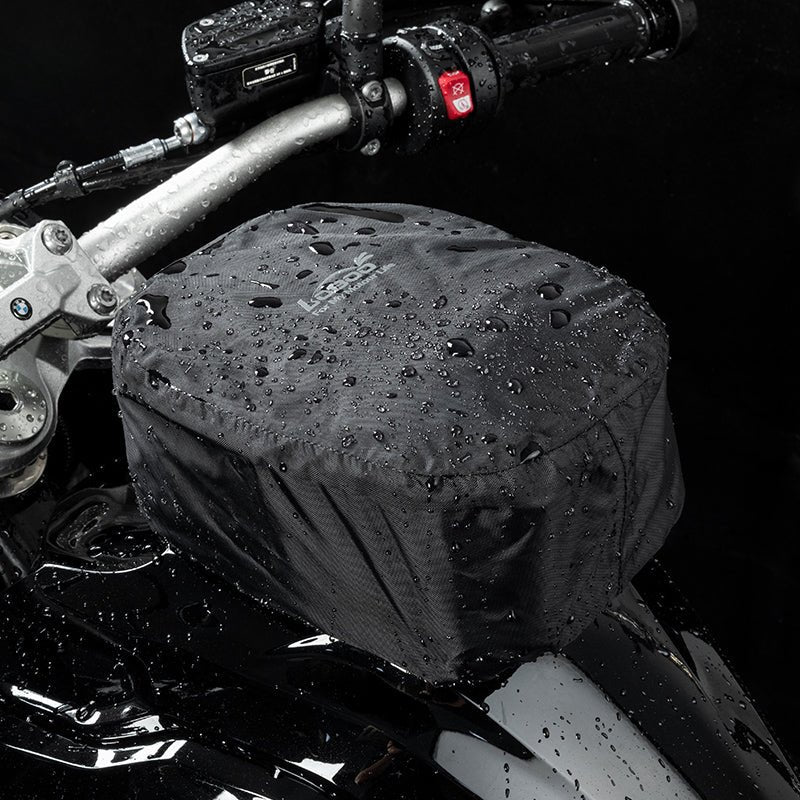
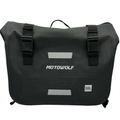
A half-filled waterproof bag sags and flaps around: the straps cannot work properly with an unstable volume. The Wanderer 50L solves this problem with an internal support plate that maintains its shape even with a reduced load; the BWB30 solves the opposite problem, because you carry it empty and compact and use it only when your luggage really grows, for example with a sleeping bag or travel purchases.

- Volume
- Up to 20 L with perimeter zipper
- Material
- Teflon-coated Cordura, thermal PEVA interior
- Extras
- Rain cover included, shoulder strap and handles
- Compatibility
- Original and aftermarket top cases
- Price
- 45 €
| Other waterproof bags in the catalog | Capacity | Protection | Price | Status |
|---|---|---|---|---|
| LOBOO BWB20PBK magnetic roll-top | 20 L | IPX6 | 36 € | Out of stock |
| LOBOO BWB40T waterproof zipper | 40 L | IPX7 | 104 € | Out of stock |
| LOBOO BWB40BK vintage canvas | 40 L | Water-repellent, no IP rating declared | 198 € | Available |
| LOBOO Alps 46L with hydration bladder | 46 L | IPX7 | 180 € | Out of stock |
Lighting and charging at camp are prepared before departure, not upon arrival
Endurrad does not sell headlamps: for portable campsite lighting, you need an outdoor retailer. What Endurrad can guarantee is that your GPS, smartphone, action camera, and the flashlight itself will arrive at camp already charged.

- Total output
- Up to 130 W across 2 USB-C ports
- Protection
- IP67
- Extra function
- Input mode: charges the motorcycle battery from a PD power bank
- Material
- CNC aluminum alloy
- Price
- 90 €
If the motorcycle remains parked for several days at base camp
Anyone who sets up camp in the same place for several nights and leaves the motorcycle parked for a long time can use the LOBOO C20Pro mini charger, powered by a power bank or any USB outlet, to keep a 4 to 35 Ah battery in good condition without having to disconnect it. It is not a jump starter: it works over hours, not minutes.
The most common mistakes made by first-time motorcycle campers
Almost always, the problem is not a single wrong item, but the sum of choices made without checking how they work together.
- Choosing individual components that are excellent but incompatible with one another. An excellent tent whose packed size does not fit the load configuration is not a good choice for that motorcycle.
- Sizing the sleeping bag for the starting temperature instead of the coldest plausible night along the route.
- Underestimating the sleeping pad. It is part of the thermal system, not a secondary accessory: a good sleeping bag is not enough on cold ground without adequate insulation.
- Assuming bivouacking is always legal just because "everyone does it": the rules vary by region, park, and property, and must be checked beforehand.
- Carrying too much "just in case." The extra sweatshirt, the spare pot, the gadget you will hardly ever use: every exception adds weight and takes up space that is needed for something else.
- Loading the cooking gear and water high up instead of near the center of gravity, changing the motorcycle's handling, especially on dirt roads and during slow maneuvers.
Frequently asked questions about motorcycle camping
Is wild camping by motorcycle legal in Italy?
No, generally it is prohibited. There is no national law authorizing it: since Legislative Decree 112/1998, responsibility lies with the regions, and where no explicit rule exists, the principle that what is not regulated is prohibited applies. Some regions, such as Sardinia, have an absolute ban outside equipped areas.
What is the difference between bivouacking and wild camping?
Wild camping means pitching a tent for an extended period, including several days, and is generally prohibited. Overnight bivouacking means setting up a tent only for sleeping, roughly from dusk to dawn, and is often tolerated in remote or high-altitude areas during a multi-stage journey, unless explicit local signs prohibit it.
Can I light a fire at the campsite?
It depends on the area and the time of year. During periods of fire risk declared by the regions, open fires are prohibited by seasonal ordinances. Even where bivouacking is tolerated, proper conduct still means not lighting unauthorized fires.
What temperature should I consider for the sleeping bag?
The EN 13537 standard (now ISO 23537-1) specifies four values: comfort, lower limit, extreme, and maximum comfort. To plan a night without compromises, use the comfort value appropriate for the season and the coldest elevation of the trip, not the lowest figure printed on the label, which is usually the extreme value.
What is a sleeping mat's R-Value, and which one should I choose?
It is the sleeping mat's thermal resistance against the ground, measured according to the ASTM F3340-18 standard. For summer, values of 1.0-2.0 are sufficient; for the Italian shoulder seasons, 2.1-3.9; for winter or snow, values above 4.0 are needed.
Can I use two sleeping mats together?
Yes, R-Value is additive: foam with R 2.0 under an inflatable pad with R 3.2 gives approximately R 5.2. Always place the foam in contact with the ground: it protects the inflatable pad from punctures and provides minimum insulation if it gets punctured.
Is a tent, tarp, or bivy better for a motorcycle traveler?
For most trips, the tent remains the most balanced choice: it provides better protection from wind and rain and offers an organized space to change clothes. A tarp is suitable in stable weather and with setup experience; a bivy is the most compact but less practical for several consecutive nights.
Where should I put the heaviest items on the motorcycle?
Low down and close to the center of gravity, in the side cases: cooking gear, tools, and water. Bulky but lightweight items, such as a tent and sleeping bag, can go in the top bag or a securely fastened rear bag without raising the center of gravity too much.
Can gas cartridges for a stove be transported safely on a motorcycle?
Yes, with a few precautions: keep them away from the exhaust, electrical system, and battery, do not expose them to direct sunlight during long stops, and never heat them to make them perform better. Standard threaded cartridges comply with the European EN 417 standard.
Does Endurrad sell tents, sleeping bags, or stoves?
No. Endurrad specializes in adventure and touring motorcycle accessories - bags, protection, onboard electronics, tools - not general outdoor equipment. For tents, sleeping bags, sleeping mats, and stoves, specialized outdoor retailers are the go-to.
What waterproof bag do I need for motorcycle camping?
It depends on how much volume you need to add. For a complete camping kit, the Wanderer 50L (IPX6, with internal support plate) is the choice for long trips; for occasional expansion, the foldable 30 L BWB30 can be carried empty and compact; for a limited budget, the top-case add-on bag adds up to 20 L with a thermal lining.
How do I manage electronics - flashlight, GPS, action camera - while motorcycle camping?
A reliable onboard charging outlet, such as the 130 W LOBOO C36 with dual USB-C, keeps your phone, GPS, and action camera charged while you ride, so they arrive at camp already fully charged. If the motorcycle remains parked in the same place for several days, a mini charger such as the C20Pro keeps the battery in good condition.
How much space is needed for a complete motorcycle camping kit?
There is no universal figure, but tent, sleeping bag, and compact sleeping pad together typically take up 25-40 liters, plus basic cooking gear and a water reserve. The actual sizing depends on the capacity of the panniers already mounted on the motorcycle and the number of people.
How do I protect my tent and sleeping bag from moisture in the panniers?
Keep them in a compartment separate from wet or dirty clothing, ideally in a bag with a dedicated inner pocket. Check the protection rating declared by the manufacturer: not all soft bags have a stated IP rating, and some protect the main compartment but not the outer pockets.
Does bivouacking in a national park follow the same rules?
Generally yes, as a principle of tolerance, but the final decision rests with the authority managing the protected area. Before stopping in a park, it is always advisable to check with the relevant authority, because local regulations may be more restrictive than regional ones.
What should I do if the land where I want to bivouac is private?
Even an unfenced area may be private property, and the owner may ask you to leave. Where possible, ask for permission first; if ownership is uncertain, choose a public area where bivouacking is known to be tolerated.
Ready for your next night outdoors?
Tell us your motorcycle's make, model, and year: we'll recommend compatible waterproof bags and onboard charging solutions to carry your camping kit safely and keep it operational at camp. You can also find the charging range in the motorcycle batteries and chargers collection and the complete selection on the Endurrad app for iPhone.
Sources: EN 13537 / ISO 23537-1:2016 (sleeping bag temperatures); ASTM F3340-18 (sleeping pad R-Value); EN 417 (threaded gas cartridges); Legislative Decree No. 112 of March 31, 1998 (regional responsibilities for bivouacking and wild camping); LOBOO technical data sheets and manuals (bags, chargers). Product data and availability verified on Endurrad on 10/12/2026.