

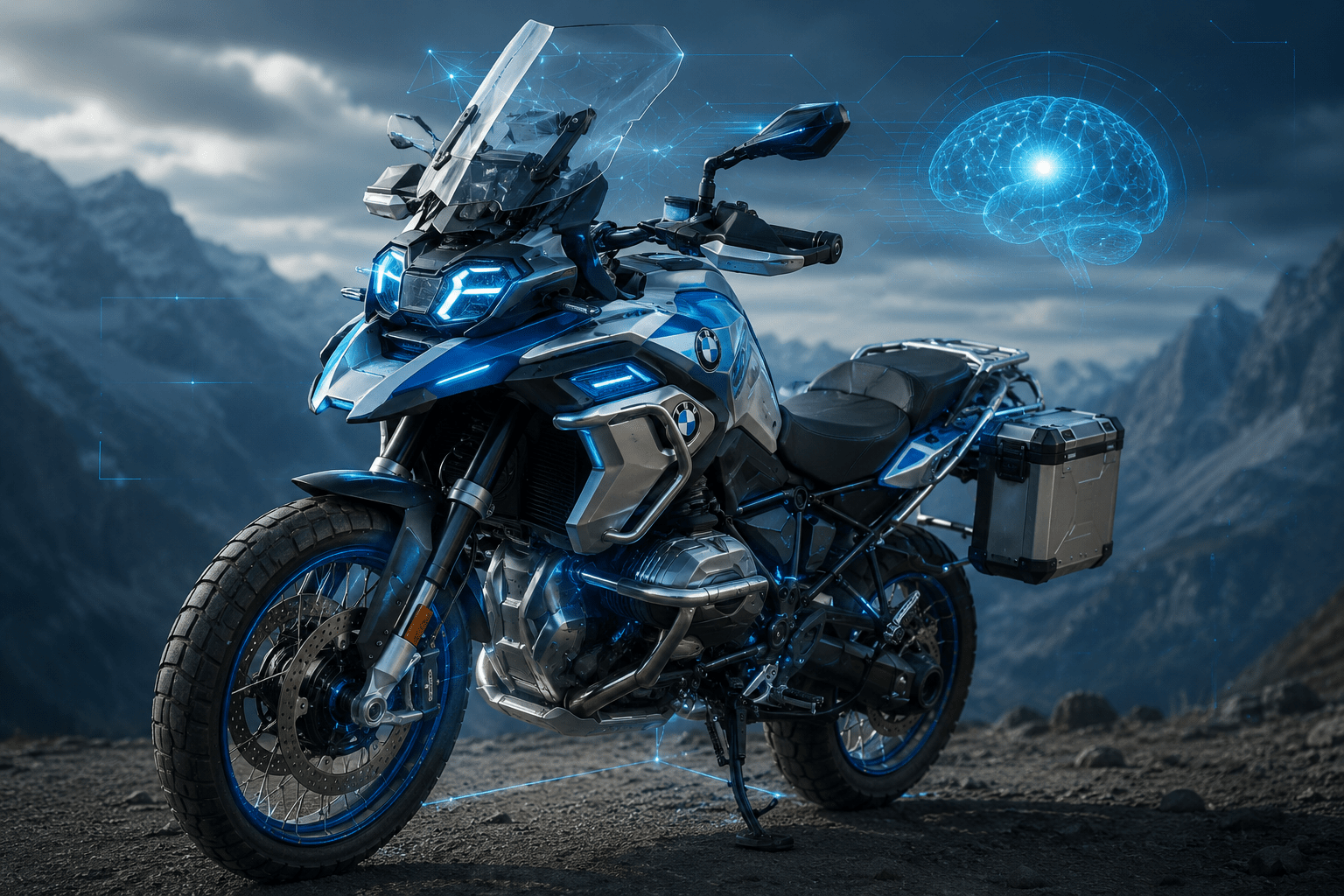
An investigation into the industry, covering radars, patents, machine learning, and advertising slogans — with the often-unspoken distinction between what is truly artificial intelligence and what simply bears its name.

The Crux of the Matter
Just browsing press releases from the last three years is enough to be convinced that motorcycles are now smart devices. "AI-enhanced," "neural network," "smart," "predictive": the lexicon of artificial intelligence has become a standard component of motorcycle marketing, just as it has for smartphones, vacuum cleaners, and electric toothbrushes.
The problem is that, behind many of these labels, artificial intelligence—understood in a technical sense—often isn't there at all. What is there, and it's far from insignificant, is a generation of radar-assisted electronic systems, sophisticated control algorithms, and connected software platforms that have indeed changed how certain motorcycles behave on the road. But "advanced electronic system" and "artificial intelligence" are not synonyms, and the confusion between the two terms is not accidental: it sells.
This investigation seeks to separate the two planes. On one hand, the technologies actually on the market and what they truly do. On the other, the promises—some kept, others disastrously failed, as we will see in the most striking case in the sector. The goal is not to diminish innovation, which is real, but to restore honest proportions to it.
To guide the reader, every relevant technical statement is accompanied by a reliability indicator:
- 🟢 Confirmed — official sources (manufacturers, suppliers, technical documentation)
- 🟡 Probable — multiple consistent sources, but without direct confirmation from the manufacturer
- 🔴 Speculative — patents, prototypes, rumors, or experimental research
The Technical Distinction Almost No One Makes

The three categories that marketing tends to merge into a single word.
Before delving into individual manufacturers, it's worth establishing three categories that marketing deliberately tends to conflate.
1. Deterministic algorithms (electronic control). These are the vast majority of "smart systems" currently installed on motorcycles. A cornering ABS, traction control, semi-active suspension, or radar adaptive cruise control operate according to pre-established rules: if the sensor detects condition X, the system performs action Y. They are extremely refined—the inertial measurement unit (IMU) of a Bosch stability system samples acceleration and angular velocity approximately one hundred times per second 🟢—but they do not "learn" or "decide" in the proper sense. They are, technically, control electronics, not artificial intelligence.
2. Machine learning. Here, the system builds its own behavior from data, rather than from hand-written rules. Obstacle recognition using neural networks trained on images, prediction of risky trajectories, and adaptation to an individual rider's style fall into this category. On production motorcycles, machine learning is, to date, much rarer than advertising suggests.
3. Artificial intelligence in a broad sense. An umbrella term that includes machine learning but is also used, improperly, for the first group.
The practical rule for the reader is simple: if a system always does the same thing in the same situation, it is most likely a deterministic algorithm, not AI. If, however, its behavior changes over time based on what it has "seen"—whether that's millions of other riders' kilometers or your own riding style—then we are dealing with something closer to machine learning.
Bosch itself, by far the world's leading supplier of these systems, refers to radar-based advanced rider assistance systems and algorithms in its technical documents, not artificial intelligence. It is the downstream manufacturers' marketing, and further downstream the press, that adds the magic word.
What's Really on Motorcycles Today

The core of current assistance systems: two radars and control algorithms, not machine learning.
The real protagonist of the last five years is not AI, but radar. The breakthrough came in 2020-2021, when Bosch introduced the first radar-assisted systems for motorcycles, and the 2021 Ducati Multistrada V4 S became the world's first production motorcycle equipped with adaptive cruise control (ACC) and blind spot detection developed with Bosch, using two radar sensors—one front and one rear 🟢.
In subsequent years, the same package, or its variants, appeared on a select group of flagship models: KTM 1290 Super Adventure S, Yamaha Tracer 9 GT+, BMW R 18 Transcontinental, Kawasaki Ninja H2 SX SE, Triumph Tiger 1200 GT Explorer 🟢. All premium motorcycles, with MSRPs in the US roughly ranging from $16,500 for the Tracer to $28,000 for the Kawasaki.
The functions actually available today on these motorcycles are:
- Adaptive Cruise Control (ACC) — automatically maintains a safe distance from the vehicle ahead.
- Blind Spot Detection (BSD) — signals vehicles in the blind spot, typically with a warning light on the mirror.
- Forward Collision Warning (FCW) — warns of an impending rear-end collision risk.
- Cornering ABS and advanced traction control — modulate braking and torque based on lean angle, thanks to the IMU.
- Semi-active suspensions — adapt damping in real time.
According to the levels of driving automation (SAE Levels 0 to 5), all these motorcycles remain at Level 0 or Level 1: the rider always maintains steering control 🟢. No production motorcycle removes actual riding from the rider—and, for the vast majority of motorcyclists, that's exactly what they want.
In 2024-2025, Bosch introduces the second generation of ARAS, with six new functions: ACC with Stop & Go (automatic stopping and restarting in traffic), Group Ride Assist (adjusts speed in staggered group formation), Emergency Brake Assist (increases braking pressure if the rider doesn't brake enough), Riding Distance Assist, Rear Distance Warning, and Rear Collision Warning 🟢. The new radar boasts a range of up to 210 meters, about 50 meters more than the previous generation 🟢. Bosch estimates that radar-assisted systems could prevent about one in six motorcycle accidents 🟡—an internal company estimate, therefore to be read with caution due to the source.
An important and honest technical detail: when traction control or ABS intervene, the radar systems deactivate to avoid overlapping 🟢. This confirms that we are talking about hierarchical and deterministic control logics, not a single "brain" making decisions.
BMW Motorrad: Connectivity, Radar, and an AI that lives (for now) in cars
BMW is probably the brand that has pushed the most on communicating the "connected motorcycle," but it's useful to distinguish between planes.
ConnectedRide is, in essence, a connectivity ecosystem: the BMW Motorrad Connected app projects smartphone navigation, telephony, and music onto the TFT display, while the ConnectedRide Navigator acts as a hub for various accessories 🟢. It's a well-made system—with navigation prioritizing "curvy routes," cloud synchronization via BMW ID, TomTom maps—but it has nothing to do with artificial intelligence: it's infotainment and connectivity software 🟢.
On the driving assistance front, the R 1300 GS and the R 18 Transcontinental feature radar-assisted systems (ACC, FCW, BSD) developed with Bosch 🟢, with the same deterministic logic described above.
Where BMW has truly invested in "serious" AI is in the automotive world, not yet in the two-wheeled sector. In 2025, the group announced with Qualcomm a new generation automated driving system—unified architecture with high-resolution cameras, radar, 360° coverage, HD maps, and precise GNSS localization, as well as V2X communication—destined for the iX3 and cars 🟢. It is a platform with perception based on neural networks (bird's-eye-view, information extraction from fisheye cameras) that represents a true AI stack. Whether part of this know-how can, in perspective, filter down to two-wheelers is plausible but not announced 🔴.
BMW is also a founding member of the Connected Motorcycle Consortium (CMC), which we will discuss later.
Ducati: The Radar Pioneer
Ducati deserves a precise historical mention: it was the first in the world to bring motorcycle radar into production with the Multistrada V4 in 2021 🟢. The system—developed entirely with Bosch—uses the front radar to regulate ACC distance and the rear radar for blind spot detection 🟢.
The rest of Ducati's electronics (Cornering ABS, Ducati Traction Control, Wheelie Control, engine maps, Skyhook semi-active suspensions on models that adopt them) are advanced electronic controls governed by the IMU: highly refined, but deterministic. Ducati itself has stated that it is working on new generation proprietary radar systems 🟡, and has shown vehicle-to-vehicle (V2V) communication prototypes at CMC events 🟢. However, there are no "onboard" machine learning systems on production models to date.
KTM and Bosch: The Second Generation Debuts (One Year Late)
The most instructive story of the biennium is that of the KTM 1390 Super Adventure S EVO, the first production motorcycle to feature the second generation of Bosch ARAS with the fifth-generation radar sensor and the new semi-automatic AMT gearbox 🟢.
The package is impressive on paper: more compact radar with better recognition of heavy vehicles, ACC with Stop & Go, Brake Assist, Collision Warning, Group Ride Assist, WP semi-active suspension with SAT technology 🟢. The motorcycle, with 173 HP from the 1,350 cc LC8 twin-cylinder engine, arrived in European dealerships between November and December 2025 for approximately €23,580 for the S EVO version 🟢.
But there's a detail that says a lot about the gap between announcement and reality: Bosch and KTM had already presented the technology in 2024, and the motorcycle was supposed to arrive "shortly after." A deep financial restructuring of KTM—culminating in its bailout and the acquisition of a majority stake by the Indian Bajaj Auto—froze the project for over a year 🟢. A useful reminder: in the motorcycle sector, entire seasons can pass between the press release announcing the technology and the actually available motorcycle, and not everything that is announced arrives.
In terms of AI, it must be stated clearly: the KTM/Bosch ARAS is in constant dialogue with the ECU, IMU, and stability control 🟢, but it remains a radar + algorithms system. It is not machine learning.
Honda: robotics, not artificial intelligence
Honda is perhaps the case where the "AI" label is most improperly applied. The famous Honda Riding Assist, presented at CES 2017 and capable of keeping the motorcycle balanced when stationary and at very low speeds, is an engineering marvel — but it is balance control robotics, not artificial intelligence.
The system is directly derived from Honda's research into humanoid robots (ASIMO) and the UNI-CUB unicycle, and is based on inverted pendulum control: by varying the steering head angle and front-end geometry, the motorcycle self-balances 🟢. In 2021, Honda presented a second generation, with "cooperative" balancing that harmonizes the machine's intervention with the rider's steering intention 🟢. It is extraordinary technology, but governed by deterministic control laws, not by learning neural networks.
On the transmission front, the E-Clutch (electronically managed clutch that eliminates the need for a lever without sacrificing the traditional gearbox) and the proven DCT are mechatronic automatons, not AI 🟢.
Yamaha: from pilot robot to self-balancing
Yamaha's most iconic contribution to this trend is MOTOBOT, the humanoid robot designed to ride a production motorcycle without modification, presented in the mid-2010s. The stated goal — to beat Valentino Rossi on the track — was not achieved: in a direct comparison, MOTOBOT clocked around 117 seconds against Rossi's 85 🟢. But the project was a true research program on control, perception, and machine learning applied to riding 🟢, not a mere marketing exercise.
From MOTOBOT came the AMSAS (Advanced Motorcycle Stabilization Assist System), a self-balancing system that, like Honda's Riding Assist, foregoes the gyroscope and uses a six-axis IMU with two actuators to stabilize the motorcycle when stopping and starting 🟡. On production models, Yamaha offers the radar-assisted package (ACC, BSD, FCW) on the Tracer 9 GT+ with the Unified Brake System (UBS), which Yamaha itself explicitly states is not a collision prevention system, but rather a braking assistant 🟢. A rare example of terminological honesty from a manufacturer.
Electric motorcycles and the true realm of software
If machine learning exists somewhere on production motorcycles, it is more likely to be found in the electric world, where software is native.
Zero Motorcycles with its Cypher OS (now at version III+) offers a proprietary operating system that orchestrates all the bike's systems and allows app-based customization: torque, regenerative braking, even speed limits 🟢. This is advanced, connected software management; however, the actual learning component remains limited and not documented as "onboard" machine learning 🟡. The LiveWire (formerly Harley-Davidson) also represents this "connected and data-driven" shift more than AI in the strict sense 🟡.
The Damon case: when AI marketing outstrips reality
No story better illustrates the theme of this investigation than that of Damon Motors. The Canadian startup, founded in 2017, had built its identity around "triple" numbers (200 HP, 200 mph, 200 miles of range) and above all around CoPilot, a collision warning system with cameras, radar and — this is the point — an onboard neural network that was supposed to learn the individual rider's style and improve threat prediction by anonymously aggregating data from the entire fleet in the cloud 🟢. On paper, it was the most ambitious machine learning case in the industry.
Damon boasted dozens of patents (according to its own press releases, over 40 filed and granted) and collected over 3,000 reservations with deposits, for a potential value of around 100 million dollars 🟢. Then the reality: repeated production delays (from 2021 to 2024, then to 2026), the departure of CTO Derek Dorresteyn in February 2025, suspension from Nasdaq in spring 2025 with the stock price plummeting below one cent 🟢. In March 2026, the entire board of directors, including the CEO and CFO, resigned; by April 2026, the company's website was offline 🟢. No production motorcycle was ever made.
The moral is not that motorcycle machine learning is a scam — Damon had serious engineers and real patents — but that announcing revolutionary AI is enormously easier than industrializing it. The distance between a demo and an approved, reliable, and marketable motorcycle is where many dreams die. Every future promise of a "smart motorcycle" should be read with this story in mind.
Suppliers: where AI truly exists
The paradox of the sector is that the most authentic artificial intelligence does not reside within motorcycle brands, but in the supplier chain.
Bosch is the reference giant: it supplies ABS, MSC (stability control), IMU, and the entire ARAS platform to Ducati, KTM, Yamaha, Kawasaki, BMW 🟢. Its approach, as mentioned, is radar + deterministic algorithms, but the stated ambition of the global head of two-wheelers, Geoff Liersch, is to bring the technology from the premium segment to the mass market — with the almost provocative goal of "10 dollars per bike" systems to truly impact statistics 🟢.
Continental is an ADAS development partner and has established a collaboration with the Israeli startup Ride Vision 🟢, the clearest case of visual AI applied to two-wheelers: two wide-angle cameras feed an onboard unit that executes predictive vision algorithms and image recognition trained on a dataset specific for two-wheeled vehicles (taking into account lean angle, rider behavior, environmental conditions) 🟢. Ride Vision is an aftermarket system, compatible with any motorcycle, and represents genuine machine learning in the market 🟢. Academic research confirms the direction: peer-reviewed studies on neural networks (YOLO, stereo-vision) for motorcycle detection and autonomous emergency braking (MAEB) show promising but still experimental results 🟡.
Qualcomm provides computing and connectivity platforms (including V2X) 🟢; Nvidia is the benchmark for neural network computing in automotive, but its direct role in production motorcycles is currently marginal and undocumented 🔴. Brembo has introduced Sensify, an "intelligent" digitally controlled braking system that integrates software and hydraulic actuation: this is advanced control, with scope for adaptive logic, rather than established AI 🟡.
Patent section
The patent landscape confirms the picture: a lot on balance and mechatronic automation, less on "onboard" machine learning applied to production motorcycles.
| Company | Area | Notes |
|---|---|---|
| Honda | Balance control (inverted pendulum), self-balancing | Derived from ASIMO/UNI-CUB robotics research 🟢 |
| Yamaha | Riding robotics (MOTOBOT), AMSAS stabilization | Research program on control and ML 🟢 |
| Damon | CoPilot (neural network, collision warning), HyperDrive, Shift | Over 40 declared patents; company collapsed in 2026 🟢 |
| Bosch | Radar-assisted systems (ARAS), MSC, IMU | Dominant supplier, algorithmic approach 🟢 |
| Ride Vision | HMI interface and predictive vision algorithms | Visual machine learning, aftermarket system 🟢 |
Patents on self-balancing robotic motorcycles with control loops based on linear and angular velocity sensors are also available in public databases (USPTO) 🟢 — a line of research, rather than a product.
A methodological caveat: a patent is not a product. It testifies to an intention or a line of research, not the existence of commercially available technology. Many patents remain dead letters.
Focus 1 — Will motorcycles become autonomous?
Short answer: no, not in the full sense, and it's probably not even the goal.
Self-balancing and self-driving prototypes exist (Honda Riding Assist, BMW Motorrad Vision Next 100, MOTOBOT) 🟢, but they originate as technological demonstrators and research tools, not as anticipations of a self-driving motorcycle to take us to work.
The reasons are structural, not just technological:
- Physical limitations. A motorcycle is inherently unstable: it loses stability as speed decreases and cannot maintain an upright position when stationary. Automating it is much more difficult than automating a car 🟢. As research on autonomous braking systems notes, cameras do not "see" through fog and rain, and leaning complicates every measurement 🟡.
- Motivations for use. Bosch is explicit: one drives a car and rides a motorcycle for different reasons. The company declares its desire to add safety without taking away the pleasure of riding 🟢. An autonomous motorcycle would solve a problem that almost no motorcyclist feels they have.
- Regulatory and insurance issues. Liability in the event of an accident with an autonomous vehicle is unresolved even for cars; for motorcycles, where the rider's body is part of the control system, it is even more so 🟡.
- Costs and acceptance. The market that pays for these technologies is, today, limited and premium 🟢.
The realistic direction is not the autonomous motorcycle, but the assisted motorcycle: systems that intervene in critical situations while leaving the rider in control.
Focus 2 — Can AI prevent accidents?
Here the potential is concrete, but it must be measured with statistical honesty.
The historical precedent is ABS: a 2013 study showed a 31% reduction in fatal accident rates on motorcycles equipped with it 🟢, and the European Road Safety Observatory estimated that widespread adoption of ABS could prevent over 1,000 fatalities per year in Europe 🟢. ABS is not AI, but it demonstrates that safety technology works when it becomes universal and affordable.
Regarding radar-assisted systems, the aforementioned Bosch estimate speaks of one in six accidents potentially avoidable 🟡. Ride Vision bases its raison d'être on a dramatic statistic: motorcycles account for approximately 28% of fatal road accidents, with a disproportionately huge incidence compared to the circulating fleet 🟡.
The decisive point is that the majority of serious accidents involve a driver who doesn't see the motorcyclist. This is why the most promising frontier is not just equipping motorcycles with sensors, but vehicle-to-vehicle communication (V2V/V2X): the Connected Motorcycle Consortium (which brings together BMW, Honda, Yamaha, Ducati, KTM, and Suzuki since 2015) is working precisely to make motorcycles and cars "dialogue", so that the car knows about the motorcycle's presence even before seeing it 🟢. Bosch envisions scenarios where a motorcycle, before braking, electronically warns the one behind it 🟡.
A word of caution: many of these estimates come from the suppliers themselves, who have an interest in advocating for their effectiveness. Independent, long-term data is needed before treating them as established facts.
Focus 3 — Will AI personalize every motorcycle?
This is the most fascinating scenario, and at the same time the most speculative 🔴.
The idea: a motorcycle that, by observing how we brake, accelerate, lean, and at what speeds we travel, adapts on its own the parameters of ABS, traction control, suspension, throttle response, engine maps, and electric range management, tailoring itself to the individual rider over time.
Some building blocks already exist:
- Today, semi-active suspensions and ride modes allow for deep manual customization 🟢.
- Connected electric motorcycles (Zero Cypher, LiveWire) allow app-based tuning and over-the-air updates 🟢.
- Damon's CoPilot promised individual style learning via neural network 🟢 — but, as seen, it never reached the market.
The leap from "manual customization + some reactive adaptation" to "motorcycle that learns and reconfigures itself" requires reliable onboard machine learning, and the industry is still behind the narrative on this. Realistically, the first credible steps towards true adaptive personalization are closer to 2030 than today 🔴.
Comparative table

The industry paradox: the most authentic AI doesn't reside in motorcycle brands, but in suppliers.
| Company | Real "AI" level | Technologies available today | Status |
|---|---|---|---|
| BMW Motorrad | Low on motorcycles (radar+algorithms); high on cars (Qualcomm) | ConnectedRide, ACC/FCW/BSD radar, connected TFT | On the market 🟢 |
| Ducati | Low (advanced electronic control) | Radar ACC/BSD (from 2021), ABS Cornering, DTC | On the market 🟢 |
| KTM | Low (Bosch ARAS 2nd gen.) | Radar 5th gen., ACC Stop&Go, AMT, semi-active susp. | On the market (2026) 🟢 |
| Honda | None/control robotics | Riding Assist (self-balancing), E-Clutch, DCT | Concept + production 🟢 |
| Yamaha | Research (ML in MOTOBOT); deterministic series | Radar on Tracer 9 GT+, UBS, AMSAS (research) | Mixed 🟢/🟡 |
| Kawasaki | Low | Radar ACC/FCW/BSD on H2 SX SE | On the market 🟢 |
| Zero / LiveWire | Low-medium (connected SW) | Cypher OS, app, OTA, ride mode | On the market 🟢 |
| Damon | High (declared ML) | CoPilot (neural network) — never produced | Collapsed (2026) 🔴 |
| Ride Vision (supplier) | High (vision + ML) | Aftermarket CAT, image recognition | On the market 🟢 |
| Bosch (supplier) | Medium (radar + algorithms) | ARAS 1st/2nd gen., MSC, IMU, ABS | On the market 🟢 |
Timeline

- 2015 — Connected Motorcycle Consortium (V2V) founded. Yamaha develops MOTOBOT. 🟢
- 2017 — Honda presents Riding Assist at CES; BMW showcases Vision Next 100. 🟢
- 2020 — Bosch launches the first generation ARAS (ACC, BSD, FCW); Ride Vision emerges from stealth with Continental partnership. 🟢
- 2021 — Ducati Multistrada V4 S: first production motorcycle with radar. Honda presents second generation Riding Assist. 🟢
- 2022 — Radar extends to KTM, Kawasaki, BMW, Yamaha, Triumph. 🟢
- 2024 — Bosch and KTM announce second generation ARAS with AMT; Yamaha, Honda, and BMW expand semi-automatic transmissions. 🟢
- 2025 — KTM faces restructuring and Bajaj acquisition; Damon is delisted from Nasdaq. 🟢
- 2026 — KTM 1390 Super Adventure S EVO with 5th gen. radar debuts in production; Damon collapses (board resignations, website offline). 🟢
- 2030 (predictions) — Widespread adoption of radar systems beyond premium; first credible steps towards adaptive personalization and mass V2X. 🔴
Box — The 10 AI innovations (or alleged ones) that will change motorcycles
- Extended-range front/rear radar (over 200 m).
- ACC with Stop & Go linked to automatic transmission.
- Assisted emergency braking (Emergency Brake Assist).
- Image detection with neural networks (Ride Vision type).
- V2V/V2X communication between motorcycles and cars.
- Group Ride Assist for group riding.
- Predictive/adaptive suspensions.
- Predictive diagnostics and maintenance via cloud.
- Rider style learning (still prototypical).
- Integrated voice assistants and contextual navigation.
Box — Who is really ahead in the AI race (reasoned ranking)
- Bosch — doesn't make motorcycles, but is the safety infrastructure for almost all of them. Dominates in volume and maturity. 🟢
- Ride Vision / Continental — the most concrete visual machine learning, already on sale. 🟢
- BMW — the most credible bridge between automotive AI (Qualcomm) and two-wheelers. 🟢
- Ducati — radar pioneer, strong electronic integration. 🟢
- KTM — first to adopt 2nd generation ARAS in series production. 🟢
- Honda / Yamaha — leaders in balance robotics, more cautious on production ML. 🟢
Box — Technologies likely to arrive by 2030 🔴
- Affordable radar widely available on medium and small motorcycles.
- Large-scale V2X between motorcycles and cars.
- Suspension and engine maps that truly adapt to the rider.
- Predictive maintenance based on fleet data.
- Autonomous emergency braking (MAEB) homologated on production motorcycles.
Conclusion: neither revolution nor deception
The answer to the title's question is not binary. It's not all revolution, but it's not all marketing either.
The real revolution is here, and it has a precise name: radar and advanced electronic control. It has truly made some premium flagships safer, and in the coming years, its price will decrease. The marketing, equally real, lies in slapping the label "artificial intelligence" on systems that, in the vast majority of cases, are deterministic algorithms: highly sophisticated, but lacking learning capabilities.
True machine learning applied to motorcycles exists — in the computer vision of suppliers like Ride Vision, in academic research, in programs like MOTOBOT — but on production models, it is still the exception, not the rule. And Damon's trajectory reminds us how fragile the transition from neural promise to on-road product can be.
For the motorcyclist, the honest summary is this: motorcycles are becoming safer and more connected, not "intelligent" in the science fiction sense of the word. And, at least for now, the most valuable part of intelligence on a motorcycle remains that of the rider.
Bibliography and sources
Manufacturers - BMW Motorrad — ConnectedRide (bmwmotorcycles.com/en/engineering/connectedride.html); R 1300 GS radar support (support.bmw-motorrad.com) - Honda Global — Riding Assist (global.honda/en/tech/Honda_Riding_Assist/; global.honda/en/innovation/CES/2017/) - KTM — 1390 Super Adventure S EVO / R 2026 (ktm.com) - Zero Motorcycles — Cypher OS / Technology (zeromotorcycles.com/ride-electric/technology) - Damon Motors — CoPilot / press releases (damon.com; ir.damon.com; prnewswire.com)
Technology suppliers - Bosch — Advanced rider assistance systems 2W (bosch-mobility.com); "New motorcycle safety systems tested" (bosch.com/stories/motorcycle-safety-systems/); Bosch Media Service US (us.bosch-press.com) - BMW Group + Qualcomm — automated driving system (repairerdrivennews.com, Sept. 2025) - Ride Vision / Continental — CAT launch (ride.vision; greencarcongress.com; venturebeat.com)
Patents - USPTO — Self-balancing robotic motorcycle (image-ppubs.uspto.gov, patent 10486755) - Damon Motors — CoPilot/HyperDrive patent portfolio (ir.damon.com)
Academic studies - MDPI, Remote Sensing (2023) — Motorcycle Detection and Collision Warning (MD-TinyYOLOv4) (mdpi.com/2072-4292/15/23/5548) - arXiv (2017) — Obstacle detection for Motorcycle Autonomous Emergency Braking (MAEB) (arxiv.org/pdf/1707.03435)
News outlets - MCN / Motorcycle News — Bosch/KTM ARAS 2nd gen. and Bosch future (Sept. 2024; Dec. 2025); KTM 1390 SA S EVO review (Dec. 2025) - RevZilla / Common Tread — Bosch ARAS test (Sept. 2024); ARAS status (Feb. 2024); first look KTM 1390 SA S EVO - RideApart — Damon decline (Feb. 2025; Mar.-Apr. 2026) - The Pack / Techcouver / Bike-EV — Damon collapse (2025-2026) - SlashGear — self-balancing motorcycles (2024)
Methodological note: The estimates of safety system effectiveness (e.g., "1 in 6 accidents") come in several cases from the suppliers themselves and should be considered indicative, pending independent validations. Predictions for 2030 are, by definition, speculative.



Share:
Motorcycle saddlebag: how to secure it so it doesn’t shift while riding
BMW M 1300 GS: Spy photos confirm the third GS, and it has a 21" front wheel