

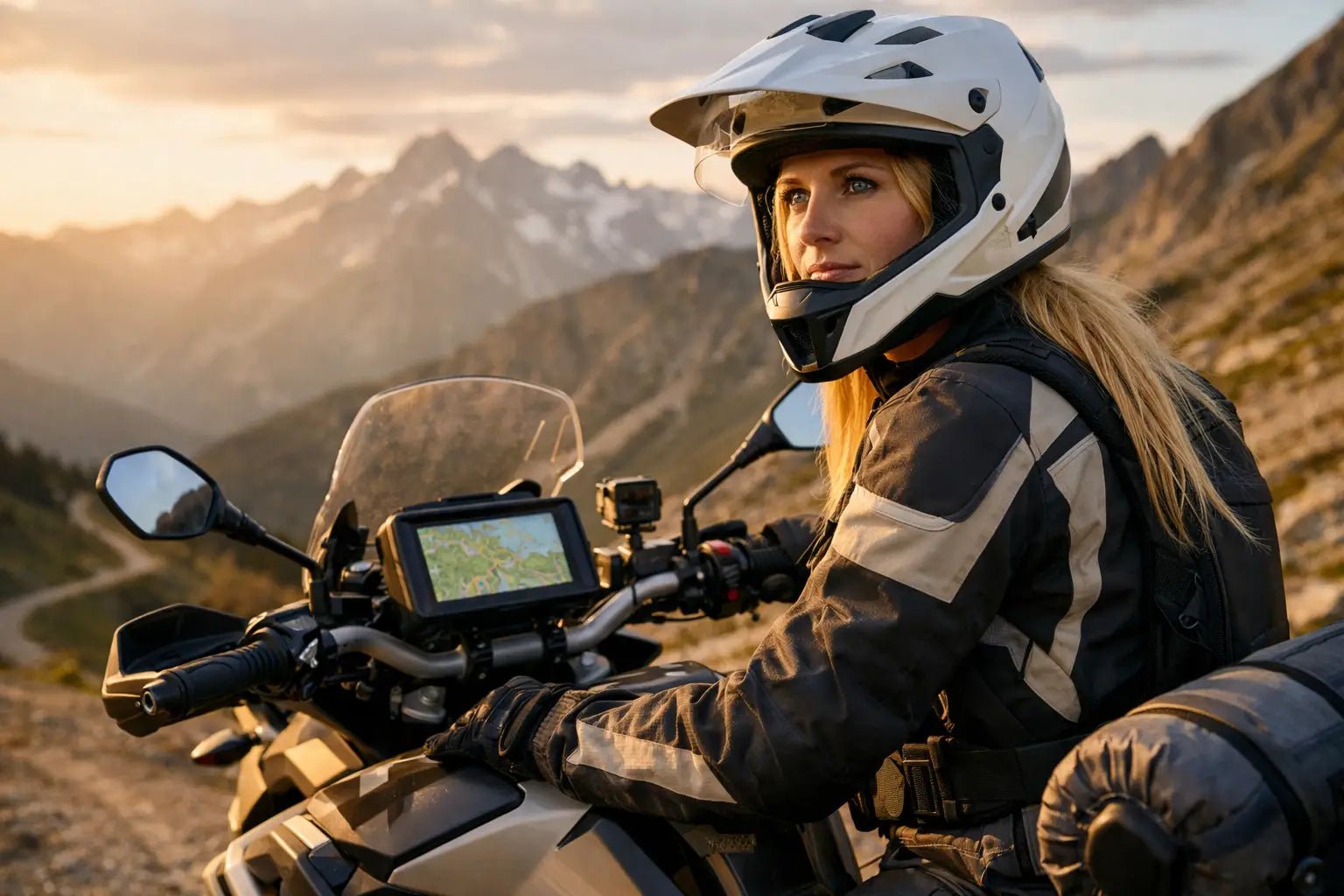
When the terrain changes every 20 km, the navigator stops being a convenient accessory and becomes part of your preparation. In the world of adventure motorcycle GPS, it's not just the map that makes a difference. It's legibility in sunlight, mounting stability, continuous power, and the ability to stay put when the track really breaks up.
Anyone who travels with a GS, an Africa Twin, a Ténéré 700, or a KTM Adventure soon discovers this. On asphalt, any solution seems to work fine. Then come rain, vibrations, wet gloves, an altitude detour, and maybe eight consecutive hours in the saddle. That's when you realize if you've chosen a system designed for travel or a compromise that you'll have to change after the first serious outing.
Adventure Motorcycle GPS: It's not just about following a track
Many start with the wrong question: dedicated GPS or smartphone? The useful question is another one. How do you travel, and under what conditions does navigation need to work without forcing you to stop every time?
If you make long transfers, cross borders, ride gravel roads, and do 600-800 km stages, continuity counts more than on-paper functions. An effective navigation device must remain legible in harsh light, respond with gloves on, not run out of battery midday, and not become a problem as soon as you hit the dirt.
The smartphone has a clear advantage: you already know it, you update everything quickly, and the interface is often immediate. But it also has practical limitations. It suffers from heat on the fairing in summer, continuous rain can make charging critical, and vibrations, on some models, are not the ideal context for intensive use. On a Sunday ride, it makes little difference. On a multi-day trip, it makes a huge difference.
The dedicated GPS has a different approach. Less phone-like convenience, more tolerance for rough use. It's generally designed to be continuously powered, manageable with gloves, and readable while standing on the pegs. It's not automatically the right choice for everyone, but it makes sense when navigation is part of the journey and not just occasional support.
What to look for before choosing
The first criterion is the screen. Not the diagonal itself, but what you can actually see at a glance. On a maxi enduro with a high fairing, you can afford something larger. On a slimmer motorcycle, or if you want to keep the cockpit clean, a more compact format is often better. A huge screen on paper is convenient, but if it takes up too much space or forces you to look away more than necessary, the advantage diminishes.
Immediately after comes the mount. This is often where mistakes are made. The best navigator, poorly mounted, becomes the most fragile part of the setup. On an adventure bike, the mount must withstand vibrations, sharp impacts, and long transfers without loosening. Position also matters. Too low and you'll lower your eyes more than necessary. Too exposed and reflections, bumps, and interference with the tank bag or fairing increase.
Power supply is the third critical point. If you rely on a flying USB cable, sooner or later you'll have a problem: a moving connector, water, irregular voltage, a cable pulled during a maneuver. For adventure use, a well-wired solution, with tidy fastening and adequate protection, makes more sense. It's not the most visible part of the motorcycle, but it's the one that prevents the classic dead navigator when you need it most.
Then there's resistance to the real environment. Real rain, fine dust, frequent washes, morning cold, full sun in the afternoon. There's no need to chase the spec sheet for sport. You need to ask yourself a simple question: if you do three mixed days, with water and dirt, does the system continue to work or do you start managing it yourself?
GPS mount or smartphone bracket?
It depends on the device you will actually use for your next trips, not on what you have mounted today for testing. If you start with a smartphone, choose a stable bracket and a position that doesn't penalize readability. If you already know you want a dedicated navigator, it's worth thinking about a suitable base right away and not buying twice.
On adventure motorcycles, model compatibility matters a lot. Attachment to the crossbar, on a dedicated bracket above the instrumentation, or on the handlebars are not equivalent solutions. They change the viewing angle, transmitted vibrations, and available space. A BMW R 1250 GS and a Ténéré 700, for example, have different cockpits and geometries. What works well on one may be less clean or less protected on the other.
The right position also changes safety
If the display is close to your line of sight, you read the next instruction without detaching too much from the road. When tackling tight hairpins, light rocky sections, or dense traffic, this difference is noticeable. It's not an aesthetic issue. It's less time with your eyes off the scene.
Conversely, an improvised position can create problems that initially seem small: reflections, interference with the tank bag, poor reading angle when riding standing up. On a short outing, you tolerate it. On a trip, after hours, it becomes unnecessary fatigue.
Dedicated GPS or smartphone: when one is convenient and when the other
If you mostly ride on asphalt, day trips, and some weekends with clear routes, a smartphone may suffice. Provided you mount it well, power it reliably, and accept that, with strong heat or continuous rain, some limitations will emerge. It's also a sensible solution for those who are just starting out and want to first understand their travel style.
If, on the other hand, you use tracks, alternate asphalt and dirt, travel for consecutive days, or don't want to entrust everything to your personal phone, a dedicated GPS takes the advantage. Not because it performs magic, but because it's designed for a harsher environment. You have fewer compromises in daily management and fewer variables to control while riding.
There's also a third way, often the most practical for those who really rack up the miles: smartphone as a backup and dedicated GPS as the main tool, or vice versa depending on the trip. It's not unnecessary redundancy. It's margin. If one navigation source fails, you're not forced to reinvent the stage on the side of a road in the rain.
The most common mistakes in adventure motorcycle GPS
The first is spending everything on the device and little on the mounting. In reality, the mount, bracket, and power supply account for half of the result. The second is choosing based on the functions you use in the garage and not on those needed with gloves, standing on the pegs, or after ten hours of riding.
The third mistake is ignoring the motorcycle. Weight, vibrations, fairing position, cockpit space, and accessories already mounted change a lot. If you already have an intercom, USB socket, high tank bag, or occupied crossbar, navigation must be thought of as part of the whole. Adding pieces without order almost always leads to a cluttered and less legible setup.
Another frequent mistake is confusing waterproofing with usability in the rain. A device can withstand water, but become awkward to manage with a wet screen, exposed connector, or poorly accessible mount. In practice, the system counts, not the isolated component.
How to choose based on your travel style
If you do medium-to-long-range touring with a maxi enduro, focus on readability, stable power, and a high display position. After hundreds of kilometers, what reduces visual fatigue and distractions is worth more than an extra function rarely used.
If you do intense weekends with more dirt, the focus shifts to fastening and compactness. Less bulk and fewer exposed masses often mean fewer problems when the terrain gets rough. In this case, the speed with which you disassemble or protect the device at the end of the day can also make a difference.
If you are in a growth phase and are equipping your motorcycle one piece at a time, avoid shortcuts. A simple but well-mounted system is better than a solution full of adapters, joints, and provisional cables. Navigation, like luggage or protection, truly works when everything is consistent with the motorcycle and the trip you have in mind.
On Endurrad, this approach matters more than the quick spec sheet: understanding whether a mount, a bracket, or a power solution makes sense for your model and for the use you will actually make of it.
Ultimately, choosing a good adventure motorcycle GPS system means removing friction from your journey. Fewer unnecessary stops, fewer doubts at the crossroads, less time wasted fixing what should have already worked. When navigation stops demanding attention, you can go back to paying attention to the road.






Share:
When is an enlarged kickstand plate needed?
Which GPS to truly choose for motorcycle trips