

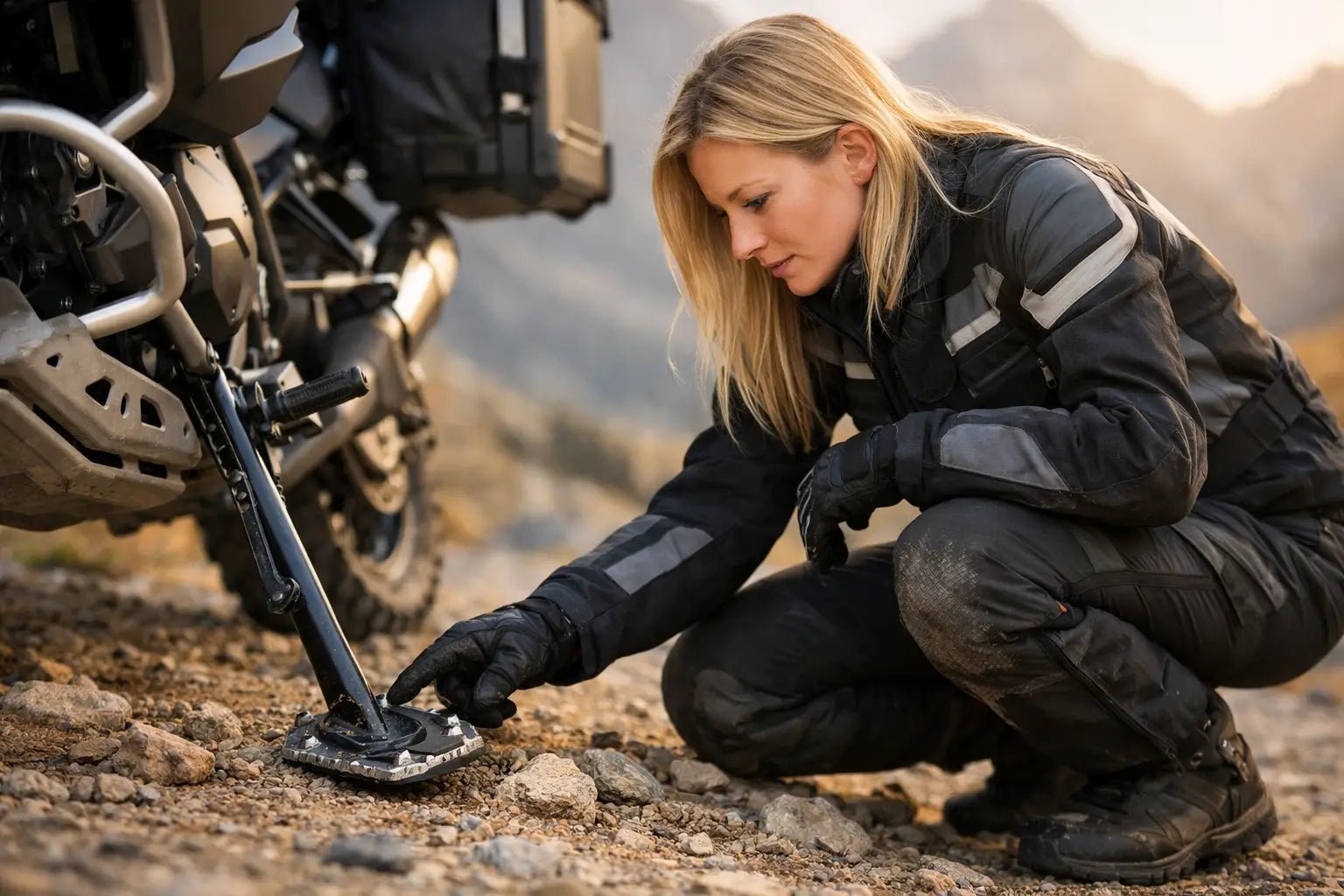
The kickstand always sinks at the worst possible moment: a loaded motorcycle, uneven ground, a two-minute stop for a photo. You return to find it leaning ten degrees farther than you left it.
The enlarged plate solves this problem, and it is not an accessory to install out of habit. But the reason it works is not the one almost everyone talks about.
It is not the motorcycle's weight. It is the pressure.
The stock kickstand foot puts the entire weight of the motorcycle onto a few square inches. What makes the ground give way is not the total weight; it is the pressure—that is, the weight divided by the supporting area.
This leads to the most surprising point: even a lightweight motorcycle sinks. A BMW G 310 GS sinks into wet grass just like a GS Adventure because its foot is proportionally just as small. The reasoning “my motorcycle is light, so I don't need one” is wrong from the outset.
The plate does not change the weight: it increases the area. The same load, many more square inches, and the pressure drops dramatically.
The four surfaces that give way
- Hot summer asphalt. It is the most deceptive because it looks solid. After hours in the sun, the bitumen softens, the foot slowly sinks, and the motorcycle lowers until it falls. You only notice when you return.
- Parking-lot gravel. The foot does not sink; it slides: the stones shift under the pressure.
- Wet grass and compacted earth. The classic scenic-stop scenario.
- Sand and light mud. There is no debate here: the foot disappears.
The plates in this series have grooves machined into the sides and bottom, which address a problem different from sinking: lateral sliding when the ground is sloped. Sinking and sliding are two distinct ways to make a stationary motorcycle fall, and they require two different solutions on the same part.
How it mounts: a sandwich, not a replacement

The original foot is not removed. The base goes underneath, the upper plate on top, and three screws close the sandwich through the stock foot. No drilling, no welding: it can be removed while leaving the motorcycle in its original condition.
In the package, identical across the entire range: base, upper plate or bracket, three M5 screws, 3 mm Allen key, and threadlocker. Nothing else is needed.
Two instructions repeated in the manual for every code, and worth following: do not fully tighten immediately — complete the adjustments first, then tighten in sequence — and check the screws periodically. There are three M5 screws on a part that takes impacts and vibrations: this type of fastening should be checked from time to time.
The plate acts only on the side stand and does not interfere with any center stand.
The code table, and the four pitfalls
This is the part that makes the difference between a correct purchase and a return. The stand foot changes not only with the model but also with the equipment.
| Code | Motorcycle | Screws | Pair | Price |
|---|---|---|---|---|
| CJC01 | BMW G 310 GS | — | — | 22,00 € |
| CJC031 | F 750 GS from 2018 · F 800 GS from 2025 · F 900 GS Comfort Edition from 2025 | 3 × M5×10 | 4 N·m | 40,50 € |
| CJC033 | F 850 GS from 2021 · F 850 GS Adventure from 2019 · F 900 GS Adventure from 2025 | — | — | — |
| CJC081 | R 1200 GS LC 2013-2016 and from 2017 · R 1250 GS from 2019 — standard seat | 3 × M5×10 | 4 N·m | 40,50 € |
| CJC072 | R 1200 GS LC Adventure from 2014 · R 1250 GS Adventure from 2019 — standard seat | 3 × M5×10 | 4 N·m | 40,50 € |
| CJC088 | R 1250 GS Adventure — low seat | 3 × M5×10 | 5 N·m | 40,50 € |
| CJC062 | S 1000 XR from 2021 | 3 × M5×12 | 5 N·m | 36,00 € |
The four things people get wrong, in order of frequency:
- Standard seat or low seat. On the R 1250 GS Adventure, these are two different codes. If yours has the lowered seat, the code is CJC088, not either of the other two.
- F 900 GS: Comfort Edition only. The CJC031 covers the F 900 GS only in the Comfort version. The standard and Adventure versions are excluded and are covered by the CJC033. This is the most likely cause of an incorrect purchase for this code.
- Liquid-cooled GS models only. For the R 1200 family, the LC models from 2013 onward are covered. The air- and oil-cooled GS models up to 2012 are excluded.
- Sport suspension. On the two most recent generations covered by the CJC081, the manufacturer states that it is not compatible with the sport suspension.
If you have an R 1300 GS, the stand has been redesigned and requires a different part: there is a dedicated plate.
How it is made
Body made of CNC-machined aluminum — the manufacturer specifies this for the surface finish and the precision of the hole positions, which is what matters on a part that must fit an existing foot — and 304 stainless steel hardware, throughout the range.
It should be noted that the weight and dimensions are not provided by the manufacturer for several codes, either in the manuals or on the technical panels. We prefer to state this rather than estimate them: if you need those measurements to check clearances, write to us and we will measure the part.
When it is not needed
If you almost always park in a garage or on stable pavement, and the motorcycle is unloaded, the benefit is limited. It is worth being honest: this is an accessory whose value is proportional to how often you stop where the ground is unreliable.
The simplest way to determine whether you need one is to look at the past month, not the ideal trip you will take once a year. If you have had to look for a flat stone or small board to place under the stand, you already have your answer.
There is also a clarification that the manufacturer puts in writing: increasing the footprint reduces the risk of sinking; it does not eliminate it. The risk remains on a steep side slope or deeply saturated ground. The plate widens the margin; it does not correct improper parking.
Frequently asked questions
When is an oversized side-stand plate needed?
When you often park on surfaces that give way: sun-softened asphalt, gravel, wet grass, compacted earth, or sand. If you have ever had to look for a stone or small board to place under the stand, you need one.
Is it also needed for a lightweight motorcycle?
Yes. Sinking depends on the pressure exerted on the ground—that is, weight divided by contact area—not on total weight. Even a lightweight motorcycle has a small foot and sinks into soft ground.
Do you need to remove the original stand foot?
No. The base is positioned underneath and the top plate above, and three M5 screws close the sandwich through the original foot. No drilling or permanent modification is required.
What tools are needed to install it?
Only the 3 mm Allen key included in the package, together with the three M5 screws and threadlocker. The specified tightening torque is 4 or 5 N·m, depending on the code.
Is the side-stand plate suitable for both the standard and low seats?
No. For the R 1250 GS Adventure, there are two separate codes: CJC072 for the standard seat and CJC088 for the low seat. The stand foot varies with seat height.
Does it interfere with the center stand?
No. It only affects the side stand and does not interfere with any center stand.
Does the plate eliminate the risk of the motorcycle falling over while stationary?
No. It reduces the risk by widening the footprint, but the risk remains on steep side slopes or deeply saturated ground: the rider remains responsible for assessing the surface where the motorcycle is parked.
If you are unsure of your motorcycle's fitment, send us the model, year, and seat height: it is a two-minute check that prevents a return.



Share:
Future smart displays for motorcycles: what's changing
Larger center or side stand: how to choose one for an adventure motorcycle