


In short. A saddlebag almost always shifts for the same reason: the straps are attached to the wrong point, or they run in parallel instead of under crossed tension. Proper fastening uses four anchoring points fixed to the motorcycle (passenger footpegs, subframe, grab handles or luggage rack, never turn signals or fairings), keeps the load low and compact, and routes it well clear of the exhaust muffler.
What changes from one motorcycle to another: not the principle, but the usable space. On a GS or a Tiger with a wide tail section, there is plenty of clearance; on a narrow dual-sport or one with a high exhaust, the margin for error is almost zero.
Why it matters outside the garage: a load that protrudes beyond the motorcycle's outline is regulated by Article 164 of the Highway Code, with fines of €87 to €344 for those who ignore it.
The attachment point matters more than the strap
Before tightening anything, the question is: what are you tying the bag to? A perfect strap on the wrong point will not hold it securely.
Good attachment points are those that remain fixed relative to the motorcycle's frame even under load: passenger footpegs, rear subframe, side grab handles and luggage rack brackets. They are designed to support a load and do not deform when you pull firmly.
The points to avoid are just as clear: turn signals, license plate holders, plastic covers and flexible mounts are not structural. They weaken over time, crack in the cold or simply bend, at which point the bag that seemed securely fastened starts to wobble on the first fast straight.
On motorcycles with a narrow tail section or high-mounted side exhaust - many dual-sports and some mid-displacement adventure bikes - the usable space for attaching the straps is greatly reduced. In these cases, it is worth checking the actual distance from the muffler with the luggage mounted and loaded, not with the motorcycle empty on its stand: the suspension compresses and the geometry changes.

A bag without structure moves even if you tighten it properly
Fastening depends not only on where you tie the bag, but also on what you are tying it to.
A roll-top dry bag, when half-filled, collapses. And a collapsed bag shifts under the straps regardless of the fastening technique: the internal volume changes shape at every bump, the tension is released differently from one side to the other, and the result is what many mistake for "straps loosening" when in fact it is the contents shifting.
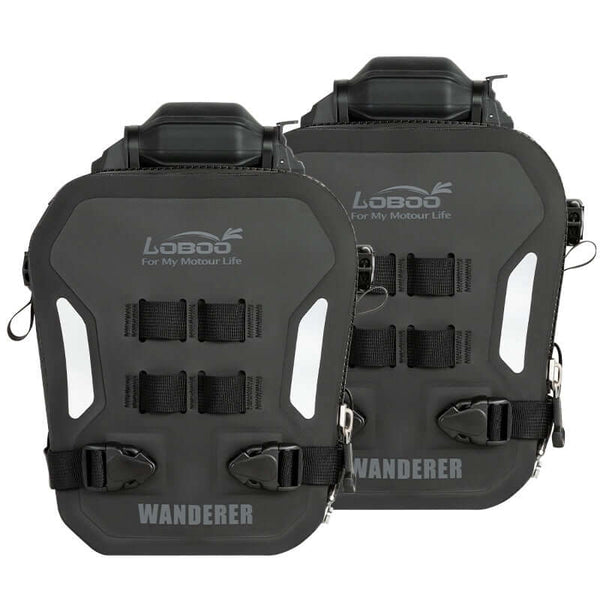
Some models solve the problem at its root with a rigid or semi-rigid internal structure: the LOBOO Wanderer 50 L, for example, incorporates a removable U-shaped support plate that maintains its shape both when the bag is full and when it is half empty. The practical advantage is that the straps work on a stable volume instead of on a sack that collapses.

A crossover fastening holds better than two parallel straps
With the same number of straps, how you make them work changes everything.
Two straps tensioned in parallel, one on each side, keep the bag pressed downward but do not prevent lateral rotation: in a turn or a U-turn with the handlebars turned, the load can "walk" a few centimeters. A third longitudinal strap, or a crossover between the two sides, also blocks that movement because it works in a different direction from the first two.
The tension must be balanced: if one side is tighter than the other, the bag sits crooked and starts to rotate while you ride. The practical rule is simple — tighten it, then push the bag with both hands: a little play is normal, but noticeable movement is not.
Those who sell saddlebags designed for this purpose almost always include dedicated quick-release straps, with buckles that do not require you to retie the knot every time you mount or remove the luggage. This is a real practical difference compared with generic ratchet straps: they can be removed and refitted in a few seconds, including during fuel stops.
One concrete example: the LOBOO vintage canvas bag documents two alternative fastening methods, both starting from the same four side anchor points on the tail. In the first, the strap attaches directly to the bag body with a quick-release buckle; in the second, it passes through the retention straps sewn onto the bag itself, securing it more firmly for riders traveling over rough surfaces. In both cases, the manufacturer recommends gathering the excess webbing, because it can flap into the rear wheel or chain.
- Straps tensioned symmetrically, with the same level of tension on both sides
- At least one tie-down point that works in a different direction from the main straps (longitudinal or crossed)
- Gather and secure any excess webbing; never leave it flapping near the wheel, chain, or exhaust
- Manual check: push the bag; a little play is fine, but noticeable movement is not
Three Endurrad bags, three ways to attach them to the motorcycle
The principle is identical; the closure system and included straps vary from model to model.
| Model | Capacity | Closure | Straps included | Price | Ideal for |
|---|---|---|---|---|---|
| LOBOO foldable BWB30 | 30 L | Roll-top, Duraflex buckles | Quick-release nylon straps | 54,00 € | Reserve volume to carry empty on board |
| LOBOO Wanderer 50 L | 50 L | Magnetic roll-top, vent valve | Quick-release strap included | 220,00 € | Long trips, IPX6 rating |
| LOBOO Vintage canvas 40 L | 40 L | Patented magnetic roll-top | Quick-release straps, 2 attachment methods | 198,00 € | Roadsters, scramblers and classics |
The practical difference between the three is not the fastening itself - they all use quick-release straps at the same four points - but how much the bag helps the fastening hold. The Wanderer, with its internal plate and vent valve, is designed to remain compact even when partially loaded; the foldable BWB30 is specifically made to stay empty and take shape only when needed; the Vintage, without rigid reinforcements, performs better when you fill it properly and use the double-attachment method the manufacturer documents for rough terrain.
The exhaust is a more tangible enemy than rain
The right fastening is of little use if the bag touches the exhaust.
Just a few minutes of contact with a hot exhaust can burn the outer fabric or deform the contents. The problem mainly concerns motorcycles with a high side-mounted exhaust - several adventure and dual-sport models have one - where the distance that seems sufficient when the motorcycle is stationary decreases as the luggage settles during riding and the suspension works.
The check must be made with the bag mounted and loaded, not beforehand. If space is tight, it is better to move the support point farther forward onto the passenger seat, reduce the loaded volume, or position the bag so that the side closest to the exhaust remains the lowest and most compact.
The law sets a limit on overhang, not just common sense
A poorly mounted bag is not just a stability problem: it can also be an offense.
Article 164 of the Highway Code regulates how loads are arranged on vehicles: the load must not impair the driver's visibility, alter the vehicle's stability, or conceal lights and the license plate. For lateral overhang, the limit is 30 cm on each side relative to the position lights; if an indivisible load extends beyond the motorcycle's profile, its ends must be marked with retroreflective panels.
For a rear duffel mounted according to the manufacturer's instructions - resting on the seat or luggage rack, without extending laterally beyond the motorcycle's profile - the rule is almost never a practical issue. It becomes one if you add a second bag to the side, or if the bag you choose is wider than the motorcycle on which you mount it.
The real test comes after the first few kilometers, not in the garage
In the garage, the bag always seems securely fastened. The real test is something else.
Before setting off on a long trip, take a short test ride with braking, pulling away, and a few genuine bumps. Then get off and check three things: whether the bag has shifted or rotated, whether a strap has loosened, and whether there are any new contact points with the exhaust or bodywork that were not present when the motorcycle was stationary. On trips lasting several days, it is worth repeating the check after the first 30-50 km, once the contents have settled and the straps have reached their final tension.
The most frequently asked questions about securing a saddlebag
What is the best way to secure a saddlebag to the motorcycle?
Use at least two quick-release straps attached to structural points on the motorcycle, such as passenger footpegs, the subframe, grab handles, or the luggage rack, with symmetrical tension on both sides and, if possible, a third securing point working in a different direction to also prevent lateral rotation.
Why does the saddlebag move even when the straps seem tight?
Almost always because they are anchored to a non-structural point, such as plastic or a turn signal, that flexes under load, or because the bag is half-filled and the internal volume shifts independently of the strap tension.
Where do you attach a saddlebag on an adventure motorcycle?
To the dedicated anchoring points when the motorcycle has them, such as passenger grab handles and the rear subframe, or to the passenger footpegs and luggage-rack brackets. Never to turn signals, license-plate holders, or plastic covers.
How far should the bag be from the exhaust?
There is no single measurement that works for all motorcycles: it depends on the position of the muffler. The check must be carried out with the bag mounted and loaded, because the suspension compresses under the weight and the actual distance changes compared with the motorcycle standing on its kickstand.
Are quick-release straps safer than generic ratchet straps?
Not necessarily safer, but more practical: they can be removed and refitted in a few seconds without retying the knot, and dedicated buckles, such as Duraflex ones, are designed to work for a long time without deteriorating. Stability still depends on the anchoring point chosen.
Does a saddlebag that is too empty move around more?
Yes. A half-filled roll-top dry bag sags, and its contents shift with every bump, something no external strap can fully compensate for. Models with a rigid or semi-rigid internal structure reduce the problem.
What should you do if the bag has never been filled completely?
Compress it as much as possible before loading it: use the air-release valve when available, wrap soft garments around rigid items to fill the gaps, and avoid leaving air trapped in the main compartment.
Is a poorly fitted saddle bag a violation of the Highway Code?
It can be if the load extends beyond the motorcycle's outline without the required marking, or if it obstructs the visibility of the lights and license plate. Article 164 of the Italian Highway Code provides for fines from €87 to €344. When fitted according to the manufacturer's instructions, without lateral overhangs, a tail bag normally does not fall into these cases.
Is a bag with a rigid structure better, or one that is completely soft?
It depends on how you use it. An internal structure (such as the U-shaped plate in the Wanderer) helps maintain its shape when partially loaded and is useful for those who often travel with varying volumes. A foldable soft bag has the opposite advantage: it takes up very little space when empty and is convenient as an emergency backup.
Can a saddle bag also be fitted to classic motorcycles or roadsters without a luggage rack?
Yes, if the motorcycle has at least four anchor points on the sides of the tail (grab handles, subframe). Some models, such as the canvas bags designed for a vintage look, are specifically designed for this type of motorcycle, without the need for dedicated supports.
How much weight can be loaded into a saddle bag?
The practical limit is almost never stated by the bag manufacturer, but depends on the maximum load allowed on the passenger seat or luggage rack as specified in the motorcycle's registration document. The bag distributes the weight; it does not increase it by itself, but an overload is still an overload in the eyes of the law and riding dynamics.
Is it better to put heavy items at the top or bottom of the bag?
Low down and toward the center of the motorcycle. Heavy items placed high up or near the closure edges increase the bag's sway and put more strain on the straps and anchor points when cornering.
Does a magnetic roll-top closure hold better than a zipper?
For motorcycle use, yes, in one specific respect: it has no zipper that can rust or jam with mud and sand, and it can also be closed while wearing gloves. Watertightness still depends more on the bag body material (TPU or waxed canvas) than on the closure system alone.
Have you already chosen the bag but still don't know how to secure it properly to your motorcycle?
Tell us the make, model, and year: we'll tell you which anchor points your motorcycle has and which bag in our catalog fits without compromise.
Further reading: motorcycle dry bag: why it moves · motorcycle tail bag: how many liters to choose · semi-rigid panniers: tail or crash bar