

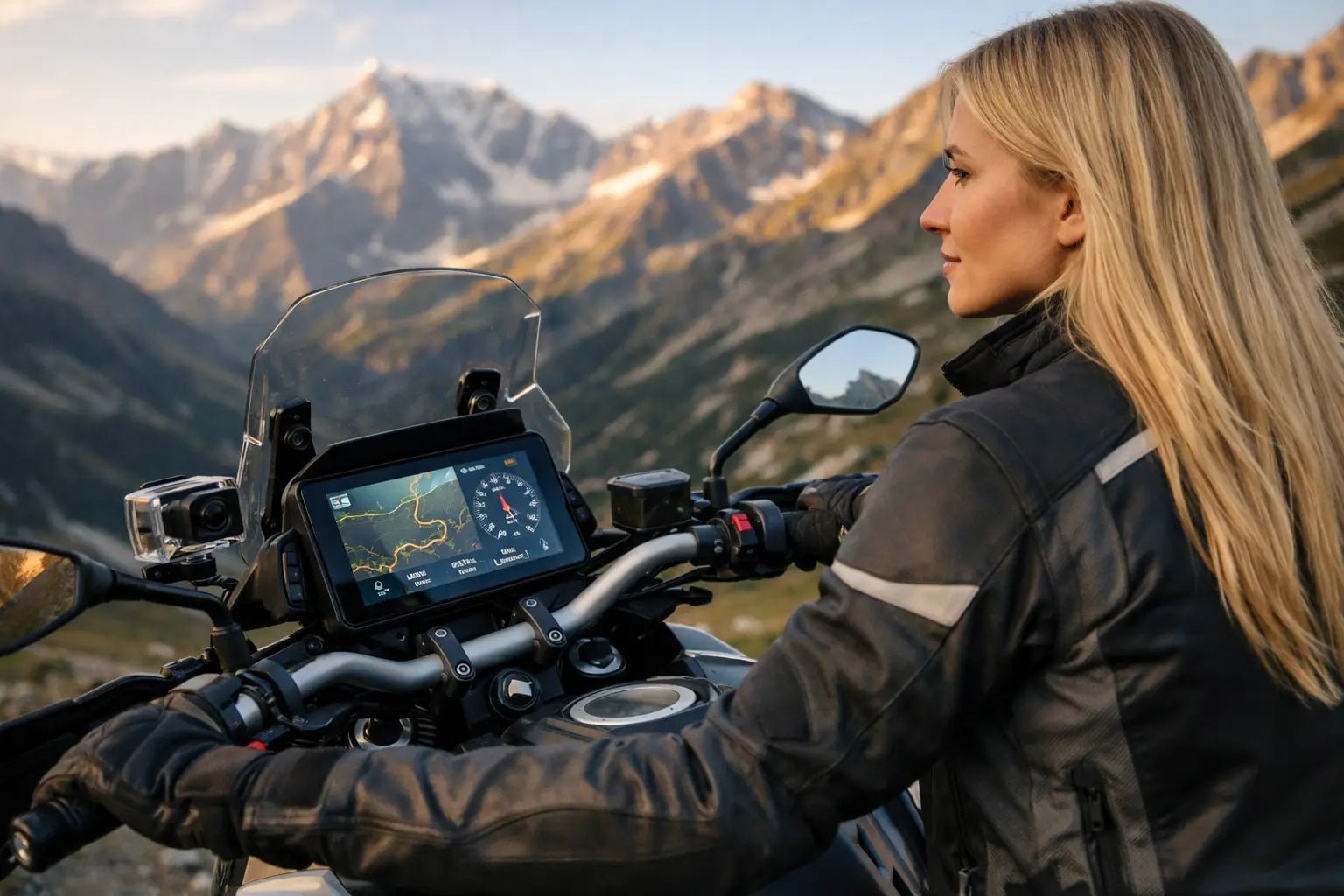
When you're riding on a white track with the low sun in front of you or crossing through a transfer in the rain for hours, you immediately understand whether a future smart motorcycle display is truly useful or if it's just extra electronics on your handlebars. For serious travelers, the point isn't having a big screen. The point is to read the right information at a glance, without distractions and without ending up with a mount that vibrates, overheats, or stops being visible precisely when you need it most.
This is why the topic deserves a practical approach. Not so much to imagine the motorcycle of 2035, but to understand which solutions are becoming truly sensible today on a GS, an Africa Twin, a KTM Adventure, or a Ténéré used for covering miles, mountain passes, and dirt roads.
The future smart motorcycle display is not just a screen
Many associate the idea of a smart display with a tablet mounted on the handlebars. In reality, the most interesting direction is different: less visual overload, more integration with what you're doing in the saddle. A good system should show you navigation, essential alerts, motorcycle status, and useful communications without forcing you to search for information amidst menus, apps, and notifications.
On an adventure motorcycle, this matters more than anywhere else. On asphalt, you can afford a few extra seconds of attention. On fast dirt roads, standing on the footpegs, you cannot. If the display requires long interaction or precise reading of small characters, in practice it works poorly, even if it seems complete on the spec sheet.
The real evolution, therefore, is not the endless addition of functions. It is the ability to select the functions that are truly needed while riding and make them readable with vibrations, gloves, dust, and variable light.
What really matters in a smart display for travel
The first discriminating factor is readability. A display can have high resolution, but if it loses contrast in direct sunlight or becomes unclear with a dark visor, you already have a concrete limitation. For a motorcycle traveler, the difference is made by perceived brightness, anti-glare treatment, and a clean interface.
Immediately after comes system stability. If you use your motorcycle for several consecutive days, perhaps with temperature fluctuations, rain, or uneven terrain, you need a device that doesn't fail due to overheating, unstable power, or shaky connections. Here you see the difference between an accessory designed for intensive use and an adapted solution.
Then there's the issue of mounting. A BMW R 1300 GS with a crossbar and tall windscreen offers different possibilities than a Royal Enfield Himalayan or a Ducati DesertX. The position of the display affects safety more than it seems. If you mount it too low, you look down too much. If you mount it too exposed, vibrations, reflections, and the risk of impact off-road increase.
Finally, interaction matters. Touching a screen with winter gloves or in heavy rain is never the ideal situation. That's why the future, rather than focusing purely on touch, seems to be moving towards mixed systems: a clearly readable screen, handlebar controls, voice commands where they make sense, and an interface that requires very few inputs while riding.
Smartphone, standard TFT, or dedicated units?
Today, this is the real comparison. The smartphone remains the most widespread solution because you already have it, it easily updates maps and apps, and offers very flexible navigation. However, it has obvious limitations when use becomes serious: heat, rain, vibrations, delicate camera sensors, and not always consistent readability. For a short outing, it's fine. For a challenging trip, it depends on how you mount it, how you power it, and how much you want to expose it.
The motorcycle's standard TFT is convenient because it's integrated and clean, but it's not always enough. In many cases, it handles motorcycle data, basic connectivity, and some simplified navigation functions well. The problem arises when you want clear map reading, complex waypoints, or customized visualization designed for long stages.
Dedicated units make sense precisely here. Not because they are always superior in absolute terms, but because they are often designed to better withstand vibrations, water, and continuous use. The compromise is that they cost more, offer less freedom than a smartphone, and must also be evaluated based on compatibility with brackets, power supply, and available space on the cockpit.
For those who use their motorcycle in a mixed way, the point is not to choose a category on principle. It is to understand which limitation you want to avoid. If you are mainly concerned about overheating and exposing your phone, a dedicated solution makes sense. If you take occasional trips and want maximum flexibility, the smartphone remains practical. If you prefer visual order and integration, you can rely more on the standard TFT, but knowing what you're asking of it.
The role of the motorcycle changes everything
Talking abstractly about smart screens only goes so far. On a KTM 890 Adventure, also used standing on rocky terrain and fast tracks, the weight of the mount, the rigidity of the bracket, and visual stability have enormous value. A perfect system on the road can become tiring or difficult to read when the motorcycle's suspension is working hard.
On a BMW R 1250 GS or R 1300 GS, where many kilometers are often covered and aerodynamic protection is greater, integration and visual comfort over the long term also come into play. After 600 or 800 km on the same day, you don't want a busy interface. You want a quick and reliable glance.
On a Ténéré 700 or a Himalayan, the reasoning is different again. Here, simplicity, low weight, and ease of restoration in case of a fall or impact are often sought. A complex, expensive, and very exposed display may be less sensible than an essential but well-mounted configuration.
For this reason, when evaluating a solution, the right question is not "how many functions does it have?" It is "how does it perform on my motorcycle and for my type of trip?"
The future smart motorcycle display will be more useful if it disappears more
It sounds like a paradox, but it isn't. The best systems will be those that require less conscious attention. Not because they will do less, but because they will only show what is needed at that moment.
Imagine three real scenarios. During a highway transfer, you want clear navigation, fuel warnings, essential weather, and perhaps simple call management, without secondary menus. In a narrow alpine section, you need graphics that are legible even with intermittent light and rapid focus changes. On dirt roads, you want almost only direction, track, and a few large data points. If the system doesn't prioritize based on context, the entire smart aspect remains theoretical.
This is where the relationship with intercoms and handlebar controls also comes in. The better the devices communicate with each other, the less you are forced to take a hand off or look down. But be careful: more integration also means more potential points of failure. A chain composed of a smartphone, app, intercom, TFT, and remote control is convenient when everything works. If one link disconnects, you must still have a reliable base.
Where the difference will be made in the coming years
The real difference will not be made by those who add graphical effects or widgets. It will be made by those who solve four concrete problems. The first is visibility in all conditions. The second is resistance to continuous use, not to a laboratory test read once. The third is real compatibility with the cockpit of adventure motorcycles. The fourth is ease of use with gloves, rain, and fatigue.
Power supply will also be a key point. A smart display only works well if it is part of an organized system, with clean wiring, adequate protection, and serious mounting. Many problems attributed to the device actually arise from flexible brackets, improvised power supplies, or incorrect positions behind the windshield.
On this ground, one can see why a well-done technical selection is worth more than an endless list of products. Endurrad, when advising on navigation accessories and supports, works precisely on this: understanding not only what mounts, but what remains readable, stable, and sensible on the motorcycle you actually use.
Is it worth waiting for the next generation?
Often no, at least not in absolute terms. If today you have a setup that creates real problems for you - illegible phone, unstable mount, uncertain power, too much distraction - it makes more sense to correct those limitations than to wait for a future promise. The market will continue to evolve, but the criteria remain quite stable.
Look for a solution that reduces mental load, not one that adds screens. Prioritize handlebar position and readability even before software functions. And always evaluate your motorcycle for what it is: a travel platform with precise geometries, vibrations, and spaces, not a neutral bench on which everything mounts the same way.
If the future smart motorcycle display will truly make sense, it will be because it makes you ride better, not because it makes you look at a screen more often. This is the most useful filter when preparing a motorcycle for a real journey.


Share:
BMW R 1300 GS: how to choose the right accessories (and why they aren’t the ones for the GS Adventure)
Oversized kickstand plate: when you need one and which code to choose