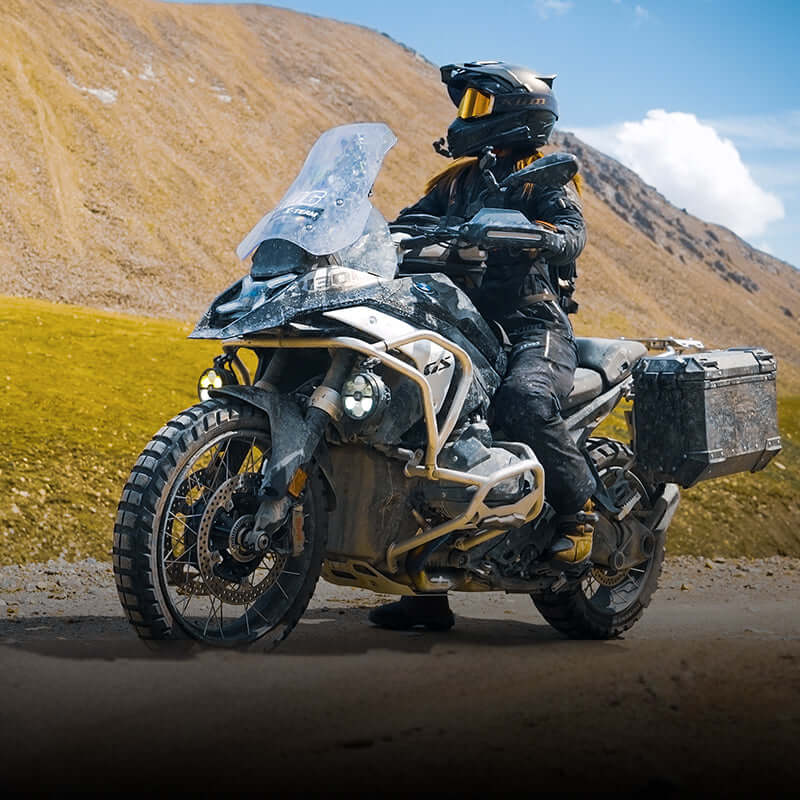
In short. The BMW R 1300 GS (not Adventure) has a 19-litre tank and weighs 237 kg in running order (official BMW Motorrad data). It is a different bike from the GS Adventure, which has a 30-litre tank and weighs over 260 kg: accessories compatible with one are not automatically right for the other, starting with pannier racks and the stand plate.
What you need first: protection (crash bars, skid plate, brake caliper guard), then luggage chosen for real-world use (aluminium or semi-rigid), then ergonomics (handguards, heated grips, stand), and finally navigation. This guide includes only accessories with verified compatibility for the standard R 1300 GS, with real availability on Endurrad.
The R 1300 GS is not a small GS Adventure
The two bikes share the engine and much of the electronics, but the rear subframe, tank capacity, and weight distribution are different. For this reason, an accessory designed for the Adventure is often not the right choice for the standard GS, and vice versa.
The data point that truly separates the two models is the tank: 19 litres on the R 1300 GS versus 30 litres on the Adventure, with the stated range increasing accordingly. The weight follows the same logic: 237 kg kerb weight according to DIN for the GS, versus approximately 269 kg for the Adventure fully loaded. That's more than a 30 kg difference, distributed mainly across the tank, rear subframe, and more robust standard protection.
| Data | BMW R 1300 GS | BMW R 1300 GS Adventure |
|---|---|---|
| Tank | 19 L | 30 L |
| Kerb weight (DIN) | 237 kg | ~269 kg |
| Seat height | 850 mm | 870 mm |
| Power / torque | 145 hp / 149 Nm | 145 hp / 149 Nm |
| Subframe and pannier mounts | Standard GS-specific | Adventure-specific, not interchangeable |
The practical consequence is simple: if you have a standard R 1300 GS, the side-case racks, kickstand plate, and much of the protection equipment must be chosen in the version specific to the standard model, not the "e Adventure" version when compatibility is not explicitly stated. On Endurrad, the BMW R 1300 GS accessories collection includes only codes compatible with the standard version.
Protection comes before luggage
Before thinking about luggage and comfort, it makes sense to ask what happens when the motorcycle touches the ground or takes a stone from underneath. On a 237 kg motorcycle, even a low-speed slide can be costly if the vulnerable points are not protected.
The stainless steel crash bars for the BMW R 1300 GS mainly come into play during slow maneuvers, standstill tip-overs, and low-speed falls: they protect the tank and side panels, with replaceable bumpers in case of impact. Under the engine, where stones thrown up by the front wheel and mud pass through, the aluminum skid plate prevents a hard impact from reaching the crankcase.

Two more targeted protections deserve a mention because they are often overlooked on this model. The aluminum brake caliper protector covers the front caliper and, indirectly, the ABS sensor as well: a detail that makes the difference on gravel between an intact caliper and one that needs replacing. The cylinder head protector, on the other hand, protects the boxer heads, the most laterally exposed part of a motorcycle with opposed-cylinder engine, precisely where the GS lands if it falls on its side.
- You ride mostly on asphalt and easy gravel roads: crash bars and a lightweight skid plate are sufficient in most cases.
- You often ride on rocky terrain or rough surfaces: add cylinder head protection and brake caliper protection.
- You travel loaded and alone: also consider headlight protection, to prevent a stone from damaging the main lens.
The right luggage depends on how you travel
With a GS, the risk is not a lack of options, but carrying more than you need. More load means less agility during slow maneuvers and on uneven surfaces: precisely the R 1300 GS's strength compared with previous GS models.
For those who mainly ride on the road, with long transfers and frequent stops, the specific racks for BMW R 1300 GS side panniers (no-drill installation, hardware and tool included) are the right starting point: they support both aluminum panniers and semi-rigid systems while maintaining the original subframe mounting point.

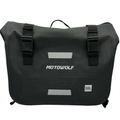
The LOBOO Conqueror aluminum panniers remain the most solid choice when you need organization, protection for your contents, and a rigid structure for long trips across Europe: the trade-off is weight and lateral bulk, which are noticeable on technical dirt roads or in the city. Those who alternate between asphalt and light off-road riding, or want to reduce unsprung weight and bulk, will find the Wanderer 40+40 L semi-rigid pannier kit with racks for BMW R 1300 GS a practical alternative: less structural rigidity, but more tolerance when laid down and less lateral protrusion during tight maneuvers.
For a broader comparison between the two technologies, regardless of the model, the guide how to choose motorcycle luggage: aluminum or semi-rigid explores selection criteria, water resistance, and how to manage them in the event of a fall.
A few millimeters of ergonomics can change your whole day
After 400-500 km, the difference is not made by the engine, but by your riding position and how hard your hands and wrists are working. On the R 1300 GS, which is more compact than previous GS models, these details are even more noticeable.
The aluminum handguards with adjustable deflector for BMW GS are not just protection from the cold: on the highway in the rain or on mountain passes in the evening, keeping your hands and levers protected means arriving less tired and with better sensitivity on the controls. The anti-vibration grips for BMW GS work in the same direction: they reduce the vibration transmitted to your wrist on long straight stretches, where the boxer engine is felt more.

The R 1300 GS has a support foot sized for standard use: those who load full luggage, travel with a passenger or often stop on soft ground (dirt, gravel, hot asphalt) will find the CNC aluminum kickstand plate for BMW R 1300 GS useful, available in a version for mechanical or adaptive suspension. It increases the support area and reduces the risk of the motorcycle sinking or tipping over while stationary. For choosing between a center stand and an enlarged side stand, including the pros and cons of each, the guide center stand or enlarged side stand? goes into detail.
Navigation must remain readable even while wearing gloves
A mount that vibrates or comes loose is worse than no mount at all: it forces you to look at your phone more often, not less.
The GPS navigation mount on an aluminum crossbar, without drilling, for BMW R 1300 GS mounts on the handlebar without modifying the original components and leaves room for a dedicated navigator or smartphone holder. The position in your field of view matters: too low and it forces you to lower your eyes more than necessary; too high and exposed and it increases vibrations and the risk of impacts in tight passages.
What to avoid when setting up your motorcycle
The most common mistake is copying the setup of a GS Adventure or a 1250 GS, assuming the mounting points are the same: the rear subframe, kickstand plate and various attachment points are specific to the standard R 1300 GS and must be checked by model, not by visual similarity.
The second mistake is unnecessary weight up high: a full top case, an always-loaded tank bag, and redundant tools. Combined, they make the low-speed agility worse - precisely the R 1300 GS's strong point compared with previous GS models.
Frequently asked questions about accessories for the BMW R 1300 GS
What are the first accessories to install on a BMW R 1300 GS?
In most cases, it is best to start with protection (crash bars and skid plate), then choose luggage based on actual use, and finally address ergonomics (handguards, grips, and, if needed, a kickstand plate).
Are BMW R 1300 GS Adventure accessories also suitable for the standard GS?
Not always. The rear subframe, luggage frames, and kickstand plate differ between the two models. An accessory should be chosen for the specific model indicated by the manufacturer, not based on visual similarity between the two motorcycles.
How much more does the GS Adventure weigh than the standard GS?
Approximately 30 kg more in running order, mainly due to the larger 30-liter fuel tank (compared with 19 liters on the standard GS) and a more robust rear subframe.
Is aluminum or semi-rigid luggage better for the R 1300 GS?
It depends on how you use it. Aluminum offers greater structure and better protection for the contents, which is useful for mainly road-based long trips. Semi-rigid luggage weighs less, is more forgiving when set down on the ground, and is suitable for those who alternate between asphalt and light off-road riding.
Is a crash bar useful even if I ride the motorcycle only on asphalt?
Yes: most impacts on crash bars occur during slow maneuvers, parking, or when the motorcycle is laid down while stationary, not necessarily off-road.
Do the luggage frames require drilling the original frame?
The frames specifically designed for the BMW R 1300 GS in the Endurrad catalog mount to the original fixing points, with no drilling required, and with the hardware and tool included in the package.
Are handguards also useful in summer?
They are useful all year round: in summer, they protect against wind and insects at high speeds; in winter or rain, they reduce hand fatigue and protect levers and controls from impacts.
When is an enlarged kickstand plate worthwhile?
When traveling with fully loaded luggage, with a passenger, or when often stopping on soft surfaces such as dirt, gravel, or very hot asphalt: it increases the support area and reduces the risk of sinking or tipping over when the motorcycle is stationary.
Does the brake caliper guard interfere with the ABS?
No, the anodized aluminum brake caliper guards are designed to cover the ABS sensor as well without compromising its operation; they protect against impacts and debris without touching the braking system.
What is the technical difference between the R 1300 GS and the R 1300 GS Adventure?
The same 1300 cc, 145 hp, 149 Nm boxer engine, but a different tank (19 L versus 30 L), different weight (237 kg versus approximately 269 kg), and a slightly higher seat height on the Adventure (870 mm versus 850 mm).
Is a handlebar riser compatible with the R 1300 GS?
Yes, there are model-specific kits, but they should be paired with a check of the cables and brake/clutch lines to prevent tension when steering to full lock.
How much does it cost to equip a BMW R 1300 GS with essential accessories?
The budget depends on how many areas you cover: protection alone starts at a few hundred euros, while a complete setup (protection, pannier frames and luggage, ergonomics) can exceed one thousand euros. It's better to proceed by priority than to buy everything at once.
Is the GPS mount compatible with smartphones as well as dedicated GPS units?
Yes, the drill-free aluminum crossbar leaves room for both dedicated GPS units and smartphone holders, selected based on the device you actually use while traveling.
Are LOBOO accessories for the BMW R 1300 GS covered by a warranty?
LOBOO products sold on Endurrad are covered by the standard commercial warranty; for details on coverage and duration, check the individual product page before purchasing.
Want to equip your BMW R 1300 GS thoughtfully?
Tell us your motorcycle's make, model, and year: we'll help you choose protection, luggage, and ergonomic accessories that are genuinely compatible with your R 1300 GS, without duplicating the equipment of the Adventure version.
Further reading: BMW R 1300 GS Adventure: how to prepare it properly · aluminum or semi-rigid motorcycle panniers · reinforced center or side stand · motorcycle handlebar risers: a selection guide