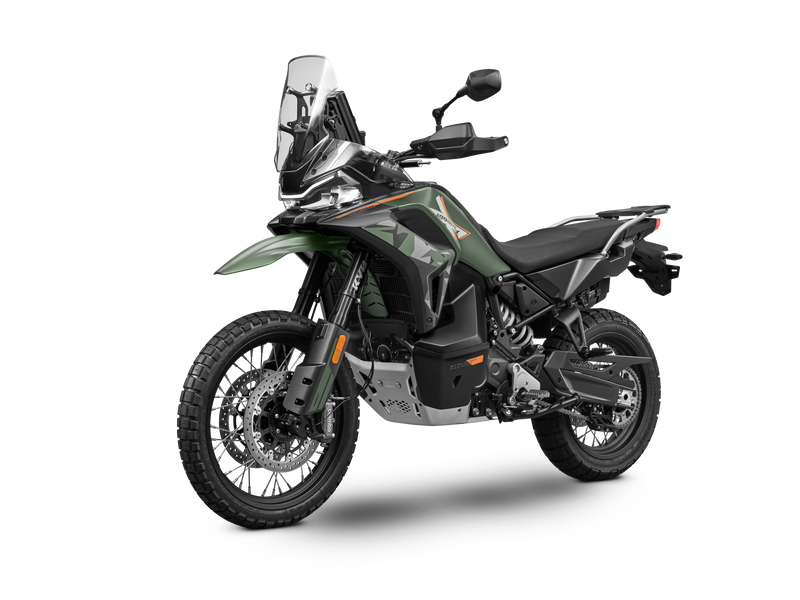
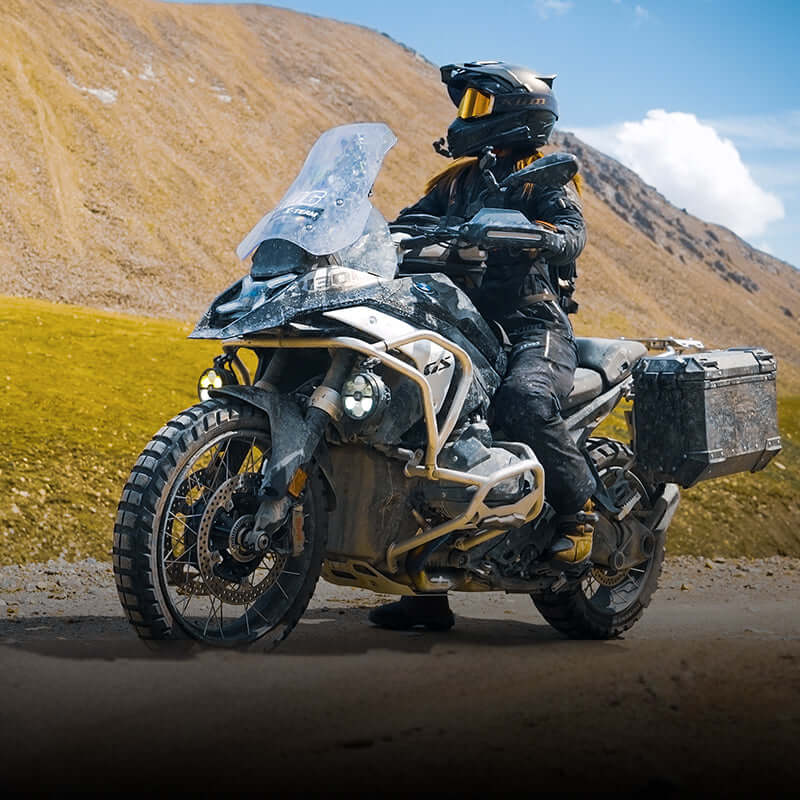
The BMW R 1300 GS Adventure is a different motorcycle from the R 1300 GS, not a GS with a large tank. It has the same 1,300 cc boxer engine, 145 hp and 149 Nm, but carries 30 litres of fuel instead of 19, weighs 269 kg in running order versus 237 kg and has its own rear subframe. In Italy, it starts at €24,150 (BMW Motorrad Italia, October 2026).
For anyone equipping it, only one thing matters: the standard GS pannier frames, upper crash bars and headlight protector do not fit the Adventure. Radiator grille, cylinder head guards, skid plate and risers are shared. The stand plate depends on the code cast onto the stand arm, not on the motorcycle name.
This page brings together the verified technical specifications, the story of the 2024 launch and the list of compatible part numbers, with price and availability checked on 03/10/2026.
The GS Adventure is a different motorcycle: 30 litres, 269 kg and its own subframe
The engine is identical to that of the R 1300 GS. Everything around it changes, and that is precisely what determines which accessories fit.
| Figure | R 1300 GS | R 1300 GS Adventure | R 1250 GS Adventure (up to 2024) |
|---|---|---|---|
| Engine | 1,300 cc boxer, 145 hp, 149 Nm | Identical to the GS | 1,254 cc ShiftCam boxer, 136 hp, 143 Nm |
| Tank | 19 L | 30 L (aluminium) | 30 L |
| Weight | 237 kg | 269 kg in running order | 268 kg |
| Maximum permitted weight | n/a on this page | 485 kg (payload 216 kg) | n/a on this page |
| Seat height | 850 mm | 870–890 mm standard, low seat 830 mm optional | n/a on this page |
| Front/rear suspension travel | 190 / 200 mm | 210 / 220 mm | n/a on this page |
| Tyres | 120/70 R19 – 170/60 R17 | 120/70 R19 – 170/60 R17 | 120/70 R19 – 170/60 R17 |
| Wheelbase / length | n/a on this page | 1.534 / 2.280 mm | n/a on this page |

Since its 2024 launch, the Adventure has changed little, but the price has
On the blog, we followed the motorcycle's arrival in four separate news articles. Below is a summary of what really happened, with the data that has since been consolidated.
Presentation: July 5, 2024
BMW Motorrad unveiled it at the BMW Motorrad Days in Garmisch-Partenkirchen, after a social media teaser at the end of June. The homologation had already appeared in Swiss documents at the end of May 2024, with power and torque figures later confirmed. The theories circulating during those months about an "R 1400" name and a 21-inch front wheel did not come true: the Adventure kept the 19".
The technical innovations compared with the R 1250 GS Adventure
New 1,300 cc boxer engine with 145 hp and 149 Nm (9 hp and 6 Nm more than the 1250, according to BMW), optional ASA automated transmission, adaptive ride-height adjustment, radar and matrix LED headlight in the packages, and a 30-liter aluminum tank that also serves as a base for bags and accessories. The declared payload is 216 kg: with rider, passenger and luggage, the margin is quickly used up, and this is one of the reasons why accessory weight matters.
| Version | Character | Launch price in Italy (July 2024) |
|---|---|---|
| Base | Racing Red, silver tank | 24.050 € |
| GS Trophy | Sporty, Racing Blue | 24.810 € |
| Triple Black | Comfort, black details | 24.870 € |
| Option 719 Karakorum | Luxury trim | 26.250 € |
And the R 1250 GS Adventure?
It was discontinued with the arrival of the 1300, after a series of limited-edition Ultimate Editions in several European countries. It remains a very common motorcycle on the used market: its accessories belong to a different family of codes, collected in the accessories collection for BMW R 1250 GS Adventure.

Only the JP151B frame fits the Adventure
It is the most frequent ordering error in the R 1300 range: a "for BMW GS" kit with JP131B frames does not fit the Adventure, because the subframe and side profile are different.
- The frame is the LOBOO JP151B, specified for the BMW R 1300 GS Adventure from 2024
- You can mount LOBOO cases on top: PIKE TRACKER 37 or 45 L, CONQUEROR 45 L, or semi-rigid Wanderer 40 L
- You have the original long exhaust, or add the CPQ131 deflector with the short exhaust
- Does not fit the standard R 1300 GS (JP131B required)
- Does not support cases from other brands: the mounting system is proprietary to LOBOO
- Does not include the cases, and the manual does not state the frame material
| System on the JP151B | Capacity | For whom | Price and status as of 03/10 |
|---|---|---|---|
| JP151B frames only | — | For those who already have LOBOO cases | €328.50 · available |
| CONQUEROR aluminum | 45 + 45 L, 40 L top case | Long trips, city stops, maximum security | Pair from €963 · available, frames sold separately |
| Wanderer semi-rigid kit | 40 + 40 L + 2 × 20 L bags | Mixed use with off-road riding, less rigidity when stationary | €1,309.50 with frames · available (1 pc) |
| PIKE TRACKER aluminum kit | 37 + 37 or 45 + 45 L | Narrower motorcycle (37 L) or maximum volume | From €1,012.40 · out of stock |


- Compatibility
- BMW R 1300 GS Adventure from 2024
- Compatible cases
- PIKE TRACKER P37/P45, CONQUEROR C45, Wanderer 40 L
- Contents
- 17 components, hardware and tool
- Tightening torque
- 18 N·m on the M8 bolts
- Drilling
- Not required
- Material
- Not stated in the manual

- Capacity
- 45 + 45 L side cases, 40 L top case
- Mounting
- 9 points, patent ZL 2017 2 0624675.2
- Equipment
- 60 lm IP66 interior light, flocked lining
- Pair of side cases
- €963 Silver · €1,044 Black
- C40T top case
- €477 Silver · €522 Black
- Frames
- JP151B €328.50 · PRO JP151WPRO luggage rack €306

- Contents
- 2 × 40 L cases, 2 × 20 L bags, JP151B frames
- Waterproofing
- IPX6, magnetic roll-top
- Construction
- Composite TPU on 840D mesh, PP panel
- Case dimensions
- 450 × 270 × 400 mm, 5.9 kg
- Case and bag weight
- Approximately 13.8 kg, excluding frames
- Anti-theft system
- Key lock
The top case shares a part with the GS
The JPT131WA top case plate is the only element of the CONQUEROR system shared between the GS and GS Adventure (€112.50, available): anyone switching from one motorcycle to the other does not need to buy it again. On the Adventure, the reinforced luggage rack is the JP151WPRO. The logic behind the plates is explained in the guide motorcycle top case plate, and that behind the frames in aluminum panniers: the frame is what matters.
Half of the protections are shared with the GS, the other half are not
The engine, radiators, and skid plate are in the same position on both motorcycles. The tank and front end are not: dedicated codes are required there.
| Protection | Code | Does it fit the Adventure? | Price and status as of 03/10 |
|---|---|---|---|
| Radiator grille | CHW131 | Yes, same code as the GS | €117 · available |
| Cylinder head protection | CGTBH151BK | Yes, same code as the GS | €130.50 · available |
| 4-point skid plate | CHB131 | Yes | €261 · available (1 pc) |
| 6-point skid plate | CHB151BK | Yes | €315 · out of stock |
| Brake caliper protection | CKQ151TG | Yes | €81 · available (1 pc) |
| Upper crash bar | CHG151 | Adventure only | €481.50 · out of stock |
| Headlight protection | CDBH151 | Adventure only (the GS uses CDBH131) | €121.50 · out of stock |
Why the crash bar is different
The 30-liter tank protrudes laterally: a bar designed for the GS would cover it only partially. The LOBOO CHG151 is made of 25 mm 304 stainless steel, has mounting holes for auxiliary lights, and remains compatible with original BMW tank bags. To understand what can be mounted on it, see engine guard bars: how to protect and make use of them; for choosing between 4 and 6 mounting points under the engine, see motorcycle skid plate: how to choose one.


- Compatibility
- R 1300 GS from 2023, R 1300 GS Adventure from 2024
- Material
- 2 mm aluminum, honeycomb perforation
- Panel dimensions
- 169,2 × 217,9 mm
- Weight
- 220 g
- Installation
- Uses original mounting points, no drilling

- Compatibility
- R 1300 GS from 2023, R 1300 GS Adventure from 2024
- Thickness
- 4 mm (original BMW 2 mm)
- Damping
- Rubber grommets in the holes + replaceable silicone block
- Function
- Replaces the original protection plate
- Weight
- Not declared
For the kickstand plate, the deciding factor is the code cast on the arm, not the motorcycle name
An earlier version of this page said that the stand foot is identical on the GS and Adventure. That is not the case: it changes with the suspension setup, and LOBOO produces three different codes.
- Read the number on the side-stand arm. It is cast in raised relief and can be seen with the motorcycle stationary without removing anything.
- Compare it with the table. If your code is not listed, do not order: write to us with the number you read.
- Fit it without fully tightening. Make the adjustments first, then tighten the three M5×10 screws in sequence (5 N·m stated for CJC131/CJC132).
| Plate | Original BMW stand | Adventure? | Price and status as of 03/10 |
|---|---|---|---|
| CJC131 | 46531638616, with adaptive height adjustment | Yes, from 2024 | €45 · available (2 pcs) |
| CJC151-CN | 4653 5A8DC01 and 4653 1636279 | Yes, from 2024 | €45 · available (1 pc) |
| CJC132 | GS without adaptive height adjustment | Not stated | €45 · sold out |


- Compatibility CJC131
- R 1300 GS and GS Adventure with stand 46531638616
- Material
- CNC aluminum, 130 g
- Mounting
- 3 M5×10 screws, 5 N·m, Torx T25 included
- Drilling
- Not required
- Manufacturer's note
- On asphalt with a loaded setup, it may not sit fully flat

- Compatibility
- R 1300 GS and GS Adventure with stand 4653 5A8DC01 or 4653 1636279
- Material
- CNC aluminum, 117 g
- Mounting
- 3 M5×10 screws
- Dimensions
- Not stated
On a 269 kg motorcycle, ergonomics are felt in your hands before they are felt in corners
Slow maneuvers, standing riding off-road, and 500 km stages: these are the three situations in which risers, hand guards, and grips make a difference.
CJG131 handlebar riser: shared, but currently sold out
It raises the handlebar by 29 mm and brings it 29.5 mm closer, with reference marks at 0° and 10°. It is listed for the R 1300 GS from 2023 and the GS Adventure from 2024 (€81). As of 03/10, it is out of stock: updated availability is in the handlebar riser collection, and the guide handlebar risers: which rise to choose explains when they are worthwhile.
CHS081 handguards and vibration-damping grips
The LOBOO CHS081 aluminum handguards (€148.50 per set, available in black and white) have a deflector adjustable to three positions and two-point mounting. The BMW GS vibration-damping grips cost €63 and are available. For both, compatibility depends on model and year: check the product page to make sure your GS Adventure is listed, and contact us before ordering if you have the factory heated grips.

A magnetic bag is not enough on the aluminum tank
The Adventure's 30-liter tank is made of aluminum: a magnet will not stick to it. A mounting ring on the cap is required, and it is not currently listed for the R 1300.
What to do today
The LOBOO tank rings available as of 03/10 fit many motorcycles, but not the R 1300 range. On this motorcycle, the real alternatives are the original BMW tank bags, which remain compatible with the CHG151 crash bar, or a bag positioned elsewhere. How the rings work and which motorcycles they fit are explained in magnetic tank bag: why it does not stay in place and how to fix it.

The right setup is built in four steps
First, choose what protects the bike and determines the geometry, then the luggage, and finally everything else. This is the order that prevents buying twice.
- Check the version, year, and equipment. Adventure or standard GS, long or short exhaust, adaptive adjustment on or off, and the stand code.
- Protection. Radiator guard, cylinder head guards, and skid plate are shared with the GS; crash bars and headlight protection must be the Adventure version.
- Luggage. JP151B frame, then the luggage family (aluminum or semi-rigid), followed by the top case and JPT131WA plate.
- Ergonomics and details. Handguards, risers, grips, and tank bag only after riding the fully loaded bike at least once.
- Will it fit my motorcycle? A code reading «BMW GS» without the word Adventure should be checked before, not afterward.
- What do I receive? The frames do not include the panniers, and the panniers do not include the frames.
- How much does everything weigh? With 216 kg of payload, panniers, protection, and a passenger, the weight adds up quickly.
Frequently asked questions
How much does the BMW R 1300 GS Adventure cost in Italy?
BMW Motorrad Italia lists a starting price of 24,150 euros, including 22% VAT, delivery, and the first service (October 2026). At launch, in July 2024, prices ranged from 24,050 euros for the Base to 26,250 euros for the Option 719 Karakorum.
How many liters is the tank of the R 1300 GS Adventure?
30 liters, with approximately 4 liters in reserve, compared with the 19-liter tank of the standard R 1300 GS. The tank is made of aluminum.
How much does the R 1300 GS Adventure weigh?
BMW states 269 kg in running order, compared with 237 kg for the R 1300 GS. The maximum permitted weight is 485 kg, so the payload is 216 kg.
What is the seat height of the R 1300 GS Adventure?
Moto.it lists a standard height of 870–890 mm; other sources report up to 900 mm depending on the seat. BMW offers an optional low seat at 830 mm and adaptive ride-height adjustment. It is advisable to measure it on the actual motorcycle at the dealership.
When was the BMW R 1300 GS Adventure released?
It was unveiled on July 5, 2024, at the BMW Motorrad Days in Garmisch-Partenkirchen and arrived at dealerships as a 2025 model.
What changes between the R 1300 GS Adventure and the R 1250 GS Adventure?
The engine increases from 1,254 to 1,300 cc, with 145 hp and 149 Nm versus 136 hp and 143 Nm (BMW data). The optional ASA automated gearbox, adaptive ride-height adjustment, and a new subframe are introduced. The tank remains 30 liters. The accessories for the two motorcycles are not interchangeable.
Does the R 1300 GS Adventure have a 21-inch front wheel?
No. It uses 120/70 R19 at the front and 170/60 R17 at the rear, like the R 1300 GS.
Do the standard R 1300 GS panniers fit the Adventure?
The LOBOO panniers do, but the frames do not. The Adventure requires the LOBOO JP151B frame; the standard GS JP131B does not fit. The JP151B accommodates PIKE TRACKER 37 or 45 L, CONQUEROR 45 L, and 40 L Wanderer semi-rigid panniers.
Is the exhaust deflector required to mount panniers on the Adventure?
Only with the short exhaust: LOBOO specifies the CPQ131 deflector, sold separately. It is not required with the long original exhaust.
Does the standard GS crash bar fit the Adventure?
No. The 30-liter tank protrudes farther: it requires the dedicated upper crash bar, such as the 25 mm stainless steel LOBOO CHG151, which remains compatible with the original BMW tank bags.
Which protections are shared between the R 1300 GS and GS Adventure?
Radiator grille CHW131, cylinder head guard CGTBH151BK, skid plates CHB131 and CHB151BK, and brake caliper guard CKQ151TG use the same code. The headlight guard differs: CDBH151 for the Adventure, CDBH131 for the GS.
Which side stand plate is required for the R 1300 GS Adventure?
It depends on the code cast onto the side stand arm. With stand 46531638616 and adaptive adjustment, the LOBOO CJC131 is required; with stands 4653 5A8DC01 or 4653 1636279, the CJC151-CN is required.
Can a magnetic tank bag be used on the R 1300 GS Adventure?
Not directly: the tank is aluminum, so the magnet does not adhere. A mounting ring on the filler cap is required, but it is not currently in the Endurrad catalog for the R 1300 range. The original BMW tank bags are an alternative.
Does the R 1300 GS handlebar riser fit the Adventure?
Yes: the LOBOO CJG131 is specified for the R 1300 GS from 2023 and the GS Adventure from 2024. It raises the handlebars by 29 mm and moves them back by 29.5 mm.
What should you check before ordering accessories for the R 1300 GS Adventure?
Motorcycle version and year, whether adaptive height adjustment is present, exhaust type, side stand code, and actual warehouse availability of the code.
Tell us the make, model, and year of your GS
Are you preparing your BMW R 1300 GS Adventure for your next trip? Tell us the year, equipment (adaptive adjustment yes or no), exhaust type, and stand code: we'll tell you which frames, guards, and plates fit without surprises. You can also find the full range in the Endurrad app for iPhone.
Sources: BMW Motorrad Italia, R 1300 GS Adventure model page (starting price, power, torque, tank, weight, equipment; accessed 03/10/2026); Moto.it price list for the 2025-26 R 1300 GS Adventure (seat, suspension travel, tires, wheelbase); Motorrad & Reisen, technical specifications (maximum permitted weight and payload); InSella, 26/07/2024 (launch prices for the versions); LOBOO technical specifications and manuals for JP151B, CONQUEROR, Wanderer, CHW131, CGTBH151BK, CHG151, CDBH151, CJC131/132, CJC151-CN, CJG131, CHS081. Endurrad catalog prices and availability verified on 03/10/2026. The R 1250 GS Adventure data are those declared by BMW for the last model year.
This page replaces the news published in 2024 about the debut of the R 1300 GS Adventure and the discontinuation of the R 1250 GS Adventure.
Endurrad app for iPhone: apps.apple.com/it/app/endurrad