Yes, a radiator protector is useful, but not for the reason you think: the real risk isn't a stone puncturing the radiator and leaving you stranded (it happens, but it's rare); it's one pebble after another bending the fins, season after season, reducing the heat-exchange surface in a way that can't be reversed.
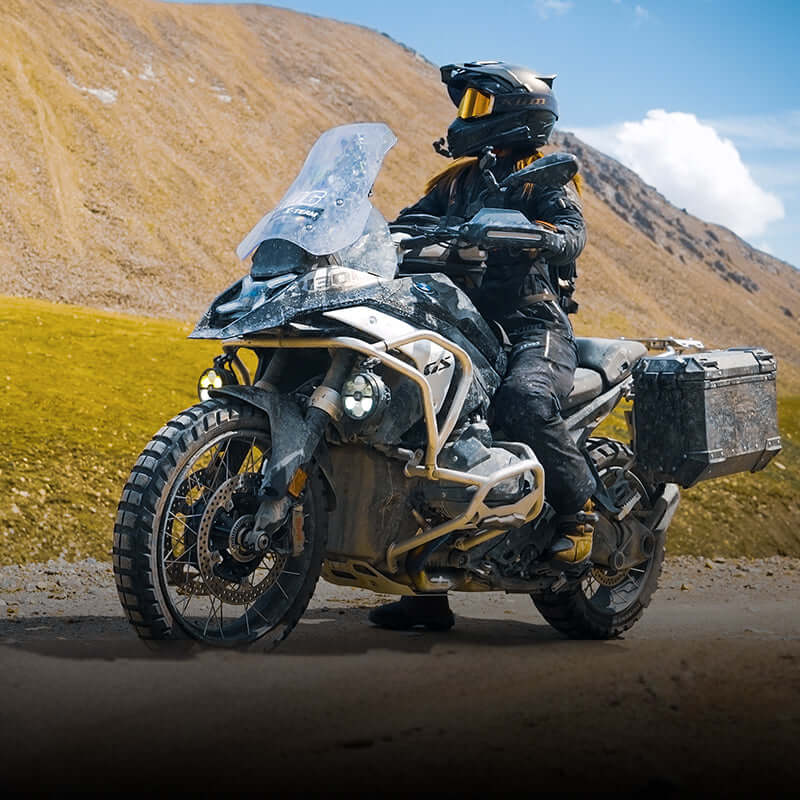
A honeycomb perforated protector stops debris without suffocating the radiator: on the BMW R 1300 GS and R 1300 GS Adventure, the LOBOO CHW131 code covers both side radiators with a pair of 2 mm aluminum panels, for a total of €117. On the same front end, the Matrix LED headlight unit is equally exposed: the CDBH131 headlight protector (€121) should be made of polycarbonate, not acrylic, because it absorbs impacts without shattering.
The radiator doesn't get punctured: it closes up, fin after fin
The radiator is the only important motorcycle component that sits right at the front, with no cover protecting it. It's made of aluminum fins just fractions of a millimeter thick, and that's where the real issue lies.
The real damage isn't what you imagine
Pebbles, fine gravel, and insects bend the fins. Every bent fin is an air channel that closes, reducing the heat-exchange surface without any warning light coming on. After two seasons on unpaved roads, the radiator has a noticeably smaller usable area than it had when it left the factory, and the bike runs hotter in summer traffic for no apparent reason.
It's cumulative and irreversible damage: bent fins don't straighten themselves, and straightening them one by one is a job nobody really does.
Grille or cover: they're not the same thing
It's the most common confusion, and it leads people to buy the wrong product, convinced they have protected themselves.
| Radiator protection | Radiator cover | |
|---|---|---|
| What it is for | Stopping stones and debris | Appearance: covering the side |
| Where it is mounted | In front of the radiator core | In place of the original side plastics |
| Typical material | Perforated aluminum | Carbon fiber |
| Does it protect the radiator? | Yes | No |
The two things are not alternatives: you can have both. But if you fitted carbon covers thinking you had protected the radiator, you haven't.
What an effective protection looks like
The trade-off to solve is obvious: a solid sheet stops everything but suffocates the radiator, while a wide mesh lets air through but also lets gravel in. Honeycomb geometry is the structural answer.

On the CHW131 guard for the R 1300 GS, the solid perimeter frame and mounting tabs are made from a single piece: there are no weld points that could fail. The detail that matters most for the price is that the package contains two panels, one for each side - the R 1300 GS has two side radiators, and both are covered with a single purchase. This is the first thing to check when comparing prices between different brands, because not everyone sells the pair.
Installation does not require drilling
It attaches to the mounting points already present on the motorcycle, reusing the original hardware.
- Clear the work area. The manual requires removing some original components: all operations are reversible, and everything removed is reinstalled after mounting.
- Attach the panels. The parts list contains only the two panels, without hardware: the motorcycle's original hardware is reused because the part attaches where the motorcycle already has its mounting points.
- Adjust, then tighten. As with all parts in this range, the manufacturer asks you not to fully tighten everything immediately: make the adjustments first, then tighten using BMW's specified torque values for the original components, not generic values. Installation is identical on the right and left.

The CHW131 code covers both the BMW R 1300 GS from 2023 and the R 1300 GS Adventure from 2024 - the same part for both, which is rare and convenient.

- Compatibility
- BMW R 1300 GS (from 2023), R 1300 GS Adventure (from 2024)
- Material
- Aluminum alloy, 2 mm
- Panel dimensions
- 169,2 × 217,9 mm
- Weight
- 220 g per panel
- Package contents
- 2 panels (pair), without hardware
- Installation
- On original mounting points, no drilling
The same protection logic also exists for other motorcycles
The honeycomb perforated-panel principle isn't exclusive to the R 1300 GS: LOBOO applies it to a wider range of models in the Endurrad catalog.
| Motorcycle | Code | Price | Availability |
|---|---|---|---|
| BMW R 1300 GS / Adventure | CHW131 | 117 € | Product page |
| Honda CB500X / CB400X | CHW292 | 63 € | CB500X Collection |
| Honda NX500 | CHW295 | 67,50 € | Protector Collection |
| Honda NX400 | CHW289BK | 78,29 € | Protector Collection |
| CFMOTO 800MT | CHW601 | 140,16 € | CFMOTO 800MT Collection |
| Harley-Davidson Pan America 1250 | CHW951 | 97,66 € | Pan America Collection |
The Matrix LED headlight is just as exposed
If you're protecting the front end, the radiator isn't the only candidate. The front of the R 1300 GS has an X-shaped Matrix LED headlight assembly, and all it takes to damage it is a stone kicked up by the truck ahead of you.
- Choose polycarbonate: it absorbs impact energy without shattering; it gets scratched but doesn't crack open
- Choose the magnetic-hinge opening: it can be cleaned at the gas station with one hand, without tools
- You often ride in the dark on unlit roads: the clear finish doesn't reduce light output
- Acrylic costs less but cracks when hit by a stone: that's the same reason helmet visors aren't made of acrylic
- Bolted-on protectors can only be cleaned by removing them with tools, so nobody cleans them: bugs and dust remain trapped all season


- Compatibility
- BMW R 1300 GS (X-shaped Matrix LED headlight assembly)
- Lens material
- Polycarbonate (not acrylic)
- Opening
- Magnetic hinge, tool-free
- Finishes
- Clear, Chrome, Light Grey smoked
- Installation
- Dedicated brackets, no drilling
So is it necessary or not? It depends on where you ride
It's not a generic "yes or no" question: it depends on how many miles you ride outside urban asphalt and how much you care about the bike over time.
- You ride gravel roads or off-road surfaces with some regularity
- You often ride behind trucks and vans on main roads
- You plan to keep the bike for more than two or three seasons
- You ride almost exclusively on urban asphalt at low speeds
- I change bikes every two or three years: the cumulative damage doesn't have time to show
The reason it is still worth installing before setting off is that radiator damage cannot be repaired: unlike a scratch or a worn bumper, bent fins stay bent. Put into perspective, the cost - €117 for the pair - is a fraction of the cost of replacing a radiator.
Frequently asked questions
Do you really need a radiator guard for a motorcycle?
Yes, if you ride on unpaved roads or main roads behind heavy vehicles. The most common damage is not puncturing but the gradual bending of the fins, which irreversibly reduces the heat-exchange surface area.
What is the difference between a radiator guard and a radiator cover?
The guard is a perforated panel mounted in front of the radiator core that stops stones and debris. The cover is an aesthetic panel that replaces the side plastics and does not protect the radiator. They are different products, and you can have both.
Does a grille in front of the radiator reduce cooling performance?
Not with a honeycomb perforation, which maintains a high percentage of open surface area. In fact, the manufacturer states that it has a favorable effect on airflow, but does not publish measurements from independent sources.
Does the radiator guard package contain one panel or two?
Two, one on each side: the R 1300 GS has two side-mounted radiators. This is the first detail to check when comparing prices between brands, because not all of them sell the complete pair.
Do you need to drill the motorcycle to install the radiator guard?
No. It attaches to the existing mounting points using the original hardware, which is why the package does not include screws. The manual calls for removing some original components, with reversible procedures.
Is the same product code valid for the R 1300 GS and R 1300 GS Adventure?
Yes, CHW131 fits both motorcycles with the same part. It is rare to find a single product code valid for two different models, and it is convenient for anyone who may need to replace it in the future.
How much does the radiator guard for the BMW R 1300 GS cost?
€117 for the complete pair (two panels, one per radiator). The price is current as of 03/10/2026 and is the same for the R 1300 GS and R 1300 GS Adventure.
Is the CHW131 radiator guard also available for the BMW R 1250 GS?
Not at the moment: product code CHW082, sometimes listed elsewhere for the R 1250 GS and R 1250 GS Adventure, is no longer listed in the Endurrad catalog. If you ride an R 1250 GS, write to us with the model and year so we can check current availability before giving you a definitive answer.
Is the radiator guard also available for motorcycles other than the BMW GS?
Yes. LOBOO applies the same honeycomb design to the Honda CB500X/CB400X, Honda NX500, Honda NX400, CFMOTO 800MT, and Harley-Davidson Pan America 1250 as well. As of 03/10/2026, these product codes are out of stock: the links in this article lead to the model collection so you can check the next restock.
Why is polycarbonate better than acrylic for a headlight protector?
Because it absorbs impact energy without shattering: it gets marked but does not break open. Acrylic, which is cheaper, cracks when struck by a stone - the same reason motorcycle helmet visors are never made of acrylic.
How much does the headlight protector for the BMW R 1300 GS cost?
€121, available in three finishes: Clear, Chrome and Smoked Light Grey. The clear finish is recommended for those who often ride in the dark because it does not reduce the beam's light output.
Does the headlight protector need to be removed for cleaning?
No, if it has a magnetic hinged opening like the CDBH131: it opens with one hand, even at the gas station. Bolted protectors, on the other hand, have to be removed with tools, which is why in practice almost nobody cleans them during the season.
How long does it take to install the radiator protector?
Installation reuses the motorcycle's original mounts and hardware, with no drilling: for anyone with basic mechanical skills, it typically takes about twenty minutes per side, removing and reinstalling the original components indicated in the manual.
Does the radiator protector need to be cleaned periodically?
Yes, like any exposed grille: dust, insects and mud accumulate in the holes and, if left there, reduce airflow. Cleaning it with water and a soft brush after dirtier rides is enough to maintain its effectiveness.
What's the difference between an aluminum radiator protector and a plastic one?
The aluminum in the honeycomb geometry combines rigidity and lightness while maintaining a high open area; a plastic mesh costs less but tends to deform on impact and ages worse under radiator heat. All LOBOO codes mentioned in this article are made of aluminum alloy.
If you're unsure about the correct code for your motorcycle, write to us with the model, year and version: we'll check it against the manufacturer's documentation.
Write to us with the make, model and year
Considering how to protect your motorcycle before your next trip? At Endurrad, you'll find radiator and headlight protectors dedicated to every model: write to us with your motorcycle's make, model and year and we'll verify the correct code together. You'll also find our complete range in the Endurrad app for iPhone.
Sources: technical data sheets and manufacturer statements from LOBOO for codes CHW131, CDBH131, CHW292, CHW295, CHW289BK, CHW601 and CHW951; Endurrad product catalog verified on 03/10/2026. Data declared by the manufacturer are identified as such when no independent public measurement exists.
Endurrad App for iPhone: apps.apple.com/it/app/endurrad