In brief. For an adventure motorcycle used year-round, with many accessories and long periods of downtime, the simplest choice remains an AGM battery in the format specified by the manufacturer: according to Yuasa, it lasts an average of 3-5 years. A LiFePO4 lithium battery makes sense if you want to reduce weight and accept three rules: a compatible charger, no charging below 0 °C, and no deep discharges.
Replace it when the numbers say so, not by feel: at rest, a charged AGM reads 12.8-13.0 V; during starting, it must not drop below 9.5 V; with the engine running, the system must hold 13.0-14.5 V. The thresholds come from the Yuasa technical manual, the motorcycle data from BMW Motorrad, and the lithium data from the LOBOO manual.
The choice between AGM and lithium depends on climate, downtime, and the electrical system, not weight
Both technologies can start a large adventure motorcycle. What changes is how forgiving they are of mistakes: AGM tolerates cold and any charger, while LiFePO4 lithium weighs less and loses less charge when stationary, but requires the electrical system to be in good condition.
| Parameter | AGM (lead-acid) | LiFePO4 lithium | Source |
|---|---|---|---|
| Resting voltage, full charge | 12,8-13,0 V | 12.8 V nominal, flat discharge curve | Yuasa Technical Manual · LOBOO |
| Average lifespan | 3-5 years | more than 2,000 stated cycles | Yuasa FAQ · LOBOO (as stated) |
| Charging temperature | from −20 to 50 °C | from 0 to 45 °C | Battery University BU-410 · LOBOO CL6F-U manual |
| When stationary | at 0 °C it retains about 90% of its capacity for 6 months | self-discharge below 1% per month | Yuasa Technical Manual · LOBOO (as stated) |
| Typical weight | higher | CL6F-U 1.14 kg; LOBOO states about half the weight of lead-acid | LOBOO manual |
| Charger | any lead-acid/AGM charger | only with a lithium profile, maximum voltage 14.6 V | LOBOO manual |
- you want to reduce weight and the motorcycle does a lot of off-road riding
- the motorcycle remains stationary for weeks without hidden draws
- you have, or buy, a charger with a LiFePO4 profile
- the dimensions and terminal positions match the original
- you often start below freezing or the motorcycle is stored outdoors
- you have an alarm, GPS, or outlets permanently connected to the battery
- you use old chargers or chargers with automatic desulfation
- you want the solution that requires no attention

Size and cranking power matter more than the Ah printed on the label
The first constraint is physical: the battery must fit in the compartment with the terminals in the same position as the original. The second is electrical: starting current and reserve for accessories are two different things.
Ah and starting amperes are not the same thing
Ah indicates how much energy is in reserve: it matters when the motorcycle is stationary and something is drawing power, or when starting is repeated. Starting amperes indicate how much current the battery delivers in the first few seconds. Lithium has very high cranking power relative to its capacity: LOBOO states that its 6 Ah battery starts the engine like a 20 Ah lead-acid battery, and the 12 Ah battery like a 40 Ah battery.
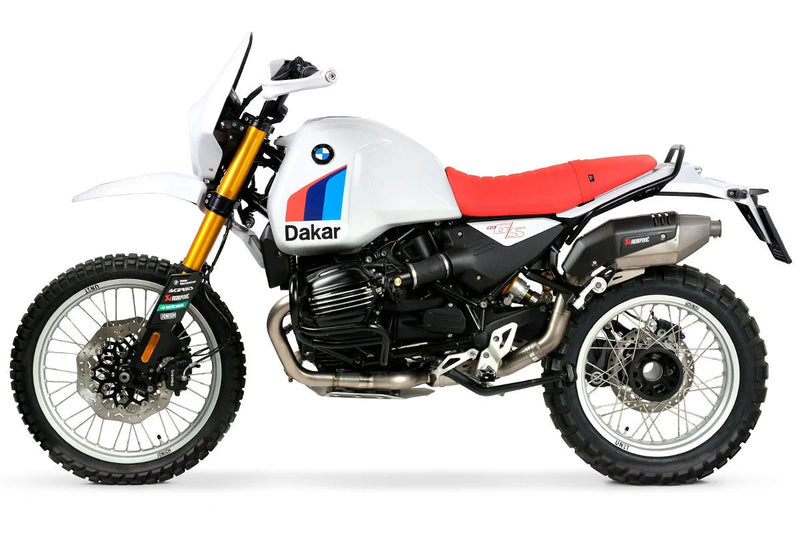
The practical implication, which is our assessment rather than manufacturer data: if you replace the 14 Ah AGM in an R 1300 GS with a 12 Ah lithium battery, the cranking power increases, but the reserve for an alarm or GPS left connected continuously remains more or less the same. A hidden drain will still deplete it.
- Read the original battery label: model designation, Ah, and technology. The motorcycle owner's manual specifies the required type.
- Measure the compartment and note the terminals: length, width, height, and where the positive and negative terminals are. LOBOO requires the polarity and position to match.
- Compare the dimensions: the CL6F-U measures 123 × 70 × 95 mm, while the CL12F-U measures 150 × 87 × 110 mm. If it is smaller than the compartment, the manual specifies using the supplied foam pad.
- Check the voltage before installing it: for the LOBOO lithium battery, LOBOO recommends charging it if it is below 12.8 V.
- Disconnect the negative terminal first and reconnect the negative terminal last: this sequence prevents short circuits if the wrench touches the frame.

An AGM lasts 3-5 years; a lithium battery lasts as long as you let it
Mileage matters little. What consumes a battery is deep discharge, heat, and incorrect recharging, especially during long periods of inactivity.
What shortens an AGM's life
- Remaining discharged: plate sulfation removes capacity that never returns. Winter storage is the time of greatest risk, and we cover it in the guide to motorcycle batteries in winter.
- Heat: according to Yuasa, an AGM left at 40 °C loses half its capacity in four months, while at 0 °C it retains about 90% after six months.
- Short trips: the alternator does not have enough time to replace what starting has used.
What shortens the life of a LiFePO4 battery
- Excessive discharge: the battery enters protection mode and can no longer start the motorcycle. LOBOO says to reactivate it with a compatible charger that supplies more than 1 A.
- The wrong charger: the charging voltage must remain below 15 V; LOBOO states 14.6 V as the maximum.
- Storing it discharged: the manual says to store it with at least 70% charge, fully recharge it every 180 days, and disconnect it if the motorcycle remains stationary for a long time.
- Engine heat: above 45 °C for long periods, the thermal protection activates, and the motorcycle may shut down until the battery cools.
Replace it when three measurements fail, not when it reaches a certain age
A multimeter costing just a few euros is enough to tell whether the problem is the battery or the electrical system. The thresholds below apply to 12 V lead-acid batteries, including AGMs.
| Measurement | How to do it | Good value | What it means if it fails |
|---|---|---|---|
| 1. Resting voltage | motorcycle stationary for hours, ignition off, probes on the terminals | 12.8-13.0 V AGM charged; 12.5-12.8 V = 75-100% | below 12.4 V, it needs recharging; if it remains below 75% after recharging, it probably needs to be replaced |
| 2. Starting voltage | multimeter connected while the starter motor is turning | not below 9.5 V (at approximately 21 °C) | below 9.5 V, the battery must be replaced |
| 3. Charging voltage | engine running at 3,000-4,000 rpm | from 13.0 to 14.5 V | outside this range, the problem is the regulator or alternator, not the battery |
- Fully recharge it with a suitable charger, then let the battery rest for a few hours.
- Measure at rest: if the AGM does not return to at least 12.5 V, its capacity is already compromised.
- Measure during starting: this is the test that exposes a battery that “seems alive”.
- Measure with the engine running: rule out the regulator before buying a new battery.
- Check for parasitic drains: if the motorcycle starts well after a ride but poorly after ten days, check what remains powered with the ignition off.
- the starter motor turns slowly even after recharging
- lights and instrumentation dim when starting
- resting voltage remains low after charging
- swollen, cracked or leaking casing
- 3-5 years old and performance declining
- with the engine running, the system remains below 13.0 V or exceeds 14.5 V
- the terminals are oxidized or loose
- a directly connected accessory drains it while parked
- the motorcycle only takes trips lasting a few minutes

With lithium, cold changes the rules for charging, not just starting
The most misunderstood point: a LiFePO4 battery can operate below zero, but it must not be charged below zero.
Why it matters on a trip
Battery University explains that charging a lithium battery below 0 °C deposits metallic lithium on the anode, causing permanent damage. On a motorcycle, the alternator charges it as soon as the engine is running: a night at −5 °C at altitude followed by an immediate start puts the battery in exactly that condition. LOBOO states that it has a heating function for charging at low temperatures, but the manual still specifies 0-45 °C as the charging range.
AGM batteries, on the other hand, accept charging at −20 °C according to Battery University. If you often ride in below-freezing temperatures, this is the strongest argument for sticking with lead-acid.
- Short attempts: crank for 3-5 seconds, then wait at least 15 seconds before the next attempt, as LOBOO recommends.
- If it enters protection mode, don't randomly connect cables from another motorcycle: you need a charger with a lithium profile and more than 1 A to reactivate it.
- Motorcycle parked outdoors in winter: consider storing the battery somewhere sheltered, or stick with an AGM.
Spotlights, switches and sockets draw power from the alternator, not the battery
Una batteria più grande non risolve un bilancio elettrico in perdita. Il conto si fa tra quello che gli accessori assorbono e quello che l'alternatore produce.
A larger battery does not solve a negative electrical balance. The calculation compares what the accessories consume with what the alternator produces.
- The calculation to make before installing accessories
- Add up the power of auxiliary lights, heated grips and gear, GPS, and USB sockets.
- Compare them with the alternator: for the R 1300 GS, BMW states 650 W nominal, part of which already powers the motorcycle. The LOBOO manual warns against installing loads that exceed the generator's output.
- Eliminate draw with the ignition off: an accessory connected directly to the terminals also operates in the garage.
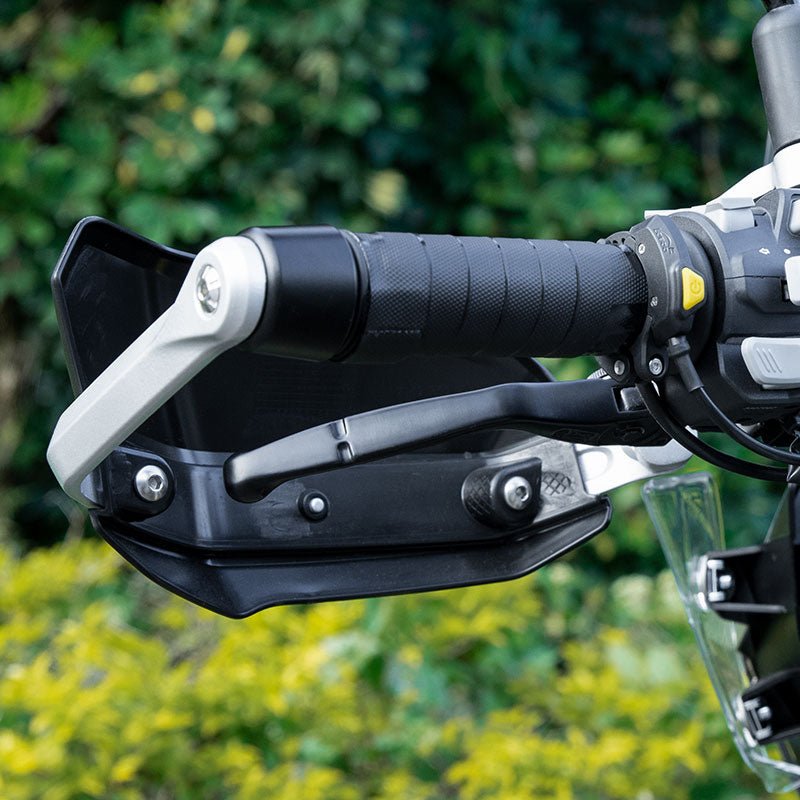
Keep an eye on the voltage: a handlebar-mounted voltmeter immediately shows whether the system stays below 13 V with everything switched on.
 where to mount auxiliary lights and how to get started with heated gear begin with electrical consumption." width="800" height="800" loading="lazy">
The C36 display shows the system voltage in real time, even while you're riding.
At Endurrad, you'll find the lithium battery and the tools to keep it alive

- 12 Ah, 600 A LOBOO CL12F-U LiFePO4 lithium battery, front view
- Voltage
- 12.8 V
- Capacity / starting current
- 6 Ah 300 A · 12 Ah 600 A
- Recommended use
- up to 900 cc · liter-class
- 123×70×95 · 150×87×110 mm
- Weight
- 1.14 kg · 1.96 kg
- Charging
- 0-45 °C, max 14.6 V
- Protections
- 6, with cell balancing
- LOBOO warranty
- 5-year replacement for defects

- Batteries
- 12 V lead-acid and LiFePO4
- Capacity
- from 4 to 35 Ah
- Power supply
- USB-A, also power bank
- Role
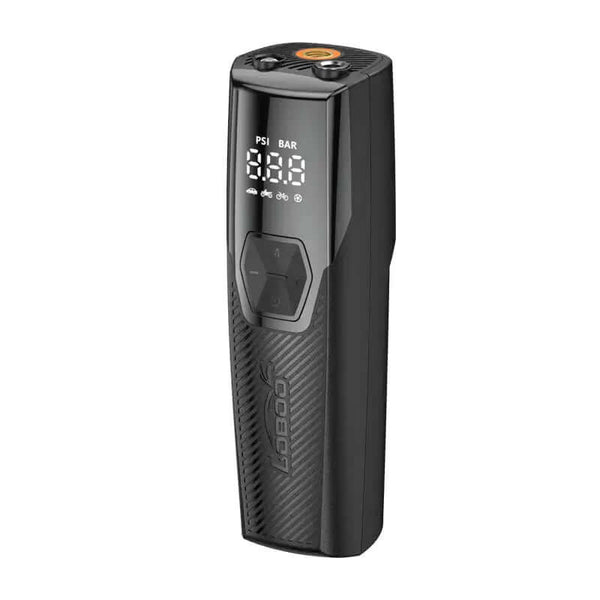
- maintenance and lithium reactivation

- Output
- 2 × USB-C, up to 130 W
- Display
- real-time system voltage
- Batteries
- lead-acid or lithium, at the press of a button
- Protection
- Stated IP67 rating
| Product | What it is for | Price | Status |
|---|---|---|---|
| LOBOO C60 | Mains charger and maintainer, 3/6 A, lithium, lead-acid and AGM profiles, IP65 | 81 € | Sold out |
| LOBOO C40T | 6/12 V, 4 A mains charger, recommended by LOBOO for lithium reactivation | 83,34 € | Sold out |
| SAE cable CSAE-20 | Quick connector under the seat with status LED | 27 € | Sold out |
| SAE cable CSAE-19 | 15 A fused quick connector | 5 € | Sold out |
Frequently asked questions about adventure motorcycle batteries
Is an AGM or lithium battery better for an adventure motorcycle?
For those who ride year-round, frequently start the motorcycle below freezing, or have accessories permanently connected, AGM is the simplest choice. LiFePO4 lithium is worthwhile if you want to reduce weight, the motorcycle has no hidden power drains, and you have a charger with a lithium profile.
How long does an AGM motorcycle battery last?
According to Yuasa, a sealed AGM battery lasts an average of 3 to 5 years; a conventional flooded battery lasts 2 to 3 years. Climate, long periods of inactivity, and deep discharges can significantly affect the result.
How long does a lithium motorcycle battery last?
There is no independent data measured in years. LOBOO claims over 2,000 charging cycles and offers replacement for 5 years in the event of defects. In practice, service life depends on avoiding deep discharges, charging below 0 °C, and incompatible chargers.
What is the voltage of a charged motorcycle battery?
According to Yuasa, a 100% charged AGM battery reads 12.8 to 13.0 V at rest, while 12.5 to 12.8 V means it is between 75% and 100% charged. A LiFePO4 battery has a nominal voltage of 12.8 V and a flat discharge curve, so voltage reveals less about its state.
How do I know if my motorcycle battery needs replacing?
After a full recharge, take three measurements: at rest, while starting, and with the engine running. If the voltage drops below 9.5 V during starting, Yuasa recommends replacing it. If it remains below 75% charge after recharging, it is probably worn out.
What voltage should the charging system provide with the engine running?
According to Yuasa, between 13.0 and 14.5 V measured at 3,000-4,000 rpm. Outside this range, the problem is the regulator or alternator, and a new battery would not last long.
Can I install a lithium battery instead of the original AGM battery?
Generally yes, if the dimensions, polarity, and terminal positions match and the cranking current is adequate for the engine. You also need a charger with a lithium profile: a lead-acid charger can damage it.
Does a lithium battery work in winter?
According to LOBOO, it can discharge down to −20 °C, but it must not be charged below 0 °C: Battery University explains that charging below freezing permanently damages lithium cells. If the motorcycle is stored outdoors in freezing weather, AGM is more tolerant.
What charger is needed for a lithium battery?
One with a LiFePO4 profile and a maximum voltage within the manufacturer's specification: for LOBOO, 14.6 V, always below 15 V. To reactivate it after excessive discharge, LOBOO recommends the C20Pro or C40T, with a current above 1 A.
How many Ah should my motorcycle battery have?
Start with the capacity specified by the manufacturer: the BMW R 1300 GS, for example, comes standard with a 14 Ah AGM battery. With lithium, the capacity can be lower for the same cranking power, but the reserve for accessories connected while the motorcycle is stationary is reduced accordingly.
Why does the battery go flat after sitting for a few days?
Almost always due to a parasitic draw with the ignition off: alarm, hardwired GPS, USB outlets with LEDs. If the motorcycle starts well after a ride but poorly after ten days, check the accessories before replacing the battery.
Is it worth replacing the battery before a long trip?
If it is 4 years old or more and starting is less responsive, yes: preventive replacement costs less than losing a day far from home. If it is recent and passes all three voltage tests, it is not necessary.
How long should I hold down the starter with a lithium battery?
LOBOO recommends attempts lasting 3-5 seconds with at least 15 seconds of rest between each one, to prevent excessive discharge and the battery from entering protection mode.
How do I store a lithium battery during storage?
The LOBOO manual says to store it with at least 70% charge, in a dry place, recharge it fully every 180 days, and disconnect it if the motorcycle will remain unused for a long time. For AGM batteries, the rule is to keep the maintainer connected throughout the period of disuse.
Read also
Don't know which battery your motorcycle uses?
Tell us your motorcycle's make, model, and year, and whether you use it in winter or with electrical accessories: we'll tell you whether the LOBOO lithium battery fits in the compartment and which charger you need. Keep your orders and the latest news close at hand with the Endurrad iPhone app.
Sources. Yuasa, Technical Manual Powersports Batteries (AGM resting voltages, 9.5 V starting test, 13.0-14.5 V system, storage at 0 and 40 °C) · Yuasa FAQ (3-5 year AGM lifespan, 2-3 years conventional) · Yuasa, when to replace the battery · BMW Motorrad, R 1300 GS technical data (12 V 14 Ah AGM battery, 650 W alternator) · Battery University, BU-410 (charging at low temperatures) · LOBOO CL6F-U and CL12F-U user manuals and LOBOO product sheets (manufacturer-declared data).
The assessments of when to prefer AGM or lithium are the Endurrad editorial team's opinion, based on the cited data. Prices and availability verified on October 8, 2026.