

In brief
A motorcycle dry bag almost never disappoints when it comes to water resistance: it disappoints because it does not stay put. The reason is that at half load, a soft sack crumples, the straps sink into the folds and the tension is lost after a few kilometers. The three elements that really change its behavior are the internal structure, the air valve that removes trapped air, and the type of closure. Capacity alone says nothing.
Below you will find the criteria, the data stated by manufacturers, what the IPX6 and IPX7 ratings really mean, what a QB/T 1333-2018 test report contains, and the two restrictions in the Highway Code concerning rear luggage. All technical data cited comes from official manufacturer documentation or regulatory sources: where a value is not stated, we say so instead of estimating it.
Table of contents
- A dry bag does not lose water: it loses its shape
- The internal structure sets a bag apart from a sack
- Trapped air is the second reason it moves
- Roll-top, waterproof zipper, or Velcro: the closure determines everyday use
- IPX6 does not mean waterproof: it tells you how much
- TPU and PVC look alike until the temperature drops below zero
- What a QB/T 1333-2018 test report says
- The two checks to make before ordering
- License plate, lights, and profile: what the Highway Code says
- The tail bags in the catalogue and when each one makes sense
- Frequently asked questions
A dry bag does not lose water: it loses its shape
The typical complaint is not "water got in." It is "after fifty kilometers, it was crooked."
Anyone who returns from a trip with a poorly mounted soft bag always tells the same story. You set off with the bag tight and properly positioned. At the first stop, one strap has slack. You tighten it again. At the second stop, the bag has rotated twenty degrees toward the exhaust side. By the third, you are riding while looking at the mirror instead of the road.
It is not the straps' fault. The problem is that a soft bag filled to seventy percent has folds, and a strap pulled tight over a fold does not create friction: it creates a cutting action. The fabric slides under the strap, the fold shifts by a centimeter and the tension is lost. Every bump creates another one.
Everything else follows from this. A rear bag should be judged by how well it remains a stable volume, not by how many liters it claims to hold. If you are instead interested in the reasoning behind volume, meaning how many nights away correspond to how many liters, we covered it separately in the guide on how many liters a rear bag needs.
The internal structure sets a bag apart from a sack

The difference between a river dry bag and a bag designed for a motorcycle lies almost entirely here. In a kayak, the bag is compressed against the bulkhead and does not have to support itself. On the tail of a motorcycle, it has to support itself because the straps work against it rather than in its favor.
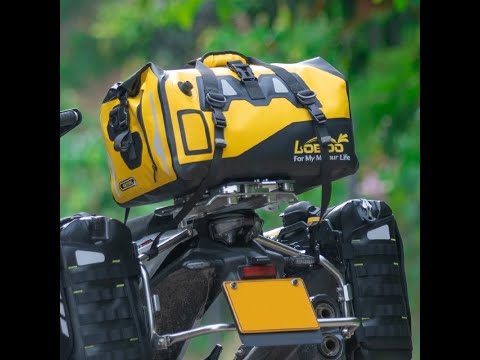
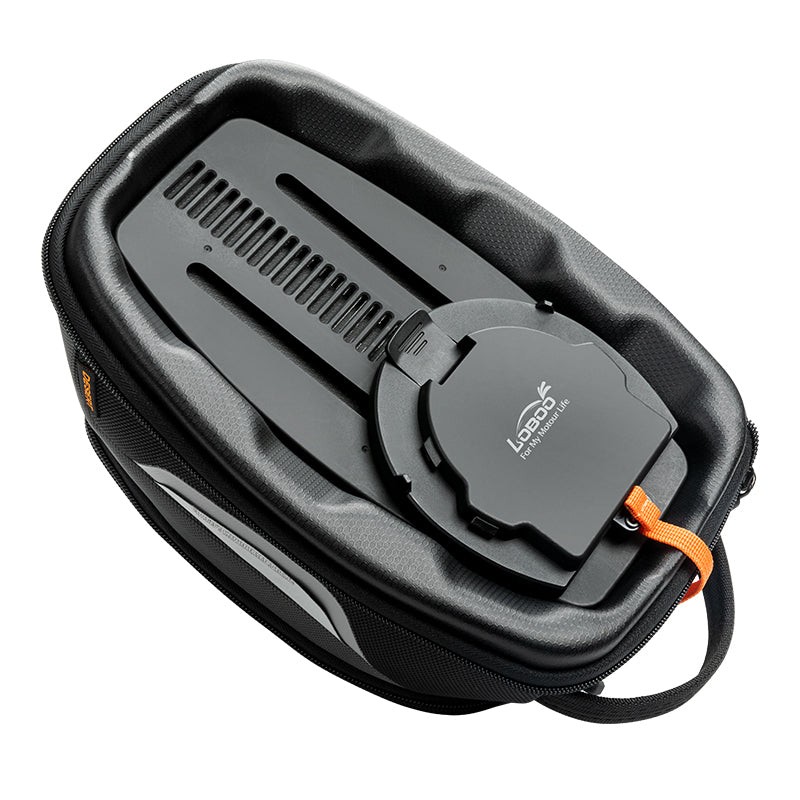
The solution adopted by LOBOO on the Wanderer 50 L is a removable U-shaped support plate: a semi-rigid panel that runs along the bottom and rises up both sides. It keeps the section open even when the bag is half empty, so the webbing presses against a flat surface instead of a fold. The advantage is not aesthetic but mechanical: pressure is distributed, and the strap stops slipping.
The fact that it is removable matters for two practical reasons. On the way back, without the plate, the bag rolls up and takes up one-third of the space in the cellar or suitcase. And if you need to load something long and irregular, the rigid bottom is sometimes an obstacle rather than a help.
- With a plate: mixed load, multi-day trip, bag often not full.
- Without a plate: a single, bulky load that fills everything, or storage.
- No plate provided: this is the case with most inexpensive dry bags, and it must be compensated for by filling them to the brim.
Trapped air is the second reason it moves
A well-closed bag is also a bag full of air. And air compresses.
The roll-top seals the bag, so it also seals in the air volume left between the clothes. That cushion compresses under braking and expands again under acceleration: the bag works like a bellows under the straps, which consequently loosen on their own. This is why an apparently well-secured bag has play after twenty minutes.
The vent valve serves exactly this purpose. Close the bag, open the valve, press down from above, and close it again. The volume decreases, the contents become a compact block, and the straps are tensioned again around something that no longer moves. On bags without one, the only remedy is to load them so air does not remain trapped: soft garments on top, no empty rigid containers.
How to interpret the data. The valve has nothing to do with waterproofing and does not improve it. It serves to stabilize the load. If a seller presents it as a sealing element, they are describing the product incorrectly.
Roll-top, waterproof zipper, or Velcro: the closure determines everyday use

On the shop counter, they look equivalent. On the road, they are not, because the closure is the action you repeat three or four times a day, often while wearing gloves and often while it's raining.
| System | How it seals | With gloves | Where it ages |
|---|---|---|---|
| Simple roll-top | Three edge rolls plus two side buckles | Fine alignment not required | Practically nothing to break: the weak point is human error, namely rolling it twice instead of three times |
| Roll-top with magnetic rim | Still the three rolls: the magnet aligns the flaps, it does not seal them | Very good, the flaps attach themselves | As above, with the added theoretical risk of the magnet weakening |
| Watertight zipper | Polyurethane tooth compression | Cumbersome, requires two hands and precision | It is the first component to seize up: sand and salt accelerate degradation, and it needs to be lubricated |
| Open Velcro | Hook-and-loop grip | Easy but imprecise | It loses effectiveness as it collects mud and lint, and the hooks damage technical garments |
On the Wanderer 50 L, the rim incorporates a magnetic strip, which LOBOO states is covered by a utility model patent under number ZL 2019 2 1740293.1. This is a claim made by the manufacturer, not something we have verified with the patent office, and it is worth understanding what it really entails: the magnet brings the two flaps together on the first try even with winter gloves, but water resistance still depends on the three rolls and two buckles. Rolling a magnetic bag incorrectly makes it wet just like incorrectly rolling any other bag.
IPX6 does not mean waterproof: it tells you how much
The IP scale in the IEC 60529 standard measures different tests, not increasing levels of the same test.
| Rating | Test specified | What it covers on a motorcycle |
|---|---|---|
| IPX4 | Water splashes from every direction | Light rain, road spray |
| IPX6 | Powerful water jets from a nozzle | Heavy rain on the highway, moderate-pressure washing |
| IPX7 | Temporary immersion in water | A shallow ford, bag ending up on the ground in a puddle |
Two practical consequences. First: IPX7 is not «improved IPX6»; they are different tests, and a product certified only for immersion is not automatically tested against water jets. Second, more important in real life: the stated rating applies to the main compartment, not the entire product.
What cannot be solved. The quick-access external pockets on tail bags - the ones where spare gloves, a map and a charging cable end up - are water-resistant but almost never included in the stated IP rating. LOBOO itself says so for the Wanderer 50 L. Phones, documents and electronics go under the roll-top, period.
The complete discussion of IP rating and attachment point, also applied to semi-rigid panniers, is in the guide to semi-rigid panniers and soft luggage.
TPU and PVC look alike until the temperature drops below zero

In your hand, a PVC-coated fabric and a TPU-coated one seem like the same product, and the latter costs more. The difference becomes apparent in two situations that only people who really travel encounter.
The first is cold. PVC stays soft thanks to plasticizers, which migrate out of the material over the years; below zero, it stiffens, and a stiff roll-top is difficult to roll up properly precisely on the morning you need it most. Technical fabric manufacturers' data sheets generally place PVC's stiffening point at around −10 / −20 °C, while TPU is said to remain flexible at much lower temperatures. These are industry values, not measured by us: they are meant to indicate the order of magnitude, not serve as a guarantee.
The second is abrasion. A rear bag rubs against the frame, the rack, and the straps on every rough patch, for thousands of kilometers. TPU withstands tearing and abrasion better at the same thickness, which is why it is used on high-end products even when PVC would be cheaper to weld.
In this specific case, LOBOO states that the Wanderer 50 L uses 840D mesh-backed composite TPU, 0.65 mm thick. The thickness is listed on the manufacturer's product page; the 2026 catalog only says TPU + Nylon. The empty weight is not stated in any LOBOO source, which is why you will not find it written anywhere on Endurrad: we prefer an empty field to an invented number.
What a QB/T 1333-2018 test report says
It is the abbreviation that appears on Asian manufacturers' specification sheets and that nobody ever explains.
QB/T 1333-2018 is the Chinese light-industry standard for bags and backpacks, issued by the Ministry of Industry and Information Technology on April 30, 2018, and entering into force on September 1 of the same year, replacing the 2010 edition. It is not a safety certification like European type approval: it is a product standard that defines classification, requirements, test methods, and inspection rules. The items updated in the 2018 edition include requirements for zippers and magnetic closures, as well as those for the oscillating impact test.
Put in terms useful to buyers: a report on this standard does not say that the bag is waterproof. It says that someone tested the components that are most likely to break first. For the Wanderer 50 L, the available report is TTTS-WF24009197, dated December 16, 2024, and it contains the following entries:
- Zipper: 200 opening and closing cycles without losing any teeth.
- Oscillating impact: 400 cycles with a suspended load on the shoulder straps, with no breakage, deformation, or failed stitching.
- Color fastness: 4/5 when dry and wet, meaning the fabric does not transfer color onto clothing.
- Substances: free formaldehyde and aromatic amines from azo dyes not detected.
- Metal hardware: no signs of corrosion.
The value of these lines is not the individual number but the existence of the document. Most bags sold on marketplaces at half the price have no associated test report, and no one ever asks for one.
The two checks to make before ordering

A rear bag does not have motorcycle model compatibility, so you have to check it yourself, and there are only two things to check.
1. Clearance against the tail
Take a tape measure and measure the flat space available between the passenger seat and the end of the luggage rack. Then compare it with the stated external dimensions: for the Wanderer 50 L, they are 550 × 310 × 300 mm when the bag is closed. Fifty-five centimeters of length fit comfortably on a GS Adventure with a luggage rack and disappear on a naked bike with a short tail.
2. Distance from the exhaust muffler
This is the check most often skipped and the only one that can ruin the bag in a day. On motorcycles with a high exhaust close to the tail, a strap resting on the hot muffler fails within minutes, and the synthetic fabric melts on contact. There must be clear space around the exhaust for both the bag and the loose ends of the straps.
For the actual fastening - anchor points, tightening sequence, and management of excess webbing - there is a dedicated guide on how to fasten the bag to the seat. If you do not have a decent support surface, however, solve that problem before dealing with the luggage: in the frames, luggage racks, and top-case plates collection, you will find the bases on which a soft bag actually works well.
License plate, lights, and profile: what the Highway Code says
Two constraints that apply to anyone who puts a bag behind the seat, and that no product description mentions.
Article 164 of the Highway Code establishes that vehicle loads must be arranged so as to prevent them from falling or being scattered, avoid compromising the vehicle's stability, and avoid obscuring the lighting and visual signaling devices or identification plates. Applied to a motorcycle: the bag cannot cover the rear light, turn signals, reflectors, or license plate, and this can easily happen when a second bag is stacked on top of the first.
The second part concerns overhang. The load may not protrude from the front and may protrude from the rear only if it consists of indivisible items, within a limit of three tenths of the vehicle's length, and always within the vehicle's outline. A travel bag is not an indivisible item: its contents can be distributed, so an overhang behind the tail has no legal justification and is also terrible for stability.
Reference text: Article 164 of the Italian Highway Code in the version published by ACI. The manufacturer's practical rule also applies: always respect the maximum load that the motorcycle manufacturer specifies for the luggage rack or passenger seat, which is usually much lower than what the bag can hold.
The tail bags in the catalogue and when each one makes sense

| Product | Capacity | Stated protection | When it makes sense |
|---|---|---|---|
| Wanderer 50 L | 50 L, one size | IPX6 on the main compartment | Three- to seven-day trips, when the bag is often not full, and also carrying it over your shoulder once off the motorcycle |
| 40 to 90 L tail bag | 40, 50, 66 or 90 L | IPX6 | When volume is the main criterion and you need to be able to choose the size |
| Vintage canvas 40 L | 40 L | Waterproof, canvas fabric | Classic motorcycles, scramblers and naked bikes where appearance matters as much as capacity |
| 30 L foldable saddle bag | 30 L | IPX6 | One- or two-day trips, and as a spare bag to keep rolled up under the seat |
The full range, including sizes not listed here, is in the motorcycle tail and saddle bags collection. If you are building a complete setup for a long trip, the loading logic is the one described in the guide to aluminium panniers and frames: keep dense weight low in the panniers, bulky and lightweight items above the tail, and anything you need during the day in the external pockets or pouches attached to the MOLLE system.
One thing that often ends badly in soft luggage: tools. They should be kept out of the main bag and secured separately, both because of their weight and because they could puncture the fabric. We discussed this in the article on what you really need to carry in your tool kit.
Are you preparing your motorcycle for your next trip?
At Endurrad, you will find tail bags, saddle bags, and the frames for mounting them, with the actual dimensions stated by the manufacturer on every product page and the water-resistance rating written out in full, compartment by compartment. If you have doubts about the size relative to your tail or exhaust, write to us before ordering.
Frequently asked questions
What is the difference between a dry bag and a motorcycle tail bag?
A dry bag is designed for water and is compressed against something. A motorcycle tail bag has to support itself on a small surface, withstand vibrations, and have attachment points for the straps. Many products sold as “motorcycle dry bags” are actually river bags with a few webbing straps sewn on top, and can be recognized because they have neither an internal structure nor a vent valve.
Why does the bag move even though I have tightened the straps properly?
For two reasons that add up: fabric folds, under which the webbing slides instead of gripping, and trapped air after closing, which compresses during every braking maneuver and loosens the tension. The internal structure and vent valve solve both problems.
What is the air valve really for?
To release residual air after closing the roll-top, so the load is compacted and the straps remain under tension. It has no role in waterproofing.
Can the internal plate be removed?
For bags designed for it, yes, and that is normal behavior. When installed, it maintains its shape with the bag half empty; when removed, the bag becomes a soft sack that can be rolled up for storage or to put in a suitcase on the way back.
Does a magnetic roll-top keep water out better than a regular one?
No. The seal is created by the edge folds and buckles on all roll-tops. The magnet helps align the edges on the first attempt, which makes a big difference with winter gloves and in the rain, but it does not add any waterproofing rating.
How many rolls are needed to be safe?
Three is the minimum indicated by manufacturers for this type of closure, and two is the most common mistake. With two turns, the bag looks closed, but the lip opens at the first pressure from inside.
Is IPX6 enough for fording?
No. IPX6 covers powerful water jets, not immersion, which is covered by the IPX7 test. For fording or a bag that ends up underwater after a fall, an IPX6 rating guarantees nothing.
Can I put my phone in the external pocket?
It is not recommended for almost all of these products. Quick-access pockets are water-resistant, but generally are not covered by the IP rating declared for the main compartment. Phones, documents, and electronics should go under the roll-top.
TPU or PVC: is the difference worth the cost?
It depends on when you use the motorcycle. If you travel from April to September and always on asphalt, PVC does the job. If you also ride in winter, cross mountain passes early in the morning, or the bag rubs against the subframe and luggage rack for thousands of miles, TPU remains flexible in the cold and withstands abrasion better.
How much can I load into a tail bag?
The limit is not the bag, but the motorcycle: the maximum load specified by the manufacturer for the luggage rack or passenger seat applies, in addition to the vehicle's overall load capacity. These figures are often much lower than what a 50-liter bag could hold.
Can the bag cover the license plate or rear light?
No. Article 164 of the Highway Code prohibits loads from obscuring lighting and visual signaling devices and license plates. This is something to check with the motorcycle loaded, not with the empty bag.
Is it better on the luggage rack or the passenger seat?
On the luggage rack, when there is one: the surface is flat, the anchor points are designed for it, and the strap pressure is distributed. It works on the passenger seat, but it's best to tighten the straps more and check them again after the first few miles, because the seat foam compresses under load.
How do you wash a TPU bag?
Use water and mild detergent, no solvents and no pressure washer held close to the seams. Then leave it to air-dry completely before storing it rolled up; otherwise mold forms and the smell won't go away.
What does the designation 840D mean on the fabric?
It is the fineness of the base fabric's yarn, expressed in denier: the higher the number, the thicker the yarn and the greater its abrasion resistance. On its own, it says nothing about waterproofing, which depends on the coating and welds.
How can I tell whether a budget bag is worth it?
Check three things on the product page: whether it specifies an IP rating and which compartment it applies to, whether it specifies a particular material instead of the generic term «waterproof», and whether a test report is associated with the code. If all three are missing, the low price is the only information available.
If you're not sure how much space you have between the seat and the exhaust, send us the make, model, and year of your motorcycle: we'll tell you which size fits and which doesn't before you order. Contact us here.
Further reading: How many liters does a tail bag need? · Semi-rigid panniers and soft luggage · How to secure a bag on the seat · Motorcycle tool kit


Share:
Motorcycle battery in winter: why it dies and how to keep it alive
Motor Bike Expo 2027 in Verona: dates, tickets, halls, and why you should go