

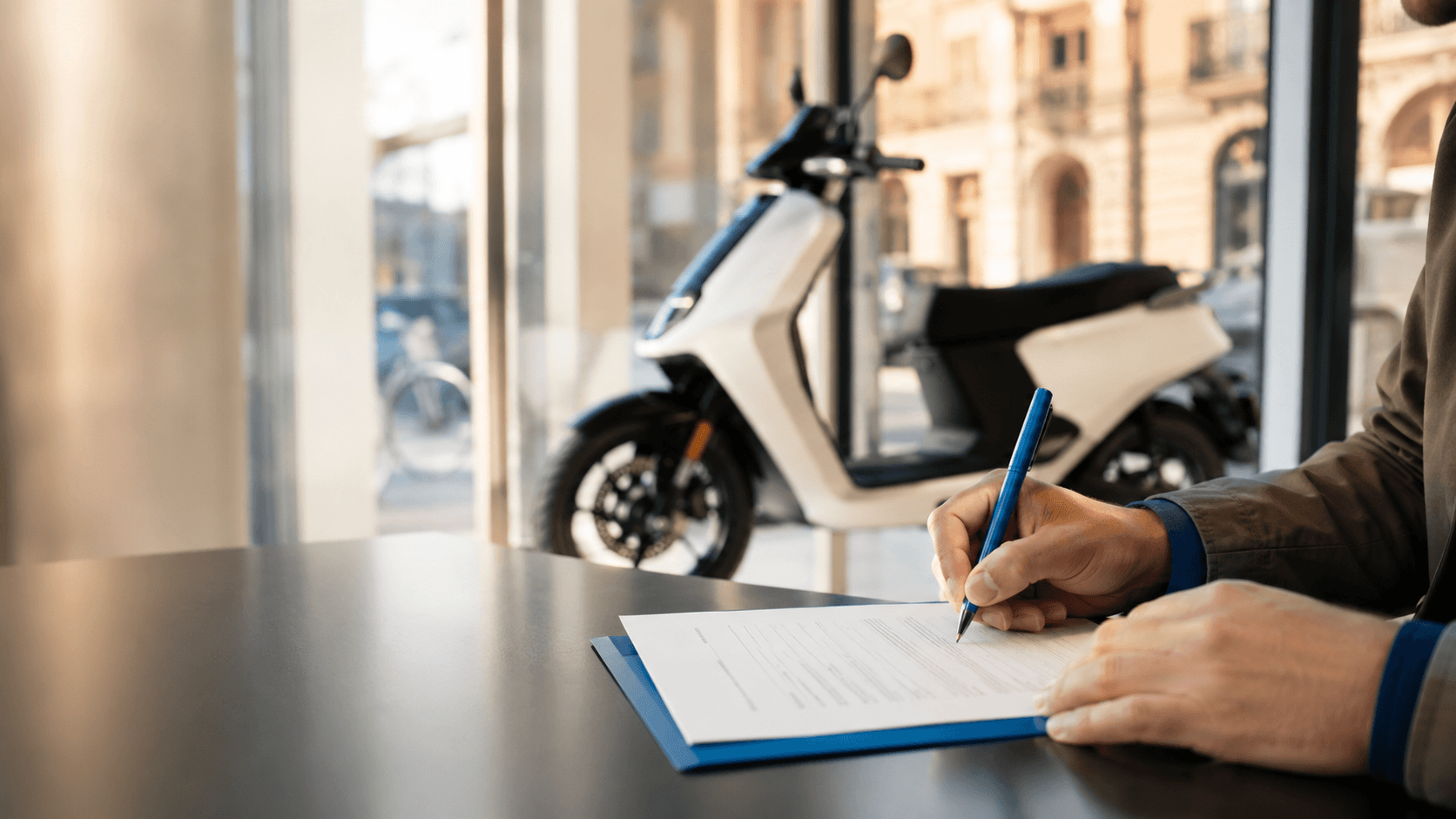
2026 is the last year in which the Ecobonus for electric scooters is worth up to 40% of the price. From 2027, the amounts decrease and the rules become stricter. The problem is that the 2026 funds ran out within a few hours during the March click day, and since then anyone wanting to buy has had to act in a very different context from the one described in generic guides.
In this guide, you will find out how the contribution for an electric moped is actually calculated, what to do when the portal says funds have run out, which regional incentives can genuinely be combined (spoiler: far fewer than those listed online), and how much you lose by waiting until 2027.
In summary
- 30% of the price without scrappage, 40% with scrappage of a vehicle with an internal combustion engine up to Euro 3.
- Caps of €3,000 and €4,000 excluding VAT: in the under-€12,000 range, they never come into play; you always receive the full percentage.
- No ISEE limit. Available to private individuals and VAT-registered businesses. The vehicle must be kept for 12 months.
- The dealer, not you, makes the reservation. From July 9, 2026, they can enter a maximum of 2 reservations per day.
- From 2027, the contribution drops to 20% / 30%: on a €4,500 scooter, that means about €450 less.
How much is the 2026 Ecobonus for electric scooters worth?
The 2026 Ecobonus is the final tranche of the incentive established by the 2021 Budget Law and makes 30 million euros available for the current year. It applies to new factory vehicles in categories L1e to L7e, electric or hybrid, with a list price not exceeding €20,000 excluding VAT.
The amounts depend on just one variable: whether or not you scrap an old vehicle with an internal combustion engine.
| Situation | % of price | Maximum cap |
|---|---|---|
| Without scrapping | 30% | €3,000 excluding VAT (€3,660 including VAT) |
| With scrappage of a vehicle with an internal combustion engine up to Euro 3 | 40% | €4,000 excluding VAT (€4,880 including VAT) |
The contribution is calculated on the list price of the purchased configuration, excluding VAT and net of any seller discounts. Optional extras included on the invoice count toward the calculation; those sold separately do not.
The actual calculation, range by range
This is the most widespread misunderstanding. Many people read “€4,000 cap” and think they will receive €4,000 for any vehicle. In reality, the cap only applies above €12,200 including VAT: below that threshold, the full percentage always applies.
Translated into the typical price ranges of 45 km/h L1e electric mopeds—those that genuinely replace 50cc scooters in the city:
| List price | 30% discount without scrappage |
Final price | 40% discount with scrappage |
Final price |
|---|---|---|---|---|
|
2.000 € entry-level |
600 € | 1.400 € | 800 € | 1.200 € |
|
3.500 € mid-range |
1.050 € | 2.450 € | 1.400 € | 2.100 € |
|
4.500 € upper range |
1.350 € | 3.150 € | 1.800 € | 2.700 € |
|
5.500 € top-of-the-range L1e |
1.650 € | 3.850 € | 2.200 € | 3.300 € |
Amounts including VAT, rounded and provided as an example. The discount is applied directly to the invoice by the dealer, who then recovers the amount through a tax credit: you pay nothing upfront and do not wait for reimbursements.
The interesting part: with the scrappage incentive, an entry-level vehicle drops below €1,300, and even a top-of-the-range L1e remains below €3,400. At that point, comparing it with a new 50cc combustion vehicle is no longer even a debate, considering that the running cost of an electric vehicle is around a few cents per 100 km and routine maintenance is limited to tires, brakes, and little else. The full calculation is in our in-depth article on how much it costs to maintain an electric scooter.
Who can access it and what the requirements are
Buyer requirements
- Resident in Italy at the time of purchase.
- Individuals and legal entities, with a limit of 500 vehicles for the same tax code or VAT number.
- No ISEE requirement: unlike car incentives, income does not matter here.
- The vehicle must remain owned for at least 12 months before being resold.
Vehicle requirements
- Brand new, never previously registered, and registered in Italy.
- Category from L1e to L7e, electric or hybrid, with no power limits.
- List price no higher than €20,000 excluding VAT (€24,400 including VAT).
- Purchase through financial leasing is also permitted.
Requirements for the vehicle to be scrapped
- Combustion vehicle certified in an environmental class up to Euro 3, in the same category as the vehicle purchased.
- Registered in the buyer’s name or that of a cohabiting family member for at least 12 months.
- Compliant with the PRA and delivered to the dealer at the time of purchase.
- The seller must deliver it to a scrapyard within 15 days and complete its deregistration from the register.
Regarding the “same category” requirement, dealers’ practices are not always consistent. If the vehicle you want to scrap belongs to a different L category from the one you are buying, ask for written confirmation when requesting the quote, before the reservation is entered.
How the reservation works (and why it does not depend on you)
The most common mistake is looking for the application form. There isn't one. The procedure does not require any direct action from the buyer: the seller accesses the portal, checks the availability of funds, and reserves the bonus, which is then granted to the customer as an immediate discount on the invoice.
The process, in order:
- Agree on the model and sign the quote or order with the dealer.
- The dealership accesses the Ecobonus portal managed by Invitalia on behalf of MIMIT and enters the reservation, attaching the documents for the vehicle to be scrapped if required.
- The reservation locks in the amount. Requests are accepted chronologically until the funds run out, with a final deadline of December 31, 2026.
- After registration and delivery, the seller uploads the final documents and confirms the transaction.
- The discount appears on the invoice. The dealership recovers the amount as a tax credit.
The July 9, 2026 update
Since July 9, 2026, a maximum limit of 2 reservations per day per dealership has been in effect on the platform, introduced by MIMIT to ensure fair access to the funds and prevent hoarding. For now, the limit applies only to 2026.
The strategy changes completely: your seller no longer needs to be the fastest in Italy on the click day. You need to be among the first two people in their queue. Before signing, explicitly ask how many people are already on their waiting list for a reservation.
Funds exhausted: what to actually do
Reservations for 2026 opened on March 18 at 12:00, and the funds ran out within a few hours, far exceeding expectations. But then something happened that almost no one talks about: after the record sellout, some of the funds were released—reservations entered without the sales actually being completed—and made available again. On May 6, 2026, the portal reopened for precisely this reason.
This means that “funds exhausted” is never a definitive condition until December 31. Here is what makes sense to do, in order of effectiveness.
1. Get on the waiting list instead of waiting for the reopening
Reopenings are not announced weeks in advance. Those who already have a signed quote, details of the vehicle to be scrapped, and their documents ready get booked within the first few minutes; those who still have to choose the color do not.
2. Take advantage of the limit of 2 reservations per day
This is the most underrated move. With the daily limit per dealership, a seller with only a few customers in the queue can book your reservation much sooner than a large chain with fifty people on its waiting list. Ask for your position: they are required to provide you with this information.
3. Keep track of reservations that lapse
Unconfirmed reservations that are not completed within the required deadlines return to the available fund. It is a continuous, silent release: small amounts reappear on the portal in the days and weeks following a sellout.
4. Check whether you qualify for a regional incentive
If you purchase with a VAT number, your options open up considerably, because the 2026 regional vehicle incentives are aimed almost exclusively at businesses. We discuss this in detail below.
5. Do not postpone until 2027 in the hope of better conditions
It is the most expensive choice, and counterintuitive because 2027 brings more overall funding. See the comparison below.
Regional incentives that can be combined: the actual situation
Many guides publish tables with generous regional figures. It is worth being precise, because the difference between those tables and reality is substantial: in 2026, there do not appear to be any regional calls aimed at individuals for the purchase of an L1e electric moped. Open measures for L-category vehicles are reserved for businesses and entities.
| Measure | Who can apply | Grant for electric L1e-L5e vehicles | Status |
|---|---|---|---|
|
Lombardy Rinnova Veicoli 2026-2027 |
Micro, small, and medium-sized enterprises and Third Sector entities with an operating headquarters in Lombardy |
€1,500 without scrappage €2,500 with scrappage |
2026 scheme open from June 3 to October 31, 2026, subject to funds being exhausted |
|
Lazio Commercial vehicle replacement |
Businesses | Not applicable: concerns N1 and N2 commercial vehicles | Extended until December 31, 2026 |
|
Emilia-Romagna Sustainable mobility calls |
Resident individuals | Not applicable: assisted-pedal bicycles and cargo bikes only | Active |
| Veneto, Piedmont, Autonomous Provinces | Varies by call | To be checked in the specific current call | Intermittent application windows |
|
Municipalities LTZs, parking, vehicle tax |
Individuals and businesses | Non-monetary but recurring benefit | Permanent, under local regulations |
Always check your Region's portal: calls have short application windows and may reopen without notice.
How combining incentives works
A regional grant can be combined with the national Ecobonus only if the call for applications expressly allows it. For businesses, the de minimis regime applies, with a maximum of €300,000 granted to the same single undertaking over the previous three years. The different disbursement mechanism must also be considered: the Ecobonus is an immediate discount on the invoice, while regional grants are almost always reimbursements claimed by application, subject to assessment and their own timelines.
When it comes to local benefits, however, the advantage is tangible and ongoing: exemption from vehicle tax for the first five years from initial registration throughout the country, with a reduced rate or permanent exemption depending on the region, unrestricted access to LTZs in most provincial capitals, discounted parking in blue-line spaces in several municipalities, and often lower third-party liability insurance premiums, as many companies offer discounted rates for electric vehicles. You can find details on plates, registration, and mandatory insurance in the dedicated guide.
What changes from 2027 (and how much waiting costs)
MIMIT has already allocated €90 million for the 2027–2030 period: €25 million for each of 2027, 2028, and 2029, and €15 million for 2030, with the program active until March 31, 2030. More overall funding, then. But with lower individual amounts.
| 2026 | From 2027 | |
|---|---|---|
| Without scrapping | 30%, max €3,000 | 20%, max €2,000 |
| With scrapping | 40%, max €4,000 | 30%, max €3,000 |
| Annual funds | €30 million | €25 million (€15 million in 2030) |
| Share reserved for L1e-L5e | Full fund | 50%, the other 50% for quadricycles |
The fourth point is the key one: from 2027, half of the annual resources is earmarked for quadricycles. The funds actually available for scooters and mopeds therefore fall to approximately €12.5 million per year, less than half of the €30 million available in 2026.
How much waiting costs, in numbers
For a €4,500 electric scooter with scrapping: in 2026 the discount is €1,800; from 2027 it drops to €1,350. Difference: €450 less. The same difference applies without scrapping. For a €5,500 vehicle, the gap rises to €550. In addition, the 2027 booking platform is not yet available, and the fund allocated to two-wheelers is cut in half.
Mistakes that cause you to lose the contribution
The MIMIT may request full repayment of the contribution. The most frequent reasons are:
- Reselling within 12 months. The restriction is formal and can be verified through the PRA.
- Non-compliant vehicle to be scrapped. An environmental class higher than Euro 3, ownership for less than 12 months, or an irregular PRA status.
- List price above the threshold. The €20,000 ceiling excluding VAT is calculated based on the official list price for the purchased configuration, not the discounted price you negotiated.
- Vehicle already registered. Zero-mileage vehicles and ready-to-deliver models that are already registered are not eligible.
- Unclear invoice. Ask for the list price, seller’s discount, VAT, government contribution, and final amount to appear separately in the quote. If the contribution is not itemized on the invoice, your position is harder to defend in the event of an audit.
Other guides on electric scooters
Last updated: September 2026. Information on amounts, requirements, and fund availability may be changed by the Ministry of Enterprises and Made in Italy. Always check the updated conditions on the official Ecobonus portal before finalizing your purchase.


Share:
Electric scooter: mandatory license plate, registration, and insurance
Electric scooter: what license do you need? Complete guide to L1e and L3e