

At the end of July 2026, self-service petrol prices came close to €2 per liter across the national road network. This is when the question “is it worth switching to electric?” stops being theoretical and becomes a calculation.
This guide does the full calculation without skipping the inconvenient items. It includes battery replacement, which almost no comparison considers, and also explains when electric is not worthwhile. All the figures include the stated assumptions, so you can redo the calculation with your own.
In summary
- Energy: approximately €0.68 per 100 km compared with €4.95 for a petrol 50cc scooter.
- Over five years and 25,000 km, the overall difference in running costs exceeds 1.500 €.
- The battery generally does not need to be replaced during the first five years of urban use.
- With the Ecobonus, the purchase price falls below that of a new 50cc scooter: the break-even point is immediate.
Energy cost
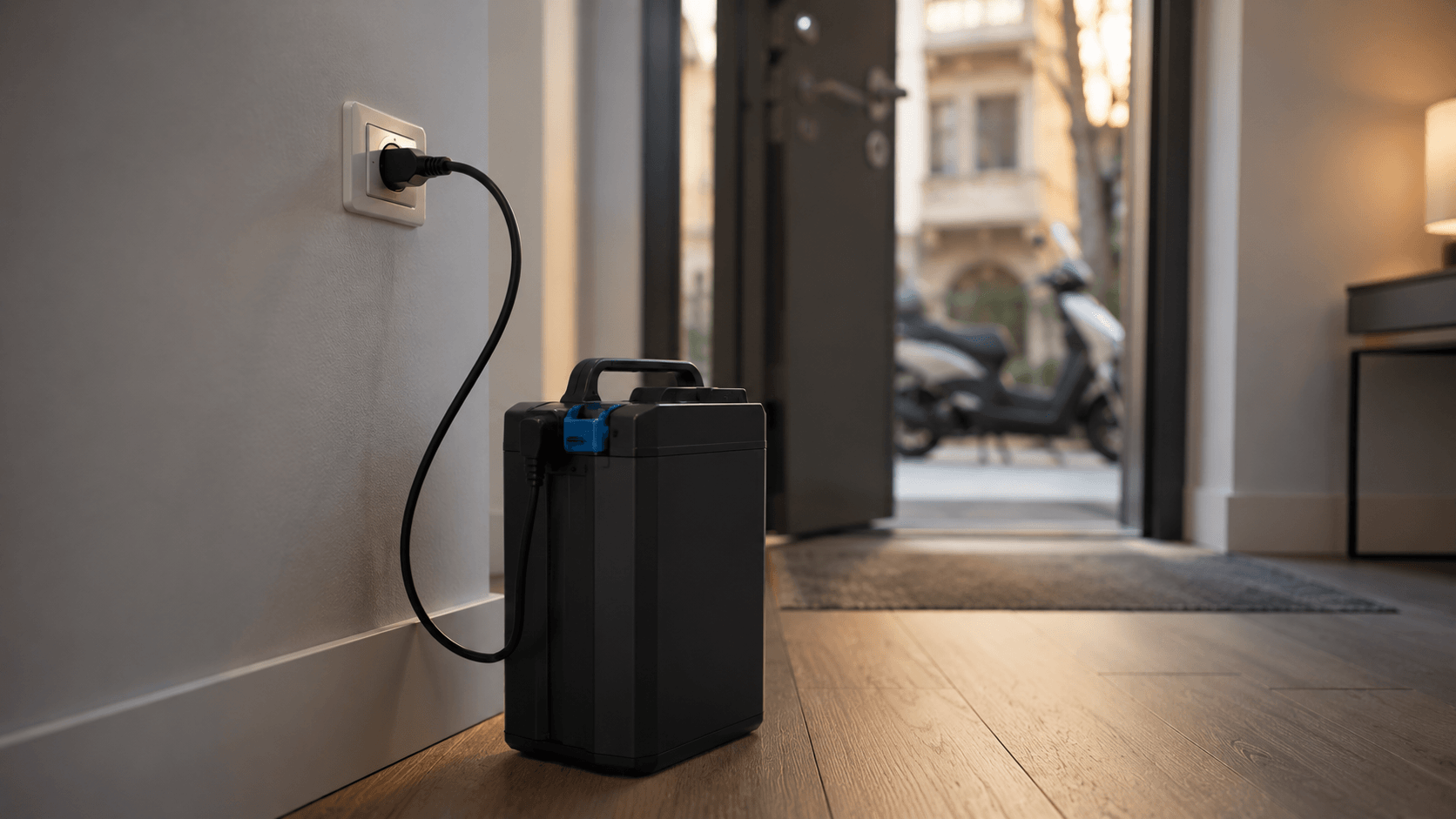
An L1e electric moped has a battery pack of approximately 1.5 kWh. At a domestic rate of €0.30 per kWh, a full charge costs between €0.41 and €0.49 and provides a claimed range of 55 to 85 km. The cost per 100 km is around €0.68.
A petrol 50cc scooter consumes an average of 2.5 liters per 100 km in urban use. The cost therefore depends entirely on the pump price, which has fluctuated considerably over the past year:
| Petrol price | Cost per 100 km 50cc petrol |
Cost per 100 km L1e electric |
Difference over 5,000 km/year |
|---|---|---|---|
| €1.80/l | 4,50 € | 0,68 € | €191/year |
| €1.98/l (July 2026) | 4,95 € | 0,68 € | €214/year |
| €2.20/l | 5,50 € | 0,68 € | €241/year |
Reference 50cc consumption: 2.5 l/100 km. Reference domestic electricity rate: €0.30/kWh. Distance traveled: 5,000 km per year, equivalent to approximately 25 km per day for 200 working days.
Maintenance: what disappears
The savings on energy are the first thing you notice, but over time maintenance matters just as much, because an electric motor physically lacks the components that wear out.
Items that disappear entirely
- Engine oil and filter change, twice a year for a 50cc scooter used daily.
- Spark plug, air filter, exhaust.
- Drive belt and variator rollers, the most expensive item in a 50cc scooter service, which must be replaced every 10,000–15,000 km.
- Centrifugal clutch.
Items that remain unchanged
- Tires, which wear out in the same way.
- Brake pads and discs, although they last longer on vehicles with regenerative braking.
- Periodic inspection and safety checks.
In practice, the annual service for an electric moped is reduced to checking the brakes, tires, electrical system, and fasteners. Average routine maintenance costs drop from around €150 per year to around €50.
Vehicle tax, insurance, and local benefits
Vehicle tax. Electric vehicles are exempt from the ownership tax for the first five years from initial registration throughout the country. After that period, a reduced rate applies, varying from region to region, with some regions maintaining the exemption permanently. These amounts are still modest for a moped: it is worth checking the regulations in your region, but this is not the factor that changes the comparison.
Insurance. Compulsory third-party liability insurance is required in both cases, and the premium depends mainly on the driver's risk class, province of residence, and age. However, many companies offer discounted rates for electric vehicles, which are statistically considered less likely to be involved in serious accidents. It is worth requesting a specific quote before assuming the cost is identical. For details on license plates, registration, and mandatory insurance, see the dedicated guide.
Local benefits. This is the item that does not appear in any table and is felt most in everyday use: unrestricted access to ZTLs in most provincial capitals, free or discounted parking in blue-lined spaces in several municipalities, and no restrictions on days when traffic is limited due to pollution. For those who work in the city center, the value of this item alone can exceed that of the fuel saved.
The question no one asks: what about the battery?
It is the most frequent objection and the point that optimistic comparisons tend to omit. It is worth addressing with the numbers.
A lithium battery in this category is rated for 600–800 full charging cycles before dropping to around 80% of its original capacity. This is not a failure: it is gradual degradation, and at 80% the vehicle continues to work, simply with less range.
In terms of distance: with a real-world range of 40–55 km per cycle, 600 cycles amount to between 24,000 and 33,000 km. With typical urban mileage of 5,000 km per year, this means five to seven years before approaching the threshold, followed by several more years of useful service after exceeding it.
In the five-year calculation shown below, battery replacement is not included because it is statistically unnecessary. However, if you expect to travel far more than average — over 10,000 km per year — then you should factor it in, and the economic break-even point will be pushed further away. Always ask the seller for the price of a replacement battery pack before purchasing: a reputable dealer will provide this information without hesitation.
We have written a dedicated guide to electric scooter batteries on how to extend the life of the battery pack — avoid leaving it discharged for long periods, do not charge below zero, and prefer frequent partial charges over full cycles — because charging habits have a greater impact than cell quality.
The complete five-year calculation
| Item | 50cc petrol | L1e electric |
|---|---|---|
| Fuel/electricity (25,000 km) | 1.238 € | 170 € |
| Routine maintenance | 750 € | 250 € |
| Vehicle tax | Varies by region | 0 € (exempt for 5 years) |
| Battery replacement | — | 0 € (not expected) |
| Third-party liability insurance | Similar, with frequent discounts on electric models | |
| Total running costs over 5 years | approximately €1,990 | approximately €420 |
Petrol at €1.98/l, 5,000 km per year, predominantly urban use. Insurance and tires are excluded, as they have a comparable impact on both options. The difference over five years is approximately 1.570 €.
And the purchase price?
This is the part that changes completely depending on whether or not you receive the incentive.
Without incentives, an approved L1e electric moped currently costs between €2,000 and €5,500, depending on range and power, compared with €2,200–€2,800 for a new 50cc. In the upper price range, the higher upfront cost is around €2,000–€2,500, which the lower running costs recoup in just over five years: a real but lengthy break-even point that only makes sense if you plan to keep the vehicle for a long time. At the entry level, however, the price is already in line with that of a 50cc even without an incentive.
With the Ecobonus and scrappage, the picture changes completely: the price drops from around €1,200 in the entry-level range to just over €3,000 in the higher range. An entry-level vehicle thus costs less than half as much as a new 50cc scooter, and even the most expensive one remains in the same price range. At that point, there is no longer an initial investment to recoup: the savings on running costs are clear from day one. This is exactly what makes 2026 an unusual year, and why it is worth reading how the 2026 Ecobonus for electric scooters works before making a decision.
One factor needs to be added that the calculation does not capture: residual value. A ten-year-old 50cc petrol scooter is worth little today and is already banned from restricted traffic zones in many cities. An electric vehicle is moving in the opposite direction, because traffic restrictions on older combustion-engine vehicles continue to tighten.
When electric vehicles are not cost-effective
There are situations where the numbers do not add up, and they are worth pointing out.
- You have nowhere to recharge. If you park on the street and cannot bring the battery indoors — because the model has a fixed battery or because you live on the fifth floor without an elevator — the vehicle becomes impractical regardless of the figures.
- You travel less than 2,000 km a year. Below this threshold, the savings on running costs become marginal, and the higher purchase price, if you do not receive the incentive, is never recouped.
- Your route includes fast extra-urban roads. An L1e is limited to 45 km/h and cannot travel on expressways. The issue is not economic but the vehicle category.
- You change vehicles every two years. The advantages of electric vehicles accumulate over time. Over short periods, the comparison comes down almost entirely to the purchase price.
Other guides on electric scooters
Last updated: September 2026. Fuel prices refer to the national average for self-service stations reported by the Observatory of the Ministry of Enterprises and Made in Italy and vary daily. Maintenance costs are indicative average values and depend on the model, workshop, and geographical area.


Share:
Electric scooter: mandatory license plate, registration, and insurance
Electric scooter: what license do you need? Complete guide to L1e and L3e