

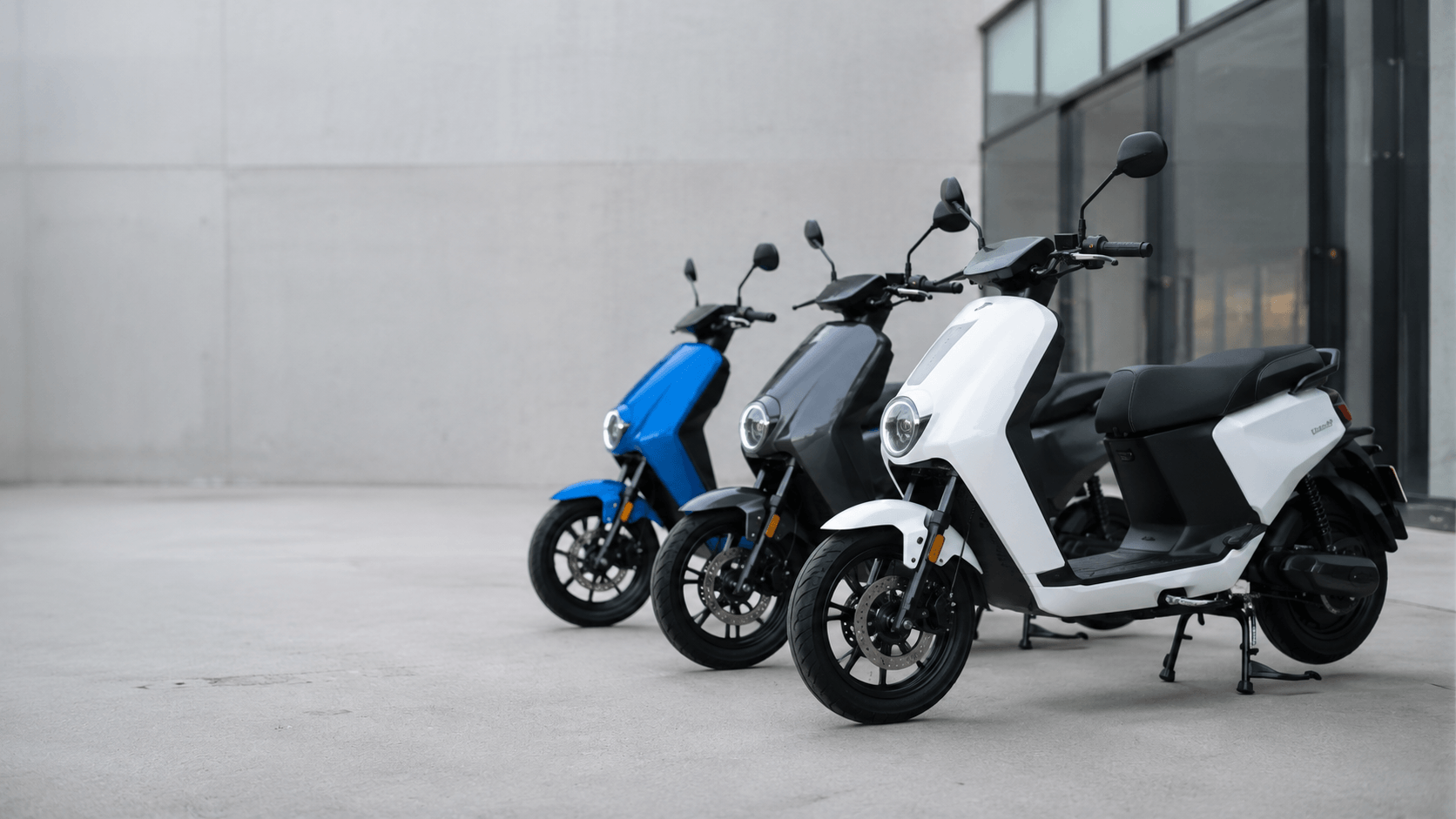
Buying an electric scooter in 2026 is more convenient than at any other time, and it is also easier to make a mistake. The market is full of vehicles all called “electric scooters” but belonging to different categories, requiring different licenses, and in some cases not even being allowed to travel where you think they can.
This guide is designed to ensure you reach the point of purchase clear on three things: which category you really need, how far claimed range and real-world range differ, and which information to demand from the seller before signing. At the end, you will find a checklist to use with any model, from any brand.
In summary
- For everyday urban use, the right category is almost always L1e, a moped with a top speed of 45 km/h, which can be ridden with an AM license from age 14.
- Real-world range is generally between 65% and 75% of the claimed range, and with two people, especially in winter, it can be even lower.
- The removable battery is the single criterion that makes the biggest difference in everyday life: without one, you need a garage with an outlet.
- The CE certificate of conformity determines whether the vehicle can be registered in Italy. Without this document, you will not get a license plate, regardless of what the listing says.
What changes in 2026
Three things make 2026 a particularly important year for buyers.
Incentives are at an all-time high, and they will not be again. The Ecobonus covers 30% of the price without scrapping a vehicle and 40% when scrapping a combustion vehicle up to Euro 3. From 2027, the percentages will fall to 20% and 30% respectively, and half of the annual budget will be reserved for quadricycles. On a €4,500 vehicle, the difference between buying now and buying next year exceeds €450. The operational details, including what to do when funds have run out, are in our guide to the 2026 Ecobonus for electric scooters.
Removable lithium batteries have also become standard in the mid-range. Until a few years ago, in the under-€5,000 segment you found almost exclusively lead-gel batteries: heavy, with fewer life cycles, and requiring recharging on board the vehicle. Today, 13–14 kg lithium battery packs can be removed and carried into the house, eliminating the biggest problem with electric vehicles in the city. We have written a dedicated guide to electric scooter batteries explaining how to care for them so they last.
LTZs have become more restrictive. More and more regional capitals have expanded their limited traffic zones and operating hours, while Euro 2 and Euro 3 internal-combustion mopeds are the first to be excluded. An electric vehicle can enter everywhere, and in several municipalities it can park for free in blue-marked spaces. It is an advantage that does not appear in the price but is felt every day.
The three questions to ask before buying
Before looking at the models, answer these three questions. 90% of incorrect purchases result from skipping one of them.
1. How many kilometres do you actually travel each day?
Not how many you think you will make, but how many you actually make. Open your phone’s location history and look at a typical week. Most urban commutes are under 15 km each way, or 30 km a day: any vehicle in this range covers them with plenty to spare, even in winter.
The calculation changes if you need to get home without being able to recharge, often travel with two people or your route includes long climbs. In those cases, real-world range matters, not the stated range, and the difference is greater than the marketing suggests.
2. Where will you charge it?
It is the question people ask themselves last, but should ask first. If you have a garage with an outlet, any solution will work. If you park on the street or in a condominium courtyard without electricity, you have only one practical option: removable battery.
A 13–14 kg lithium battery can be removed in a few seconds, taken indoors and connected to a regular household outlet. There is no need for a wallbox, dedicated electrical installation or permission from the building manager. That is why a vehicle with a removable battery and a stated range of 70 km is, in practice, far more usable than one with a 100 km range and a fixed battery.
3. Who will ride it, and with which licence?
If other family members will also use it, choose the category based on the lowest licence available. Anyone aged at least 14 with an AM licence can ride an L1e at 45 km/h, as can anyone with a category B licence. An L3e requires an A1 licence and a minimum age of 16. You can find the complete overview in the guide on which licence is required for an electric scooter.
L1e or L3e: the choice that determines everything else
In Italy, “electric scooter” covers two very different homologation categories. Choosing one means accepting a complete package of consequences regarding the required licence, speed, roads you can use and costs.
| L1e — moped | L3e — motorcycle | |
|---|---|---|
| Top speed | 45 km/h | Over 45 km/h |
| Driving licence | AM from age 14 (or A1/A2/A/B) | A1 from age 16 |
| Expressways and ring roads | No | Yes |
| Typical price range | 2.000 - 5.500 € | 6.000 - 12.000 € |
| Ideal use | Cities and surrounding areas | Extra-urban routes |
The price ranges are indicative of the Italian market in 2026 and include VAT, before the Ecobonus is applied.
The practical rule: if your usual route does not include stretches of dual carriageway, L1e is the rational choice. It costs almost half as much, is cheaper to insure, the incentive covers a higher percentage of the price, and the top speed is not a real limitation in an urban setting, where the actual average rarely exceeds 25–30 km/h. Those who move up to L3e do so for a specific reason—a regular stretch of ring road—not to have “more headroom.”
Claimed range and real-world range
Manufacturers’ range figures are measured under favorable conditions: a single rider of average weight, flat terrain, moderate constant speed, mild temperature, and a new battery. None of these conditions reflects everyday use.
Based on the known factors that affect lithium batteries, these are the deviations to factor in:
- Two people on board: 20% to 30% less range.
- Temperatures below 5 °C: 15% to 25% less, almost entirely recovered when the weather warms up.
- Hilly routes: up to 30% less than on flat terrain.
- Ageing: a well-maintained lithium battery retains about 80% of its capacity after 600–800 full cycles, which for typical urban use means several years.
Practical rule to avoid mistakes: take the claimed range, subtract one third, and check that the remaining figure covers your longest daily journey with at least 10 km to spare. If it does not, it is not the right vehicle—or you need a second battery.
The checklist of figures to request
Technical specifications are written to impress, not to help you compare. These are the seven figures that really matter: always ask for them for every model you are considering, and compare those instead of the listing headlines.
| Data | Why it matters | What to consider solid |
|---|---|---|
| Homologation category | Determines the licence, registration plate, roads you can use, and access to the incentive. | L1e or L3e stated in writing, not “road legal.” |
| CE certificate of conformity | Without it, the motor vehicle authority will not register the vehicle. | The seller shows this before the order, not afterward. |
| Battery type and weight | Determines where you can recharge and whether you can bring it indoors every evening. | Removable lithium battery under 15 kg, with a carrying handle. |
| Voltage and capacity (V / Ah) | These are the figures that enable a real comparison between models. | Both must be declared. If one is missing, the range figure cannot be used for comparison. |
| Nominal and peak power | The nominal figure is the approved rating; the peak figure explains acceleration and hill-climbing ability. | Both should be provided and distinguished. A single generic number says little. |
| Declared service life cycles | It tells you when you will need to budget for a new battery. | 600–800 cycles at 80% remaining capacity is the reference standard. |
| Support in Italy | An electronic failure without a support network means months out of service. | Importer or declared local network, with verifiable contact details. |
If a model is missing three or more of these data points, the problem is not an incomplete technical specification: it is that no one is taking responsibility for stating them.
Which profile, which features
Limited budget, first vehicle
At the entry level, prices drop considerably, but this is also the category where the stated figures become vague. If an inexpensive model does not state a verifiable range along with its voltage and capacity, treat it as a vehicle for short, predictable trips, not as an unknown to be discovered after purchase.
Short trips, aesthetics first
If you travel less than 15 km per trip, range stops being a criterion and battery weight becomes the priority. A lightweight pack that you carry up the stairs every evening is worth more than an extra 20 stated kilometers that you will never use.
Those who do not want to think about charging
Look for models designed for two battery packs. They double the stated range and, above all, eliminate a fixed routine: you charge one pack while the other is on the vehicle. Check that the provision is standard and not an improvised modification.
Those looking for acceleration and comfort
Peak power matters here, not range. You notice it when pulling away at traffic lights and on hills with two people, where less powerful vehicles lose speed. Expect a powerful vehicle to state a more limited range: it is a physical trade-off, not a defect.
Long distances or frequent use with two people
This is the only profile in which the highest stated range truly justifies the higher price. Above 20 km per trip, or with a regular passenger, an extra 20 or 30 kilometers can mean the difference between charging every day and charging every other day.
The most common mistakes
- Buying based only on range. It is the most heavily advertised figure and the least reliable. A removable battery, power, and the availability of support matter more in daily use.
- Confusing the categories. Kick scooters, e-bikes, and mobility scooters for seniors are often sold under the same “electric scooter” label, but they are not mopeds: they have no license plate, are not type-approved as L1e vehicles, and do not qualify for the Ecobonus.
- Not checking European type approval. Without a CE certificate of conformity, the vehicle cannot be registered in Italy or receive a license plate. This is the main risk when buying on general marketplaces at unusually low prices. We have written a dedicated guide on license plates, registration, and mandatory insurance.
- Underestimating the battery’s weight. Thirteen kilos may not seem like much until you have to carry it to the third floor without an elevator every evening. If you live upstairs, check this beforehand.
- Putting it off while waiting for better conditions. As far as incentives are concerned, 2026 is the peak: from 2027, the contribution will decrease and the budget for two-wheelers will be halved.
- Don’t just ask who provides servicing. An electric vehicle requires little maintenance, but when a specific repair is needed, having local service support can mean the difference between two days and two months off the road.
How much does it cost to run
Charging is the cost that surprises people most when they switch from combustion engines. A full charge of a 60V, 25–26 Ah battery pack costs less than half a euro at a household electricity rate, and the cost per 100 km remains below one euro. A petrol moped uses around €4–5 worth of fuel to cover the same 100 km.
On top of this, there is reduced maintenance—no oil, filters, spark plugs, or clutch—and tax and local benefits: exemption from road tax for the first five years from initial registration, access to ZTLs, and discounted parking in blue spaces in several municipalities. The complete five-year cost, with a detailed comparison against a petrol-powered 50cc, is covered in our article on how much it costs to run an electric scooter.
Other guides on electric scooters
- Which license do you need: a complete guide to L1e and L3e
- 2026 incentives: the Ecobonus and what to do if the funds have run out
- The battery: how long it lasts, how to recharge it, and how to make it last
- License plate, registration, and mandatory insurance
- How much does it cost to run: the 5-year cost compared with a 50cc
Last updated: September 2026. The price ranges shown refer to the Italian market as of the update date and may vary. Manufacturers’ stated ranges are measured under standard conditions; the real-world range estimates in this guide are cautious indications and do not replace a test ride on your route.



Share:
Electric scooter: mandatory license plate, registration, and insurance
Electric scooter: what license do you need? Complete guide to L1e and L3e
1 comment
CARINO, SERVE PER RICORDARSI DI NON ESSERE SUPERFICIALI