

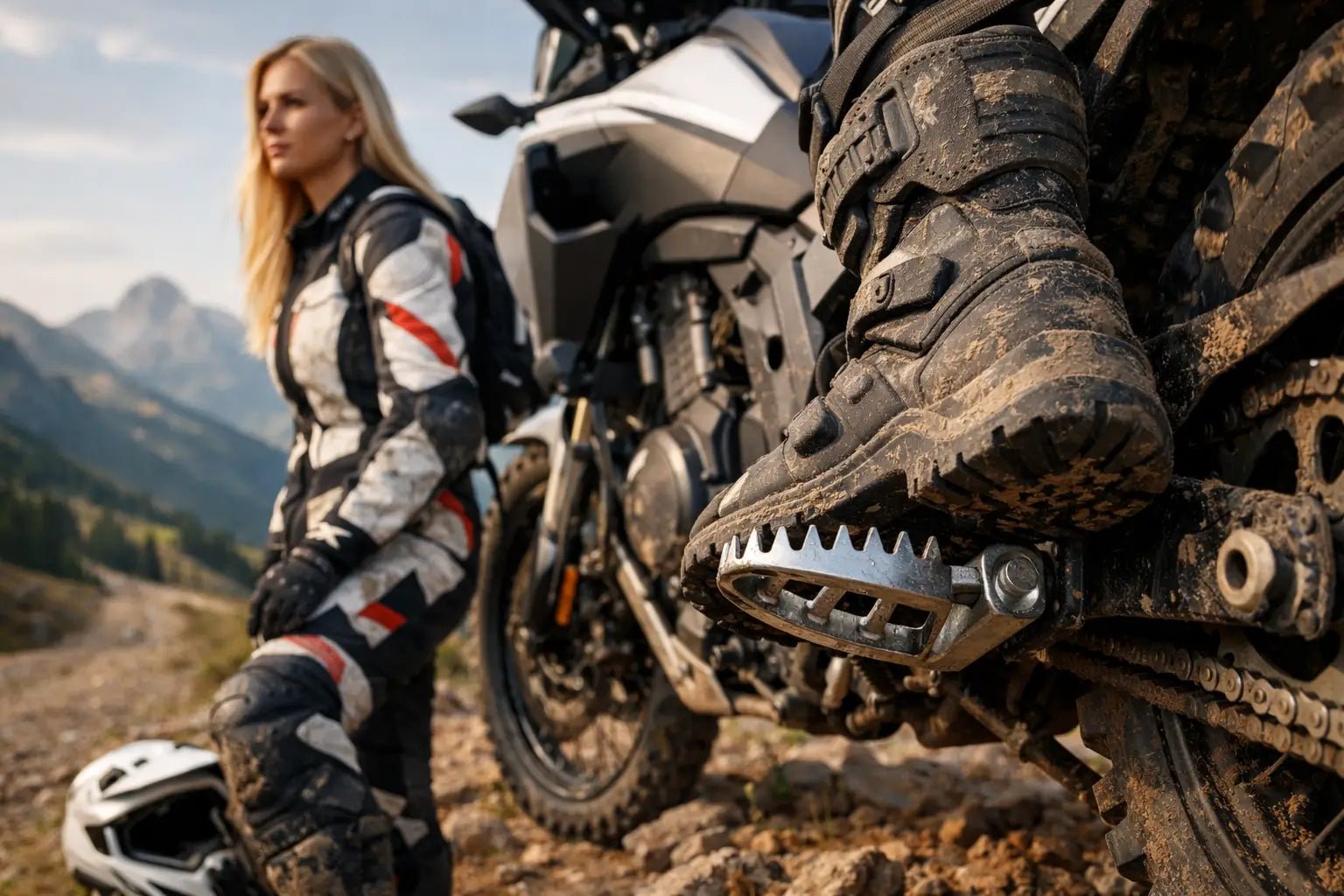
If you only feel stable standing on your bike for a few minutes, or if you find yourself looking for support with your boots instead of riding off-road, the problem often starts there: with rally motorcycle footpegs. They are not an accessory to be installed for aesthetics. They are one of the contact points that most change control, fatigue, and precision, especially on adventure and dual-sport bikes truly used off-road.
Rally motorcycle footpegs: what they are really for
The difference is felt when riding standing up for long stretches, over rocky terrain, through mud channels, or fast transfers on bumpy dirt roads. A wider footpeg distributes weight better on the boot and prevents that discomfort under the sole of your foot that, after an hour, makes you lean back or stiffen your legs. A more aggressive tooth pattern, on the other hand, helps when the sole and footpeg are wet or caked with dirt.
On a BMW R 1250 GS or R 1300 GS, for example, the issue is not just about having more grip. It's also about being able to shift weight precisely on a bike that, when fully loaded, requires clear movements. On a KTM 890 Adventure or a Yamaha Ténéré 700, the benefit is felt more in active riding: more front-end control, fewer unnecessary corrections, less wasted energy.
However, not all oversized footpegs are automatically right for your use. More surface area means more support, but also a different interface with the gear lever and brake pedal. If you ride a lot on asphalt with less rigid touring boots, or if you already have a very precise position set on the original footpegs, the transition needs to be carefully evaluated.
How riding changes with wider footpegs
The first difference is mechanical, not psychological. With a wider support base, the foot works less with the ankle to stay still. This translates into a more relaxed posture and more sustainable standing riding. On uneven terrain, where the bike moves beneath you and you have to let it work, having a stable platform under your boots helps much more than it seems when standing still in the garage.
The second difference concerns the load on the body. If you've ever ended a day with stiff calves and sore forefeet, you already know how much such a detail can affect you. Well-designed rally motorcycle footpegs reduce pressure points and allow you to distribute weight between the inside and outside without that feeling of precarious balance typical of narrow surfaces.
Then there's the grip issue. On mud, rain, or wet sand, an effective tooth pattern holds the sole better. But here too, actual use matters: a very aggressive tooth pattern works well with structured off-road or adventure boots, while it can be more uncomfortable with softer footwear and wear out soles faster.
More control, but only if the position remains correct
A wide footpeg works when it allows you to remain natural on the bike. If the new height or new surface forces you to unnaturally rotate your foot to reach the rear brake, the advantage is reduced. The same applies to the gear lever: with bulky technical boots, it is often necessary to check if the available range remains comfortable even when standing.
For this reason, the choice should not be made by just looking at the platform. It matters how the footpeg integrates with the overall ergonomics of your bike and with your equipment.
What to look for before choosing rally motorcycle footpegs
Width is the first data everyone looks for, but by itself, it says little. The shape of the platform also matters. Some footpegs offer a more uniform surface along the entire foot, others concentrate support in the central area. If you do a lot of off-road riding standing up, a platform that can be used well even on the outer part provides more sensitivity in weight transfers.
The material affects resistance, weight, and impact response. Without going into unverified specifications, the practical difference is this: a well-built footpeg must withstand impacts and vibrations without play over time and without giving you that feeling of flexion when you strongly load the outer foot on a broken surface in a bend.
The teeth also deserve attention. They must bite the sole, not turn every foot movement into a struggle. If you alternate asphalt, alpine passes, and medium dirt roads, a balanced solution is often advisable. If, on the other hand, you use the bike for more serious off-road riding, grip comes before perceived comfort when standing still.
Height and setback
On some bikes, a different footpeg can slightly change the triangulation between the seat, footpeg, and handlebar. For a tall rider on an Africa Twin, Tiger 900, or DesertX, even a few millimeters perceived in the right way lighten the knees and improve the standing position. For a shorter rider, however, a poorly managed variation can complicate access to the controls.
There is no single answer here. If you make long journeys with many hours seated, you evaluate overall comfort. If you often go out on technical dirt roads, you prioritize standing control. The two needs do not always coincide perfectly.
Compatibility: the point that avoids costly mistakes
For footpegs, compatibility is not an administrative detail. It is what determines whether the assembly will be correct and whether the bike will maintain the intended geometry at the support points. BMW, KTM, Honda, Yamaha, and Triumph have different attachments, dimensions, and clearances. Even within the same family, compatibility must be checked by model and year.
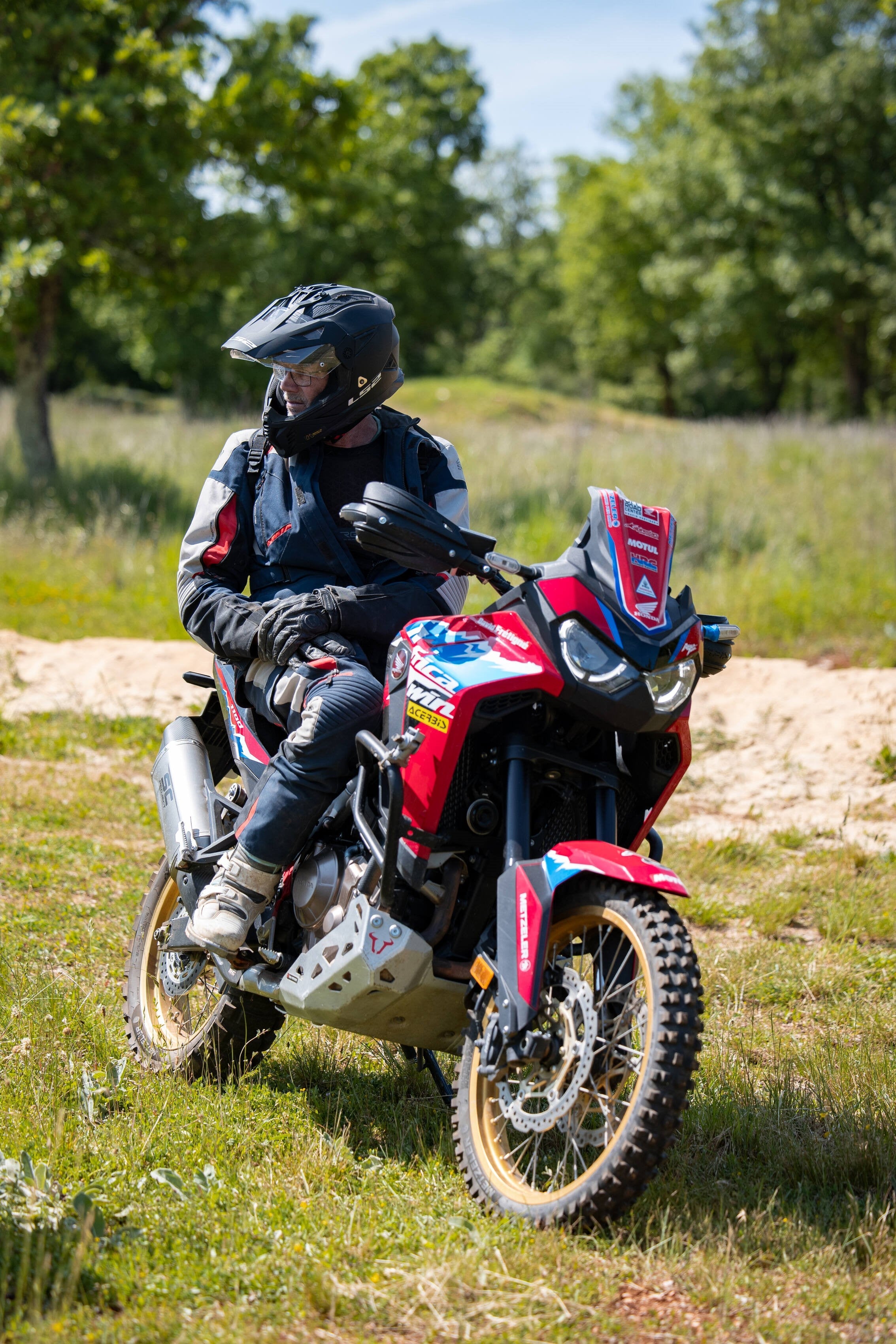
On a Honda Africa Twin CRF1100L, for example, the interaction with the gear lever and brake pedal should always be considered together with the footpeg. On a Royal Enfield Himalayan or an F 850 GS, where many seek safer standing riding without drastically changing the bike, the right product is one that improves support and control without creating improvised adaptations.
This is one of the reasons why it makes sense to start by navigating by model, as Endurrad does, instead of choosing only from photos or generic dimensions. A footpeg may seem perfect on paper and then not be suitable for your attachment or your use.
When the upgrade is really worth it
If you mostly do touring on asphalt, only stand up occasionally, and have never felt instability or foot fatigue, the original footpegs may be sufficient. Not everything that improves rally riding or intense off-roading is equally useful for those who do road transfers and easy dirt roads.
The upgrade makes a lot of sense in three cases. The first is if you often ride standing up and want a more stable base. The second is if you use technical boots and feel that the standard footpeg is too small or slippery. The third is if you are preparing the bike for trips where you alternate many hours in the saddle with sections of broken ground, perhaps fully loaded.
On a Ténéré 700 ready for fast white roads or on a 1290 Super Adventure used for long trips with serious deviations from tourist dirt roads, the difference is not theoretical. You feel it in the precision with which you stay centered on the bike and in the clarity you retain at the end of the day.
Common mistakes in choosing
The most common mistake is buying the most aggressive footpeg, thinking that more grip always means more control. This is not the case if you then struggle to reposition your foot or if the tooth pattern is excessive for your boot and for your predominant use.
The second mistake is ignoring the ergonomics of the controls. After installation, your foot must continue to find the brake and gear without hesitation. If you have to raise your toes too much or rotate your foot forcefully to brake, you will immediately notice it on mixed terrain or downhill.
The third is to think of footpegs as an isolated element. In reality, they work together with the seat, handlebars, risers, boots, and overall setup. If you are adjusting your riding position, it makes sense to consider the complete package, not just a single component.
The right choice depends on where you want to go
Rally motorcycle footpegs make sense when they solve a concrete problem: less fatigue while standing, more grip in the wet, more precision off-road, more support with serious boots. If your ideal journey includes long days, variable terrain, and a properly loaded bike, they are one of those interventions that you feel every kilometer, not just on the day of installation.
It is worth choosing calmly, starting with your bike, your boot, and the terrain you actually ride on. Because a good footpeg is not noticeable for how it looks. It is noticeable when, after hours in the saddle, you are still riding well.


Share:
Are you about to buy a motorcycle? Read this first.
Is a dashcam needed on a touring motorcycle?