

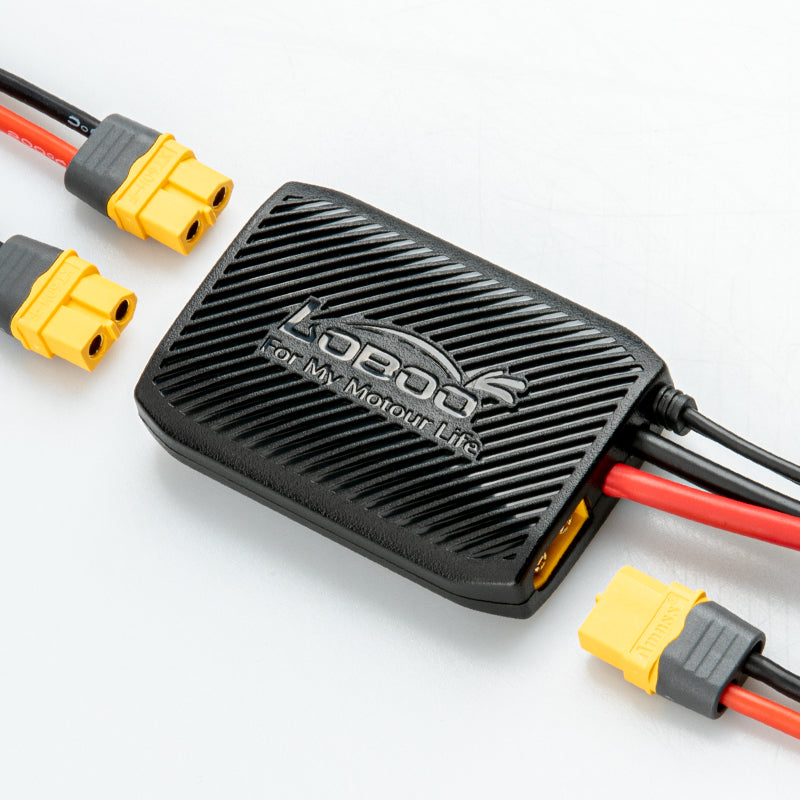
In brief. A power distribution unit replaces the cluster of cable lugs on the battery terminal: one connection, one protected output for each accessory, and the ACC wire that switches everything off when you remove the key. On Endurrad, there are the LOBOO CB20, with three outputs rated at 20, 15, and 10 A (480 W total rated), and the CB10, with a single output up to 30 A (360 W rated).
The choice comes down to a calculation: divide the accessory's watts by 12 V to get the amps to assign to a channel. Here you will find the manufacturer's stated protection thresholds, which channel to use for each load, what the ACC wire does and does not do, and how to install it. It works on any motorcycle with a 12 V electrical system because it is not a model-specific product; the stated input is 12-15 V, so it is not suitable for 6 or 24 V systems.
Why you need a distribution unit
Every electrical accessory you add seeks the same thing: the battery terminal. After the third one, the terminal becomes a cluster of overlapping cable lugs.
- a single connection to the battery, instead of four cable lugs on the terminal;
- the accessories turn on with the key and switch off when you park, without switches and without the risk of leaving anything on;
- if an accessory short-circuits, only its line is disconnected, not the entire system;
- below a voltage threshold, the loads are disconnected and the current remains available for starting.
- it is neither a charger nor a maintainer: it distributes power, it does not recharge;
- it is not a jump starter;
- it does not replace the fuse near the battery: it is additional protection, not the only one.
This is the step worth taking when auxiliary lights, heated grips, a USB socket, and a navigator are all installed on the motorcycle. For the lighting side, see the motorcycle auxiliary light comparison; for the USB-C socket, see the guide to the 100 W socket.
CB20 or CB10: the choice in one table
It is the same product in two versions, with a shared manual and photos. The number of lines changes, not the philosophy.
| Feature | CB20 · three outputs | CB10 · one output |
|---|---|---|
| Outputs | OUT1 20 A, OUT2 15 A, OUT3 10 A | One, up to 30 A |
| Rated power | 480 W total | 360 W |
| ACC wire | To connect: turns on and off with the key | Not necessary |
| Destination indicated by the manufacturer | OUT1 for high loads such as spotlights, OUT2 for medium loads such as heated grips, OUT3 for low loads such as USB sockets and navigation devices | One large accessory on its own |
| Endurrad price | 72,00 € | 59,00 € |

Which one to choose
The CB20 is the answer when the loads differ and it makes sense to keep them on separate lines, each with its own indicator: one light going out does not turn off the phone socket. The CB10 makes sense when there is one important accessory to power, such as a pair of spotlights, and you do not want to depend on the ACC wire. If you have three or more accessories, the CB20 saves you from having to add up terminals again.
Calculating amperage: from watts to channel
The wattage is written on the accessory. For the electrical system, amperage is what matters, and it is calculated by division.
Why 480 W is not the sum of the channels
The three channel maxima add up to 45 A, or 540 W at 12 V (calculation). However, the LOBOO panel declares 480 W total for the CB20, equivalent to 40 A at 12 V (calculation). These are two different limits: the per-line limit and the overall limit. In practice, the three channels should not all be pushed to their maximum at the same time.

| Accessory | Power draw | Location |
|---|---|---|
| LOBOO C36 USB-C socket | 130 W declared, at least 10.8 A at 12 V (calculation) | OUT1 or OUT2. Not on OUT3 at full load: 10.8 A exceeds the channel’s 10 A |
| LOBOO L11 spotlights | Power not specified in the datasheet | Check the wattage on the rating plate and divide by 12; the high-current channel is OUT1 |
| LOBOO CP06 compressor | Current not specified in the datasheet | Powered at 12 V from the cigarette lighter or battery terminals: check the rated data first |
| Navigation device or charging mount | A few watts: read the value on the power supply | OUT3, indicated by the manufacturer for low loads |
Declared protection thresholds
The manual lists precise values, not a generic “multiple protections.” This is the manufacturer’s table.
| Protection | What happens (LOBOO data) |
|---|---|
| Undervoltage | Below 11 V, the OUT2 and OUT3 indicator lights flash slowly for one minute, then the outputs switch off. Below 10 V, OUT1 does the same, with three minutes of advance warning |
| Overvoltage | Above 24 V, all outputs switch off and the indicator light goes out. Rated withstand up to 55 V |
| Overcurrent | Over 25 A on a single line: automatic shutdown and an indicator light that flashes rapidly |
| Short circuit | Immediate shutdown of the affected line |
| Overtemperature | Above 80 °C, the device switches off automatically |
| Reverse polarity | If the positive and negative terminals are reversed, the device does not deliver power |
Why undervoltage really matters
A battery drained by accessories while the motorcycle is off is the most common reason for a failed start. With the 11 V and 10 V thresholds, the control unit disconnects the medium and low loads first, then the high load, leaving enough power in the battery to start the engine. It does not replace a healthy battery: to understand which one to choose, see the guide to adventure motorcycle batteries, and for long periods of inactivity, how to keep your battery alive in winter.
The ACC wire: accessories follow the ignition
It is the connection that transforms the control unit from a "junction box" into a system that never leaves anything turned on.
How it works
On the CB20, the ACC wire must be connected to a point on the motorcycle that carries voltage only when the ignition is on. When you turn the key, the outputs turn on; when you remove it, they turn off. The CB10 does not need this: it has only one output and no ACC wire to locate.
What you receive and how to install it
The three Endurrad questions: will it fit my motorcycle, what do I receive, and how do I install it?
- The motorcycle's electrical system is 12 V (declared input 12-15 V);
- The battery is lead-acid, AGM, maintenance-free, or lithium iron phosphate;
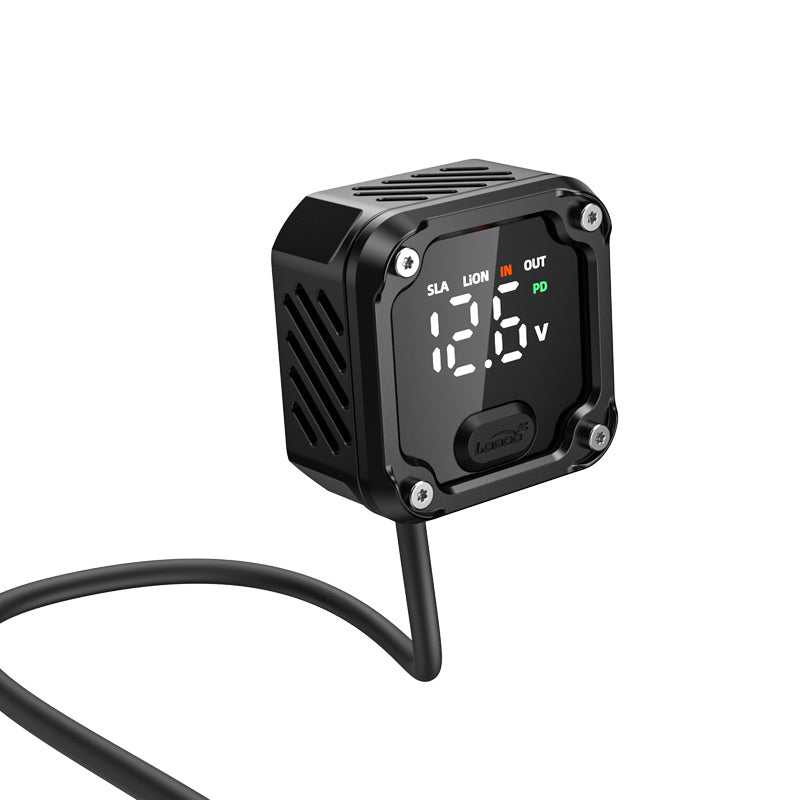
- There is space under the seat or in the compartment: it measures 72.8 × 50.4 × 16.9 mm and weighs 127 g with cable and indicator light.
- It does not work with 6 V or 24 V systems;
- There is no model-specific compatibility: it is a universal accessory;
- It is not designed for areas with direct high-pressure jets: the rating is IP65, protected against dust and water jets.
What you receive
According to the manual's parts list: the control unit, three output cables with female connectors, eight heat-shrink solder rings, fifteen cable ties, and the battery maintenance card. The kit photos also show the power cable with fuse holder; the fuse rating is not specified on the product page. The bilingual manual can be downloaded from the product page.

- Choose the location. Near the battery and protected from heat and moving parts. With its IP65 rating, it fits well under the seat.
- Disconnect the battery. Disconnect the negative terminal first, then the positive, and reconnect them in reverse order when the work is complete.
- Connect the power supply to the battery. Positive and negative, observing the polarity: reversing them disables power delivery, but it is not a good test to perform deliberately.
- Connect the ACC wire (CB20 only). To a point that carries voltage when the ignition is on.
- Connect the accessories to the outputs. Connect the highest load to OUT1, medium loads to OUT2, and low loads to OUT3. If you need to extend a cable, use solder-seal wire connectors: strip the section, insert a wire into the ring, cross the two conductors, heat it until the solder melts, and then shrink the sleeve. No crimping pliers are needed.
- Secure it with the cable ties and test it. With the ignition on, the indicator lights for the connected outputs should illuminate; with the ignition off, they should turn off.
Limits and data LOBOO does not state
Better to know before ordering.
What is not stated on the product page or in the manual
- Included fuse rating: the fuse holder appears in the photos, but its amperage is not specified.
- Quiescent current draw: the current drawn by the control unit with the ignition off is not specified.
- Cable cross-section: the output cables do not have a stated cross-section on the product page.
- ACC points by model: no bike-by-bike list is provided. On bikes with CAN bus, it is best to ask first.
Technical specifications
The distribution unit and two accessories that pair well with it, with specified data and actual availability.

- Outputs
- CB20: 20 + 15 + 10 A · CB10: 30 A
- Power
- CB20 480 W · CB10 360 W
- Operating voltage
- 12-15 V
- Batteries
- Lead-acid, AGM, maintenance-free, LiFePO4
- Protection
- IP65
- Dimensions and weight
- 72.8 × 50.4 × 16.9 mm · 127 g

- Output
- 100 W + 30 W, 130 W total
- Input
- DC 12-15 V
- Current at 12 V
- ≥ 10.8 A (calculated)
- Recommended channel
- OUT1 or OUT2 of the CB20

- Approval
- ECE R149.00
- Maximum luminous flux
- 15,000 lumens per pair
- Ingress protection
- IP68
- Electrical power
- Not specified in the product page
To see the rest of the electrical range, visit the LOBOO electronics and navigation collection, as well as motorcycle lighting and electrical and motorcycle batteries and chargers.
Frequently asked questions
What is a motorcycle power distribution unit used for?
How many amps can the LOBOO CB20 handle?
How many amps can the LOBOO CB10 handle?
How do I convert an accessory's watts to amps?
Why don't 20 + 15 + 10 A add up to 480 W?
What happens if the battery gets too deeply discharged?
At what overvoltage does it switch off?
What is the ACC wire and where is it connected?
Does the CB10 need the ACC wire?
Can I use it on a motorcycle with a lithium battery?
Is it waterproof?
Is a fuse still needed near the battery?
Is the C36 USB-C socket connected to OUT3?
What is the difference between a control unit and a battery maintainer?
How many accessories do you have on your motorcycle?
Tell us the make, model, and year, along with the list of electrical accessories you want to connect: we'll tell you whether you need the CB20 or CB10 and where it's best to tap the ACC wire. Find the entire LOBOO range and the Endurrad iPhone app to order from your phone.
Sources. LOBOO CB20 user manual and LOBOO technical panels (data declared by the manufacturer, verified on the Endurrad page on 09/09/2026); Endurrad product pages for the LOBOO C36, L11, and CP06; Littelfuse, ATO series (automotive blade fuses, 32 V). Amp and watt values marked «calculation» are calculated figures (watts divided by voltage, amps multiplied by voltage), not declared data. Prices and availability updated on 12/10/2026.


Share:
New Triumph Tiger 1200 and Tiger 900 2027: presentation dates, what is official and what to expect