GS: The History of the Maxi Enduro
The BMW GS has redefined the concept of the adventure motorcycle since it was introduced in 1980. With its revolutionary design and immense technical capabilities, the GS has become an icon in the world of enduro motorcycles. But what is the story behind this two-wheeled legend?
It all began with the R80 G/S, the first model in the series, where 'G' stood for Gelände (off-road) and 'S' for Straße (road). This model combined the best of both worlds, offering a versatile motorcycle capable of tackling not only paved roads but also the roughest terrain. The R80 G/S stood out for its ease of handling, reliability, and robustness, and set new standards for motorcycles with an enduro design.
In the 1990s, BMW introduced the R1100GS, followed by the R1150GS, which incorporated the most advanced technology of the time, including ABS and a four-valve-per-cylinder boxer engine. These innovations marked a turning point for the GS range, making the motorcycles not only more powerful but also safer and more reliable. The combination of comfort and performance caused the GS's popularity to grow exponentially.
With the new millennium came the R1200GS and then the R1250GS. These models were equipped with larger engines, improved suspension, and advanced electronics that included rider-assistance systems such as traction control and customizable engine maps. The R1250GS, in particular, introduced the ShiftCam system, which optimizes engine power and efficiency by adjusting valve timing.
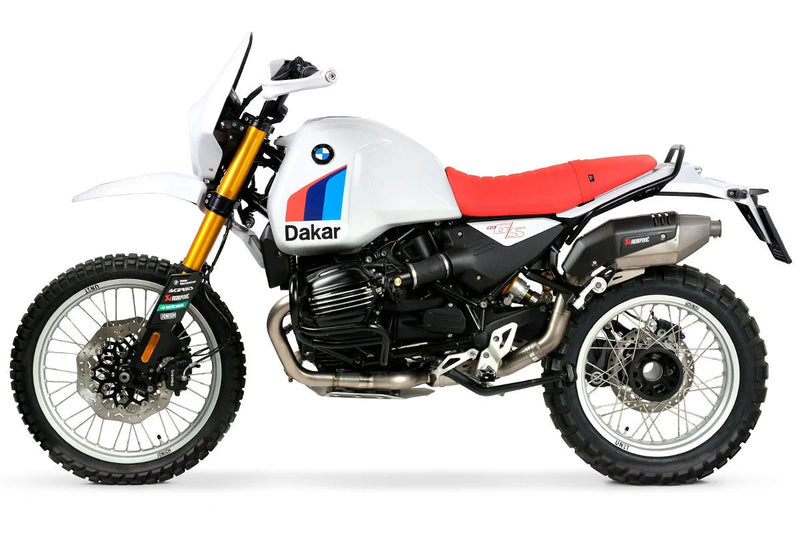
Today, the BMW GS continues to be a benchmark in the maxi-enduro segment. The GS's versatility, technological innovation, and longstanding reputation for reliability attract adventurers and motorcyclists of all kinds, from off-road enthusiasts to long-distance travelers. Events such as rallies and endurance competitions continue to cement the GS's dominant role in the adventure-motorcycle landscape.
In conclusion, the GS is not just a motorcycle but a living legend that represents the essence of freedom and adventure on two wheels. Whether you are a road veteran or a new enthusiast, discovering the history of the GS means understanding why it continues to be the preferred choice for those seeking uncompromising performance and a desire to explore the world.
This is an overview of the history and development of BMW's "GS" motorcycle series, with particular attention to the off-road and touring versions. Here is a summary of the main stages and models mentioned in the text:
-
Origins in the 1970s:
- The design of the "GS" series began in the late 1970s with BMW's involvement in off-road competitions such as the "Six-Days".
- BMW's tradition of off-road sporting activities dates back to the 1930s.
-
Sporting successes and development:
- Victory in the German off-road championship in 1979 provided the impetus to develop a road-legal production version based on racing experience.
- The R 80 G/S, launched in 1980, was the first large twin-cylinder enduro, introducing a new category of large touring enduros.
-
Popularity and globetrotters:
- The R 80 G/S quickly became popular among globetrotters thanks to its power reserves, long-distance comfort, and off-road capability.
- Participation in events such as the Paris-Dakar and African rallies brought notable successes.
-
Expansion of the range:
- In 1988, the R 100 GS was launched as the highest-displacement enduro on the world market at the time, achieving enormous commercial success.
- Subsequent models, such as the R 1150 GS and R 1200 GS, continued to dominate sales rankings in many countries.
-
Innovations and commercial success:
- In 1994, GS models with four-valve-per-cylinder engines became a major commercial success.
- In 2004, the R 1200 GS was introduced, followed by the HP2 Enduro in 2005, representing a return to the past with a particular focus on off-road riding.
-
A new era and specialization:
- In 2005, the R 1200 GS became the leader in the over-750 cc segment and ranked fifth in Italy's sales rankings.
- In 2006, the HP2 Enduro represented a sporting turning point with a specialized approach to design and engineering.
The history shows how BMW's GS series has evolved over time, becoming one of the most highly regarded and recognizable ranges of touring and off-road motorcycles.