

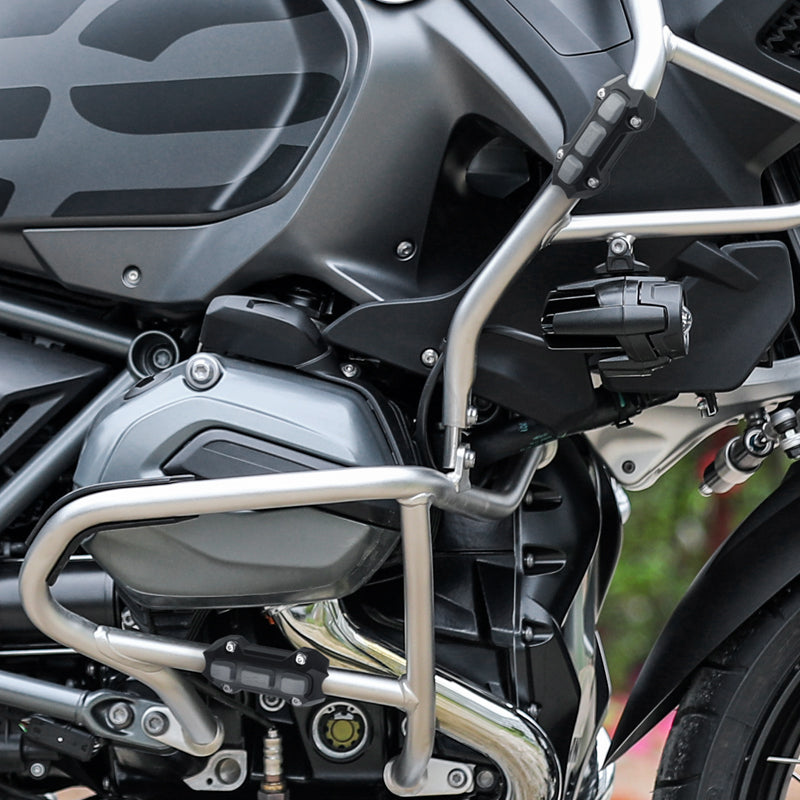
In short. Crash bars are protected with a pair of clamp-on crash protectors: in a stationary fall, they slide instead of the tube, and cost €22 compared with the hundreds of euros for a new bar. Before buying anything to mount on the bars - crash protectors, bags, auxiliary lights - measure the outside diameter of the tube: that number, not the motorcycle model, determines what fits.
- LOBOO crash protector and BHGB05T inflatable bag: 25 mm tube only.
- BHGB11T roll-top bag: tubes from 22 to 28 mm.
- Auxiliary lights: better anchored to a hole in the bar than tightened with a clamp.
Prices and availability verified in the Endurrad catalogue on 2 October 2026; the technical data are those declared by the manufacturers.
The crash protector wears out instead of the tube
Crash bars do their job only once, and that one time they get scratched. The crash protector lets you decide which part gets damaged.
The sacrificial part
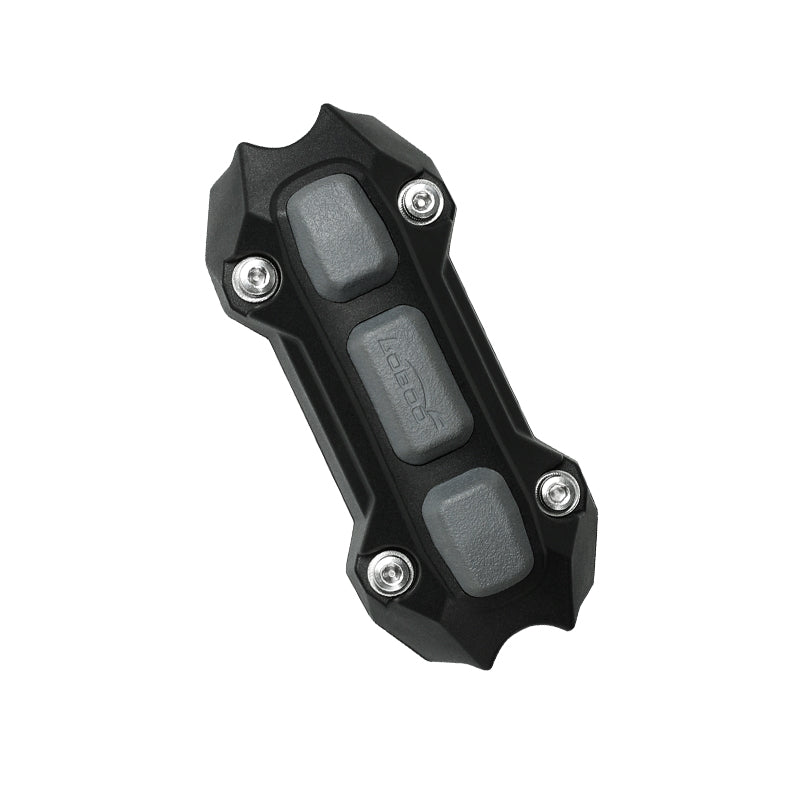
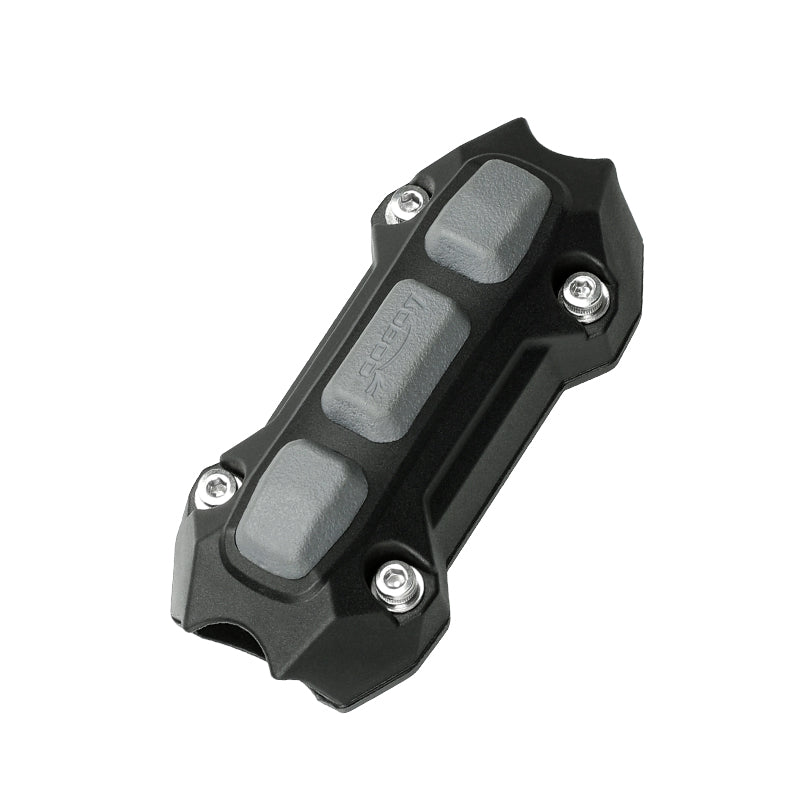
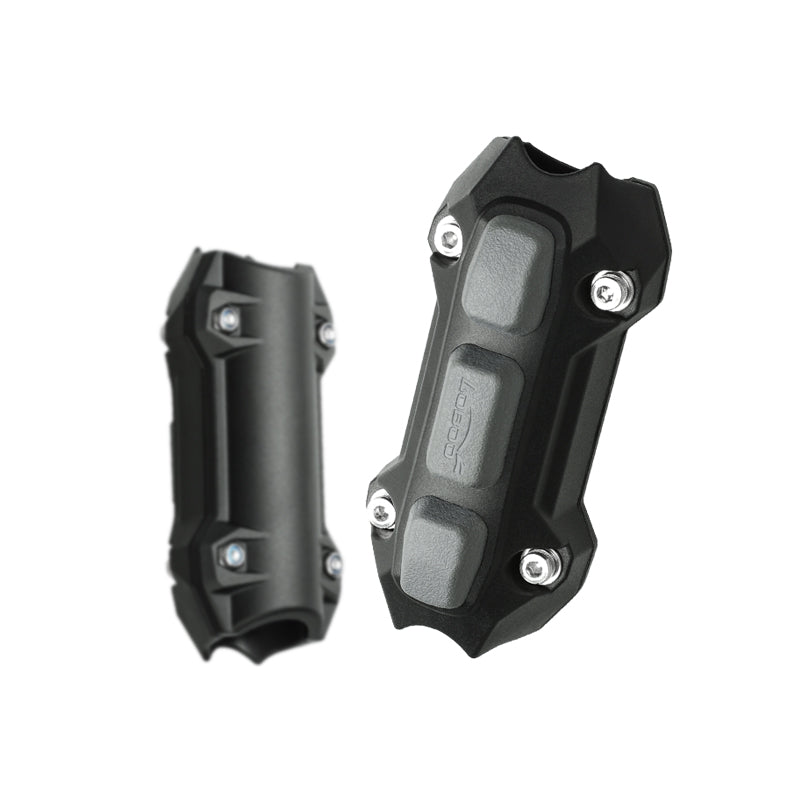
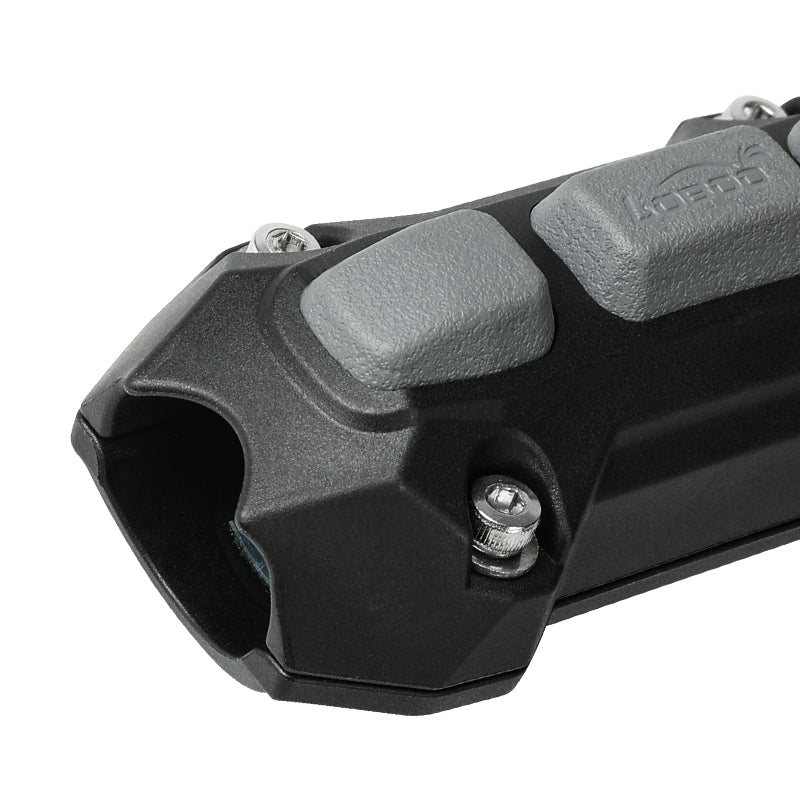
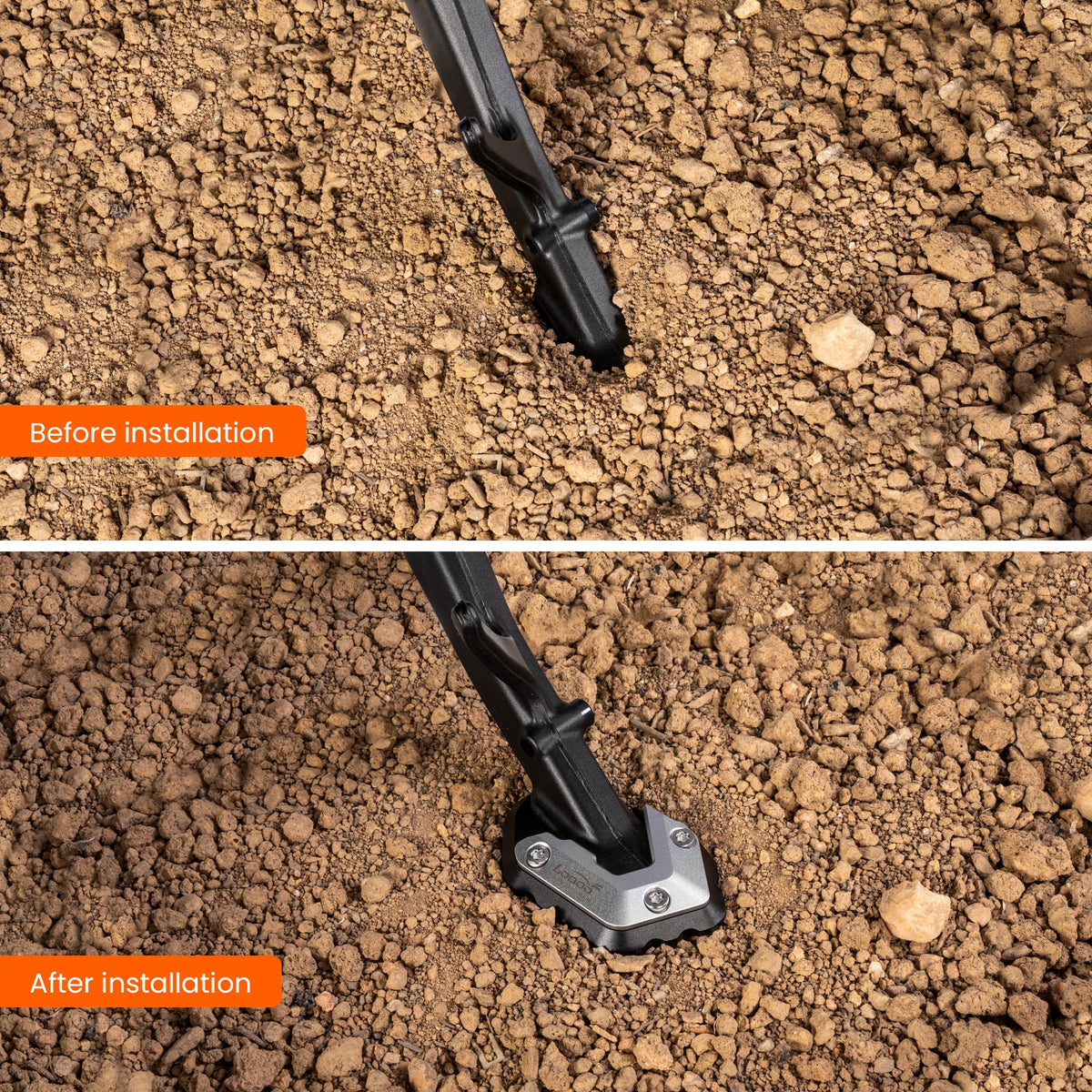
The 25 mm crash-bar protectors are two technical-plastic shells with rubber pads that clamp onto the most exposed point of the bar. In a stationary or low-speed fall, the crash protector is what slides along the asphalt: the tube underneath remains intact, and you replace a part costing a few euros instead of a bar.
Why four bolts instead of two
The clamp distributes the grip across four points, so the crash protector does not rotate on the tube when it takes a side impact - exactly the direction from which the impact comes in a sideways fall. A two-bolt clamp, under the same stress, turns and shifts out of position.
There is also a second benefit: the rubber pad widens the contact point by a few millimetres and keeps the fairings and engine block farther from the ground.


- Brand
- LOBOO
- Tube diameter
- 25 mm (only this size)
- Materials
- Engineering plastic and rubber pads
- Mounting
- 4-screw clamp, Allen key
- Weight
- 108 g per piece, 216 g per pair
- Package contents
- 2 bumpers + hardware
- Drilling
- None, reversible installation
The right spot is the one that touches first
No theory: the motorcycle itself tells you where to mount the bumpers as soon as you place it on its side stand.
- Place the motorcycle on its side stand and see which area of the crash bar protrudes farthest outward: normally, the vertical section at engine-block height.
- Open the bumper with the Allen key and place it on the selected section of tube, checking that there are no welds or brackets underneath.
- Position the screws without fully tightening them: the manual recommends completing positioning first.
- Tighten the four screws evenly, in a cross pattern.
- Recheck the tightness after the first few miles, as indicated by the manufacturer.
- the tube has an outer diameter of 25 mm
- the selected section is round and free of welds
- you want reversible installation without drilling
- does not fit 22 or 28 mm tubes
- does not replace the bar: it protects it
- does not turn the bar into an approved protective device

The bar diameter determines everything you can mount on it
A crash bar is also the only free structural point in the lower part of the motorcycle. Protectors, bags, and lights depend on a single number: the tube's outer diameter.
It does not depend on the motorcycle; it depends on the bar
This is the detail that prevents half of all incorrect orders. Two identical BMW R 1250 GS motorcycles may have different tubes if they use crash bars from different brands: the information must be found on the crash bar product sheet, or measured, not on the motorcycle's product sheet.
| Accessory | Tube diameter | Data source |
|---|---|---|
| LOBOO CHGJT25MM bumper | 25 mm | LOBOO product sheet |
| LOBOO BHGB05T inflatable bag | 25 mm, round section | LOBOO manual |
| LOBOO BHGB11T roll-top bag | From 22 to 28 mm | LOBOO product sheet |
| DENALI LAH0010300B spotlight clamps | From 21 to 29 mm | DENALI specifications |
| DENALI LAH0010400B spotlight clamps | From 32 to 38 mm | DENALI specifications |

Measure the tube in one minute, even without calipers
You need calipers or a tape measure. Compare the result with the table below before ordering any accessory.
- With calipers, measure the tube's outer diameter at the point where you want to mount the accessory.
- Without calipers, wrap a tape measure around the tube, read the circumference, and divide it by 3.14.
- Check the section: it must be free of welds and brackets, and away from the exhaust and cylinder heads.
| Outer diameter | Circumference measured with a tape measure | What you can mount on the mentioned accessories |
|---|---|---|
| 22 mm | approx. 69 mm | BHGB11T bag, DENALI clamps 21–29 mm |
| 25 mm | approx. 78.5 mm | LOBOO bumper, BHGB05T, BHGB11T, DENALI clamps 21–29 mm |
| 28 mm | approx. 88 mm | BHGB11T bag, DENALI clamps 21–29 mm |
LOBOO crash bars in the catalogue with 25 mm tubing
The diameter below is the one stated in the LOBOO product specifications; for original or other-brand engine guards, use the measurement taken on your motorcycle.
| Code | Motorcycle | Tube | Availability as of 2/10/2026 |
|---|---|---|---|
| CHG131 | BMW R 1300 GS | 25 mm | Available (high, full black) |
| CHG151 | BMW R 1300 GS Adventure (upper) | 25 mm | Out of stock |
| CHG082 | BMW R 1250 GS Adventure (tank) | 25 mm | Out of stock |
| CHG033 | BMW F 750 GS, F 800 GS, F 850 GS | 25 mm | Out of stock |
| CHG025S/X | BMW F 900 GS | 25 mm | Out of stock |
| CHG289 | Honda NX400 and NX500 | 25 mm | Out of stock |
| CHG441 | Aprilia Tuareg 660 | 25 mm | Out of stock |
| CHG581 | Ducati DesertX | 25 mm | Out of stock |
| CHG901 | Husqvarna Norden 901 up to 2025 | 25 mm | Available (silver) |
The entire range is in the crash bars and engine guards collection. High-wheel scooters (Honda X-ADV 750, ADV 350, Forza 350, Yamaha XMAX 300, BMW C 400 GT) use 22 mm LOBOO bars instead: 25 mm bumpers do not fit them.

- Compatibility
- BMW R 1300 GS from 2023 (not Adventure)
- Material
- 304 stainless steel, TIG welding
- Tube
- Ø 25 mm, 2 mm wall thickness
- Spotlight mounts
- Ø 6.5 mm holes, 21 mm hole spacing
- Contact
- Replaceable nylon and silicone bumper modules
- Complete set weight
- 8.76 kg
- Available
- High: black/silver, Full: black; low: out of stock
Between the bar and the fairing, there are six liters on each side
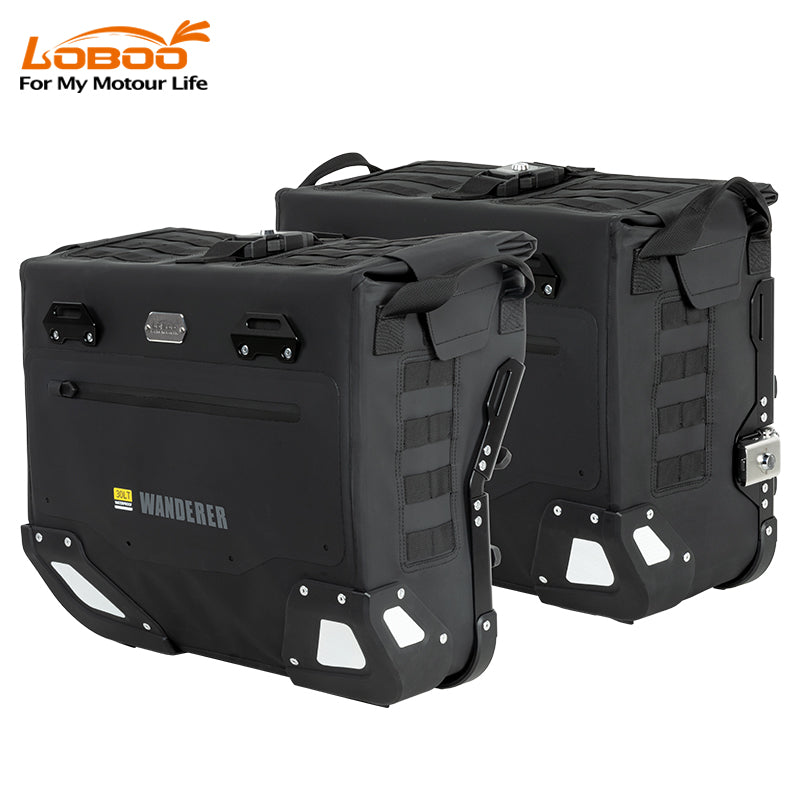
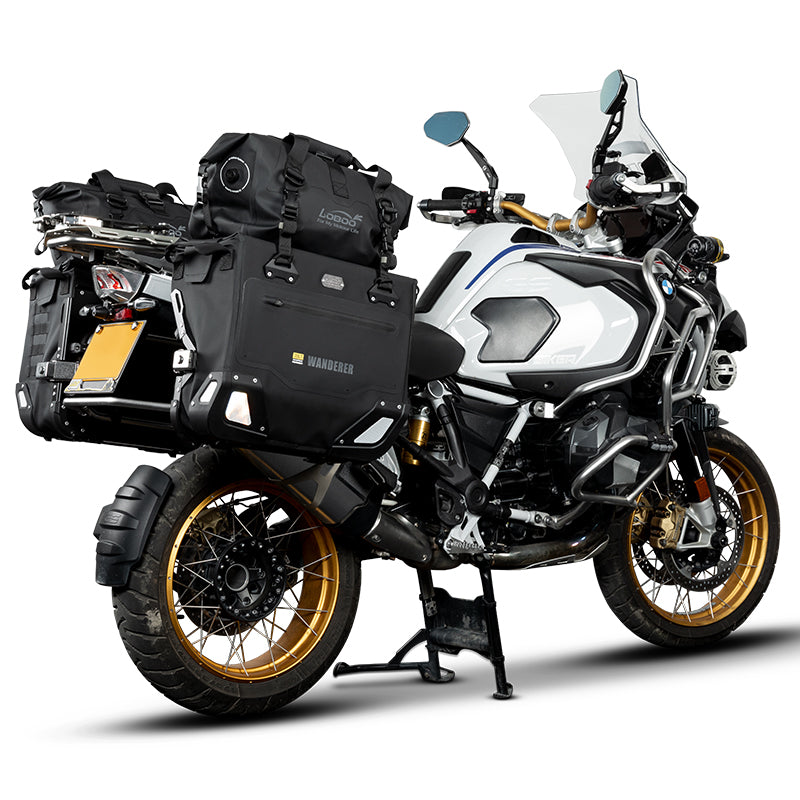
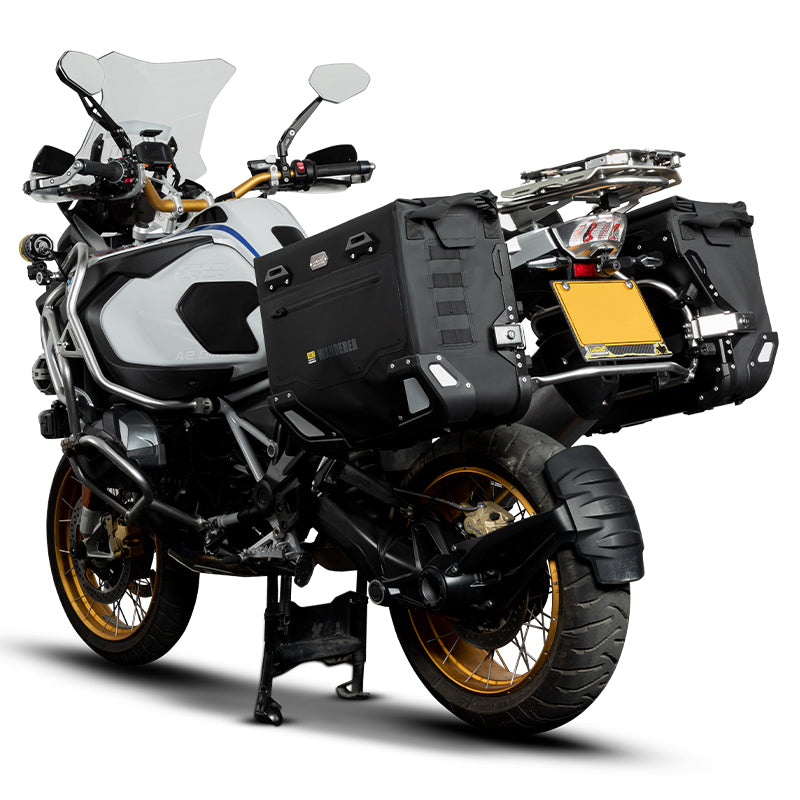
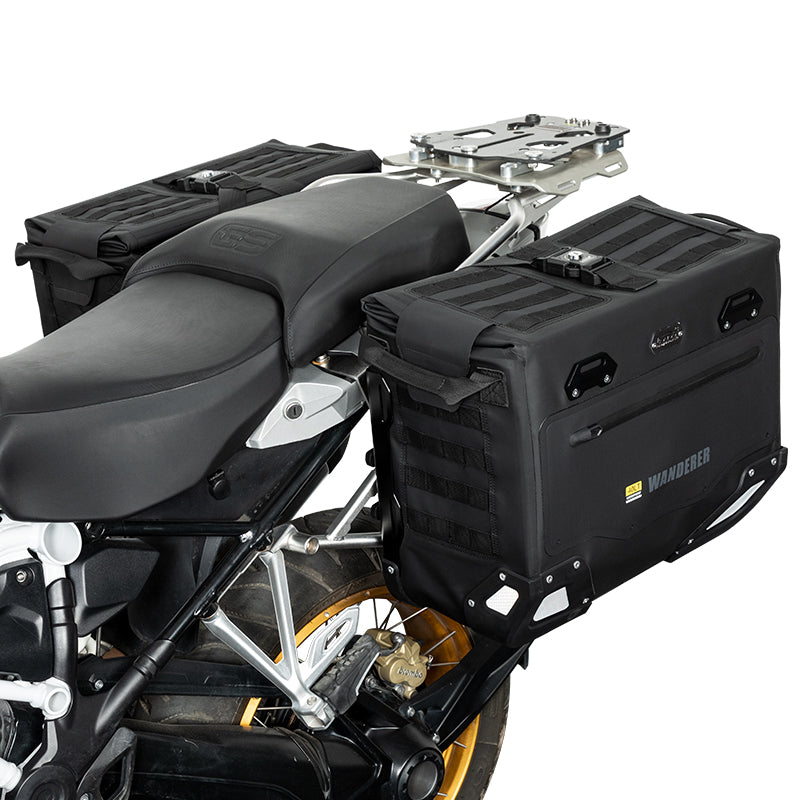
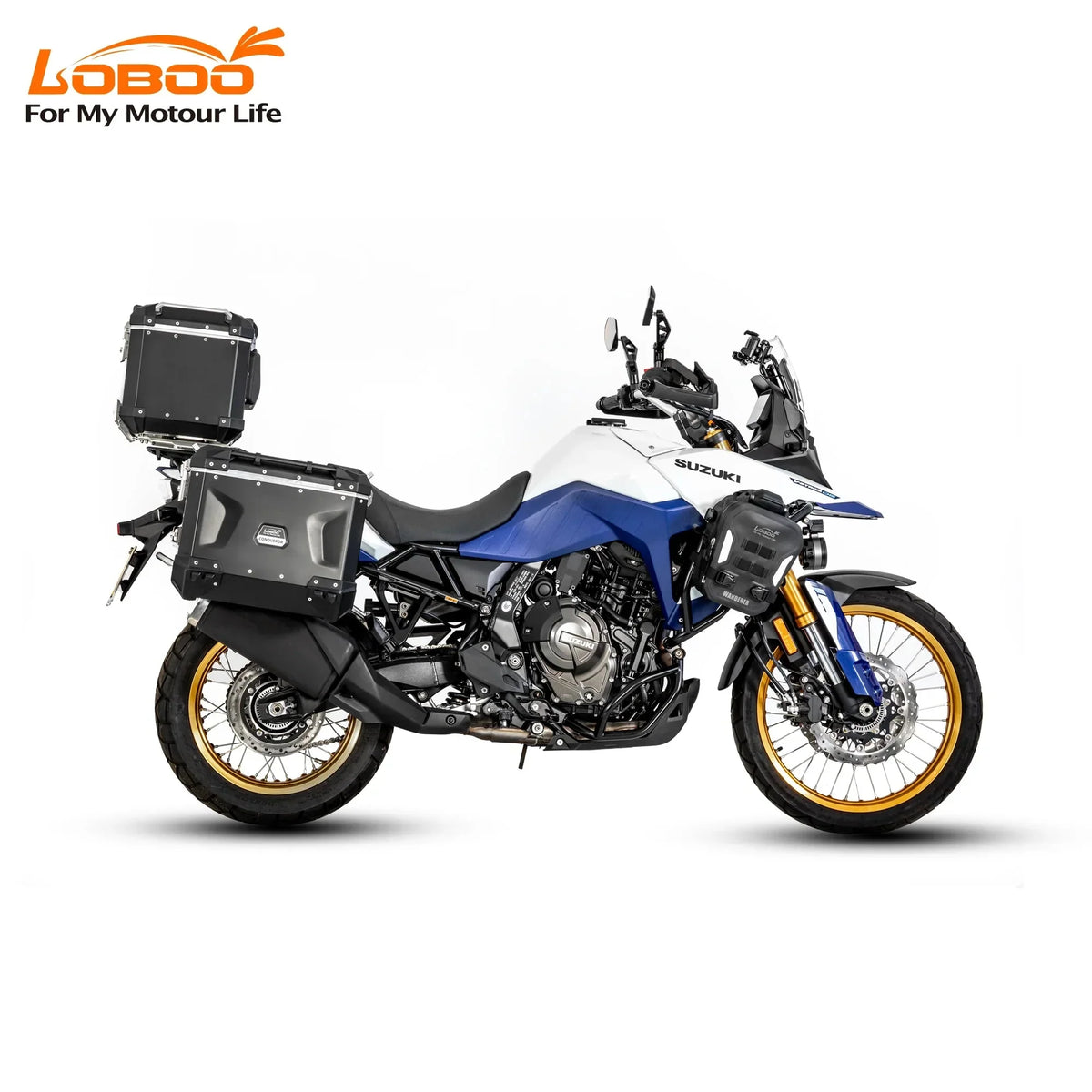
It is the quickest storage to access: standing beside the motorcycle, without removing your helmet or opening the luggage.
| Bag | Liters | Tube | Water resistance | Price |
|---|---|---|---|---|
| LOBOO WANDERER BHGB11T roll-top | 6 + 6 | 22–28 mm | IPX6 | 94,50 € |
| LOBOO WANDERER BHGB05T inflatable | 6 + 6 | 25 mm round | IPX7 | 234 € |
| LOBOO BHGB13 for R 1300 GS Adventure | 5 + 5 | Dedicated | — | €207 (sold out) |
- the tube measures 22, 25 or 28 mm
- you want to mount and remove it without tools
- IPX6 water resistance is enough for you
- the tube is round and measures 25 mm
- you want IPX7 and a key lock
- you want to deflate it and stow it at the end of the trip


- Capacity
- 6 L per bag, 12 L per pair
- Compatible tube
- From 22 to 28 mm
- Mounting
- Adjustable straps, tool-free
- Fabric
- TPU composite, 0.6 mm 840D mesh
- Closure
- Three-turn roll-top, two buckles
- Water resistance
- IPX6
- Structure
- Internal PP frame

- Capacity
- 6 L per bag, 12 L per pair
- Dimensions
- 230 × 100 × 330 mm
- Compatible tube
- Round Ø 25 mm
- Mounting
- 5-position buckle, M6×10 screw at 12 N·m, straps
- Water resistance
- IPX7 with waterproof zipper
- Inflation
- Integrated pump, ≥ 6 hours per inflation
- Anti-theft
- Steel cable and key lock
The comparison between crash bar bags and tail bags is in the guide to semi-rigid adventure motorcycle luggage; all the bags are in the engine guard and crash bar bags collection, while the complete technical guide to the inflatable bag is on the inflatable engine guard bags page.
Auxiliary lights hold better on a hole than on a clamp
The bars are the most protected position for auxiliary lights in a fall. But how you secure them determines whether the beam still points where it should after a few hundred kilometers.
Friction against the mounting point
A collar tightened around the tube holds by friction, and friction degrades with vibration: the auxiliary light can rotate. A mount secured to a bar hole cannot turn. That's why some crash bars are designed with mounting points already provided: the LOBOO CHG131 for R 1300 GS has Ø 6.5 mm holes with a 21 mm center-to-center spacing for auxiliary light mounts, and the LOBOO CWJ082 mount for R 1200/1250 GS Adventure uses 25 mm through spacers instead of the stock screw of the original BMW bar.
If you use clamps, choose the right size range
The universal DENALI clamps are sold by diameter: 21–29 mm (the most common size on adventure crash bars according to DENALI), 32–38, 39–49, and 50–60 mm. The octagonal inner profile also grips tubes that are not perfectly round.


- Compatibility
- Genuine BMW R 1200 / R 1250 GS Adventure crash bar
- Type
- 2 through spacers Ø 25 mm + long-shank screws
- Material
- CNC aluminum alloy
- Mounting
- On the bar hole, replacing the stock screw
- Included
- Mechanical mount only: auxiliary lights and wiring not included
The complete discussion of positions, height, and beam is in the guide to where auxiliary lights are actually mounted.
First measure, then protect, then load
The order matters because each step depends on the previous one, and the first costs nothing.
- Measure the tube with calipers or a tape measure before buying anything.
- Install the crash protectors if the diameter is 25 mm: it's the smallest expense with the best ratio of cost to damage avoided.
- Add the bags, choosing between roll-top and inflatable models based on the diameter and security you need.
- Install the auxiliary lights, using a mount anchored to a hole or clamps with the right size range, away from the bags.
- Double-check everything after the first few miles: crash protector screws, bag straps, and auxiliary light orientation.

Frequently asked questions about crash bars
What are crash bar protectors used for?
They are the sacrificial part: in a stationary or low-speed fall, they slide instead of the tube, which remains intact. The rubber pad also adds a few millimeters between the fairings or engine block and the asphalt.
How much do LOBOO crash bar protectors for 25 mm bars cost?
The LOBOO CHGJT25MM pair costs €22 at Endurrad (price checked on October 2, 2026). A new crash bar costs from approximately €175 to over €550, depending on the model and configuration.
Why does the clamp need four screws?
Because it distributes the load across four points instead of two: the protector does not rotate on the tube when it receives a side impact, which is the typical direction of impact in a sideways fall.
Where should the crash bar protectors be positioned?
At the most protruding point, normally the vertical section at engine-block height. Identify it by viewing the motorcycle on its side stand and observing which part of the crash bar protrudes the most.
How do you measure the diameter of a crash bar?
Use calipers to measure the outside diameter, or wrap a tape measure around it and divide the circumference by 3.14. A 25 mm tube has a circumference of approximately 78.5 mm, a 22 mm tube approximately 69 mm, and a 28 mm tube approximately 88 mm.
Does the bar diameter depend on the motorcycle model?
No, it depends on the crash bars installed. Two identical motorcycles can have tubes of different diameters if they are fitted with bars from different brands: check the crash bar specifications or measure the tube.
Do you need to drill the bar to install the crash bar protectors?
No. They open, are positioned on the tube, and are closed again by tightening the four screws with an Allen key. Installation is reversible, and they can be repositioned at any time.
Are the crash bar protectors suitable for bars of any diameter?
No, only on 25 mm tubing. The clamp is shaped for that diameter: on a thinner tube it would remain loose and rotate on the first impact, while on a thicker one it would not close.
Which LOBOO crash bars have 25 mm tubing?
According to LOBOO’s specifications, the following models have 25 mm tubing, among others: CHG131 for BMW R 1300 GS, CHG151 for R 1300 GS Adventure, CHG082 for R 1250 GS Adventure, CHG033 for F 750/800/850 GS, CHG025 for F 900 GS, CHG289 for Honda NX400 and NX500, CHG441 for Aprilia Tuareg 660, CHG581 for Ducati DesertX, and CHG901 for Husqvarna Norden 901.
Which bags can be mounted on crash bars?
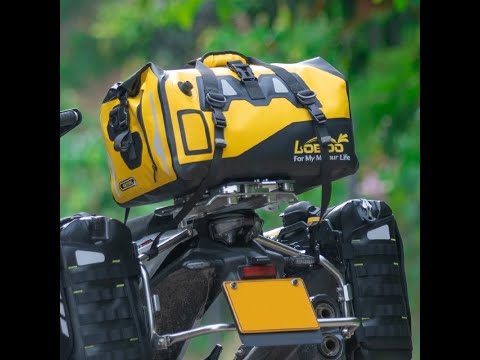
Endurrad offers two types: the 6-liter-per-side LOBOO WANDERER BHGB11T, with adjustable straps for tubes from 22 to 28 mm, and the 6-liter-per-side inflatable BHGB05T, which the manual specifies for a 25 mm round tube. A dedicated 5-liter hard-shell bag is also available for the R 1300 GS Adventure.
Is the inflatable or roll-top bag better for crash bars?
The BHGB11T roll-top costs less, has an internal PP structure and fits tubes from 22 to 28 mm. The inflatable BHGB05T has a stated IPX7 rating, key-operated anti-theft protection and deflates when not needed, but requires a 25 mm tube.
Can auxiliary lights be mounted on engine-guard bars?
Yes, and it is a protected position. The most stable attachment is to a hole in the bar, using a spacer or a dedicated bracket; a tight collar around the tube holds by friction and may rotate with vibrations. If you use clamps, choose the right size: DENALI offers them for tubes from 21 to 29 mm, 32 to 38, 39 to 49 and 50 to 60 mm.
Is there a standard diameter for auxiliary-light clamps?
No. The clamps are sold for diameter ranges: for example, the DENALI LAH0010300B pair covers tubes from 21 to 29 mm, which includes both 22 and 25 mm. Before ordering, measure the tube rather than looking up the motorcycle.
How often should the tightness of bumpers and bags be checked?
The bumper manual recommends checking the tightness again after the first few kilometers. The same applies to crash-bar bags after the first few dozen kilometers, and then before every departure: checking the screws and straps takes just a few seconds.
Don't know the diameter of your bars?
Write to us with your motorcycle's make, model and year, and the make of the engine guard if it is not the original one: we will check the tube diameter before you order bumpers, bags or auxiliary-light mounts. You can also find the full range of protection products in the Endurrad app for iPhone.
See the 25 mm bumpersSources: LOBOO technical data sheets and manuals (CHGJT25MM bumpers, WANDERER BHGB11T and BHGB05T bags, CHG131 and CHG901 crash bars, CWJ082 auxiliary-light mount) and the DENALI data sheet for LAH0010300B clamps - data declared by the manufacturers. LOBOO crash-bar diameters from the respective Endurrad product pages. Prices and availability checked on October 2, 2026, and subject to change. Circumferences are editorial calculations (diameter × 3.14).


Share:
Motorcycle tool kit: what to really bring on a trip
Auxiliary spotlight mounts: where additional spotlights are actually installed