

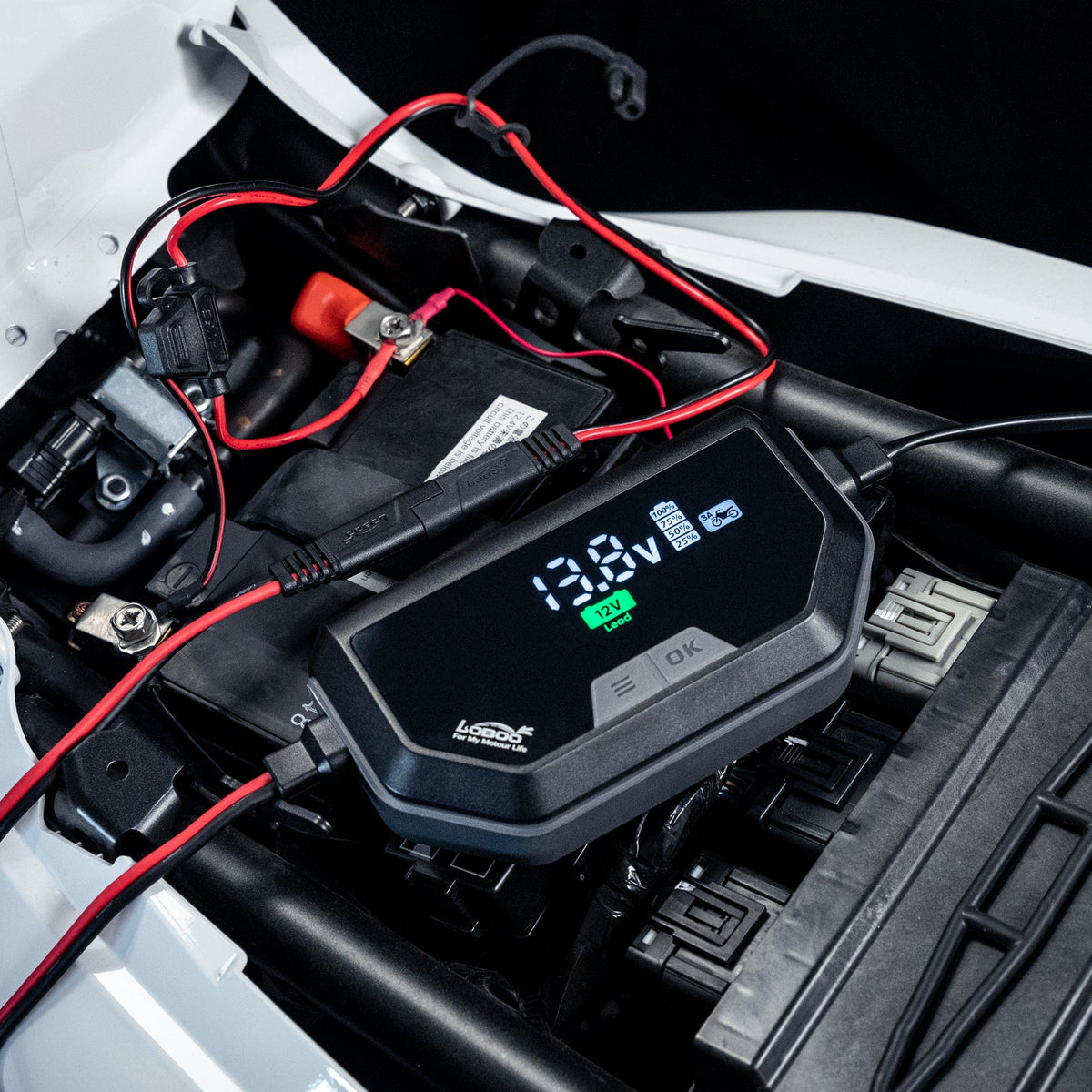
In brief. A motorcycle battery maintainer is an automatic charger that stops charging when the battery is full and remains connected to monitor it, intervening only when the voltage drops. This is what is needed during months of storage, because a lead-acid battery left to drop below 60% charge begins to sulfate and permanently loses capacity.
- Amperage: for a motorcycle battery (about 4-20 Ah), 1 to 3 A is enough; higher ratings are only needed for cars.
- Chemistry: LiFePO4 lithium requires a dedicated charging profile and does not tolerate continuous lead-acid maintenance charging.
- Connection: a fixed cable connected to the terminals with a quick connector is the difference between using it all winter and leaving it in a drawer.
- Where you power it: an outlet in the garage, a power bank, or no outlet at all changes which model is right.
Product data stated by LOBOO in the user manuals; voltage and self-discharge values from Battery University and Yuasa. Prices and availability checked on Endurrad on October 12, 2026.
A battery maintainer charges a little and keeps monitoring
Charger, battery maintainer, trickle charger, booster: in stores, the names get mixed up, but these are four devices with four different jobs. Choosing the wrong category is the most common mistake, and the most expensive one.
| Device | What it does | Can it be left connected? | When it is needed |
|---|---|---|---|
| Smart battery maintainer | Charges in stages, then switches to maintenance mode and resumes only when the voltage drops | Yes, for the entire storage period | Winter storage, motorcycle used rarely |
| Charger without maintenance mode | Brings the battery to a full charge and stops | No, it must be disconnected when charging is complete | Occasional recharging of a discharged battery |
| Traditional trickle charger | Always applies the same current or voltage, without diagnostics | Not recommended: it does not know when to stop | Now replaced by automatic models |
| Emergency starter (booster) | Provides the boost needed to start the engine immediately | No | Dead battery far from home |
Why storage is the critical time
According to Battery University, a lead-acid battery at 20 °C loses about 3% of its charge per month through self-discharge, and the rate doubles for every additional 10 °C. Anti-theft systems, immobilizers, and control units that draw current even when the ignition is off add to this. The point of no return is 60% charge: left below that threshold, a lead-acid battery sulfates. We explain why it discharges and at which voltages to intervene in our guide to the motorcycle battery in winter.

Choose the amperage based on the battery’s capacity, not the largest number
The most frequently searched question is “how many amps should a motorcycle battery maintainer have?” The answer is on the battery label: its capacity in Ah, which for a motorcycle normally ranges from 4 to 20 Ah.
No formula is needed: simply read the ranges that manufacturers specify for each current. These are the ranges for the three LOBOO chargers in the catalog.
| Model and current | Lead-acid and AGM | LiFePO4 lithium | Typical use |
|---|---|---|---|
| C20Pro, up to 1.25 A (with an 18 W power supply) | 4-35 Ah | 4-35 Ah | Motorcycles, scooters, quads |
| C40T, 1 A or 4 A | 1-120 Ah total: 1 A for motorcycle batteries, 4 A for car batteries | Motorcycles, including 6 V models, and cars | |
| C60 at 3 A | 3-20 Ah | 1-20 Ah | All motorcycle batteries |
| C60 at 6 A | 15-120 Ah | 6-120 Ah | Large motorcycles and cars |
How long does it take to recharge?
A theoretical estimate helps avoid unrealistic expectations. A 12 Ah battery that has fallen to half charge needs to recover about 6 Ah: at 0.8 A, the current that the C20Pro delivers with a 12 W USB power supply according to the manual, that takes at least 7-8 hours, and in practice longer because the current drops during the final stages. At 3 A, the same job takes just over two hours. For maintenance charging, current matters little; for recovering a discharged battery, it matters a lot.
Lead-acid, AGM, and lithium batteries require different charging curves
On recent large adventure bikes, the AGM battery remains the most common, but lithium iron phosphate (LiFePO4) is gaining ground, especially as a replacement to save weight. And lithium changes the rules for maintenance charging.
| 12 V battery | Nominal voltage | Maximum charge | Float |
|---|---|---|---|
| Lead-acid (6 cells) | 12 V | 14.4 V | 13.5 V |
| LiFePO4 with a lithium charger (4 cells) | 12.8 V | 14.6 V | No continuous charging |
Nominal values from Battery University, BU-409b. Yuasa indicates a resting voltage of 12.8-13.0 V for a charged AGM and 12.6 V for a conventional battery.
Lithium doesn’t want the trickle
A lead-acid charger, once charging is complete, keeps the battery at about 13.5 V to compensate for self-discharge. Battery University explains that lithium does not tolerate this continuous charging: extending it shortens the battery's life. The right maintainer for a LiFePO4 battery completes the charge, stops the current, and restarts only when the voltage falls to a threshold. That is why, with a lithium battery, the dedicated mode is not optional.
Desulfation: lead-acid only
The recovery functions (Repair on the C60, regeneration for up to two hours on the C40T) are intended for slightly sulfated lead-acid batteries. They make no sense for a lithium battery: there, the useful function is different, namely activation of a battery that has fallen below the threshold at which its protection circuit isolates it, as stated for the C40T and C60. Neither function can bring an end-of-life battery back to life.

The cable left on the motorcycle determines whether you will actually use the battery maintainer
Having to remove the seat and fairings every time you want to charge is the number one reason battery maintainers end up forgotten on a shelf. The solution costs just a few euros and only needs to be installed once.
- Secure the cable with ring terminals to the battery posts: red to positive, black to negative, under the original bolts. The motorcycle manual specifies the order in which to disconnect the posts.
- Position the connector somewhere accessible with the seat installed, away from the exhaust, chain, and moving parts, and secure the cable with zip ties.
- Connect the battery first, then the mains. This is the sequence specified in the LOBOO manuals; on the C40T, it is also the only way to start activating a deeply discharged lithium battery.
- Set the battery type and current (C40T and C60), or let the C20Pro operate on its own, as it recognizes the battery automatically.
- When charging is finished, disconnect it in reverse order and close the connector cap.
The fused SAE cable
The SAE cable for a motorcycle battery (CSAE-19) has an 18 AWG copper conductor, a 15 A blade fuse in a waterproof fuse holder, and an IPX5 connector with cap, available in 50 or 120 cm versions. The version with an LED charge indicator (CSAE-20) adds push-button readings: green above 12.6 V, yellow between 12.0 and 12.6 V, red below 12.0 V. The C60 already comes with its own SAE cable; the C20Pro and C40T include their own quick-connect cable.

Outlet in the garage, garage without power, or travel: three scenarios, three tools
There is no single best maintainer. There is the right one for the place where your motorcycle spends the winter.
Garage with a power outlet
This is the classic case: a mains charger with a display and automatic maintenance, left hanging on the wall for the entire season. Here, durability matters: both the C40T and the C60 claim an IP65 protection rating, meaning protection from dust and water jets, not immersion. If there is also a car in the garage, the 4 or 6 A current covers that too.
Condominium garage or parking space without an outlet
This is the situation in which almost everyone gives up. The C20Pro mini charger is powered from a USB-A port, including a power bank: connect it, let it work, then take it home to recharge. The manual specifies 0.35 A with 5 W, 0.8 A with 12 W, and 1.25 A with 18 W input; above 20 Ah, LOBOO recommends the 18 W power supply.
On the road
During a trip lasting several days, the alternator recharges the battery. A pocket-sized maintainer is useful in one specific situation: when the motorcycle is parked for a few days somewhere with only a USB outlet, or when an accessory has accidentally been left on. At 6.9 cm long, the C20Pro fits in the tool bag. Anyone who also wants to read the voltage while riding can consider the dual bidirectional USB-C outlet with voltmeter, which is not a storage maintainer, however.
- the motorcycle remains unused for more than two or three weeks at a time
- you have an alarm or accessories that are always powered
- you mainly ride short trips in cold weather
- the battery is already a few years old
- a battery at the end of its life or damaged
- a faulty motorcycle charging system
- immediate starting with a dead battery
- a swollen or leaking battery: it must be replaced
C20Pro, C40T, and C60: three maintainers for three different garages
These are the three battery maintainers currently listed in Endurrad's catalog. Data from LOBOO user manuals; prices and availability as of October 12, 2026.
| Feature | C20Pro | C40T | C60 |
|---|---|---|---|
| Power supply | USB-A, 5-18 W | 100-240 V mains | 100-240 V mains |
| Battery voltage | 12 V | 6 and 12 V | 12 V |
| Current | Up to 1.25 A | 1 A or 4 A | 3 A or 6 A |
| Batteries | Lead-acid, AGM, LiFePO4 | SLA, AGM, LiFePO4 | Lead-acid, AGM, LiFePO4 |
| Capacity | 4-35 Ah | 1-120 Ah | 1-120 Ah depending on chemistry and current |
| Cycle | 6 stages + Softstart | 9 stages, regeneration up to 2 h | Multi-stage, Repair and Force |
| Setting | Automatic | MODE and current buttons | Display, remains in memory |
| Display | LED indicators | LCD | Display |
| Protection | Not stated | IP65 | IP65 |
| Ideal for | Garage without an outlet, travel | Garage with classic motorcycles and cars | Garage with modern motorcycles and cars |
| Price | 32 € | 84 € | 81 € |
| Status | Available | Out of stock | Out of stock |

- Input
- USB-A, 5-18 W
- Output
- 14.6 V max, up to 1.25 A
- Maintenance
- 300 mA
- Batteries
- 12 V lead-acid, AGM, LiFePO4
- Capacity
- 4-35 Ah
- Cycle
- 6 stages + Softstart
- Dimensions
- 6,9 × 3,7 cm
- Protections
- Short circuit, overcharge, reverse polarity

- Input
- AC 100-240 V
- Current
- 3 A or 6 A
- At 3 A
- Lithium 1-20 Ah, lead-acid/AGM 3-20 Ah
- At 6 A
- Lithium 6-120 Ah, lead-acid/AGM 15-120 Ah
- Modes
- Lead, AGM, Lithium, Repair, Force
- Protections
- Overcharge, short circuit, reverse polarity, undervoltage
- Protection rating
- IP65
- In the box
- SAE cable, clamps, 4 cable ties

- Input
- 100-240 V, 50-60 Hz
- Voltages
- 6 and 12 V, automatic detection
- Current
- 1 A motorcycle, 4 A car (6 V slow charging only)
- Batteries
- SLA, AGM, LiFePO4, 1-120 Ah
- 12 V thresholds
- 14.4 V charging, 13.5 V maintenance
- Charge recovery
- at 12.6 V
- Protection rating
- IP65
- Protections
- Short circuit, reverse polarity, overcharge, temperature
Six mistakes that shorten battery life even with a maintainer
The maintainer works well only if you use it properly. These are the mistakes we see most often.
- Connecting it to an already dead battery and expecting a miracle. Regeneration and Repair help with light sulfation, not with a battery at the end of its life.
- Using lead-acid mode on a lithium battery. Continuous maintenance at 13.5 V is what a LiFePO4 battery cannot tolerate.
- Connecting it to the dashboard socket on a BMW without a charger declared compatible: the control unit may disconnect it.
- Putting the motorcycle away already discharged. Store it with the battery charged and the maintainer connected from the start, not in January.
- Charging a lead-acid battery in an enclosed, unventilated area. The C40T manual reminds you that lead-acid batteries can emit gas during charging.
- Forgetting the cold. Below 10 °C, LOBOO asks users to use AGM mode on lead-acid batteries with the C40T: the manual's operating conditions must be read.

Frequently asked questions about motorcycle battery maintainers
What is a motorcycle battery maintainer?
It is an automatic charger that brings the battery to full charge and then switches to maintenance mode: it remains connected and intervenes only when the voltage drops. It keeps the battery in good condition during periods of inactivity, especially in winter.
What is the difference between a battery maintainer and a charger?
A simple charger brings the battery to full charge and must be disconnected. After charging, a maintainer monitors the battery and recharges it only when necessary, so it can remain connected for weeks. Many modern models, such as the LOBOO C20Pro, C40T, and C60, do both.
Can you leave the battery maintainer connected to the motorcycle all the time?
Yes, if it is an automatic model with a maintenance phase: it is specifically designed to remain connected throughout the period of inactivity. A charger without a maintenance function or an old trickle charger should instead be disconnected once fully charged.
How many amps should a motorcycle battery maintainer have?
For motorcycle batteries, which normally range from 4 to 20 Ah, currents between 1 and 3 A are sufficient: this is the range manufacturers indicate for this capacity range. The LOBOO C60 at 3 A covers lead-acid batteries from 3 to 20 Ah and lithium batteries from 1 to 20 Ah; currents of 4-6 A are intended for large batteries and cars.
Is a battery maintainer suitable for a motorcycle's lithium battery?
Only if it has a mode specifically for lithium iron phosphate (LiFePO4). Battery University explains that lithium does not tolerate the continuous float charging used for lead-acid batteries: the right charger completes the charge, stops the current, and restarts only when the voltage drops.
Can I use desulfation mode on a lithium battery?
No. Desulfation, Repair, and regeneration are intended for slightly sulfated lead-acid batteries. For lithium batteries, the useful function is activating batteries that have fallen below the protection threshold, which LOBOO states is available on the C40T and C60.
How do you use a battery maintainer if there is no outlet in the garage?
With a charger powered via USB, such as the LOBOO C20Pro, which also works from a power bank. According to the manual, it delivers 0.35 A with 5 W, 0.8 A with 12 W, and 1.25 A with 18 W input; above 20 Ah, LOBOO recommends the 18 W power supply.
Can I connect the battery maintainer to the BMW's accessory socket?
Only with a charger declared compatible with that socket; otherwise, the vehicle's electronics may disconnect it after a short time. LOBOO does not declare this compatibility for the C20Pro, C40T, and C60, so on a BMW they must be connected to the battery terminals or to a permanently installed SAE cable.
What is an SAE cable used for?
It is a cable that is attached once to the battery terminals and brings a connector to a convenient location. From there, you can connect a battery maintainer, compressor, or USB socket without removing the seat. The LOBOO CSAE-19 cable has a 15 A fuse and an IPX5 connector; the CSAE-20 adds an LED that indicates the battery status.
How long does it take to recharge a motorcycle battery with a maintainer?
It depends on the current and how discharged the battery is. A 12 Ah battery that has dropped to half charge needs to recover about 6 Ah: at 0.8 A, that takes at least 7-8 hours; at 3 A, a little over two hours. These are theoretical estimates: the actual time is longer because the current decreases toward the end of charging.
Can the maintainer restart the motorcycle when the battery is completely flat?
No. Maintainers work with low currents and recharge batteries over several hours. To start a motorcycle immediately with a flat battery, you need an emergency starter (booster), which is a different device.
Is there a maintainer for 6-volt batteries in vintage motorcycles?
Yes, but many inexpensive models work only at 12 V. In the LOBOO range, the C40T handles both 6 and 12 V, with automatic voltage detection; at 6 V it charges only in slow mode.
Can the maintainer be kept in a damp garage?
It depends on the stated protection rating. C40T and C60 are rated IP65, meaning they are protected from dust and water jets but not immersion. LOBOO does not state an IP rating for the C20Pro.
If the maintainer is connected, do you need to disconnect the battery?
No: the maintainer compensates for both self-discharge and the power consumption of alarms and control units. Disconnecting the negative terminal without a maintainer eliminates parasitic consumption, but not self-discharge, which is about 3% per month at 20 °C for lead-acid batteries according to Battery University.
Read next
Don't know which battery maintainer is right for your battery?
Tell us the motorcycle's make, model, and year, and, if you know it, the battery designation: we'll check the chemistry and capacity and tell you which charger and cable you need.
Motorcycle batteries and chargers





Share:
Motorcycle power distribution unit: CB20 or CB10, and how many amps can they really handle for auxiliary lights, heated grips, and outlets
New Highway Code and motorcycles: what is already law, what is only a draft, and what to do now