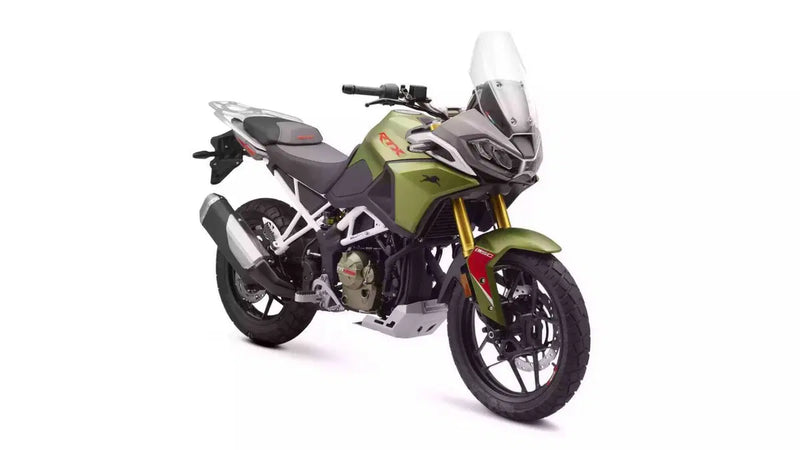



In brief. The BMW F 600 GS does not yet exist as a production motorcycle: BMW Motorrad has not announced it and has communicated neither a name, nor specifications, nor a date. There is a prototype undergoing testing, photographed by the German magazine Motorrad in August 2026, with a 21-inch front wheel, dual discs, and a steel frame. Rumors point to a parallel twin of 585-600 cc producing 65-70 hp and a dealership arrival no earlier than 2028.
The point that almost everyone overlooks: between the F 450 GS (€7,590) and the F 900 GS (€14,600), BMW already sells the F 800 GS (€11,100). The new mid-size GS would not fill a price gap, but rather the gap for a lightweight BMW with a 21" off-road wheel, namely the territory of the Yamaha Ténéré 700.
BMW has not announced any F 600 GS: the only certainty is that there is a prototype
Every piece of information circulating about this motorcycle should be read with a label alongside it. Below, we separate what is confirmed from what is merely likely or completely unknown.
| Element | Status | Source |
|---|---|---|
| Prototype undergoing road testing | Documented | Spy photos published by Motorrad (August 2026), picked up by the entire European press |
| Official BMW announcement | Absent | No BMW Motorrad or BMW Group PressClub press release |
| 21" front wheel | Visible on the prototype | Spy photos |
| Dual front disc | Visible on the prototype | Spy photos |
| Steel frame, similar to the F 900 GS | Likely | Interpretation of the photos (inSella, ADV Pulse) |
| 18" rear wheel | Likely, but not unanimous | ADV Pulse and inSella indicate 18"; other readings do not rule out 17" |
| Displacement of 585-600 cc | Rumor | Specialist press, no BMW data |
| Power output of 65-70 hp | Rumor | Specialist press, no BMW data |
| Weight under 200 kg | Hypothesized objective | MotorBox, ADV Pulse (estimated at around 204 kg) |
| Commercial name | Unknown | F 600 GS and F 650 GS are journalistic hypotheses |
| Price | Unknown | Specialist publications estimate around €10,000: this is an estimate |
| Release | Unknown | Recurring hypothesis: production from 2028 |
What BMW really said
The only official statements are general in nature. Markus Flasch, CEO of BMW Motorrad, had already explained with the F 450 GS concept that a family of models would be built around the new twin-cylinder platform, and at EICMA 2025 he identified the 450 to 900 cc range as an area of interest. Neither statement announces an F 600 GS. Both do, however, make the hypothesis consistent with the brand's strategy.

The prototype has a 21-inch front wheel: BMW is building an off-road GS
Anyone fitting a 21" front wheel is not making a crossover. It is the size used by the Ténéré 700, Transalp and F 900 GS, and says much more than power.
What can be read from the photos with reasonable certainty
- Cross-spoked tubeless wheels, 21" up front: according to ADV Pulse, the rear is also 18".
- Steel bridge frame, closer to that of the F 900 GS than to the F 450 GS's trellis frame: BMW would not simply be «inflating» the smaller model.
- Dual front disc with components that ADV Pulse believes were taken from the larger models.
- Headlight with an X-shaped light signature in the style of the R 1300 GS, without the typical GS front beak: on a test mule, this may be a part that has not yet been fitted.
- Upside-down fork and monoshock with long travel, consistent with genuine off-road use.
- handles rocks, steps and potholes better
- holds its line on gravel and sand
- wide choice of knobby tires
- slower steering when changing direction
- less precision in fast corners
- more sensitivity to road grooves

The Norton Atlas's 585 twin is a relative, not a twin
BMW is producing the F 450 GS with Indian partner TVS, and TVS controls Norton, which has just unveiled the Atlas with a 585 cc parallel-twin engine. Hence the theory that the new GS might use that engine. The premises are true, but the conclusion is not - or not yet.
Why 135° and 270° are not a detail
The F 450 GS's twin-cylinder engine has a 135-degree crank, chosen by BMW for smooth low-end delivery and a distinctive sound. The Norton Atlas's 585 uses a 270-degree crankshaft instead, the classic layout of modern parallel twins. These are two architectures with different characteristics. ADV Pulse emphasizes that it is unclear which solution BMW will adopt; MotorBox speculates that it will retain the 135° timing.
The most accurate reading today is this: the future GS's engine would belong to the same industrial family, and the Atlas shows that this configuration can handle 585 cc and nearly 70 hp. No one has demonstrated that it is the same engine.
What 65-70 hp would mean on the road
Taken at face value, those figures would put the BMW just below the Ténéré 700 (73.4 hp) and well below the F 800 GS (87 hp) and Transalp (92 hp, according to Honda). In this category, that is not automatically a disadvantage: the Ténéré has become the benchmark despite being, on paper, the least powerful of its rivals. Mid-range torque, weight, and fuel consumption matter, and BMW has communicated nothing about these.

In BMW's price list, the gap is not in price: it is a lightweight GS with a 21-inch wheel
Many articles mention a €7,000 and 40-kilogram gap between the F 450 GS and F 900 GS. They forget the F 800 GS, which already sits in between. The full comparison changes the picture.
| Model | Engine | Power | Weight | Front wheel | Price from |
|---|---|---|---|---|---|
| F 450 GS | 420 cc | 48 hp | 178 kg in running order | 19" | 7.590 € |
| Mid-size GS (assumption) | 585-600 cc | 65-70 CV | target under 200 kg | 21" | not disclosed (estimated ~€10,000) |
| F 800 GS | 895 cc | 87 hp | 227 kg in running order* | 19" | 11.100 € |
| F 900 GS | 895 cc | 105 hp | 219 kg DIN unladen | 21" | 14.600 € |
The reading that changes everything
Today, anyone who wants a BMW with a 21" front wheel has to move up to the F 900 GS: 105 hp and 14,600 euros. The F 800 GS costs less but is a road and light off-road motorcycle, with a 19" wheel and a weight of 227 kg. The mid-size GS would fill precisely this gap: BMW's lightest motorcycle with a genuine off-road focus, under 200 kg and around 10,000 euros, if the estimates are confirmed.
There is also the issue of licensing: the F 800 GS already exists in an A2 version with 48 hp (BMW Motorrad Italia). A 65-70 hp motorcycle would fit the same formula, but for now it is only an estimate.

Against the Ténéré 700, the BMW would compete on weight and electronics, not horsepower
The Yamaha Ténéré 700 is the natural benchmark: 21- and 18-inch wheels, essential electronics, and a huge community. Here is where the BMW would fit, with the estimates column clearly separated from the list-price data.
| Item | BMW mid-size GS (estimate) | Yamaha Ténéré 700 | Norton Atlas |
|---|---|---|---|
| Engine | 585-600 cm³ parallel twin | 689 cm³ CP2 twin-cylinder, 270° | 585 cm³ twin-cylinder, 270° |
| Power | 65-70 CV | 73.4 hp at 9,000 rpm | 69 hp at 9,300 rpm |
| Torque | not known | 68 Nm at 6,500 rpm | 57 Nm at 7,500 rpm |
| Weight | target under 200 kg | 208 kg in running order | not stated |
| Wheels | 21" / 18" (probable) | 21" / 18" spoked wheels | 19" / 17" |
| Fuel tank | not known | 16 L | not detected |
| Seat | not known | 860-875 mm | not detected |
| Price | not disclosed | 10.999 € | £ 8.250 (UK) |
| Availability | 2028 estimate | on sale | coming soon |
- weight: ten fewer kilos are noticeable when maneuvering and lifting it back up
- electronics: TFT, riding modes and rider aids that the Ténéré does not have
- BMW service network and financing
- exists and can be bought today
- the CP2 has a reputation for robustness built over years
- one of the widest accessory ranges in the segment
- around 100 cm³ more on the motorway with luggage
The other rivals in this segment
- Honda XL750 Transalp: 755 cm³, 21" and 18", with a more road-oriented setup.
- Suzuki V-Strom 800DE: 776 cm³, 21" and 17", very solid for touring.
- Aprilia Tuareg 660: 659 cm³, the sportiest and lightest through the bends.
- CFMOTO 800MT-X: KTM-derived engine and aggressive price.
- KTM 790/890 Adventure: more racing-oriented setup, higher price.
At 585-600 cm³, the BMW would be the smallest in the group. It would not compete on performance but on accessibility: less weight, lower costs, and the GS badge.

The most frequently cited date is 2028: EICMA 2026 is possible, but no one confirms it
A test mule with temporary bodywork still has homologation, industrialization, and fine-tuning ahead of it. The news timeline helps show how early the project still is.
- Mid-August 2026: Motorrad publishes the first spy photos of the prototype; inSella republishes them on August 16.
- August 19, 2026: inSella lists the F 600 GS among five possible BMW models for the 2027 lineup, warning that the project is still at an early stage.
- September 11, 2026: DDG Moto Magazine speculates that it could be presented as a prototype at EICMA 2026, along with a more road-oriented sister model, the “F 550 GS.” These are the author's hypotheses.
- November 3-8, 2026: EICMA in Milan, with press days on November 3 and 4. This is the first useful opportunity for a preview, if BMW decides to show it.
- 2028: production start repeatedly indicated; MotorBox refers to summer 2028. No date is official.
F 600 GS or F 650 GS?
F 600 GS is consistent with the current naming convention; F 650 GS would bring back a designation much loved in Europe. BMW's history shows that the name does not indicate the engine displacement: the F 450 GS has 420 cm³, and the F 650 GS presented at EICMA 2007 used the same 800 cm³ twin-cylinder engine as the F 800 GS, as recalled in the BMW Group press release at the time. A 585-600 cm³ motorcycle could be called either. BMW has not publicly registered either designation for this model.

It's the GS for riders moving on from an A2 license who don't want to manage 220 kilos
The profile that emerges is not that of a large-enduro customer. But waiting two years makes sense only in some cases.
- you have an F 450 GS and want to move up while staying with BMW, without going all the way to the 900
- you find the F 900 GS too tall, heavy, or expensive
- you are looking for gravel roads and leisurely trips, not extreme enduro
- you want a lightweight second motorcycle alongside the large enduro
- you need to travel next season: the motorcycle does not exist today
- you need a well-equipped motorcycle right away
- you often travel two-up with luggage on motorways
- you want confirmed weight, seat height, and tank figures before deciding
Our view
For anyone choosing a mid-size adventure bike now, this news changes nothing concrete: the Ténéré 700, Transalp, Tuareg 660, and the F 900 GS itself remain what they are. For those who can wait, it is worth following EICMA 2026 and, more realistically, autumn 2027. This is an editorial opinion from the Endurrad editorial team, not a fact.
Accessories for the F 600 GS do not exist yet: here's what buyers today are fitting
Until the bike is in production, no manufacturer can declare compatibility: anyone selling "accessories for the F 600 GS" today has no bike on which to test them. Those who buy one of its rivals now, however, can already find dedicated frames, protection, and bags.

- Bike
- BMW F 900 GS from 2024
- Kickstand
- original part only, code 1697904-02
- Material
- CNC-machined aluminum, 2 pieces
- Mounting
- 3 M5×10 Torx bolts, 5 N·m
- Does not fit
- F 900 GS Comfort (CJC031), Adventure (CJC033)

- Bike
- Yamaha Ténéré 700 from 2022
- Panniers
- PIKE TRACKER 35+30 L, Wanderer, ALPS
- Installation
- no drilling, M8 bolts at 20 N·m
- Top case
- JP871W plate sold separately
- Weight and load capacity
- not declared by the manufacturer
Where to find accessories for bikes in the same class
- Accessories for the BMW F 450 GS: tank bags, mirrors, protection.
- Accessories for the BMW F 800 GS and accessories for the BMW F 900 GS: frames, kickstand plates, risers, handguards.
- Accessories for the Yamaha Ténéré 700: PIKE TRACKER frames, panniers, and top-case plate.
- Accessories for the "old" BMW F 650 GS, for those who still have one in the garage.
Frequently asked questions about the BMW F 600 GS
Has BMW confirmed the F 600 GS?
No. As of October 12, 2026, BMW Motorrad has not issued any announcement about a GS positioned between the F 450 GS and F 900 GS. There are only spy photos of a prototype undergoing testing and general statements by CEO Markus Flasch about the intention to build a family of models around the F 450 GS's twin-cylinder platform.
When will the new BMW F 600 GS be released?
There is no official date. The most recurring hypothesis is that production will start in 2028, with a possible preview at EICMA 2026 or, more likely, EICMA 2027. These are estimates from the specialist press.
How many horsepower will the BMW F 600 GS have?
Rumors mention 65-70 hp from a 585-600 cm³ parallel twin. BMW has not communicated anything. For comparison, the F 450 GS claims 48 hp, the F 800 GS 87 hp, and the F 900 GS 105 hp.
Will the F 600 GS use the Norton Atlas's engine?
It is not confirmed. Both motorcycles revolve around the TVS partnership, but the Norton Atlas uses a 270-degree crankshaft, while the F 450 GS's twin-cylinder engine has a 135-degree crankshaft. Rather than the same engine, it would be a relative from the same industrial family.
What wheels will BMW's new mid-size GS have?
The prototype has a 21-inch spoked front wheel. For the rear, ADV Pulse and inSella indicate 18 inches, the same size as the Ténéré 700, but BMW has not confirmed this, and different configurations may be tested on a development mule.
How much will the BMW F 600 GS cost?
The price has not been announced. Several publications speculate about 10,000 euros, between the F 450 GS at 7,590 euros and the F 800 GS at 11,100 euros. This is an estimate, not a confirmed figure.
What difference will there be between the F 600 GS and F 800 GS?
Based on the rumors, the mid-size GS would have less displacement and power but a 21-inch front wheel and lower weight: a motorcycle more oriented toward unpaved roads. The F 800 GS, with 895 cm³, 87 hp, a 19-inch wheel, and a 227 kg curb weight, is more road-oriented.
Will the BMW F 600 GS be rideable with an A2 license?
It is not known. A 65-70 hp motorcycle would fall within the limits for a restricted 35 kW version, as BMW already does with the 48 hp F 800 GS, but no A2 version has been announced.
Is the F 600 GS a rival to the Yamaha Ténéré 700?
In terms of concept, yes: 21- and probably 18-inch wheels, an off-road focus, and mid-range displacement. On paper, it would be somewhat less powerful than the Ténéré (73.4 hp) and, if the weight target is met, lighter than its 208 kg curb weight.
Will it be called the F 600 GS or F 650 GS?
It is not known. These are the two most widespread journalistic hypotheses. BMW rounds off its model names: the F 450 GS has 420 cm³, and the 2008 F 650 GS used the 800 cm³ twin-cylinder engine from the F 800 GS, so the name will not necessarily indicate the exact displacement.
Will we see it at EICMA 2026?
It is possible but not confirmed. EICMA takes place in Milan from November 3 to 8, 2026, with press days on November 3 and 4. DDG Moto Magazine speculates about a prototype preview; other publications consider 2027 more likely.
Are there already accessories for the BMW F 600 GS?
No. Without a production motorcycle, no manufacturer can declare compatibility. Anyone buying an F 450 GS, F 800 GS, F 900 GS, or Ténéré 700 today will instead find dedicated frames, stand plates, luggage, and protection equipment already available.
Is it worth waiting for the F 600 GS or buying now?
If you need to travel next season, it makes sense to choose from the motorcycles already on sale: according to estimates, the BMW will not arrive before 2028. Waiting only makes sense if your current motorcycle will still be enough for at least a couple of seasons.
Read also
Choosing a mid-size adventure bike now?
Tell us the make, model, and year of the motorcycle you own or are about to buy: we'll tell you which frames, protection equipment, and luggage already exist for your motorcycle and which do not. Orders, new products, and releases of new accessories are always within reach with the Endurrad app for iPhone.
Sources. BMW Motorrad Italy, F 450 GS · BMW Motorrad Italy, F 800 GS · BMW Motorrad Italy, F 900 GS (data and prices consulted on October 12, 2026) · BMW Group PressClub, Concept F 450 GS · BMW Group PressClub, F 650 GS at EICMA 2007 · Rider Magazine, Norton Atlas and Atlas GT (Norton-reported data) · Moto.it price list for the Yamaha Ténéré 700 and F 800 GS weight. Rumors and spy photos: Motorrad (Germany), inSella (August 16 and 19, 2026), ADV Pulse (August 17, 2026), DDG Moto Magazine (September 11, 2026), MotorBox.
All data on the future mid-displacement BMW are rumors or estimates: none has been confirmed by BMW Motorrad. Assessments of the advantages and limitations are the editorial opinion of the Endurrad editorial team. We will update this page after EICMA 2026 or upon the first official announcement.