When it comes to how to choose auxiliary motorcycle lights, the point isn't to simply add "more light" in a generic sense. The point is to see better where needed, to be seen sooner by others, and to do so without overburdening the electrical system, without creating unnecessary reflections, and without ending up with a mount that fails as soon as you hit the dirt. On a well-prepared adventure or touring bike, auxiliary lights are not an aesthetic accessory. They are a real part of the travel setup.
How to choose auxiliary motorcycle lights without making mistakes
The most common mistake is to start with the most striking data point: lumens. It's an important parameter, but it's not enough on its own. Two pairs of auxiliary lights with similar numbers can perform very differently on the road, in the rain, or on slow off-road sections.
The correct choice begins with the actual use of the motorcycle. If you do night transfers on asphalt, you need depth. If you alternate between switchbacks, gravel roads, and slow trails, you need broader and more controlled illumination. If you travel heavily loaded, with panniers and a tall windscreen, you also need to consider vibrations, mounting points, and available space around frames and guards.
That's why the right question isn't "how many lumens do they have?", but "what kind of light do I need on my motorcycle and for my way of traveling?".
Light beam: spot, flood, or combo
The beam is the first real distinguishing factor. A spot light concentrates light further away. It's useful when you want to read the road ahead, identify curves, animals, obstacles, or changes in terrain further in advance. On a maxi enduro used for long transfers, a well-positioned spot can truly change the perception of night riding.
A flood light, on the other hand, spreads light laterally and illuminates the area near the motorcycle. It's very useful on slow routes, in light and medium off-road conditions, during maneuvers, and on secondary roads where you want to see the road edge better. It doesn't reach as far as a spot, but it fills the field of vision where the main headlight often leaves darker areas.
The combined solution is often the most sensible for travelers. A setup with a mixed beam offers both depth and width, but it must be chosen carefully. On some motorcycles, it makes sense to use two identical lights with combined optics. On others, especially if the mount is wide and stable, it makes sense to work with a more specific distribution. It depends on average speed, terrain, and the geometry of the motorcycle.
Beware of "too" white light
Color temperature also matters. A very cold light may seem more powerful at first glance, but in rain, fog, or dust, it can cause more fatigue and worsen terrain readability. A more balanced tone, well managed by the optics, often proves more usable in the real world. Those who truly travel, especially outside urban areas, notice this immediately.
Real power, absorption, and electrical management
More power doesn't automatically mean a better result. On a motorcycle, how that power is managed also counts. An efficient system, with well-designed electronics and adequate thermal dissipation, maintains constant performance longer and works better in demanding conditions.
Absorption should always be evaluated in relation to the motorcycle's electrical system and other installed accessories. If you have heated grips, a GPS, auxiliary power outlets, a heated seat, or dedicated control units, the available margin changes. On modern adventure motorcycles, the problem is less critical than in the past, but ignoring it remains a mistake.
Wiring also counts. A serious kit must include relays, a fuse, a switch, or integration with dedicated systems, with reliable and protected connections. Improvised mounting works until you ride in the rain for hours, or until vibrations start to be felt.
Homologation and road use
Those who use their motorcycle for regular travel should consider homologation as a technical criterion, not a bureaucratic one. An auxiliary light intended for road use must be designed for that context, with a correctly managed beam and consistent installation.
This aspect matters for two reasons. The first is obvious: to comply with traffic regulations. The second is more practical: poorly managed light dazzles others and also degrades the quality of riding for you. If the beam reflects off signs, windshields, or suspended particles, the sensation of having more light can be deceptive.
For mixed road-dirt use, it is advisable to choose products clearly designed for motorcycles and for stable mounting, not generic adapted solutions. The difference is seen in the quality of the optics, mechanical resistance, and beam precision.
Mounts and fixing points: where durability is decided
Many look at the light body and neglect the mount. In reality, part of the system's quality lies precisely there. If the mounting point is weak or too exposed, the light vibrates, the beam moves, and performance quickly degrades.
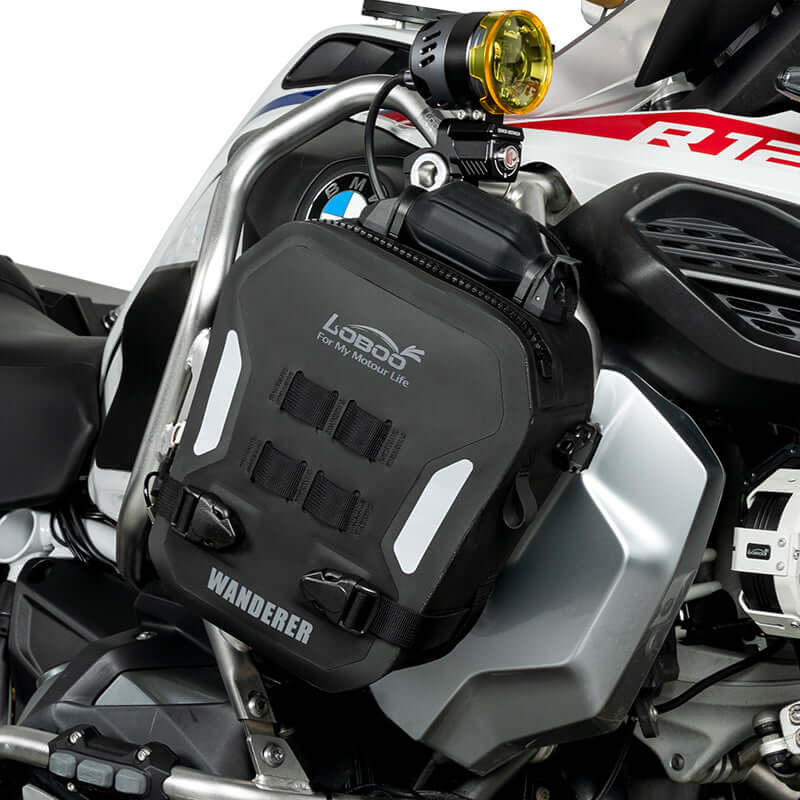
On adventure motorcycles, the most common points are engine guards, dedicated brackets under the headlight assembly, or integrated supports in the front frames. Each solution has pros and cons. Low mounting tends to improve the perception of the vehicle's width and illuminates the nearby ground well, but it is more exposed to mud, water, and impacts. Higher mounting better protects the auxiliary lights and can provide a cleaner beam in certain situations, but it requires rigid and well-designed brackets.
Compatibility with the motorcycle model
Here, it's not advisable to improvise. A BMW GS, a KTM Adventure, an Africa Twin, or a Ténéré have different spaces, fairings, frames, and vibrations. Real compatibility isn't just "it mounts." It means the kit leaves adequate space for components, doesn't interfere with steering and suspension, doesn't expose cables in critical areas, and maintains a stable orientation even on uneven terrain.
This is why it makes sense to rely on model-specific solutions or at least those verified on precise motorcycle platforms. On https://endurrad.com, this approach to compatibility is central, and for those who prepare their motorcycle for long trips, it makes a tangible difference.
How to choose auxiliary motorcycle lights based on use
If you primarily do road touring, focus on auxiliary lights with good depth, a clean beam, and neat integration with the electrical system. In this scenario, mounting stability and light quality at medium-high speeds are very important.
If you use the motorcycle for mixed travel, with asphalt, mountain passes, and dirt roads, the best compromise is often a combined beam or a pair capable of spreading well to the sides without losing too much distance. Here, versatility is worth more than extreme data.
If you do a lot of off-road, especially in slow or technical sections, lateral distribution and system robustness become priorities. An auxiliary light that illuminates well near the front wheel and the edges of the path, with solid mounts and a body resistant to vibrations and dirt, is more useful than a solution designed only to project light far away.
Materials, waterproofing, and vibration resistance
On a touring motorcycle, auxiliary lights operate in severe conditions. Prolonged rain, washing, fine dust, heat, cold, and vibrations are the norm. For this reason, it is advisable to carefully examine the body, brackets, quality of the seals, and level of protection against water and dust.
Good aluminum construction, with effective thermal dissipation and appropriate hardware, helps both durability and consistent performance. The lens also matters: it must resist well over time and not fog up easily. These are details that often don't emerge in concise specifications, but after a season of real use, they become evident.
Switch, control unit, and practicality in daily use
Ergonomics count more than it seems. An auxiliary lighting system must be easy to manage even with winter gloves, at night, or on rough terrain. If activation is inconvenient or unintuitive, you will end up using it less than you could.
On some motorcycles, it makes sense to integrate the auxiliary lights with dedicated control units or controls compatible with the onboard electronics. On others, a well-made independent wiring harness is more practical. There is no single answer. What matters is that the system is reliable, organized, and simple to control while riding.
How much does price really matter?
In the world of auxiliary lights, price often reflects real differences: optical quality, beam stability, electronics, materials, mounts, and compatibility. On a motorcycle designed for long-distance travel, these aspects are more important than initial savings.
The point is not to spend more regardless. The point is to choose a system consistent with the value of the motorcycle and the type of use. If you are preparing an adventure bike to cover miles on asphalt and dirt, you need an accessory designed for that job, not just something that looks good in the garage.
The best choice comes when you combine four factors: the right beam, real compatibility, reliable wiring, and a solid mount. From then on, every night ride becomes more readable, less tiring, and safer. And that's exactly what a well-chosen accessory should do: disappear as a problem and remain present as an advantage, from the first transfer to the last trail of the trip.


Share:
Adventure motorcycle tank bags: how to choose them
BMW GS Tall Windshield: How to Choose