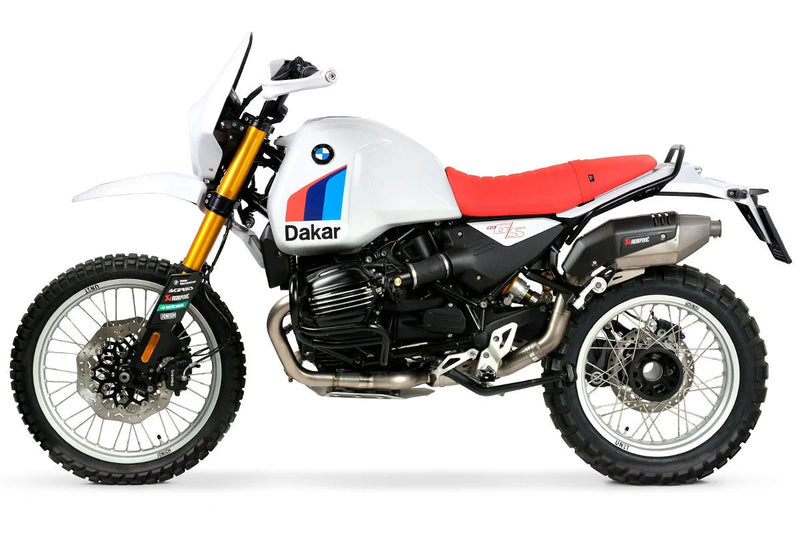
In brief. On the Honda Africa Twin CRF1100L, the accessories that are genuinely useful are few and should be installed in this order: protection for the engine and radiator if you leave the pavement, a luggage system chosen for your version, ergonomics and controls (handguards, cruise control, tank bag) for long distances, and only then auxiliary lights and details.
The most important rule is the version: Africa Twin and Adventure Sports have different tanks, weights, and subframes, and many accessories are not interchangeable. Here you will find, for each category, the codes we sell, prices and availability verified today, and the compatibility limitations stated by the manufacturers.
Africa Twin and Adventure Sports do not fit the same accessories
Same engine, different bikes: the tank, weight, seat, and rear subframe differ, and so do their compatibility requirements.
| Specification (2026, manual transmission) | Africa Twin | Africa Twin Adventure Sports |
|---|---|---|
| Engine | 1,084 cm³, 102 hp at 7,500 rpm, 112 Nm at 5,500 rpm | Same |
| Fuel tank | 18.8 L | 24.8 L |
| Curb weight | 231 kg | 243 kg |
| Seat height | 850 mm (870 mm in the high position) | 835 mm (855 mm in the high position) |
| Price | 15.490 € | 19.490 € |

Protect the bike first, then load it, then make it comfortable
The most common mistake is starting with panniers and auxiliary lights. The right order follows the risk: first what prevents damage, then what helps you travel, and finally what makes the day better.
- Protection. Crash bars, a skid plate, and a radiator guard if you ride off-road; a tip-over while stationary without crash bars can cost more than the rest of the setup combined.
- Luggage system. Frames and cases dedicated to your version, choosing between aluminum and semi-rigid options based on how much off-road riding you do.
- Ergonomics and controls. Handguards, cruise control, tank bag, and any risers and windshield: these are what you feel after 300 km.
- Navigation and power. A stable mount and a switched power outlet, without improvised wiring.
- Auxiliary lights. Useful for dawn departures, fog, and secondary roads, provided they have sturdy brackets and dedicated wiring.

Protection is the first purchase if the motorcycle leaves the asphalt
On the Africa Twin, the lower engine, radiators, levers, and headlight are the areas most exposed to rocks and low-speed falls.
What to protect and why
- Sides and fairings: engine guards absorb a stationary fall and save the fairings, radiators, and levers. They must allow access for maintenance and not obstruct airflow to the radiators.
- Lower engine: on rocky terrain and steps, you need a sturdy skid plate that covers the oil pan and headers, accepting a few extra kilos.
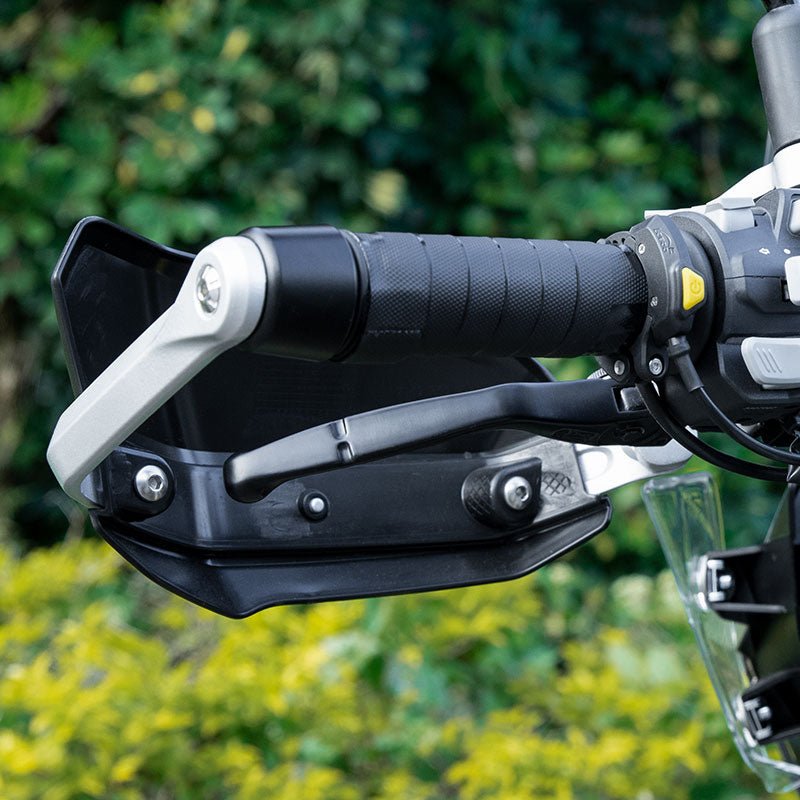
- Hands and levers: handguards with an aluminum backbone protect levers and hands in falls and from branches. On the CRF1100L, they are installed with a model-specific kit.
- Bodywork: protective and anti-slip tank films prevent scratches from boots and jacket zippers.
The frame determines the cases, and the frame depends on the version
Before choosing between aluminum and semi-rigid cases, check that the frame is specified for your Africa Twin: the rear subframes on the Africa Twin and Adventure Sports are not the same.

- Stated motorcycle
- CRF1100L Adventure Sports from 2020 onward
- Material
- Steel
- Mounting
- At original mounting points, with no drilling
- Torque values
- 12 N·m M6, 20 N·m M8
- Compatible panniers
- PIKE TRACKER P35L+P30R, Wanderer 40+30
- Standard Africa Twin
- Not stated by the manufacturer

- Capacity
- 35 L left, 30 L right (exhaust side)
- Case weight
- 11.6 kg per pair, frames excluded
- Maximum load
- 10 kg per case
- Left-side dimensions
- 498 × 268 × 408 mm
- Material
- Aluminum, keyed lock
- Finish
- Silver available, black out of stock
- you mainly tour and make long transfers
- you want lockable cases with a regular shape
- you travel as a couple with a lot of luggage
- you often alternate between asphalt and dirt roads
- you want less rigidity in minor falls
- you prefer a lighter system: the 40+30 L Wanderer cases fit the same JP322B frames

The top case and tank bag complete the load without raising the center of gravity too much
The top case loads high and toward the rear: convenient, but noticeable while riding. The tank bag keeps what you need during the leg within easy reach.

- Stated motorcycle
- CRF1100L Adventure Sports from 2020 onward
- Compatible top cases
- PIKE TRACKER P36 and P45 (P series)
- Recommended load
- 5 kg in the top case
- Top case
- Not included
| Tank bag | Capacity | Price | Availability |
|---|---|---|---|
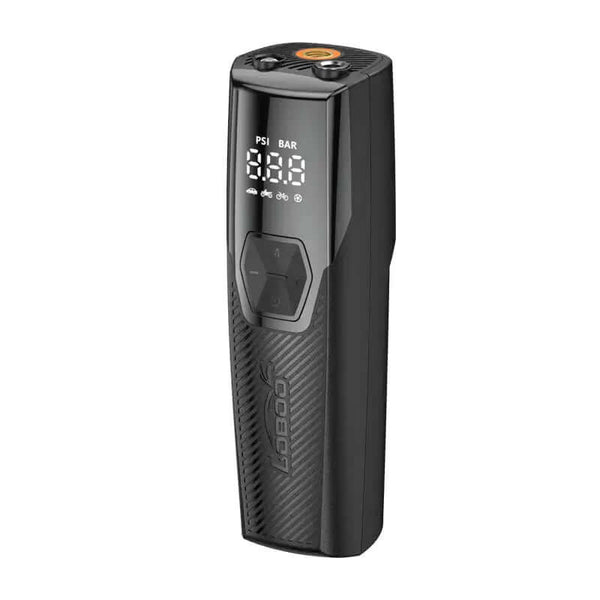
| LOBOO BTBZJ321 mounting ring (Honda Africa Twin) | Base for ring-mounted magnetic bags | 26 € | Available |
| BTB10 expandable tank bag | 4.5–6.5 L | 113 € | Available |
| BTB15 expandable tank bag | 7–9 L | 126 € | Available |
| BTB12 tank bag with sliding base | 10 L | 126 € | Available |

Handguards, cruise control, and lights are the accessories you notice after 300 km
They do not protect the motorcycle or add liters, but they reduce fatigue and increase safety on long stages.
What the catalog offers for Africa Twin
- KAOKO mechanical cruise control for CRF1100L, CRF1000L, and X-ADV 750 (€125), and version for motorcycles with Barkbusters handguards (€120): these are throttle stabilizers that hold the throttle in position. Currently out of stock.
- Dedicated DENALI auxiliary lights: DL4 kit with wiring and mount for Africa Twin 1100 (€397.35) and D7 PRO kit with CANsmart controller (€1,459.27), which integrates with the motorcycle's electronics. Currently out of stock.
- LOBOO CJC321 sidestand foot enlarger plate for CRF1100L and Adventure Sports (€41): increases support on soft ground. Currently out of stock.
- handguards for wind, cold, and falls
- cruise control for highway transfers
- switched USB socket and stable navigation mount
- auxiliary lights on universal brackets that vibrate
- risers that are too high without checking cables and hoses
- parallel wiring without a fuse
All Africa Twin codes in one table, with today's price and availability
Prices and stock levels recorded on 08/10/2026 in the Endurrad catalog. Out-of-stock items remain in the collection and can be ordered on request when they become available again.
| Accessory | Code | Declared version | Price | Status |
|---|---|---|---|---|
| Side pannier racks | JP322B | CRF1100L Adventure Sports from 2020 onward | 329 € | Available |
| Rack + PIKE TRACKER 35+30 L kit | JP322B+P35L+P30R | CRF1100L Adventure Sports from 2020 onward | 973 € / 1.040 € | Silver available, black out of stock |
| Top case plate | JP322W | CRF1100L Adventure Sports from 2020 onward | 153 € | Available |
| Tank bag ring | BTBZJ321 | Honda Africa Twin | 26 € | Available |
| Barkbusters hand guard kit | BHG-082 | CRF1100L and Adventure Sports | 141,50 € / 152 € | Out of stock |
| Barkbusters hand guard kit | BHG-062 | CRF1000L and X-ADV 750 | 123,50 € | Out of stock |
| KAOKO cruise control | HND310 | CRF1100L, CRF1000L, X-ADV 750 | 125 € | Out of stock |
| DENALI DL4 auxiliary light kit | DNL.01.KIT.001 | Africa Twin 1100 | 397,35 € | Out of stock |
| Kickstand plate | CJC321 | CRF1100L and Adventure Sports from 2020 onward | 41 € | Out of stock |
Frequently asked questions about Honda Africa Twin accessories
What are the first accessories to install on a Honda Africa Twin?
Are the Adventure Sports accessories suitable for the standard Africa Twin?
What is the difference between the CRF1000L and CRF1100L for accessories?
Are aluminum or semi-rigid panniers better on the Africa Twin?
How much weight can be put in the panniers?
Why do the two panniers have different capacities?
Is a side rack needed to mount the top case?
How do you fit a tank bag on the Africa Twin?
Does cruise control work on the Africa Twin?
Which auxiliary lights should you fit to the Africa Twin CRF1100L?
How much does the Africa Twin weigh, and how much does it change with accessories?
Does Endurrad sell engine guard bars for the Africa Twin?
Preparing your Africa Twin?
Write to us with your bike's version (Africa Twin or Adventure Sports), model code and year: we'll confirm rack, plate and accessory compatibility before you order. With the Endurrad app for iPhone, you can follow availability and new products from your phone.