Overloading the rear of the motorcycle is one of the most common mistakes when preparing for a trip. It often happens with saddle bags, top cases filled to the brim, and gear secured to the luggage rack without considering one simple fact: how much weight a motorcycle luggage rack can hold does not depend only on the rack itself, but on the entire motorcycle-frame-subframe-mounting point system.
If you are preparing an adventure or touring bike to cover miles on asphalt and light off-road terrain, the right question is not just “how many kilos can I put on top,” but “how many kilos can I carry without compromising stability, durability, and safety.” This is what makes the difference between a motorcycle ready to travel and one that has been loaded incorrectly.
How much weight can a motorcycle luggage rack really hold?
The short answer is: it depends. And it depends much more than you might think. Some aftermarket luggage racks specify a load capacity, often only a few kilos when the load is concentrated high up and far to the rear. But that figure alone is not enough.
Actual capacity is determined by four factors: the limit specified by the luggage-rack manufacturer, the capacity of the motorcycle’s rear subframe, the type of mounts installed, and how the weight is distributed. A sturdy luggage rack attached to a lightweight subframe does not automatically become suitable for heavy loads. Likewise, a very well-built top-case plate can perform poorly if used with overloaded cases on rough roads.
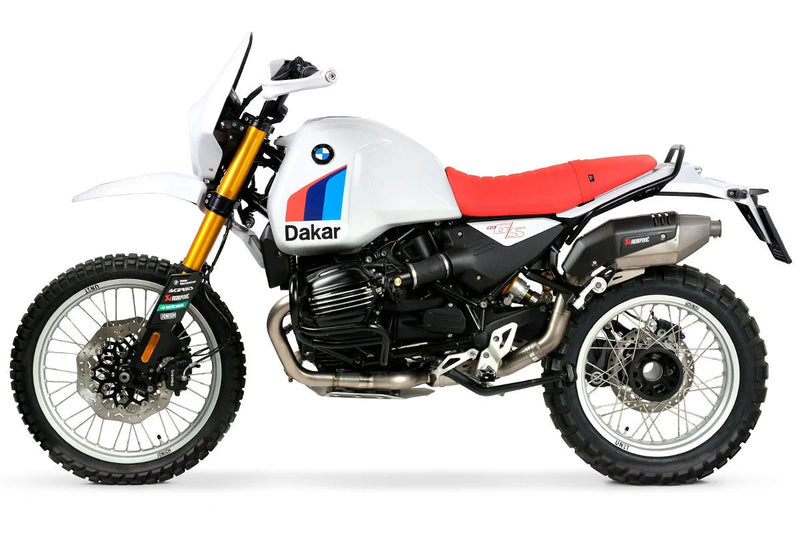
On modern adventure motorcycles, the issue is even more delicate. BMW GS, KTM Adventure, Africa Twin, and Ténéré motorcycles are designed for travel, but not to carry any load thrown entirely onto the rear. The motorcycle may seem stable when stationary and become nervous as soon as the surface worsens or the pace increases.
The specified figure is not enough
When you read a maximum load rating, you should always ask under what conditions it was specified. Static load - meaning the motorcycle standing still in the garage - is not the real issue. The issue is dynamic load, meaning what the luggage rack and subframe must withstand during bumps, compressions, vibrations, off-road riding, braking, and acceleration.
An 8 kg load properly secured on a smooth road is one thing. The same 8 kg mounted high up, protruding outward, and subjected to continuous impacts on a rough trail can generate much greater forces. That is why an experienced motorcyclist never reasons only in nominal kilos. They think in terms of leverage, vibrations, and real-world use.
This is also why a large top case encourages overloading. The available space makes it easy to exceed the correct load, especially on long trips. But the fact that everything fits inside does not mean the motorcycle can handle it well.
Luggage rack, subframe, and mounting points
The luggage rack is only the last part of the chain. Beneath it is the rear subframe, which may be more or less robust depending on the motorcycle’s design. Then there are the brackets, bolts, adapter plates, and any top-case support.
The critical point is not always the load platform. Often it is the mounting points and the stresses transmitted to the subframe. If the load is positioned far to the rear, the leverage effect increases and the structure performs worse. This is why two configurations with the same total weight can behave very differently.
A compact soft bag, positioned close to the seat and properly secured, is generally less problematic than a heavy hard top case mounted far behind the rider. Weight should be evaluated not only by quantity, but also by position.
High and rearward loads: the worst combination
If you want to preserve handling and reliability, the worst load is one positioned high, far from the center of gravity, and shifted toward the rear wheel. It worsens steering response, lightens the front end, and increases oscillations during changes of direction.
At high speeds on asphalt, this can translate into less precise handling. Off-road, where the motorcycle relies heavily on suspension movement and weight transfers, the problem is magnified. You do not need to reach a structural failure to have an incorrect setup: a less stable motorcycle that is more tiring to ride and more sensitive to bumps is enough.
How much to load in practice on a touring motorcycle
There is no universal figure that applies to every model, and it is important to say that clearly. However, there is a reliable rule: keep only light or medium-light loads on the rear luggage rack, reserving heavier items for low-mounted side cases or, better still, a central position close to the rider.
A tent, sleeping bag, compressed clothing, or a soft bag containing bulky but lightweight gear are often ideal candidates. Tools, liquids, spare parts, and dense items should be kept lower down. This approach improves weight distribution and reduces stress on the rear of the motorcycle.
If you often travel with a passenger, the margin decreases even further. The passenger, top case, and rear luggage all place additional load on the same area of the motorcycle. In that case, you need to be even more conservative, because the dynamics change quickly and the rear suspension also has to work harder.
How to tell if you are overdoing it
There are fairly clear signs. The first is a motorcycle that tends to run wide or becomes light at the front. The second is excessive pitching, especially when braking or riding over bumps. Then there are unusual vibrations from the top-case mount, play that develops over time in the fasteners, and, in the worst cases, cracks or deformation in the support.
The motorcycle’s behavior when stationary also says a lot. If lifting the motorcycle off the side stand requires more effort than usual or the rear appears visibly heavily sagged, the setup needs to be revised. Simply increasing rear-shock preload is not always enough to compensate for a poorly positioned load.
The role of the suspension
Properly adjusted suspension helps, but it cannot perform miracles. Increasing preload serves to restore ride height and attitude, not to make an excessive luggage-rack load acceptable. If the weight is too far from the center of gravity, the motorcycle will still be less effective.
On adventure motorcycles used in real conditions, especially on mixed surfaces, the suspension setup should always be adapted to the trip. But the correct order is this: first distribute the load, then adjust the motorcycle. Doing it the other way around means addressing the root of the problem incorrectly.
How much weight can a motorcycle luggage rack hold with a top case and panniers?
When top cases, dedicated plates, and side cases are involved, the issue becomes a system-wide one. Each component has its own limit, but above all, the components interact with one another. A well-designed setup does not aim to exploit the theoretical maximum of every part. It aims to maintain balance, accessibility, and long-term durability.
Well-supported side cases are often the best choice for carrying heavier loads because they keep the weight lower and distribute it more evenly. The top case is useful, practical, and quick to access, but it should mainly hold lightweight or delicate items, rather than becoming the main container for the trip.
On many adventure-touring motorcycles, the most effective solution is to combine side cases, a compact soft rear bag, and an organized central load. This reduces stress on the luggage rack and improves handling, especially when the route alternates between fast transfers and rough sections.
How to choose the right luggage rack
The choice should be based on the motorcycle and its actual use. It is not enough for a luggage rack to be listed as compatible in a catalog. You need to evaluate the quality of the structure, material thickness, mounting method, presence of reinforcements, and how it integrates with side frames or top-case supports.
For riders traveling on motorcycles such as the GS, Africa Twin, KTM Adventure, or Ténéré, model-specific compatibility matters a great deal. A system designed for that model performs better because it takes the actual dimensions, anchoring points, and geometry into account. This technical approach is what truly makes the difference between a universal accessory and a component designed to go anywhere.
If your goal is serious travel, always choose components designed for intensive use, with clearly stated load ratings and construction suited to an adventure motorcycle. Endurrad works according to this principle: specific, solid, compatible accessories, not generic solutions forced to fit.
The most costly mistake is not exceeding a number
The most costly mistake is ignoring the overall effect of the load on the motorcycle. Even if you stay “within the weight limit,” you can still have an incorrect setup if you place too much weight high up, toward the rear, and far from the center. Conversely, a well-planned configuration often allows you to travel better with the same amount of luggage.
When preparing the motorcycle, always think like someone who truly covers miles: keep weight close to the center, heavy items low, use the luggage rack carefully, and check the fasteners regularly. Your next adventure also starts here - with a motorcycle that not only carries luggage, but carries it the right way.