

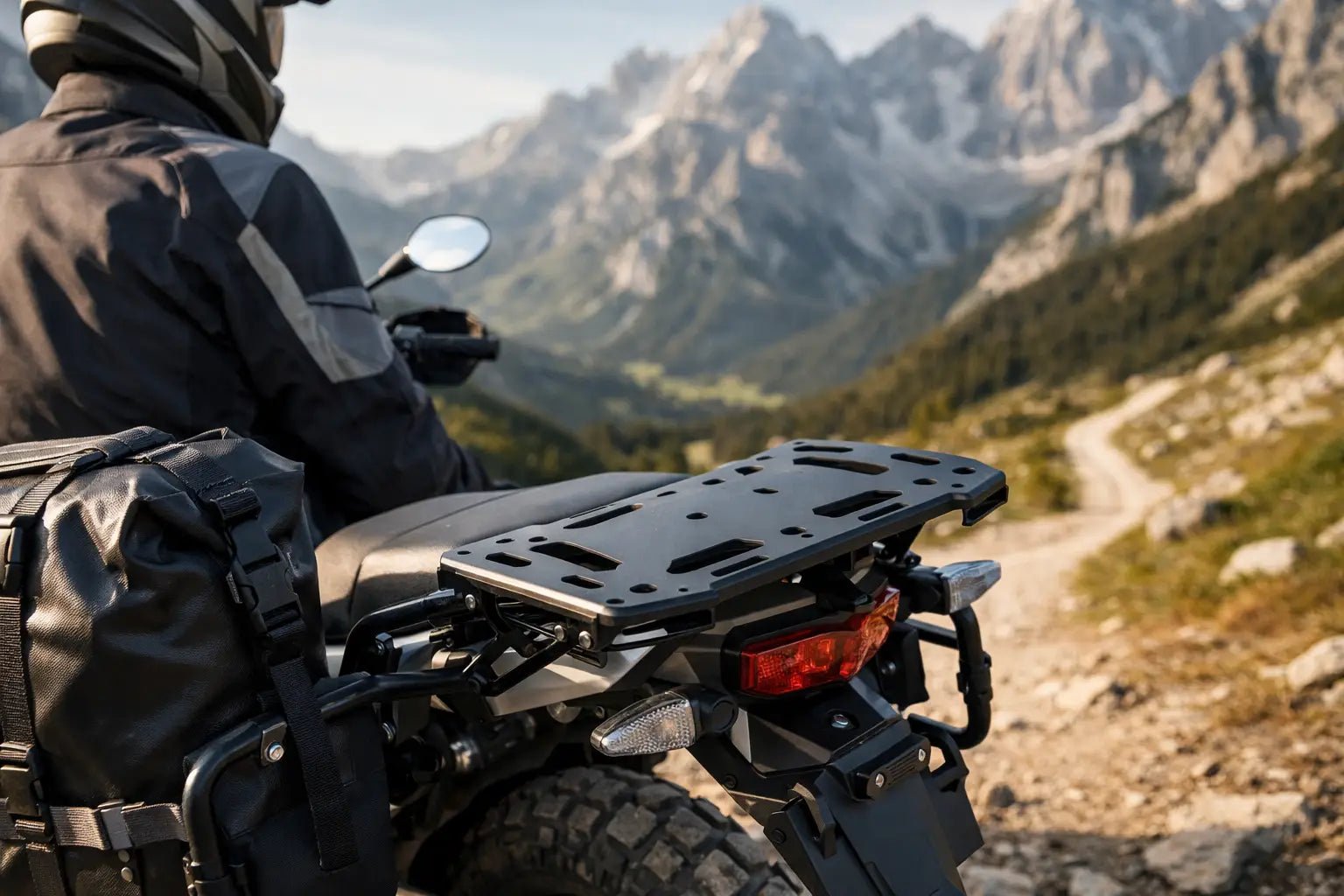
When you start seriously loading a touring motorcycle, the luggage rack stops being a secondary accessory. The rear luggage rack for an adventure motorcycle is one of the most stressed points of the entire setup because it has to withstand weight, vibrations, impacts, and constant fastening without compromising stability, seat access, or ease of use.
On asphalt, everything may seem simple. Then come a rough trail, a descent standing on the footpegs, or an entire day with a roll bag, soft fuel can, and camping gear strapped to the rear. That is when you see the difference between a well-designed plate and a generic solution.
What a rear luggage rack for an adventure motorcycle is really for
Its purpose is not simply to increase carrying capacity. A good luggage rack is mainly designed to create a stable, predictable base for your luggage, keeping the weight secure even when the pace changes or the surface gets rougher.
On an adventure motorcycle, rear luggage affects much more than you might think. If the bag moves, the weight sits too far back, or the anchor points do not work properly, the motorcycle becomes less precise during weight transfers and more tiring to ride over long distances. That is why the luggage rack should be chosen as a functional component, not just as a surface for placing things.
There is also a practical aspect that is often underestimated. A well-designed luggage rack improves travel organization: it allows soft luggage to be secured more effectively, makes it easier to mount top bags or small technical cases, and often keeps the seat, grab handles, or useful passenger points accessible. When a trip lasts several days, these details make a difference.
Motorcycle compatibility: the first filter you should not skip
In the adventure world, model-specific compatibility is not a marketing detail. It is a technical matter. BMW GS, KTM Adventure, Honda Africa Twin, and Yamaha Ténéré have very different rear frames, tail sections, grab handles, and geometries. The correct luggage rack must work with these elements without forcing anything into place.
This means always checking the motorcycle’s year, version, and configuration. On some models, everything changes between the standard version and variants with touring packages, a different seat, or provisions for original panniers. The presence of the OEM luggage rack can also affect which plate is compatible or which mounting kit is required.
A component designed for a specific model offers concrete advantages: it distributes the load more effectively, uses the correct mounting points, and reduces the risk of interference with plastics, lighting, or seat opening. For serious travelers, this is the bare minimum.
Materials and construction: where durability is determined
The most commonly used materials are aluminum and steel, with different choices depending on the design goals. Aluminum is highly valued because it offers a good balance of low weight, rigidity, and corrosion resistance. On an adventure motorcycle intended for long trips, it helps avoid adding unnecessary weight high up and at the rear of the motorcycle.
Steel can make sense when the design prioritizes structural strength and the ability to withstand repeated stress in harsh conditions. It is not always the best solution overall because it weighs more, but in some designs it can offer excellent reliability.
Plate thickness, the quality of any welds, the surface finish, and, above all, the shape also matter. The slots for the straps must be well positioned, sufficiently numerous, and easy to use with different fastening systems. A very attractive plate with few useful mounting points often creates more problems than it solves.
Payload and weight distribution
This is where realism is important. The issue is not only how much weight you can put on the luggage rack, but how that weight behaves while you ride. Ten kilograms sitting still in the garage are not the same ten kilograms after hours of vibrations, bumps, and off-road riding.
For this reason, you must respect both the luggage rack’s limit and the limit specified by the motorcycle or rear subframe manufacturer. Loading too far back worsens the handling, lightens the front end, and makes riding feel less natural, especially during slow maneuvers or on loose surfaces.
In general, it is best to keep bulky but relatively light items on the luggage rack, such as a well-compressed roll bag, technical clothing, or soft gear. Heavier items should be placed lower and closer to the center of gravity, for example in the side panniers if the setup allows it. It is a simple rule, but it prevents many problems.
Luggage racks and soft luggage: the most common combination
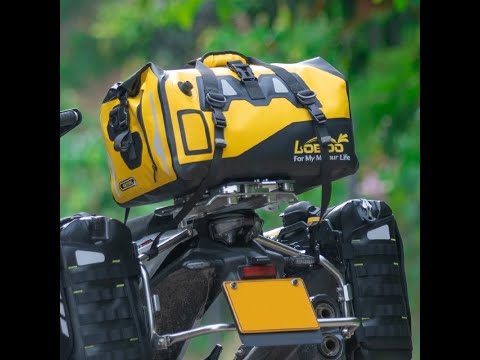
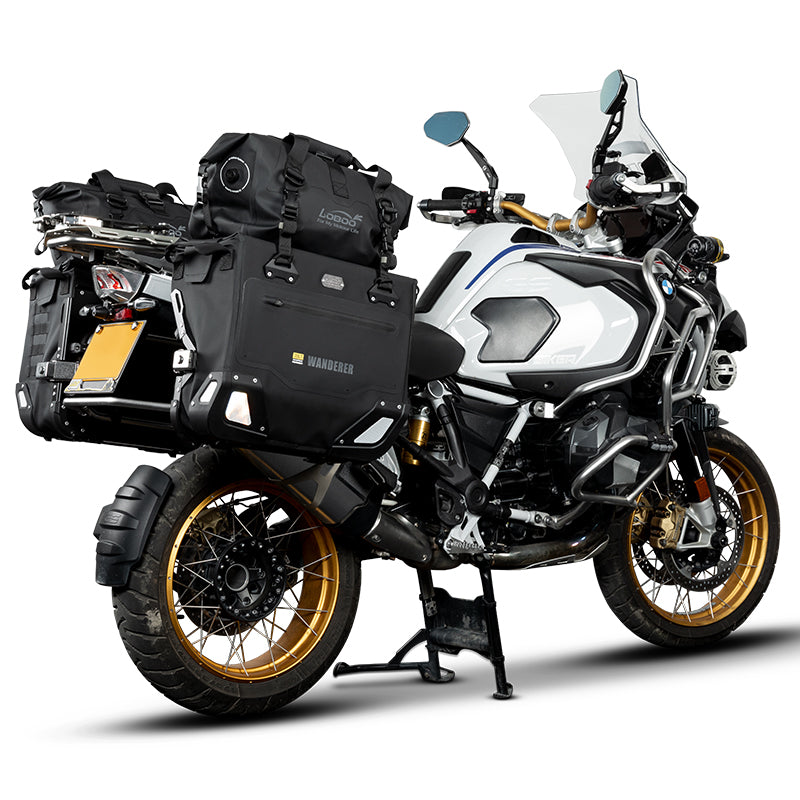
For many adventure travelers, the rear luggage rack is used mainly with soft luggage. It is a logical choice: more flexibility, less rigid bulk, and better adaptability to mixed routes. But for that very reason, the support must be well designed.
Roll bags and modular systems require even surfaces, well-distributed slots, and edges that will not damage the straps. A plate that is too small makes the load unstable. One that is too wide can create interference or unnecessarily increase the bulk behind the motorcycle.
Position also requires attention. If the luggage ends up too far back, the leverage on the subframe increases and the motorcycle’s handling changes. If, on the other hand, the luggage rack allows you to keep the bag centered and close to the rider, everything becomes more balanced. You feel it at speed on the road. On light off-road terrain, you feel it even sooner.
When it makes sense to fit a top case
Not all adventure motorcycles are used in the same way. Riders who alternate commuting, asphalt travel, and long weekends may prefer a hard top case, especially for convenience, protection of the contents, and quick access. In this case, the luggage rack must be compatible with the dedicated plate or the mounting system specified by the brand.
The compromise is clear here. A top case is very practical, but it adds weight high up and at the rear, and on rough surfaces it may be less suitable than a properly secured soft bag. If the main use is road touring, it can be an excellent solution. If the motorcycle frequently tackles dirt roads and fast trails, it is worth considering carefully.
The details that make a difference in real-world use
A good luggage rack is recognized by small details that are not always obvious on a technical data sheet. Ease of installation is one of them. If the kit uses the correct spacers, quality hardware, and well-aligned mounting points, installation is clean and does not introduce abnormal stress.
Accessibility also matters greatly. Some plates make seat removal more difficult or cover useful areas for securing other equipment. Others integrate grab handles or maintain a clear surface that makes loading much more orderly.
Then there are vibrations. A well-designed luggage rack must not only withstand them, but also work properly with the motorcycle’s frame. Excessive rigidity that is poorly distributed is not always an advantage. On adventure motorcycles, where stress is continuous, the overall design matters more than any isolated specification.
How to choose a rear luggage rack for an adventure motorcycle
The right choice starts with how you actually use your motorcycle, not with a photo of it fully loaded for an extreme trip. If you mainly ride on asphalt with some dirt roads, you may prioritize modularity, top-case compatibility, and everyday practicality. If you travel with a heavy load on mixed routes, strength, anchor points, and how the luggage behaves under vibration matter more.
It is worth asking yourself three specific questions: What type of luggage will you use most often, how much weight will you really put at the rear, and will you travel alone or with a passenger? With a passenger, the available space changes, as does the need to leave part of the rear area clear or keep the grab handles accessible.
The motorcycle itself also matters more than personal taste. On a heavy maxi-adventure motorcycle, the luggage rack may work together with panniers and side frames in a very different way than on a lighter dual-sport. Those who prepare their motorcycle carefully know this: every component must improve the overall setup, not merely add possibilities on paper.
For this reason, a catalog organized by motorcycle model is often the most efficient way to avoid mistakes. Endurrad works in precisely this direction, with a selection focused on real compatibility, reliable brands, and practical use on touring motorcycles.
Common mistakes to avoid
The most common mistake is choosing based only on appearance or plate size. Another is treating the luggage rack as an independent structure without considering the subframe, type of luggage, and overall weight distribution.
Underestimating the quality of the hardware or fastening system also causes problems. On a motorcycle that travels far, on asphalt and dirt, the component must remain reliable over time, not just during the first installation. Then there is the simplest mistake: loading too much at the rear because “there is room for it.” Often there is, but the motorcycle will make you notice it in a corner, under braking, or when the surface becomes rough.
The best choice is the one that makes the trip more organized, the ride more predictable, and the load more stable. If a luggage rack does this without making your life more difficult every time you prepare the motorcycle, then it is the right component for setting off for real.


Share:
Soft bags or hard cases on a motorcycle?
How to mount a motorcycle GPS holder without mistakes