


Overpacking is easy. The difficult part is building a motorcycle touring camping kit that really works after 600 km, in the rain, with limited luggage space and the need to set everything up in just a few minutes. It’s not about having a lot of gear. It’s about having the right equipment, in the right dimensions, for the type of motorcycle and route you’re preparing for.
Anyone traveling with a maxi enduro, dual-sport, or touring motorcycle knows that motorcycle camping is not a scaled-down version of car camping. Weight, bulk, load distribution, and how quickly you can access your equipment make the difference between a balanced motorcycle and a tiring setup to manage, especially on dirt roads or during long days.
How to choose a motorcycle touring camping kit
The first rule is simple: build the kit around the motorcycle, not around your wish list. A BMW GS with aluminum panniers handles volumes and weights differently from a Ténéré with a semi-rigid set or a KTM Adventure prepared for mixed asphalt and dirt use. There is no universal setup.
You therefore need to consider three variables. The first is the duration of the trip. For a weekend, you can accept a few more compromises, while on long routes every unnecessary gram becomes tiring during maneuvers and loading. The second is the expected climate. If you are crossing areas with major temperature swings, the sleep system needs to be sized more carefully than for a stable summer trip. The third is the type of route. The more off-road riding is involved, the more crucial compactness, secure fastening, and resistance to vibration become.
A good kit must not only fit in the luggage. It must stay dry, remain accessible, and be well distributed. Heavy items should be kept low and close to the motorcycle’s center of gravity. Items you use frequently should be reachable without having to unpack half the luggage every time.
The three elements you cannot get wrong
A compact tent that is genuinely suitable for motorcycle travel
You should not choose a motorcycle touring tent solely based on its stated capacity. What matters most is its packed size, how quickly it can be set up, and how well it holds up in wind and rain. A tent that is too long or has bulky poles can be difficult to arrange neatly, even with spacious panniers.
For touring and adventure use, it makes sense to choose low-volume models with a double-wall design and a stable structure. Weight remains important, but it should not be considered in isolation. An ultralight tent may be appealing, but if it requires more care during setup or offers little protection in changing conditions, the benefit is reduced. Those who often travel as a couple need to pay even closer attention: moving up a size can improve livability and make it easier to manage nighttime gear, but it requires more space in the load system.
Sleeping bag and genuine thermal comfort
Many mistakes start here. Looking only at the stated minimum temperature is the quickest way to sleep badly. What matters is the comfort temperature, considered in relation to the season and the altitude of the trip. A sleeping bag that is too warm takes up more volume than necessary, while one that is too light forces you to wear extra layers and worsens your rest.
For motorcycle travel, a compressible sleeping bag with an efficient storage sack and materials that maintain their performance in humid conditions works well. Synthetic options are often more tolerant of intensive use and less delicate to manage day to day. Down can make sense for those seeking the best warmth-to-volume ratio, but it requires more protection from water and condensation.
Sleeping mat: small when packed, serious when you sleep
Sleeping on the ground without adequate insulation means recovering poorly, even if the sleeping bag is good. The sleeping mat is not a secondary accessory. It is part of the thermal system and overall comfort. For those covering many miles, a compact inflatable or self-inflating model offers the best compromise between packed size and rest.
Here, durability is the key point. An extremely light but delicate sleeping mat may be fine in controlled settings. On a trip, however, you need a reliable structure that is easy to inflate and pack away and will not become a problem after several consecutive nights.
A motorcycle touring camping kit also comes down to cooking
If the trip includes self-sufficient stops, the cooking setup should be reduced to the essentials. A stove, small pot, compact cutlery, and a thermal mug may be enough. Adding rarely used accessories fills the luggage without providing any real benefit.
The choice of stove depends heavily on the scenario. For road tours with predictable stops, a simple and compact solution is often best. For more remote routes, fuel availability and system stability in less-than-perfect conditions matter more. The general rule applies here too: fewer pieces mean fewer chances of wasting time or forgetting something.
Always carry a small water-management setup suited to the trip. There is no need to turn the motorcycle into an expedition vehicle if you make regular stops, but having a well-secured, easily accessible reserve improves range and safety, especially in summer.
Load organization: the real dividing line
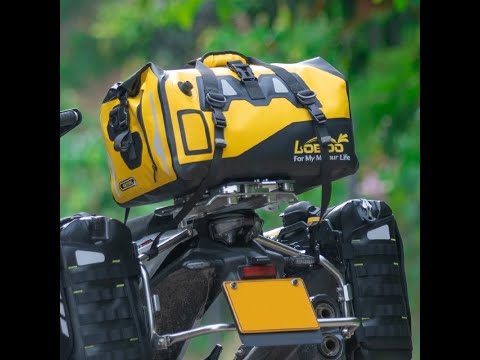
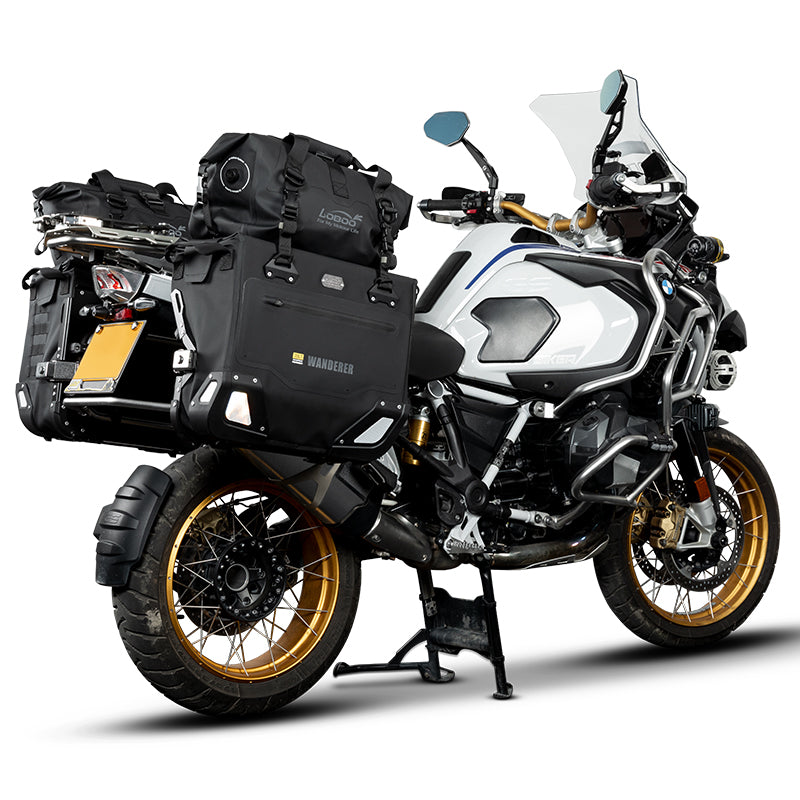
A well-chosen kit that is loaded poorly harms handling, comfort, and reliability. The issue is not only how much you carry, but where you put it. The tent, sleeping bag, and sleeping mat are bulky but relatively light: they can go in the top bag or in a well-secured rear bag. Denser items, such as cooking equipment, tools, or supplies, should be kept lower, ideally in the side panniers.
On motorcycles such as the Africa Twin, GS, or Super Adventure, load capacity helps but does not solve everything. If you place too much weight toward the rear, the motorcycle’s behavior changes during slow maneuvers and on rough transfers. On slimmer bikes such as the Ténéré or mid-displacement dual-sports, the margin is even smaller. You need a genuinely compact kit, not one that is compact only on paper.
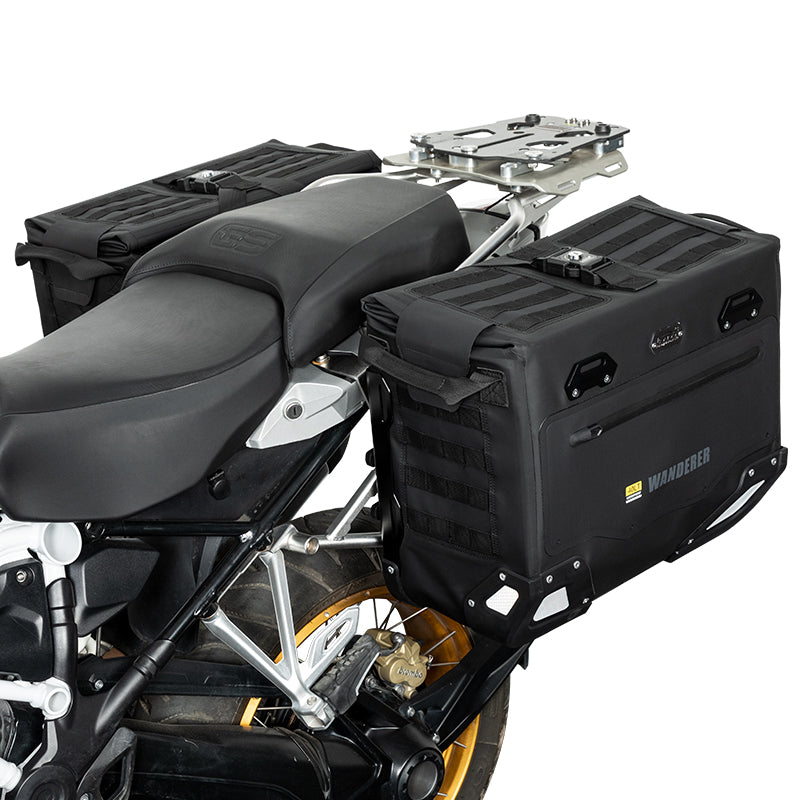
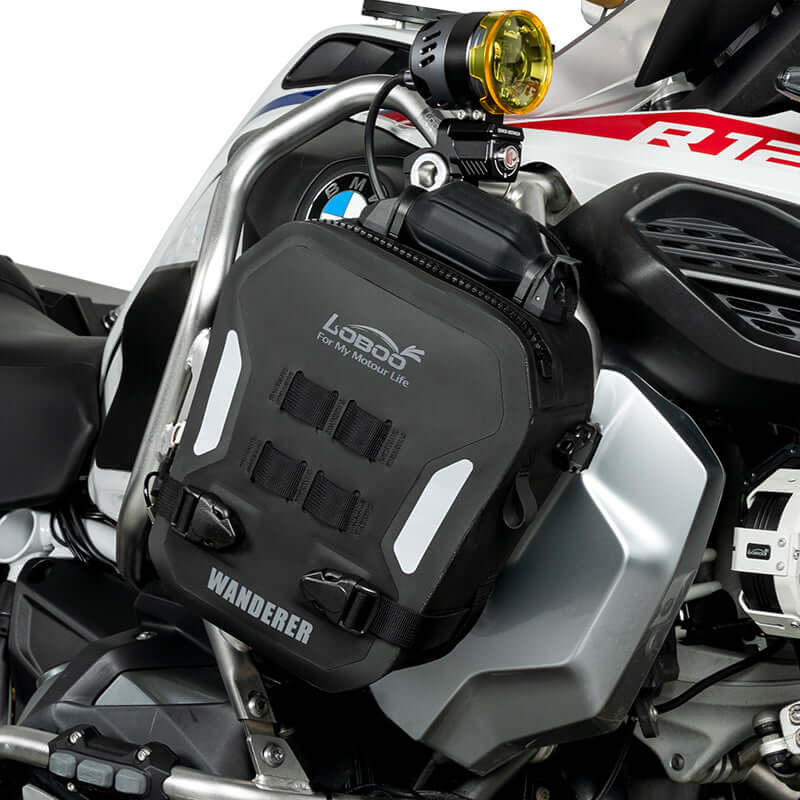
Dry bags make sense when they protect what must stay dry without complicating access. Hard panniers provide order and protection, but they need to be used well. Semi-rigid bags suit those looking for less bulk and greater adaptability, provided you use internal organizers and reliable fasteners.
What to keep immediately accessible
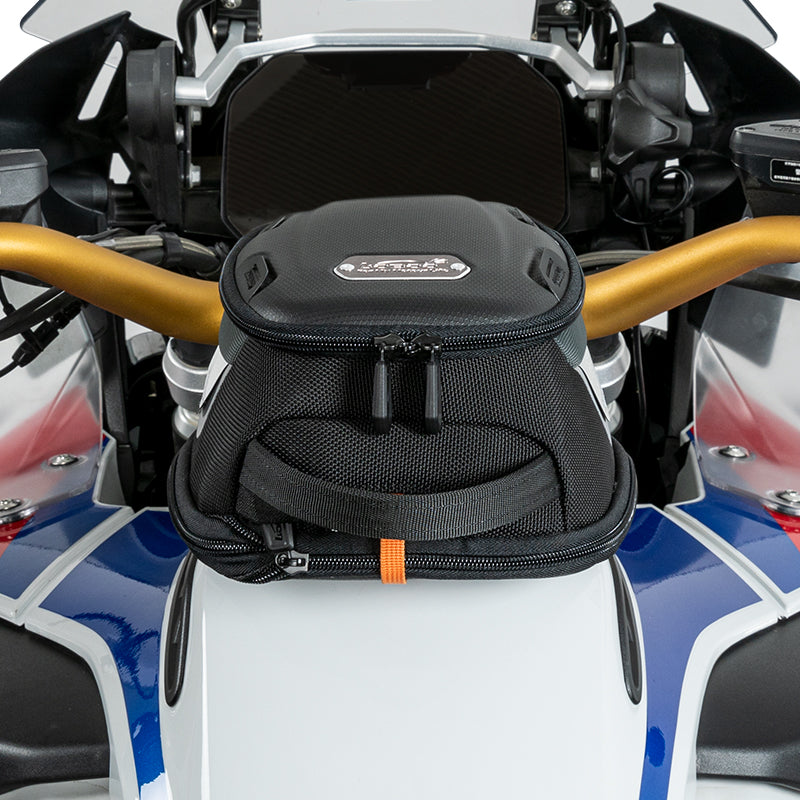
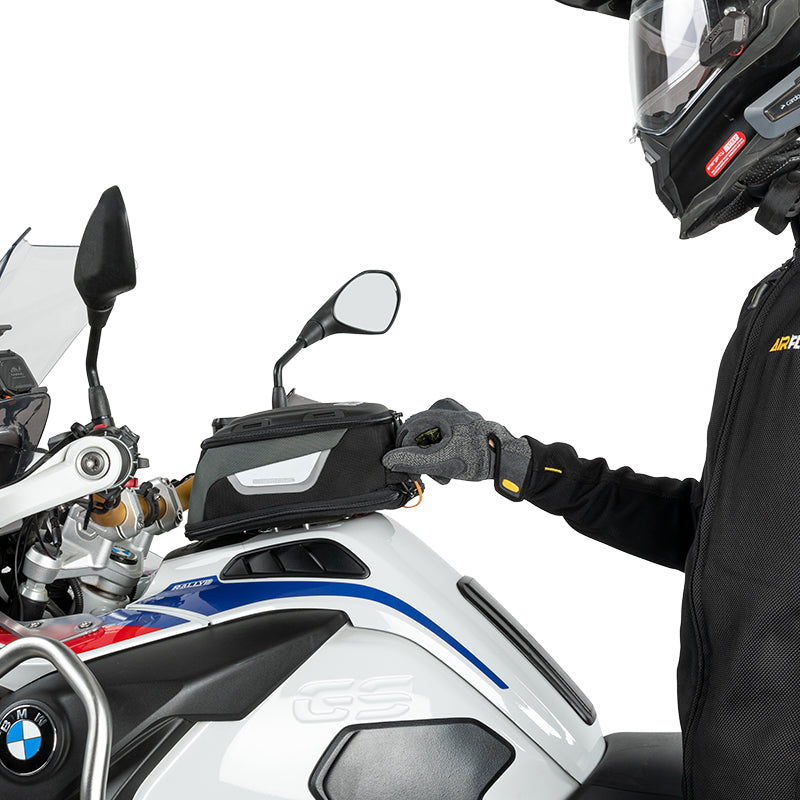
Some items should never end up at the bottom of your luggage. Rain gear, a headlamp, a first-aid kit, thermal layers, and anything needed to set up camp quickly must be retrievable within seconds. Arriving late, in low light, or during a storm is a normal scenario in motorcycle touring. If every task requires emptying half the motorcycle, the system is wrong.
Common mistakes when choosing a kit
The most common mistake is buying individual products that are good on their own without checking how they work together. A tent may be excellent, but if the poles do not fit well within the load configuration or the sleeping bag requires too much remaining volume, the final result is not efficient.
The second mistake is overestimating your needs. Many motorcyclists leave with a setup designed for every possible situation and realize after two days that they always use the same few things. An effective motorcycle touring camping kit comes from selection, not accumulation.
The third mistake concerns compatibility with the motorcycle. Spacious panniers are not enough. You need to consider the overall width, exhaust position, presence of racks, passenger, other accessories already installed, and the space taken up by technical equipment such as a compressor, repair kit, or tools.
A sensible setup changes according to the trip
For a summer tour on asphalt and easy gravel roads, the focus can be on compactness, quick setup, and good ventilation. If you are planning mountain passes, unstable weather, and higher elevations, it is worth increasing thermal protection and insulation, even at the cost of a few extra liters.
Solo travelers have more room to optimize. Those traveling as a couple need to think in terms of an integrated system: not two separate kits, but an intelligent distribution between shared equipment and personal gear. This is where experience really matters. Every component must earn its place on the motorcycle.
The motorcycle itself also has more impact than it may seem. A setup that is right for a GS Adventure could be excessive on a Ténéré 700 used on dirt roads, where lightness and control carry greater weight. Packing thoughtfully means respecting the motorcycle’s design and the type of riding you want to maintain.
When the kit is truly ready
The right time to assess your setup is not the evening before departure. Test it. Set up the tent, compress the sleeping bag, simulate a full load, and check how long it takes to access the things you use most often. If something requires too many steps in your garage, it will be worse on the road.
In the adventure world, details make the difference: a stable load system, a well-positioned waterproof bag, an accessory that is 100% compatible with the motorcycle, and an organized space without unnecessary compromises. This is the level at which it makes sense to prepare your trip, and it is also why specialized companies such as Endurrad are chosen by those looking for components designed for real travel, not just to fill out a specification sheet.
The right choice is not to carry more equipment. It is to set off with a kit that lets you ride well, sleep well, and get moving again without wasting time. When you are far from home, everything else matters much less.


Share:
Waterproof Motorcycle Tail Bag: Complete Guide 2026 | Endurrad
Motorcycle touring chain maintenance: what to do