

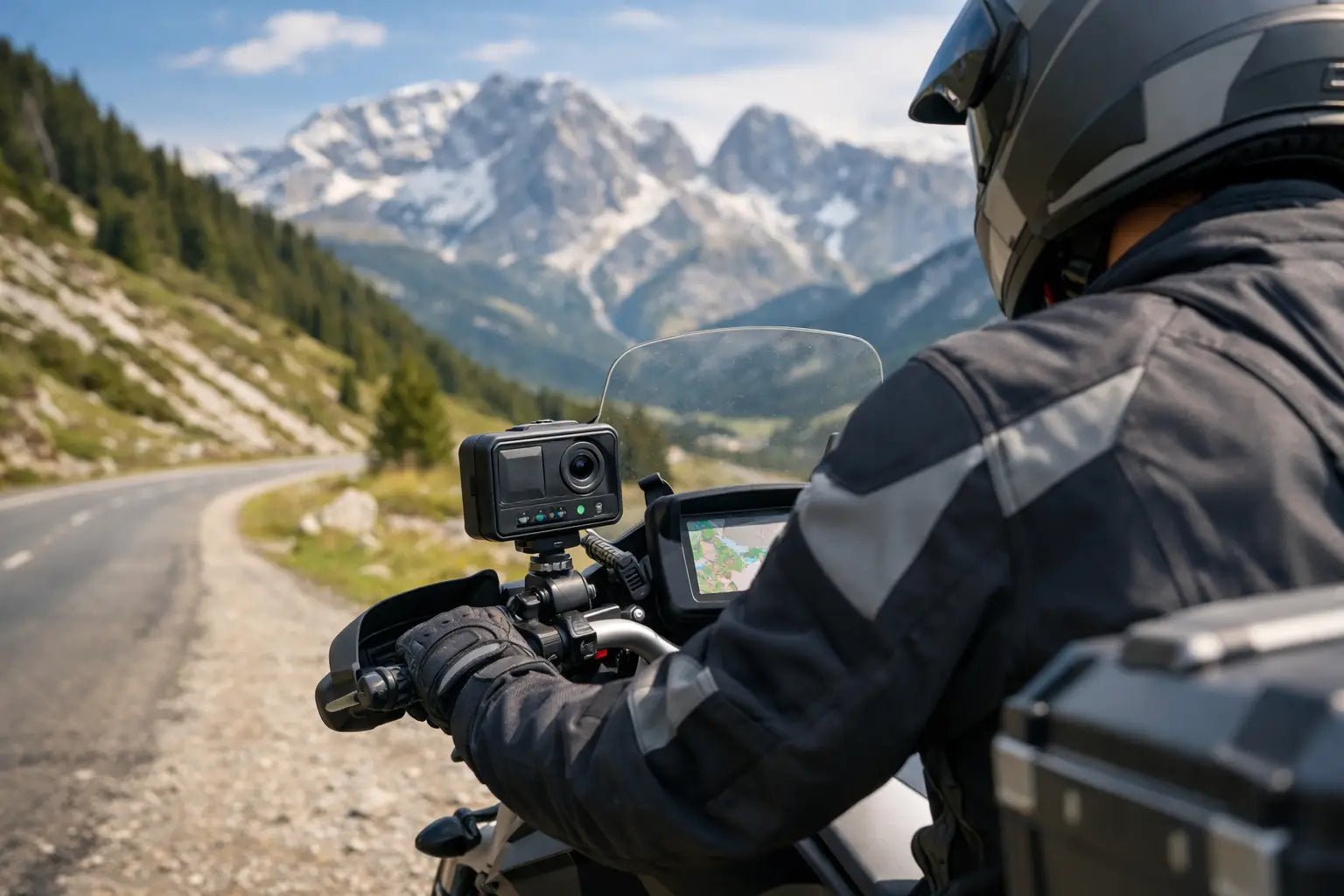
Anyone preparing a motorcycle for touring knows that the ideal navigator is not just a matter of a large screen or an attractive price. On the road, under the sun, with gloves on and constant vibrations, priorities change completely. This is precisely where the Jado S6 enters the list of devices many motorcyclists consider as an alternative to better-known navigation systems.
What Is the Jado S6 and Why Does It Interest Motorcyclists?
The Jado S6 is a handlebar-mounted display designed to replicate functions such as navigation, music, calls, and smartphone mirroring on the screen. In practice, it does not completely replace the phone, since it continues to depend on it for many functions, but it moves the interface to a position that is easier to read and more convenient while riding.
For those who ride an adventure, touring, or dual-sport motorcycle, the concept is simple: keep the smartphone better protected, reduce direct handling of the phone, and have a dedicated display in front of your eyes. On paper, it is a sensible solution, especially for anyone who wants to avoid traditional mounts with the phone exposed to rain, dust, vibrations, and overheating.
The point, however, is not whether the Jado S6 works. The point is understanding under which conditions it really makes sense and for what type of use it can be a valid choice.
Jado S6 on an Adventure Motorcycle: Where It Really Delivers
On a touring motorcycle, the first advantage is readability. A dedicated display, correctly mounted above the instruments or in a central position, is often easier to consult than a smartphone attached to the handlebar. This is especially true on long stretches, when directions need to be immediate and should not require you to lower your gaze too much.
The second aspect is practical. Many motorcyclists do not want to entrust their primary phone to continuous vibrations, especially on dirt roads or damaged asphalt. With a system such as the Jado S6, the phone can remain in your pocket, in the tank bag, or in a more protected compartment, while the display provides the information needed for the journey.
There is also an often-underestimated advantage: cockpit organization. On a BMW GS, an Africa Twin, or a Ténéré prepared for touring, having neatly arranged and easily readable instruments genuinely improves the riding experience. If the mount is well designed and the position is correct, the result is cleaner and more functional than an improvised solution.
Where the Jado S6 Shows Its Limitations
It is important to be clear here. The Jado S6 should not be considered a pure motorcycle navigator in the most traditional sense. It is more accurately viewed as an external interface for the smartphone, with some concrete advantages but also a structural dependence on the phone.
If you often travel in remote areas, do light or moderate off-road riding for many hours, or take long tours where absolute reliability is a priority, you need to consider certain compromises. The quality of the experience depends on connection stability, the navigation app being used, power management, and the quality of the installation.
Resistance to real-world conditions also matters more than the specification sheet. Rain, mud, fine dust, direct summer sunlight, and vibrations are unforgiving. A device may seem adequate for urban use or daily commuting but behave differently during a week-long trip with 400-kilometer stages.
For this reason, anyone who rides year-round should pay less attention to secondary features and focus more on three factors: real-world visibility, power-supply reliability, and mount stability.
Display, Waterproofing, and Mounting: What to Check First
When evaluating the Jado S6 for touring or adventure use, it is not enough to read the screen size. A large screen is useful only if it remains readable in strong light, with the visor down and sunglasses on. In real-world use, contrast and brightness matter at least as much as size.
The same applies to waterproofing. A stated certification is a good starting point, but for anyone who really travels, it is not enough to know that the device resists water. You also need to consider connectors, cable routing, long-term sealing, and overall assembly quality. A component exposed on the handlebar operates in a much harsher environment than an automotive cabin accessory.
Mounting deserves separate consideration. On motorcycles such as the KTM Adventure or Yamaha Ténéré, vibrations and load transfers during light off-road riding can overwhelm insufficiently rigid mounts or generic fasteners. A display such as the Jado S6 performs well only when installed with robust brackets, a carefully considered position, and clean power wiring. If the mount flexes or the wiring is improvised, the limitation will not be the display but the entire system around it.
Jado S6 or a Dedicated Motorcycle Navigator?
It depends on how you travel.
If your primary use is road touring, long weekends, mountain passes, asphalt transfers, and the occasional easy gravel road, the Jado S6 may make sense. It gives you a more practical interface than a smartphone mounted in plain sight and maintains good flexibility in apps and route management.
If, on the other hand, you take long trips in changeable weather, spend many consecutive hours in the saddle, and require strong operational continuity, a dedicated navigator often remains a more predictable solution. It costs more, but it is designed with a different logic: fewer dependencies, greater integration with motorcycle use, and better tolerance of difficult conditions.
There is no single answer. The Jado S6 may be the right choice for anyone who wants to modernize the cockpit without entering the price range of top-of-the-line systems, but it should not be purchased expecting the same behavior as a navigator designed exclusively for adventure riding.
Which Motorcycles Make the Most Sense for the Jado S6?
It makes the most sense on motorcycles that offer usable mounting space and a riding position that allows you to check the display without diverting too much attention. On a maxi enduro with a crossbar, navigation bracket, or well-organized tower, the advantage is immediately noticeable. The cockpit remains readable and the device finds a natural position.
On more compact motorcycles, with less space or reduced aerodynamic protection, you need to be more careful. The display may end up too low, too exposed, or unintuitive to read. In these cases, the problem is not the Jado S6 itself but its practical compatibility with the motorcycle's geometry and the accessories already installed, such as adjustable windshields, GPS mounts, bars, and additional instruments.
Anyone who sets up a motorcycle properly always starts here: not with the individual accessory in isolation, but with the complete combination of mounts, power supply, protection, and accessibility while riding.
Who Do We Really Recommend It To?
The Jado S6 is suitable for motorcyclists who want a dedicated display for navigation and essential smartphone functions without leaving the phone exposed on the handlebar. It is an interesting solution for anyone who often rides on the road, uses the motorcycle for medium- and long-distance touring, and wants a more organized cockpit.
It is less suitable for those who demand maximum operational independence from the phone, use the motorcycle in very harsh conditions, or are looking for a device to treat as the primary instrumentation on demanding expeditions. In that context, the required reliability threshold is higher, and it makes sense to consider systems specifically designed for intensive motorcycle use.
For this reason, the best choice does not come from a superficial comparison of stated features. It depends on how you travel, the type of motorcycle you ride, and the quality of the installation. Even a good device performs below expectations if it is poorly mounted or integrated into an inconsistent setup.
Before Buying the Jado S6, Ask Yourself These Questions
The first is simple: will you use the display mainly on asphalt or also on frequent dirt roads? The second concerns the phone: do you want to protect it from vibrations and keep it sheltered, or will you still use it often during stops? The third is technical: do you already have a cockpit area prepared for a clean, stable installation?
If you answer these questions clearly, you will quickly understand whether the Jado S6 is a suitable solution or whether you are looking for a product different from what it actually offers. In the world of motorcycle accessories, the right choice is not the one with the most features on the product page. It is the one that continues to work well after thousands of kilometers, in the rain, with gloves on, and with the motorcycle loaded and ready to depart.
The real difference is always made by actual use: choosing accessories designed for travel means building a motorcycle ready to follow you anywhere without making the road more complicated.


Share:
Best luggage racks for adventure motorcycles
Semi-rigid vs. aluminum suitcases: which to choose