

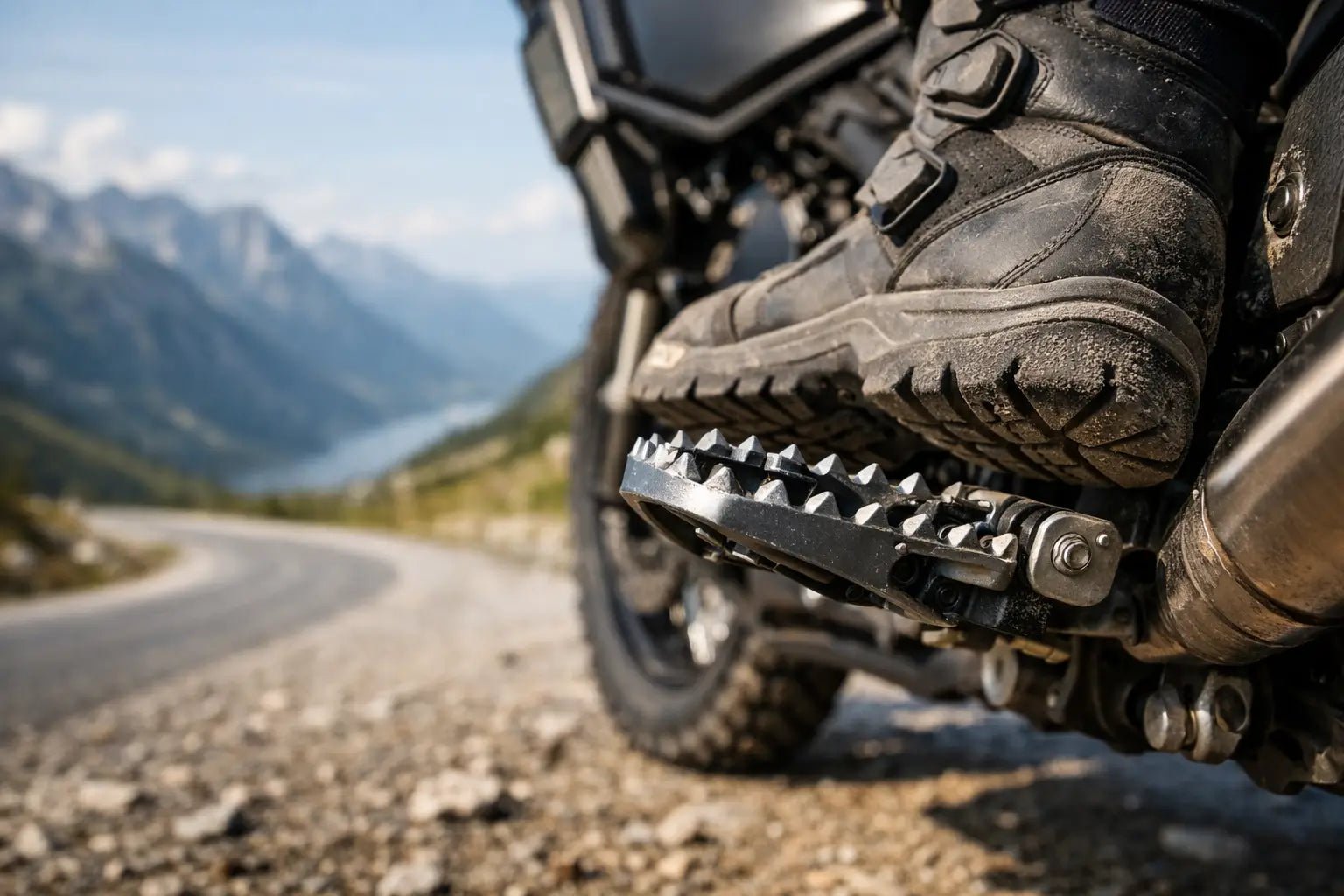
If, when riding standing up, your foot seeks support, or after a few hours on the footpegs you feel pressure under the arch of your foot, the problem is often not the technique but the support surface. The best wide street enduro footpegs truly change motorcycle control, especially on large adventure and dual-sport bikes used on asphalt, dirt roads, and light to medium off-road terrain. They are not an aesthetic accessory: they affect stability, comfort, and precision in weight transfers.
Why choose wide footpegs on a street enduro motorcycle
On an adventure motorcycle, the footpegs' role is more important than it seems. When standing, almost all of your body weight goes through them. If the footpeg is narrow, has ineffective teeth, or a short platform, your foot will tire more quickly, and sensitivity in direction changes will worsen. You'll immediately feel this on uneven terrain, but also on damaged asphalt or during long journeys where you alternate between sitting and standing positions.
A wide footpeg better distributes the load and offers more support to the boot. The practical advantage is twofold: less concentrated pressure on the sole of the foot and more control when you need to lighten the front, correct your trajectory, or absorb a series of bumps. On heavy motorcycles, such as BMW GS, Africa Twin, or KTM Adventure, this difference is even more noticeable.
However, one point needs to be clarified immediately. Wider does not automatically mean better. If the footpeg is too wide for your riding style or the motorcycle's geometry, it can slightly reduce ground clearance when cornering or make using the rear brake and gear shift less natural. The right choice depends on the type of use.
Best wide street enduro footpegs - what really matters
When evaluating the best wide street enduro footpegs, width is only one factor. What makes the difference is the complete package: usable surface, shape, grip, height, material, and compatibility with original controls.
Platform width and length
A wider platform increases lateral support, while greater length helps better support the entire foot. For mixed road-off-road use, a balanced size is often preferable to an extreme solution. On a touring motorcycle, the footpeg must improve support without becoming cumbersome during rapid movements.
Those who spend many hours standing on dirt roads appreciate generous footpegs, especially with rigid adventure boots. Those who use the motorcycle mainly on the road with some off-road deviations usually find a wide but not excessive platform more comfortable.
Real grip, not just aggressive teeth
Grip depends on the shape and arrangement of the teeth, not just their height. A well-designed tooth pattern keeps the boot steady in light mud, wet conditions, and the typical vibrations of rough tracks, but without being unnecessarily aggressive during frequent maneuvers or tourist transfers.
Footpegs with replaceable teeth offer a tangible advantage: when they wear out or get damaged, you don't have to change the entire footpeg body. For those who travel frequently and use their motorcycle intensively, this is a technical detail worth considering.
Materials and resistance
The best solutions for this segment are stainless steel, high-strength steel, or high-quality CNC-machined aluminum. Steel tends to offer great robustness and excellent durability, with a very solid feel in heavy use. Premium aluminum allows for lighter weights and precise machining, but construction quality is very important.
On a motorcycle intended for long journeys, impact and corrosion resistance is not a minor detail. A footpeg can hit stones, mud, water, salt, and falls from a standstill. A component designed to go anywhere is needed, not just to look good in photos.
Height and riding position
Some aftermarket footpegs maintain the original height, while others slightly lower the support point. A lower position can improve comfort on long distances and increase legroom, a useful aspect for tall riders or those who travel many consecutive hours.
On the other hand, lowering the footpeg changes the ergonomic triangle and may require adjustments to the gear shift lever and rear brake. Furthermore, if you do a lot of technical off-road, a footpeg that is too low can be less favorable in some sections where clearance and freedom of movement are needed.
How to choose based on actual use
The right choice always starts with how you use the motorcycle, not the product category.
Adventure touring with a lot of asphalt
If you do long transfers, with panniers mounted, alpine passes, and only a few dirt sections, aim for wide footpegs with stable support and a well-finished profile. Here, comfort almost comes before extreme grip. You need a platform that reduces fatigue when you stand up to overcome potholes, speed bumps, damaged sections, or uneven terrain.
On BMW GS or Triumph Tiger, for example, many motorcyclists are looking for precisely this: more support without compromising road riding.
Mixed road and frequent dirt road use
For those who regularly alternate between asphalt and off-road, balance is the priority. Effective grip, good surface, robust structure, and a shape that allows freedom of movement. In this case, the footpeg must work well with adventure or enduro boots and maintain sensitivity even when the terrain constantly changes.
Africa Twin, KTM Adventure, and Yamaha Ténéré are motorcycles where a well-chosen footpeg immediately improves the standing feel. The motorcycle is controlled better with less energy, and at the end of the day, the difference is noticeable.
More aggressive off-road with travel bikes
If your street enduro sees rocky terrain, gullies, loose climbs, and long sections standing up, you can opt for more specialized footpegs. Wider, more open for mud shedding, with a more pronounced tooth pattern and a very robust structure. Here, the compromise on purely road riding is acceptable because the priority becomes control in difficult conditions.
Compatibility with the motorcycle: the detail that prevents errors
For this component, compatibility is as important as quality. A footpeg designed for a specific model integrates better with the original support, maintains the correct travel, and reduces the risk of play, imprecise mounting, or interference with controls.
You must always check the motorcycle's year, version, and trim level. Between a standard GS and an Adventure, or between different generations of Africa Twin or KTM, attachments, dimensions, and linkage geometry can change. The presence of lowered supports, aftermarket brake or shift kits can also have an impact.
For this reason, in a technical catalog like Endurrad's, searching by model is not a commercial detail but a practical advantage. It immediately directs you to solutions truly compatible with your motorcycle and how you use it.
Common mistakes in choosing wide footpegs
The first mistake is buying based solely on aesthetics or declared measurements. Two wide footpegs that are identical on paper can offer very different sensations due to shape, tooth pattern, and height.
The second is ignoring the type of boot. With a soft touring boot, a very aggressive tooth pattern can be less comfortable. With a rigid adventure boot, however, a footpeg that is too smooth or narrow compromises control.
The third is neglecting to adjust the controls after mounting. If you change the platform height or volume, the position of the gear shift lever and brake pedal must be checked. Just a few millimeters out of place can worsen riding, even with a high-quality footpeg.
When the upgrade really makes a difference
There are accessories that you hardly notice on the first ride and only appreciate over time. Wide footpegs do not fall into this category. If you choose well, the difference is almost immediately perceptible. On standing sections, the motorcycle seems more readable, weight is managed better, and the foot works with less tension.
On long distances, the benefit is less spectacular but often even more important: less fatigue, more natural posture changes, greater safety when the terrain suddenly worsens. It is one of those upgrades that improves real riding, not just the motorcycle's technical specifications.
Which features to truly prioritize
If you are looking for the best wide street enduro footpegs, prioritize four elements: useful support, grip consistent with your use, materials suitable for intensive use, and precise compatibility with your motorcycle. The rest comes after.
A good footpeg should make you feel more stable without requiring strange adaptations. It must work well with your boots, your riding position, and the terrain you actually encounter. This is where a premium component stands out: it doesn't promise miracles, but it continues to function well ride after ride, journey after journey.
If you are preparing your motorcycle for the next season, this is one of those interventions that makes sense before many other more visible accessories. Because when the terrain changes and you need to ride standing with precision, the contact point that matters is under your feet.




Share:
Jado S6 for motorcycles: is it really worth it?
Semi-rigid vs. aluminum suitcases: which to choose