


Riding a motorcycle on wet roads doesn't take courage; it takes room for error: brake more gently and earlier, lean less in corners, leave twice the distance from the car ahead, and check your tires when cold. It's not the water itself that causes trouble, but the spots where grip drops off (road markings, manhole covers, leaves, shiny asphalt) and worn or underinflated tires.
An honest fact first: the 2025 ISTAT report gives no figures for crashes on wet roads. Instead, here's what sources say about riding technique, tires, and ABS, and which Endurrad accessories are really useful in the rain.
In brief
- Official data: ISTAT counts 802 motorcyclists killed in 2025, but doesn't distinguish crashes on wet roads. Anyone citing precise percentages for rain has no ISTAT source.
- Slippery spots: The first rain after dry weather, road markings, manhole covers, rails, shiny asphalt, wet leaves.
- Braking: Brake smoothly and early, keeping the motorcycle as upright as possible. ABS prevents wheel lockup but doesn't increase grip.
- Tires: Check cold pressure at least twice a month, keep the tread well above the legal minimum, and monitor tire age.
- Gear: Dry hands, waterproof luggage, and a clean visor matter as much as technique.
The 2025 ISTAT data doesn't distinguish wet roads: here's what we really know
Confident-sounding percentages about riding in the rain circulate without sources. The official report says something else, and it's worth reading for what it actually contains.
The ISTAT 2025 road accident report reports that crashes peak on weekdays at 6:00 p.m., with 12,691 incidents, or 8.2% of the weekday total. In late October, the sun has already set by then, so rain, darkness, and traffic combine. However, the version of the document we consulted contains no table on weather conditions or wet road surfaces.
The most useful statistic for riders is this: nearly one in two motorcyclists killed loses their life in a collision with a car. In the rain, cars brake less effectively, windscreens fog up, and visibility drops. For more on lights and evening visibility, see the article on how to ride a motorcycle in the dark during daylight saving time.
Where motorcycles really slip
On wet roads, grip doesn’t decrease evenly: it remains acceptable almost everywhere, then suddenly disappears in a few spots. Recognizing them is worth more than any accessory.
| Where | Why it’s hazardous | What to do | Source |
|---|---|---|---|
| First rain after several dry days | Smog and dust that build up on the asphalt form a slippery film | Take it slower for the first few minutes | Insella |
| Road markings and pedestrian crossings | Paint offers less grip than asphalt, especially when shiny | Cross straight over without braking or accelerating | Insella, Moto.it |
| Metal manhole covers and grates | Wet metal has very little grip | Avoid them or cross with the motorcycle upright | Insella |
| Tram tracks | Wet steel, often on bends | Cross them as close to a right angle as possible | Insella |
| Shiny, worn asphalt | The smooth surface drains water poorly | Lean less, leave more distance | Insella |
| Wet leaves | A slippery layer in shaded bends, typical of October and November | Maintain steady throttle, don’t brake while leaned over | Riding experience |

The controversy over road markings, in brief
In 2012, two motorcyclists’ associations wrote to the City of Milan to report that pedestrian crossings were slippery. The city replied that the markings complied with the ANAS manual and that pollution could also be a factor. Moto.it pointed out that the manual requires pedestrian crossings to have at least 80% of the grip of the surrounding asphalt. The incident dates back a while, but the practical advice hasn’t changed.
Braking on wet roads: gentler, earlier, never abrupt
On wet roads, braking distance increases and the margin for error shrinks. Good braking is the kind you don’t notice.
- Look far ahead and anticipate. If you see a traffic light or a queue, start slowing down earlier than usual: closing the throttle is already a form of braking.
- Use the controls gently. Insella recommends gradual braking even with ABS and suggests starting with the rear brake, then adding the front brake to keep the bike balanced. This is the publication’s advice: also follow your model’s manual and your own riding habits.
- Straighten up before braking hard. If you need to brake firmly, bring the motorcycle as upright as possible: while leaned over, grip is already being used.
- Don't pump the brakes with ABS. If you feel the pulsing, maintain pressure on the lever: the system is working for you.
- Double the following distance. Following cars and vans too closely is a mistake: you can't see much past them, and they brake differently.
- braking is progressive and the lever is not snatched
- the tires have the correct tread and pressure
- the motorcycle is as upright as possible
- does not create grip where there is none, such as on a wet manhole cover
- does not shorten stopping distance on slippery surfaces
- does not replace a safe following distance
As for overall effectiveness: in a 2014 news report cited by Motoring Research, Bosch estimated that ABS could prevent around a quarter of motorcycle injury cases, but the source does not cite the study and does not refer to wet roads. Treat this as an approximate figure. In the European Union, ABS is mandatory on new motorcycles over 125 cc, but older motorcycles may not have it: check your owner's manual.
Corners, electronics, and lines on wet roads
In a turn, grip is shared between lateral force and braking or acceleration: on wet roads, there's less grip to share.
InSella recommends moving smoothly and leaning into the turn to reduce the lean angle needed for the same curve. Keep your feet on the footpegs, maintain steady throttle without jerking, and look toward the exit. Riders with advanced electronics can use the slippery-surface riding mode and a more sensitive traction control setting; motorcycles with an inertial measurement unit also offer cornering ABS and traction control, which are useful but no magic fix.
Advice you won't find in the manuals
This is our editorial opinion, not a fact: in the wet, ride as if there were an egg under the throttle grip. If you find yourself making frequent corrections, you're going faster than the road surface allows. Shaded bends and stretches with leaves call for an extra degree of caution.
Tires and pressure: the check that matters most
Tires are the only point of contact with the road. In the wet, their tread channels away water, and without the right pressure they don't work properly.
Pressure: when cold, and regularly
InSella recommends checking the tire pressure when the tires are cold, meaning the motorcycle has been stationary for at least a couple of hours, at least twice a month, or weekly if you ride a lot. Follow the value in the owner's manual. With a passenger and luggage, the magazine suggests adding about 0.2-0.3 bar, but check the manufacturer's recommendations. Too much pressure reduces the contact patch and grip; too little makes the bike harder to handle and increases wear.
Tread and age
For motorcycles, the sources consulted indicate 1 mm as the legal minimum tread depth (0.5 mm for mopeds): check the current text of the Highway Code implementing regulations for the applicable value. This is a legal limit, not a safety recommendation. The following test is on cars, not motorcycles, but it shows how much tread matters on wet roads.
| Tread | Braking distance from 80 to 0 km/h on wet roads |
|---|---|
| 8 mm | 42,3 m |
| 3 mm | 51,8 m |
| 1.6 mm | 60,9 m |
Data from a test on passenger cars reported by Quotidiano Motori: indicative, not measured on motorcycles. As for tires, the same publication gives an average lifespan of around 3-5 years, and Insella suggests checking the DOT code: a tire sitting in storage ages even when it isn't being used.

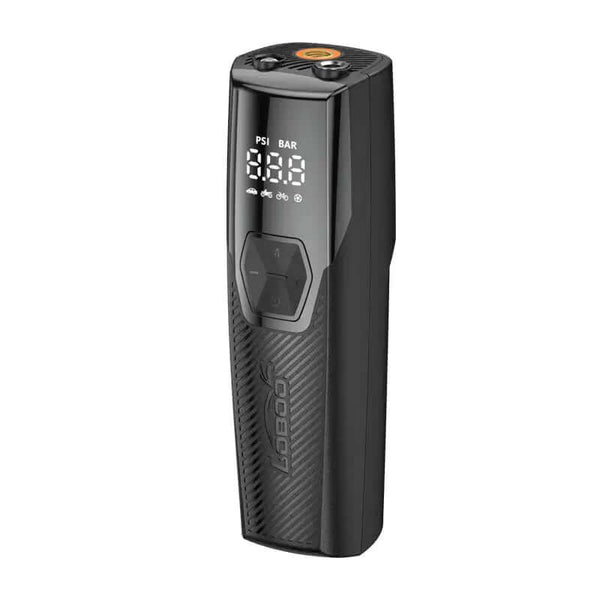
- Pressure
- 2 to 150 PSI
- Flow rate
- 35 liters per minute
- Weight
- 294 g
- Power supply
- 12V, cigarette lighter socket or battery clamps
- Listed price
- 50 €
As of October 21, 2026, two units remain in stock. To choose an inflator and find out when you need one, see the guide to portable motorcycle compressors.

- Installation
- in place of the valve caps, one per wheel
- Measurement
- pressure and temperature
- Connection
- Bluetooth
- Listed price
- 40 €
As of October 21, 2026, the pair is sold out, so the button leads to the collection. The sensors show pressure and temperature, but they don't replace a cold tire check with a pressure gauge: the complete guide is TPMS sensors for motorcycles.
Dry hands, clear visor, and waterproof luggage
A frozen hand on the brake lever is less precise. A fogged-up visor takes away the most important thing: seeing.
Hands
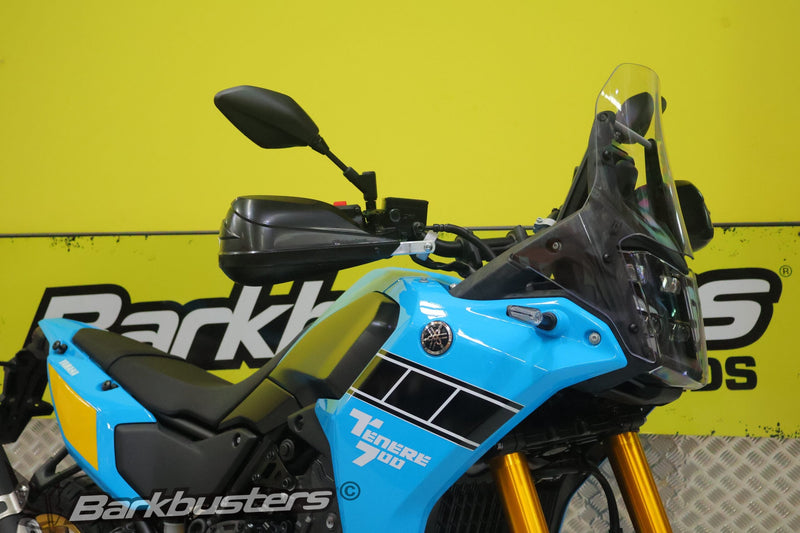
In the rain, your hands are the first to suffer. The LOBOO H80 heated grip covers (€81, one in stock as of October 21) fit over the standard grips and operate at four heat levels. For protection from water and wind, there are handguards: for the BMW GS, LOBOO aluminum handguards with adjustable deflector, while the Barkbusters collection offers alternatives for other motorcycles, currently with limited stock. To figure out what to heat first, see the guide to heated motorcycle gear.

The visor and lights
In the rain, the visor fogs up and gets splashed with dirt. An anti-fog treatment, a clean, unscratched visor, and a quick clean at the first stop are simple but crucial. The lights must always be on: Article 152 of the Highway Code requires motorcycles to have their lights on even during the day. For the meaning of the sign with the semicircle and black lines, see the article on the road sign and lights on motorcycles.
Luggage
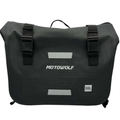
A bag that doesn't close properly lets water in through the first zipper. The Wanderer 50 L waterproof tail bag (€221, two pieces in stock) and waterproof options like those described in the guide to motorcycle dry bags keep clothes and documents dry. We don't give water-resistance percentages in the article: the stated figures are on the product pages.
Checklist before setting out in the rain
Five checks, two minutes, no excuses.
- Cold tire pressure checked with a gauge, according to the owner's manual.
- Tires. Tread, age (DOT code), and sidewall damage.
- Lights. Low beam, brake light, and turn signals all working.
- Visor. Clean, unscratched, and treated with an anti-fog coating.
- Riding mode and settings. If your motorcycle allows it, select the mode for slippery surfaces and a more sensitive traction control setting.
Frequently asked questions about riding a motorcycle in the wet
The most frequently asked questions, with sources listed in the notes.
Can you ride a motorcycle safely in the rain?
How much does stopping distance increase in the wet?
Can I brake hard in the wet with ABS?
What is the right tire pressure for riding in the rain?
What is the minimum tread depth for a motorcycle tire?
Why is the first rain after days of sunshine the most dangerous?
Are pedestrian crossings, manhole covers and tram tracks really more slippery?
How can you avoid aquaplaning on a motorcycle?
Should you use your motorcycle’s Rain mode?
Do low beams need to be on when it rains?
Which accessories do you really need to ride a motorcycle in the rain?
Are TPMS sensors useful in the wet?
Read next
Get your motorcycle ready for rainy days
At Endurrad, you'll find accessories for tires, dry hands, and waterproof luggage. Start with the LOBOO collection, Barkbusters handguards, or JADO displays with pressure sensors.
Take Endurrad with you everywhere: download the Endurrad app for iPhone.
ISTAT, 2025 road accident report (July 2026).
Insella, Riding a motorcycle in the wet: essential tips (December 15, 2025).
Insella, Tire pressure: how to check it.
Quotidiano Motori, Braking in the wet and When to change motorcycle tires.
Moto.it, Pedestrian crossings make motorcyclists fall in Milan (December 17, 2012).
Motoring Research, Motorcycle ABS prevents 1 in 4 casualties (October 25, 2014).
Highway Code, Art. 152: normattiva.it. Last updated: October 21, 2026.