A stone thrown by the wheel of the rider ahead is enough to ruin a day, or an entire trip. Adventure motorcycle radiator guards are designed for this purpose: to protect an exposed, expensive component that is essential for managing engine temperature, without compromising cooling when the motorcycle is really working, on asphalt, uphill, or on slow trails loaded with luggage.
On a modern adventure motorcycle, the radiator is not a secondary detail. It is often large, mounted on the side, and vulnerable to impacts and debris. Those who use their motorcycle only in the city may underestimate the risk. Those who travel, however, know that a fast gravel road, a rocky section, or even a ride in the rain and dirt is enough to understand how much a well-designed guard can make a difference.
Why install an adventure motorcycle radiator guard
The point is not only to prevent the radiator from being punctured. A guard also helps reduce exposure to pebbles, branches, compacted mud, and insects, all of which can bend the fins or significantly dirty the heat-exchange surface over time. Immediate damage is the worst-case scenario, but gradual deterioration also affects efficiency and reliability.
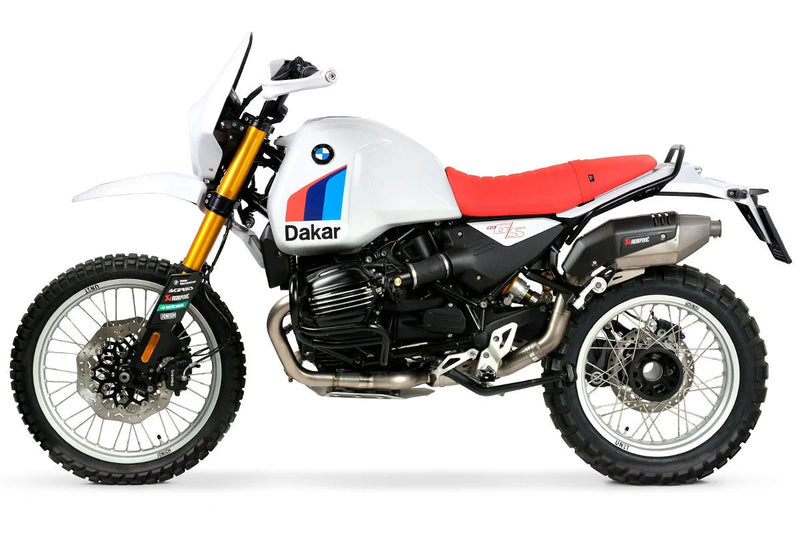
This aspect matters even more on touring motorcycles. BMW GS, KTM Adventure, Honda Africa Twin, Yamaha Ténéré, and similar models are used with luggage, varying temperatures, and often at low speeds on light or medium off-road terrain. Under these conditions, the cooling system works hard, and any accessory mounted in front of the radiator must provide protection without creating an excessive barrier to airflow.
This is the real distinction between a well-designed guard and a choice based solely on aesthetics. If the mesh is too closed, the material is too thick, or the design does not follow the radiator’s geometry, the risk is to add more protection but reduce efficiency. On an adventure motorcycle that is genuinely used, this compromise must be evaluated carefully.
Materials and construction: what really makes a difference
High-end adventure motorcycle radiator guards are generally made from stainless steel, laser-cut aluminum, or combinations of a frame and metal mesh. Stainless steel offers excellent impact and corrosion resistance, with a rigid structure that handles heavy use well. On the other hand, it can weigh slightly more. Aluminum is lighter and well suited to a motorcycle prepared for touring, but it must be properly designed to avoid deforming too easily under repeated impacts.
The finish also matters greatly. A durable coating or serious corrosion treatment is not merely an aesthetic detail. Mud, water, frequent washing, and salt on winter roads put everything under stress. A guard that begins to oxidize or peel after a short time is not consistent with a motorcycle designed to travel far.
The mesh design also plays a concrete role. The openings must be large enough to allow sufficient airflow while still stopping the most dangerous debris. There is no single perfect size for everyone. It depends on the radiator, its position, the fan, the available space, and the motorcycle model.
Tight mesh or open mesh?
It depends on how you use the motorcycle. If you often ride over rocky terrain, fast gravel roads, or travel in groups on dirt, more extensive coverage makes sense. If you mainly ride on asphalt, in summer, with long stretches and high temperatures, it is better to prioritize a solution that allows the radiator to breathe properly.
The right approach is always to find a balance. On a heavy, fully loaded maxi enduro that also travels slowly off-road, a mesh that is too closed can make the fan run more often. This is not automatically a problem, but it is a sign to consider when choosing.
Compatibility: the most common mistake
In the adventure world, compatibility is not a commercial detail. It is a technical matter. Radiator dimensions, mounting points, the presence of air guides, engine guards, or side fairings can vary greatly from one model to another, and often even between different years of the same model.
For this reason, adventure motorcycle radiator guards should be chosen based on the exact motorcycle: make, model, year, and version. A solution specific to the BMW R 1250 GS is not automatically correct for an R 1300 GS. The same applies to the standard Africa Twin and Adventure Sports, or to the KTM 890 Adventure and 890 Adventure R.
A dedicated guard fits better, vibrates less, and maintains the correct distance from the radiator. This is important not only for stability, but also to prevent rubbing, noise, or contact points that could cause problems over time. In a technical catalog such as Endurrad’s, model-specific selection is especially useful here: it reduces errors and guides you toward genuinely compatible accessories.
Pay attention to bars and guards already installed
Many riders prepare their motorcycles in stages. First they install engine guards and side bars, then they add radiator protection. This is a normal sequence, but compatibility between components must be checked. Some guards integrate perfectly with original or aftermarket bars, while others require space that is not always still available.
Before purchasing, always check whether the manufacturer specifies compatibility with crash bars, enlarged fairings, or other front protection. It is a simple check that prevents forced installations and untidy results.
Installation: simple does not mean it can be overlooked
In most cases, installation is straightforward and does not require structural modifications. But that does not mean it can be improvised. A poorly installed guard can vibrate, touch the radiator, or remain misaligned with the airflow.
Pay attention to spacers, tightening torque, and the correct order of the screws. If the kit includes dedicated brackets, they must be used exactly as intended. Even a few millimeters can make a difference. The radiator is a delicate component: forcing anything during installation is the worst way to protect it.
After installation, it is useful to check two things. First, make sure there is no contact with the radiator body or the air guides. Second, monitor the motorcycle’s thermal behavior during the first real rides, especially if you use it in summer, in traffic, or on slow routes.
How to choose the right radiator guard for your use
If the motorcycle is mainly used for long asphalt trips with occasional detours onto gravel roads, it makes sense to choose a lightweight, well-finished guard with excellent airflow and a clean installation. If you do more off-road riding, even if it is not extreme, a sturdier structure is preferable, with a design intended to stop more aggressive debris.
For a fully loaded maxi enduro, design quality should always be the priority. It is not enough for the guard to simply “cover” the radiator. It must protect without complicating heat management and without becoming a weak point amid vibration, mud, and washing. On a lighter dual-sport, the margin may be different, but the principle remains the same.
Another useful criterion is ease of cleaning. Mud, fine dust, and insects accumulate. A well-made guard must allow for simple inspection and maintenance, because a clogged guard reduces precisely the airflow it is supposed to preserve.
When they are really worth installing
The practical answer is: almost always, if your adventure motorcycle leaves urban use behind and tackles trips, dirt roads, or damaged roads. The cost of a good guard is modest compared with the value of the radiator, and especially compared with the problems damage can cause far from home. It is not a decorative accessory. It is functional protection designed for those who use their motorcycle as it is meant to be used.
That said, not every motorcycle and not every riding style requires the same solution. Those who ride almost exclusively on smooth asphalt can tolerate a more open guard. Those who alternate between alpine passes, gravel tracks, and summer transfers need a better-engineered product, with a precise balance between shielding and cooling.
In the end, the right choice is not the most aggressive-looking guard or the simplest one to install. It is the one compatible with your motorcycle, suited to how you use it, and built to last when the journey gets longer, the terrain worsens, and the radiator stops being a hidden component and becomes something that genuinely needs protection.