


The difference between a travel-ready motorcycle and one that's just loaded with accessories can often be seen here: in the pannier racks. If you're wondering how to choose motorcycle pannier racks, the point isn't just to attach two bags to the sides. The real issue is having a stable, compatible system designed to withstand miles, vibrations, dirt roads, and actual loads without compromising riding and safety.
A wrong support is immediately noticeable. The panniers move, the mounting is forced, the weight is poorly distributed, and every bump turns into stress for the rear frame. A correct support, however, works silently: it keeps the load steady, follows the bike's geometry, and lets you ride with confidence, both on asphalt and when the journey gets rough with stones and corrugations.
How to choose motorcycle pannier racks based on usage
The first criterion is always the actual use of the motorcycle. Not the ideal one, but what you actually do. If you primarily travel on roads with long stages, a passenger, and full luggage, you need a rigid, stable system designed for spacious panniers. If, on the other hand, you alternate between asphalt and light or medium off-road, the priority changes: you need robust but not excessively bulky supports, capable of protecting the bags and better resisting twists and impacts.
Those who use aluminum panniers for motorcycle touring often opt for side frames with a well-reinforced perimeter structure. Those who prefer semi-rigid or soft adventure bags look more at compatibility with lightweight systems, distance from the exhaust, and the ability to contain lateral bulk. So, there is no single best support. There is the one most suitable for the weight, the type of route, and the luggage system you will actually use.
Frequency also matters. A motorcycle that undertakes two important trips a year and a few weekend outings can tolerate a more modular setup. A motorcycle ready to churn out weeks of consecutive travel, however, requires components designed for intensive use, with precise fastenings and a reliable structure in the long term.
Compatibility with the motorcycle: the first real filter
On this point, we need to be clear. Model-specific compatibility matters more than design, brand, and even declared weight. A support designed for a BMW R 1250 GS should not be evaluated with the same criteria as one for a Yamaha Ténéré 700, KTM Adventure, or Honda Africa Twin, because the rear subframe, exhaust, lateral dimensions, anchoring points, and space distribution all change.
When the support is developed for the correct motorcycle, the mounting is clean, the fastening points work as they should, and the assembly remains consistent with the vehicle's structure. When an adaptation is forced, however, problems arise: interference with turn signals or passenger handles, panniers that stick out too far, asymmetries, and poorly distributed loads.
Pay attention to the exhaust, passenger, and accessories already installed
Many motorcyclists prepare their bikes in stages. First the crash bars, then the luggage rack, then the panniers, perhaps even a different seat or oversized footpegs. Each modification can affect the overall dimensions. For this reason, it is necessary to check whether the pannier racks are also compatible with aftermarket exhausts, top cases, rear plates, or original handles.
If you often travel with a passenger, also check the leg and foot space for the passenger. A well-built system should not create interference when getting on the bike and should not force the passenger into an unnatural position. It may seem like a detail, but over long distances, it makes a big difference.
Materials and construction: where quality is evident
Pannier racks operate under continuous vibration. It's not enough for them to be resistant when stationary in the garage. They must withstand bumps, uneven surfaces, load oscillations, thermal changes, and, in the case of adventure bikes, even occasional impacts or low-speed falls.
For this reason, it's important to evaluate the tube diameter and thickness, the quality of the welds, the surface finish, and the precision of the brackets. A well-built frame distributes stress better and reduces the risk of localized failures at the anchoring points. Anti-corrosion treatment also matters, especially if the motorcycle is ridden all year round or encounters rain, salt, and mud.
Steel often remains the preferred choice for robustness and repairability, especially for adventure and long-distance travel setups. Aluminum can make sense in some specific systems but requires very accurate design. Here, it's not about chasing the lightest figure on the technical sheet. It's about finding the best balance between strength, weight, and field reliability.
Supports for rigid or semi-rigid panniers
The choice of supports directly depends on the type of pannier. Rigid aluminum panniers normally require a dedicated frame and a precise attachment system. The more stable the fastening, the less the load moves and the less stress it transmits to the motorcycle. On a maxi enduro or an adventure tourer, this solution offers excellent load capacity and organized luggage management.
Semi-rigid or soft bags may require less invasive supports, but they are no less important. Their task is to keep the bag away from the wheel, exhaust, and hot parts, as well as to provide a stable base when riding standing up or on uneven terrain. On motorcycles like the Ténéré 700 or KTM 890 Adventure, many travelers prefer this configuration to reduce weight and bulk during mixed outings.
Quick-release system or fixed structure
The quick release is convenient, especially if you use the motorcycle without luggage. It allows you to remove frames or panniers more quickly and leaves the bike cleaner. The fixed structure, however, can offer greater mechanical simplicity and fewer elements subject to play over time.
Here the choice depends on the use. If you alternate commuting, weekends, and long trips, modularity is a concrete advantage. If the motorcycle is designed as a travel vehicle and almost always remains equipped, a well-designed fixed system makes a lot of sense.
Load, width, and dynamic behavior
Many choose supports based solely on pannier capacity. This is a common mistake. It's more useful to ask how that system changes the bike in motion. Increasing the lateral width too much penalizes urban traffic, but more importantly, it can make riding through narrow passages or on uneven surfaces more delicate. Similarly, a structure that protrudes too much exposes it more to impacts and contact.
The placement of weight also matters. A good support keeps the panniers as close as possible to the motorcycle's center of gravity, without compromising the necessary space for the exhaust and suspension. This helps with changes of direction, low-speed maneuvers, and restarts with a full load.
The maximum supported weight should also be considered, but without reading the data superficially. It's not enough to know how many kilos the support can hold. You need to understand how that weight will be distributed and whether the motorcycle, the rear subframe, and the intended use are consistent with that load.
How to choose motorcycle pannier racks without common mistakes
The most frequent mistake is buying panniers first and only then thinking about the supports. In reality, the system must be considered as a whole. Panniers, frames, attachments, and the motorcycle must work as a single unit. When one of these elements is chosen without considering the others, unconvincing adaptations arise.
The second mistake is underestimating the type of route. A support excellent for road touring may not be the ideal choice for those who often face dirt roads and continuous vibrations. The third is ignoring maintenance. Even a premium system needs to be checked: tightening torques, bushings, any play, and the condition of the bolts after the first few kilometers with a full load.
Then there's an often overlooked aspect: ease of access. Very high or too far back panniers can make it less practical to get on the bike, load the motorcycle, or open the lids with other accessories installed. A good configuration shouldn't just be resistant. It should also simplify your journey.
The right choice starts with the motorcycle model
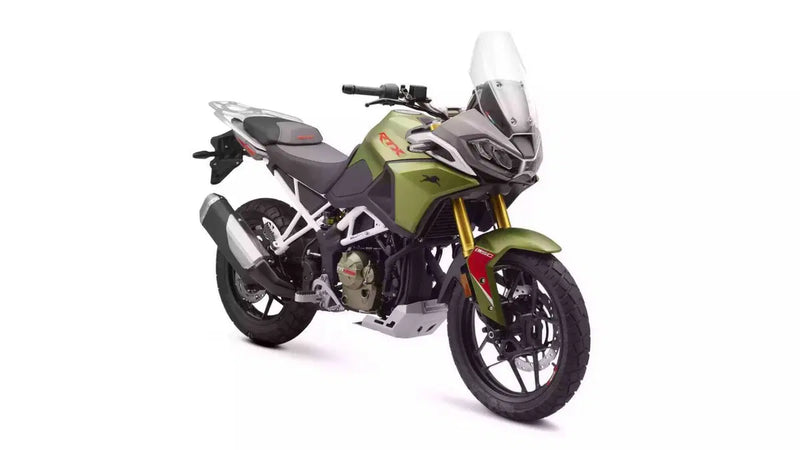
On a large displacement GS, you can afford more structured systems and high-capacity panniers, provided the support is developed to manage weight and bulk well. On an Africa Twin, the ideal compromise may be different, especially if you alternate fast transfers and dirt sections. On a Ténéré 700 or some KTM Adventures, the issue of weight containment and lateral slimness becomes even more important.
For this reason, a serious approach always starts with three questions: what motorcycle do you have, where do you really go, and what luggage will you use. From there, you arrive at the correct support, not the other way around. This is also why catalogs built by motorcycle model are more useful than a generic choice based only on pannier dimensions.
When the system is coherent, you notice it on the first trip. The motorcycle remains balanced, the mounting creates no surprises, and the luggage stops being a problem to deal with at every stop. That's when the pannier racks truly do their job: they disappear from your attention and leave room for the road ahead.