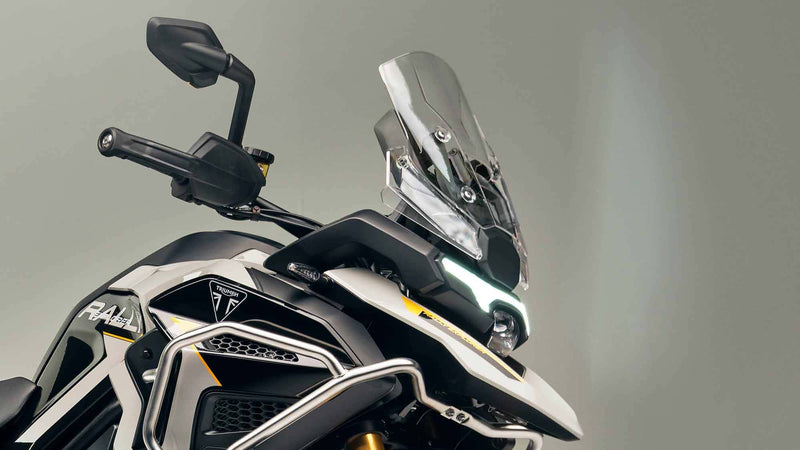



Installing a set of auxiliary spotlights seems like a simple job until you end up with handlebar vibrations, wiring that is pulled too tight, or a light beam that illuminates the trees instead of the road. If you are wondering how to install motorcycle fog light bars correctly, the point is not just to attach two brackets: where you install them, how you distribute the weight, and how neat the electrical system remains all matter.
On adventure and touring motorcycles, fog light bars are not only for adding light. They are a mounting base designed to keep the lights stable, protect them better from vibrations, and keep them in a consistent position even when the motorcycle is ridden on dirt roads, over potholes, or on damaged asphalt. That is why correct installation varies significantly between a BMW GS, an Africa Twin, a KTM Adventure, or a Ténéré: the principle is the same, but the available space, mounting points, and clearances are never identical.
How to install motorcycle fog light bars without mistakes
Before picking up your wrenches and Allen keys, one thing must be checked: actual compatibility with the motorcycle model. It is not enough for the bar to “fit”. It must be designed to use structural mounting points, without forcing plastics, lightweight subframes, or supports that were not designed to withstand vibrations and additional weight.
On large enduro bikes, installation generally takes place in one of these areas: beneath the headlight assembly, on the front beak supports, together with the upper crash bars, or on a dedicated crossbar. The best choice depends on how you use the bike. If you do a lot of asphalt riding and touring, a high position improves passive visibility to other vehicles. If you are looking for a true fog-light function, a lower installation generally works better in fog and rain because it limits reflections toward the rider. On the other hand, a position that is too low exposes the lights more to stones, mud, and impacts.
Before final tightening, it is always worth doing a dry fit. Place the bar in position, check the fork travel, cable routing, clearance from the fender, windscreen, and fairings, and make sure there is no contact when the handlebars are turned fully. This is when you prevent real problems, not afterward.
Tools and work preparation
A workshop is not necessary for a clean installation, but method and precision are. Hex keys, correctly sized sockets, medium-strength threadlocker, quality cable ties, protective sleeving for the wiring, and a torque wrench are the basics. The torque wrench matters more than you might think: overtightening fasteners on aluminum supports or delicate threads is the quickest way to damage a premium kit.
Before starting, the motorcycle should be positioned securely, preferably on the center stand or a rear paddock stand. If you need to work near the electrical system, disconnecting the negative battery terminal is good practice. It is not just a precaution: it prevents accidental short circuits while you route cables and connectors.
Choosing the position and mounting geometry
A fog light bar should remain as symmetrical as possible relative to the motorcycle’s centerline. Even a slight misalignment is immediately visible in the light beam and often in the vibrations as well. For this reason, installation should initially be done with all bolts only loosely started, without tightening them fully right away.
Once the bar is in place, check three aspects. The first is levelness. The second is uniform clearance from the fairings or crash bars. The third is mechanical freedom, meaning there are no points of interference during compression, steering, or movement of nearby parts. Only after these checks should you proceed with gradual tightening.
If the kit includes spacers, they must be installed exactly as specified. Many problems involving cracks, bent brackets, or abnormal stress are caused by reversed washers or forgotten spacers. A well-designed kit works with precise tolerances: improvising here offers no advantages.
Correct tightening and vibration checks
Tightening should be progressive and done in a crisscross pattern, especially if the bar uses two lateral mounting points. First bring everything into contact, then align it, and finally tighten it to the torque specified by the manufacturer. If you do not have the exact specification, it is better not to force it.
Medium-strength threadlocker makes sense on a motorcycle that will experience vibrations, off-road riding, and many miles. However, it must not replace the correct torque. If a support comes loose, the problem is often not the lack of threadlocker but installation under stress or a mounting surface that is not perfectly flat.
After the initial installation, a check after 100-200 km is always recommended. On adventure bikes, especially if the first miles include cobblestones, gravel roads, or rough sections, the components settle into place.
Wiring the lights to the bar
This is where the difference lies between a neat job and one that will cause problems at the first rainstorm or during the first maintenance operation. The light cables must follow a protected route, away from heat sources, sharp edges, moving parts, and areas where the fork could pinch them.
The correct solution almost always includes a relay, a dedicated fuse, and a separate switch, except for specific kits designed to interface with the motorcycle’s original electronics. On recent models with a CAN bus, improvising direct connections can cause errors or abnormal behavior. In these cases, it is best to use compatible wiring harnesses or dedicated interfaces.
The cables should never be left dangling beneath the bar. They must be secured with cable ties at stable points, with a little slack only where needed to accommodate steering movement. That slack must be checked: too little pulls on the connectors, while too much causes rubbing.
The switch also deserves attention. It must be reachable while wearing gloves, without forcing you to release your grip or become distracted. On touring motorcycles, real-world practicality comes before an aesthetically tidy position.
Adjusting the light beam after installation
Once the bars have been installed and the lights secured, the job is not finished. If the beam is poorly adjusted, you have spent time and money on components that make night riding worse. Fog lights should complement the main headlight, not overlap it randomly.
For a sensible initial adjustment, the motorcycle should be on level ground, with its setup as close as possible to normal riding conditions. If you often travel with panniers and a roll bag, it is better to adjust the lights with that weight in mind. An unloaded motorcycle and one ready for a long trip will not aim the lights in the same way.
In general, lights mounted on a fog light bar should not point too high. The aim is to widen and fill the near and middle field of vision, improving the visibility of road edges and the perception of the road surface. If you point them too far outward, you gain little and risk scattering the light. If you angle them too far inward, you create a central hotspot that is of limited use.
A real test should be carried out at night, on a dark and safe road. That is when you understand whether the beam genuinely helps or whether you are simply producing more lumens without better quality.
Common mistakes when installing motorcycle fog light bars
The most common mistake is choosing the mounting point based on appearance. On an adventure motorcycle, function comes first: stability, protection, maintenance access, and the absence of interference. The motorcycle’s lines come afterward.
The second mistake is underestimating the total weight. The bar, brackets, lights, and wiring may not seem like much, but if they are all concentrated far forward, they have an effect. We are not talking about radically changing the setup, but on dirt roads and during long rides, the difference can be felt.
The third is installing everything without considering future maintenance. If removing a fairing or accessing a windscreen bolt requires dismantling half the lighting system, the job was not designed properly. A touring motorcycle must remain easy to work on even far from the garage.
There is also the issue of waterproofing. Exposed connectors, improvised joints, or unprotected wiring are acceptable only until the first serious storm. And if you ride the motorcycle year-round, that storm will come.
When to do it yourself and when not to
If the kit is specific to your model, with dedicated brackets and well-designed wiring, installation is within the reach of anyone with basic mechanical skills, suitable tools, and some experience. If adaptations are required, the electronics are complex, or workspace is limited, it is better to pause and assess the situation.
It is not a question of abstract skill. It is a question of reliability. On a motorcycle designed to go anywhere, every accessory must work as part of the system, not as a precarious add-on. That is why model-specific compatible kits remain the most sensible choice: fewer compromises, cleaner installation, and less time wasted correcting vibrations and interference.
Anyone who prepares a motorcycle for long trips knows this well: accessories that are installed properly stop drawing attention to themselves. They work, they withstand the conditions, and they do not require extra attention. That is the result to aim for when installing a fog light bar: not just more light, but a motorcycle that is more prepared, easier to read at night, and more reliable mile after mile.
If you have doubts about compatibility or the best position, stop before reaching for the drill and cable ties. On the right motorcycle, with the right support, correct installation is barely noticeable. But on the road, you feel the difference immediately.