

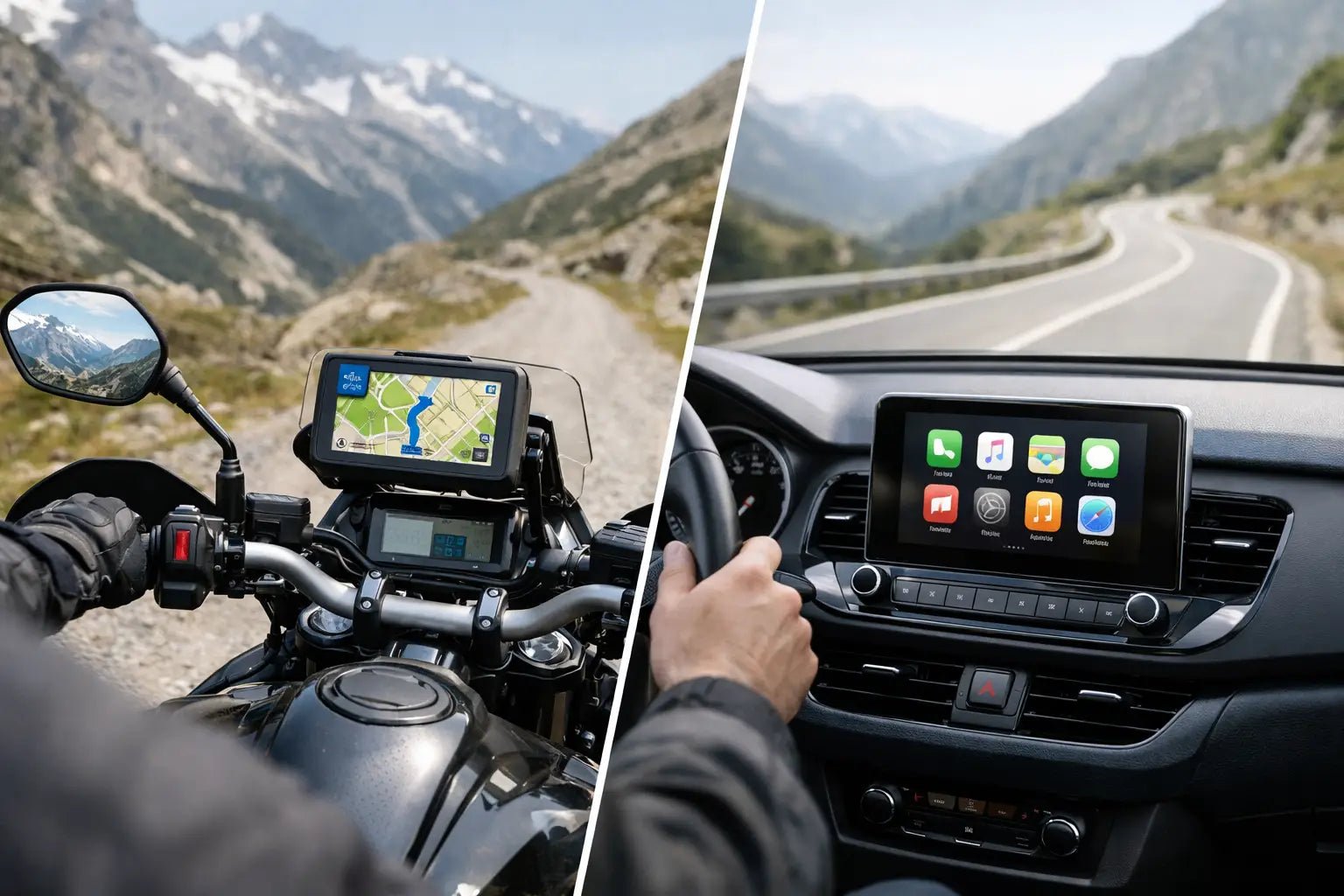
When you really start preparing a motorcycle for touring, the question comes up quickly: motorcycle CarPlay or GPS navigator? It is not a catalog choice made for aesthetics. It changes the way you read the road, handle detours, deal with rain, vibrations, gloves, and full days in the saddle. Above all, it changes how much you trust the system when you are far from home.
For those who ride a GS, an Africa Twin, a KTM Adventure, or a Ténéré, the point is not to have the most modern screen. The point is to understand which solution best withstands your actual use. Pure asphalt, mixed terrain, light dirt roads, long stages with changing weather: every scenario rewards different features. That is why the comparison must be technical, without shortcuts.
Motorcycle CarPlay or GPS navigator: the real difference
A CarPlay system for motorcycles is not, strictly speaking, an autonomous navigator. It is a display that mirrors and manages some smartphone functions, particularly navigation, calls, music, and messages, with an interface designed for use while riding. The phone remains the brain.
A dedicated navigator, on the other hand, is designed to do one thing and do it well on a motorcycle: guide you along a route with hardware designed for vibrations, direct sunlight, water, continuous power, and controls often compatible with gloves and intensive use.
This distinction is more important than it may seem. If you choose CarPlay, you are investing in flexibility and familiarity. If you choose a dedicated GPS, you are investing in specific reliability and operational independence. Neither option is automatically better. It depends on how you travel.
When CarPlay on a motorcycle really makes sense
CarPlay works well for riders who travel mainly on the road, regularly use navigation apps updated in real time, and want simple information management. Traffic, alerts, quick destination searches, and an intuitive interface: this is where the advantage is tangible.
If you do road touring, long weekends, fast transfers, and routes that often change at the last minute, a good CarPlay display can be very practical. You have constantly updated maps, can modify the route with a few taps before setting off, and can take advantage of the phone's ecosystem without mounting it directly on the handlebars, which is also useful for protecting the smartphone from vibrations and overheating.
There is also another often-underestimated aspect: mental readability. People who already use certain apps find their way more quickly, make fewer mistakes, and immediately understand the directions. On a trip, especially through urban areas or complex junctions, this makes a difference.
That said, motorcycle CarPlay performs at its best when the installation is done properly: a solid mount, stable power supply, a sunlight-readable display, genuine waterproofing, and a reliable wireless connection. If any of these elements is weak, the experience quickly deteriorates.
The practical limitations of CarPlay on an adventure motorcycle
The main limitation is simple: it depends on the phone. If the smartphone overheats, loses battery, has network problems, or suffers a fall, the CarPlay system is affected too. For light touring use, this may be acceptable. On a long trip with demanding stages, less so.
There is also the issue of managing tracks and complex routes. For asphalt, the system is convenient. For those who use digital roadbooks, detailed GPX tracks, off-road variants, or navigation in remote areas, the smartphone-app approach is not always the most efficient. Some apps work well, but the level of control and predictability is not always that of a dedicated GPS designed for this purpose.
Finally, there is overall durability. A high-quality motorcycle CarPlay display may be designed to go anywhere, but it is still essential to assess its resistance to rain, vibrations, and the quality of the installation. On large adventure bikes, especially on dirt or uneven surfaces, it is not enough for the screen simply to turn on: it must remain readable and stable for hours.
When a dedicated navigator remains the better choice
A dedicated navigator still makes a great deal of sense for those who take long trips, frequently use routes prepared in advance, or ride in situations where consistency matters more than initial convenience. Here, specialization wins.
A good motorcycle GPS usually offers a screen that is readable in bright light, a casing built for outdoor environments, more predictable power management, and better compatibility with tracks, waypoints, and detailed planning. It does not need to rely entirely on the phone, reducing one potential point of failure.
For those who alternate between asphalt and light or moderate off-road riding, it is often the more robust solution. Not because it is more modern, but because it is more consistent with the way it is used. If you are following a track in the mountains, far from populated areas, with wet gloves and a loaded motorcycle, you greatly appreciate a device designed to be there.
Where a navigator may be less convenient
The downside is that a dedicated navigator can be less immediate when searching for destinations, less fluid in its smart features, and less integrated with everyday smartphone use. For those who also use their motorcycle every day and want one unified system, this can be a drawback.
In addition, the learning curve is often more technical. Planning routes properly, managing tracks, and updating maps and settings requires some method. For many riders, this is an advantage. For others, it means extra time to invest.
The right choice depends on how you use your motorcycle
It is worth being clear here. If you mainly ride on the road, want real-time traffic information, often use new addresses, and prefer a familiar interface, motorcycle CarPlay is a very sensible solution. If your use is more adventurous, more remote, more focused on carefully planned routes and reliability on difficult surfaces, a dedicated navigator often remains ahead.
There is also a middle ground, very common among experienced travelers: a CarPlay display for everyday road use and touring, with a dedicated GPS or specialist apps as backup and support for more technical trips. This is not pointless redundancy. It is risk management.
On a motorcycle prepared for long-distance travel, navigation is not just a convenience. It is part of the equipment, like luggage mounts or protective gear. If it stops working at the wrong moment, it changes the whole day.
What to look for before choosing between motorcycle CarPlay and a navigator
Before looking at the price, it is worth assessing the actual context of use. The first question is how many consecutive hours you will really spend in the saddle. A Sunday ride and a 600 km stage in rain and sunshine do not place the same demands on the system.
The second question concerns the terrain. If the motorcycle sees almost nothing but asphalt, you can prioritize interface and speed. If you ride on dirt, vibrations and dust become central criteria. In that case, the quality of the mount, the solidity of the wiring, and protection from the elements matter greatly.
The third is compatibility with your motorcycle. The windscreen, crossbar, instrument tower, available space, and viewing position vary considerably from one model to another. On a BMW GS or an Africa Twin, you can have very clean setups. On other motorcycles, more attention is needed to avoid reflections, incorrect angles, or interference with the instruments.
Finally, consider how you plan your trips. If you enter a destination on the fly and set off, CarPlay makes life easier. If you build itineraries, save tracks, and work with waypoints, a dedicated GPS remains more natural.
Do not choose the screen; choose the system
The most common mistake is to compare only the display and visible features. In reality, the entire system matters: mount, power supply, position, rain resistance, glove operation, connection, intercom compatibility, and overall stability.
A poorly mounted CarPlay system on a touring motorcycle becomes a weak point. An excellent navigator positioned badly is harder to read and more distracting. That is why, when preparing the riding position, you need to think as you would with any technical accessory: integration comes first.
Anyone who really travels knows this. The right solution is not the one with the most features on the box, but the one that keeps working when the day gets longer, the weather changes, and the surface deteriorates. This is also why specialized companies such as Endurrad focus on components compatible with specific models and real-world use, rather than generic accessories.
If you are deciding between motorcycle CarPlay and a navigator, start with a simple question: do you want an extension of your smartphone or a tool dedicated to navigation? The right answer is not universal. But when it matches the way you ride, you notice immediately - fewer distractions, more control, and more time to look at the road you chose.
The JADO S6 system on Endurrad
- JADO S6 — 6" 1800-nit display with CarPlay and Android Auto, IP69K
- JADO quick release for BMW — for the original navigator mount
- Universal JADO quick release — with power supply, for any motorcycle
- JADO Bluetooth remote control — control the display without taking your hand off the handlebars


Share:
BMW GS accessories guide: what to really choose
DENALI Motorcycle Auxiliary Lights Review: Are They Really Worth the Cost?