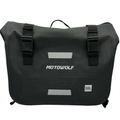
Anyone who uses hard aluminum panniers knows it well: the real problem is not just how much to load, but how to do it. Inner bags for aluminum panniers are born precisely here, where practicality and real travel meet. When you reach the end of your stage, opening the pannier, pulling out the bag and leaving everything else on the bike makes a tangible difference, especially if you travel for days, with variable weather and tight schedules.
They are not a secondary accessory. If chosen well, they improve load organization, reduce wasted time during stops, and help protect clothing, electronics, and small items better. If chosen poorly, they become just a soft duplicate inside a rigid box.
Why use inner bags for aluminum panniers
Aluminum panniers protect against impacts, maintain their shape, and work well in mixed travel, on asphalt and dirt roads. But the interior, alone, is not always practical. Edges, pannier hinges, internal attachment points, and the not perfectly regular shape can make it uncomfortable to use all available volume.
A well-designed inner bag solves this limitation. It allows you to pack your luggage at home more neatly, distribute the contents better, and only take what you need when you stop at a hotel, refuge, or campsite. It's a simple advantage, but it makes a big difference on long journeys.
Then there's an often underestimated aspect: managing the load during the day. If you need to grab a rain jacket, a fleece, or an electronics kit, having everything already divided into dedicated bags prevents you from emptying half your pannier on the side of the road. On a loaded maxi enduro, in the rain or after hundreds of kilometers, this is a detail that matters.
How they should really be made
Shape suitable for the pannier, not universally at all costs
The first point is geometry. The best inner bags follow the shape of the pannier, making good use of height, depth, and width, and taking into account any indentations or inclinations. A bag that is too generic leaves empty spaces, moves inside, and makes you lose useful capacity.
This is why compatibility matters. On many adventure and touring motorcycles, from BMW GS to KTM Adventure, from Africa Twin to Yamaha Ténéré, panniers can vary greatly in shape and volume between the right and left sides. In some cases, the exhaust side has reduced capacity or a different shape. A pair of identical bags is not always the best solution.
Durable materials and stable structure
The inner bag doesn't take hits like the pannier, but it operates in demanding conditions. It must withstand continuous rubbing, compression, not always uniform loads, and frequent opening. High-density technical fabrics, solid zippers, and clean stitching make more of a difference than mere aesthetics.
A structure that is too soft tends to collapse when only partially filled. A structure that is too rigid, however, can make it awkward to insert into the pannier, especially if the inner opening is narrow or if you have accessories mounted inside. The right balance is a bag that maintains its shape and accessibility without becoming bulky.
Handles, shoulder strap, and convenient opening
When you get off the bike, practicality is measured in seconds. Sturdy handles, a removable shoulder strap, and a wide opening are details that seem minor until you have to carry the contents of an entire stage up two flights of stairs.
Wide top openings work well if you want to see the contents immediately. U-shaped zippers are very practical, but they must remain smooth even when the bag is full. If, on the other hand, you prefer a more compact load management, some bags focus on a more squared and less expandable profile, useful when you want to use the pannier precisely.
Inner bags for aluminum panniers: what to evaluate before buying
The right choice depends on how you travel. Those who use their motorcycle for weekend road trips have different needs than those who prepare a multi-week trip with off-road sections. There is no single best bag. There is the one that is most consistent with your setup.
Real capacity, not just declared liters
Two bags with similar liters can offer a very different experience. What matters is how well they utilize the internal space and how easy they remain to use when fully loaded. A bag that fits precisely but forces you to force zippers and closures every time quickly becomes uncomfortable.
It is better to consider the volume of the pannier, its actual shape, and the type of contents you are transporting. Compressible technical clothing, shoes, photographic equipment, and tool kits occupy space very differently. If you often travel as a couple, the speed of access to the contents can be as important as the pure capacity.
Waterproofing: is it really necessary?
Here, a practical consideration applies. If the aluminum pannier is of good quality and watertight, the inner bag doesn't necessarily have to be waterproof. In many cases, it is sufficient for it to be moisture-resistant and easy to clean. However, if you transport electronics, spare technical clothing, or want redundant protection on long trips, a more protective construction can make sense.
The important thing is not to confuse the concept. The inner bag does not replace the pannier, but complements it. Rather than pursuing extreme features on paper, it is better to ask yourself under what conditions you will actually use the motorcycle.
Compatibility with the luggage system
This is where many people make mistakes. It is not enough for a bag to "fit inside." It must work well with that specific pannier. Side or top lid, internal profile, asymmetric volume, presence of nets or organizers already installed: every detail affects comfort of use.
On motorcycles prepared for travel, the difference between a dedicated solution and an adapted one is immediately apparent. If your goal is an organized, fast, and reliable setup, it makes sense to choose accessories developed around actual luggage systems and motorcycle models, not designed generically.
Common mistakes to avoid
The first mistake is buying a bag that is too big to utilize every available liter. On paper, it seems correct. In practice, a bag filled to the limit loses maneuverability, stresses zippers and seams, and makes it more difficult to insert or extract contents.
The second is to ignore the side of use. If you frequently open a pannier during the day to retrieve rain gear, gloves, or tools, the bag must allow quick access. If, on the other hand, you only open it at the end of a stage, you can prioritize capacity and internal organization.
The third is neglecting the overall weight. Inner bags add comfort, but they shouldn't encourage you to load more than necessary. On an adventure bike, the load affects maneuverability, balance, and behavior on uneven terrain. Better organization doesn't mean carrying half a garage.
When they really make a difference on a trip
Inner bags perform best on itinerant trips, with many stops and frequent overnight stays. Entering a facility with only the necessary luggage, without detaching panniers or carrying rigid containers, is a real convenience. The same applies to camping, where dividing contents by function helps to save time.
They are also useful in advanced commuting or on motorcycle business trips, when you want to separate clothing, documents, and electronic devices without turning every pannier opening into a complete reorganization.
If, on the other hand, you use panniers only occasionally and for day trips, the advantage exists but is less significant. In that case, it is advisable to opt for a simple, well-built solution suitable for your luggage system, without seeking superfluous accessories.
How to combine them with your adventure setup
Inner bags work best when they are part of a coherent setup. Aluminum panniers, any top cases, top bags, and internal organizers should communicate with each other. If each element follows a different logic, the result is often a load that is less practical than it seems.
On a well-prepared touring motorcycle, every space has a function. One pannier can be dedicated to clothing, the other to tools, electronics, and quickly accessible materials. Inner bags help precisely here: they transform a rigid volume into a more efficient system, especially when the day requires quick changes between road, rain, dirt, and technical stops.
For those looking for accessories compatible with specific models and loading systems, this approach is the same that guides Endurrad's technical selection: fewer universal solutions, more components designed for real use.
Choosing the right inner bags doesn't just change the way you pack. It changes the rhythm of the journey, because it makes you waste less time, helps you find what you need immediately, and leaves more space for what truly matters: riding, going far, and setting off again without complications.