Start with a concrete scene: you’re 300 km from home, it’s raining, your phone is at 18%, your wet gloves don’t respond well to the touchscreen, and the correct turn comes in the middle of three interchanges. In that moment, you immediately understand the difference between improvising and having electronic guidance for touring motorcycles that is genuinely designed for traveling.
On a touring or adventure motorcycle, navigation is not a secondary accessory. It is part of the setup just as much as luggage, protection and lighting. A well-chosen solution improves safety, reduces route errors, limits distractions and lets you manage long stages, secondary roads and complex transfers with greater clarity.
What electronic guidance for touring motorcycles really means
When people talk about electronic guidance for touring motorcycles, many think only of the navigation device. In reality, the system is broader. It includes the navigation device, mount, power supply, display visibility, integration with the helmet and controls, and above all, reliability in real-world use.
Whether you are riding a lightweight crossover or a large enduro loaded for two weeks of travel, vibrations, cockpit space, viewing angle and cable management all change. That is why there is no single solution that is right for everyone. Instead, there is a correct setup for your motorcycle model and the type of route you ride.
If you mainly ride fast asphalt roads with hotel-to-hotel stages, you can prioritize simplicity and readability. If you alternate between Alpine passes, unpaved roads and remote sections, you need durability, stable power and more advanced track management.
Dedicated GPS or smartphone?
This is the first real choice, and it should be made without ideology. A smartphone works well in many situations, but it is not always the best solution. A dedicated GPS is designed to remain on the handlebars for hours, in sunlight, vibrations, rain and changing temperatures. It usually offers better readability in direct light, a more robust structure and more reliable management of long routes.
The smartphone’s advantages are familiarity, up-to-date apps and great flexibility when planning. For those who mainly travel on roads and want to use familiar maps, it can be an effective system. The problem arises when conditions become more challenging: summer heat, continuous charging, vibrations, gloves, water and battery life can turn a convenient setup into a weak point.
A dedicated navigator has a higher initial cost, but offers continuity of use. A smartphone can work well as the main solution on simple trips or as a backup on mixed routes. On long, intensive journeys, however, a dedicated GPS often remains the most reliable choice.
When a dedicated GPS makes sense
It makes sense if you do long transfers, use GPX tracks, often travel in areas with limited coverage, want to avoid overheating and do not want to sacrifice your personal phone to continuous navigation. It is particularly suitable for motorcycles such as BMW GS, KTM Adventure, Africa Twin and Ténéré, where the cockpit allows advanced installations and the journey is often more demanding than a simple Sunday ride.
When a smartphone is really enough
If you do road touring, regular daily stages, frequent overnight stays and use apps you know well, a properly mounted smartphone may be sufficient. On one condition: a stable mount, adequate weather protection and proper power supply. Without these three elements, the system quickly loses reliability.
The mount matters as much as the device
One of the most common mistakes is investing in the navigator and saving money on the mount. On a journey, the opposite of what you might expect happens: the software does not fail, the mounting does. Vibrations, insufficient tightening, incorrect angles and unsuitable materials can undermine even the best display.
A good mount must keep the device readable without forcing you to lower your gaze too much. It must remain stable on damaged asphalt and light gravel roads, without continuous micro-movements that strain your eyes. It must also be compatible with the motorcycle’s cockpit, including any windscreen, crossbar, adjustments and original instruments.
On modern touring and adventure motorcycles, the ideal position is often high up, close to your line of sight. This reduces the time you take your attention away from the road. But the highest position is not always the best: on some motorcycles it can create reflections, interfere with the windscreen or make the controls difficult to access. This is where model-specific compatibility makes a real difference.
Power supply: the detail that prevents the worst problems
Electronic guidance for touring motorcycles is useful only if it stays on when needed. That is why the power supply must be treated as a technical component, not a marginal accessory.
The USB socket on the handlebars may be enough for light use, but on long journeys you need to assess power consumption, voltage stability, exposure to water and connector quality. Some devices consume more than an undersized port can provide, especially with high brightness, an active connection and high outside temperatures.
Direct wiring, when done properly, offers greater reliability. It reduces interruptions, limits false contacts and provides more consistent power. However, it must be installed carefully, protecting cables and connections from rubbing, bending and water ingress. On motorcycles genuinely used for traveling, this is what makes the difference between a tidy electrical system and a recurring problem.
Display, readability and use with gloves
The best navigation system is the one you understand in half a second. If you have to interpret overly dense screens or struggle with an inaccurate touchscreen, electronic guidance stops helping you and starts distracting you.
Readability depends on several factors: screen size, brightness, contrast, anti-glare treatment and position on the cockpit. A large display is useful, but it is not always the best choice. On a motorcycle with limited space, it can become bulky, cover the instruments or increase perceived vibrations.
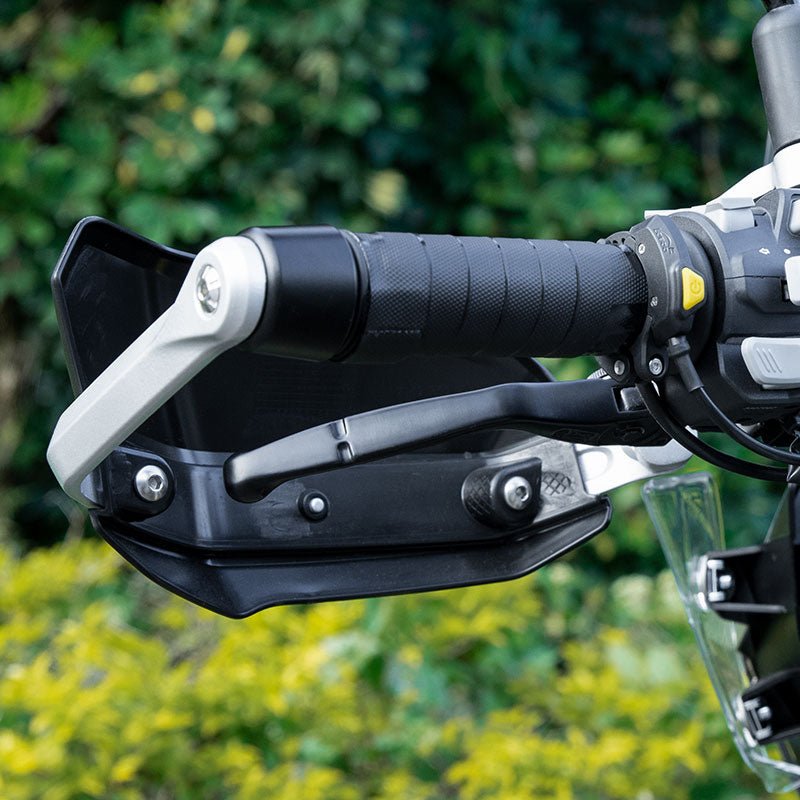
The interface also matters greatly. On a journey, you need essential information, not a crowded dashboard. Next turn, distance, reference speed, any recalculation and a few clearly readable elements. If you use adventure or winter gloves, always check the touchscreen response or whether the system can be controlled with buttons or remote controls.
Route planning: road, light off-road and tracks
This is where the real difference emerges between those who use a navigator to get from A to B and those who properly plan a motorcycle journey. Electronic guidance for touring motorcycles must manage not only the final destination, but also how you want to get there.
For road touring, clear turn instructions, fast recalculation and the ability to set stops and waypoints matter. For adventure travel, even light adventure travel, importing tracks, reliable offline operation and continuous navigation away from the main routes become central.
Not all systems handle tracks and routes in the same way. Some are intuitive on roads but less effective when working with complex GPX files. Others require more experience but offer greater control. The right choice depends on your level of technical independence and how much time you want to spend preparing before setting off.
Motorcycle compatibility: an often-underestimated factor
On a touring or adventure motorcycle, compatibility is not limited to the mechanical attachment. It concerns ergonomics, visibility, wiring and coexistence with the other accessories already installed.
If you have support bars, a tank bag, a larger windscreen, roadbook mounts, cameras or additional power sockets, the available space quickly decreases. A system that looks perfect on paper can become uncomfortable in reality. That is why it makes sense to choose components designed for specific models, especially on platforms that are widely used for long-distance travel.
It is the same approach used when selecting protection, luggage and technical mounts: compatibility comes first, followed by features. Endurrad takes a very clear approach to this point, because a motorcyclist preparing a motorcycle for a journey does not need generic solutions, but components that work together.
How to choose without making the wrong purchase
If you mainly ride asphalt roads, want immediacy and prefer simple management, focus on a system that is readable, properly powered and easy to use with gloves. If you alternate between roads and light gravel, prioritize durability, mount stability and track management. If you often travel two-up or with a heavily loaded motorcycle, pay even more attention to display position and control accessibility.
Do not buy based only on the device. Evaluate the complete package: navigation, mounting, power supply and compatibility with your motorcycle. That is what determines whether electronic guidance will be a real advantage or a constant source of minor problems.
In the end, the right choice is not the one with the most features on the specification sheet. It is the one that remains readable in the sun, keeps working in the rain and helps you take the right road when you are tired, far from home and simply want to ride well toward the next stage.