The Honda CRF1100L Africa Twin costs 15,490 euros. Or 23,490. In between there are eight list configurations, two models that share the name but not the chassis, and a question that anyone entering a dealership has been carrying around for months: how much of that difference is really necessary?
The short answer is that the expensive versions do not add a horsepower, change the safety electronics, or improve the brakes. They add convenience, and in one case they add eleven kilos. Let us see where the money goes, with the Italian price list at hand.
The 2026 Italian lineup, in a table
These are the dealer prices and full-tank weights declared by Honda Italia for model year 2026.
| Version | Price | Weight with a full tank | What sets it apart |
|---|---|---|---|
| CRF1100L Africa Twin | 15.490 € | 231 kg | Multiple-adjustment mechanical Showa suspension |
| Africa Twin ES | 16.490 € | 233 kg | Showa EERA electronic suspension, standard 12V socket |
| Africa Twin DCT ES | 17.690 € | 244 kg | Dual-clutch transmission, parking brake |
| Adventure Sports ES | 19.490 € | 243 kg | 19" wheel, 24.8 l tank, cornering lights |
| Adventure Sports DCT ES | 20.690 € | 253 kg | As above, with DCT |
| Adventure Sports Travel Edition | 22.290 € | 243 kg | Standard touring equipment |
| Adventure Sports DCT Travel Edition | 23.490 € | 253 kg | As above, with DCT |
The engine is the same across all versions: a 1,084 cm³ parallel twin with a 270° crankshaft, 102 hp at 7,500 rpm, and 112 Nm at 5,500. No version is faster than another.
From the base version to the ES: a thousand euros for the suspension
The first step up costs 1,000 euros and concerns almost only the suspension. The base version has a Showa cartridge fork with multiple adjustments and a rear shock absorber with a knob-adjustable preload; the ES adopts the electronically controlled Showa EERA system, which adjusts damping according to the riding mode and allows the rear preload to be adjusted while riding, from the display.
The travel range does not change: 230 mm up front and 220 mm at the rear on both. Nor do the wheels, the 250 mm ground clearance, the seat height, the frame, or the braking system change. The entire difference lies in how it is adjusted, not in how much it can be adjusted.
There is also a small but practical detail that almost never appears in reviews: on the base version, the 12V socket is a paid accessory, while on the ES it is standard. If you were planning to add a navigation system, heated grips, or a socket for your phone, you should mentally add that cost to the 15,490 euros.
Is it worth the thousand euros? If you adjust the suspension once and then leave it alone for three years, no. If you travel alternating between rider only, rider with passenger, and rider with passenger and luggage, the EERA saves you ten minutes of wrenching and a fair amount of guesswork every time. It is a real convenience, not a gadget, but it is still a convenience.
The DCT: 1,200 euros and eleven kilos
The next step is the one that divides buyers. From the manual ES to the DCT ES, there's an extra 1,200 euros and, above all, eleven kilograms: from 233 to 244 kg with a full tank.
Honda's dual-clutch transmission is a mature technology, in production for more than fifteen years, and it has a G function designed specifically for off-road riding, which reduces clutch slip to provide a more direct throttle response. Those who try it in traffic or during a day riding Alpine passes find it hard to go back. In markets where it's available, well over half of buyers choose the DCT.
Those eleven kilos, however, aren't just a figure on a spec sheet. You feel them when the bike is stationary and you have to turn it around on a sloping patch of ground, when you lift it after a minor fall on a dirt road, and when you load it onto a ferry. On a bike that already weighs 233 kg, reaching 244 shifts the threshold of how much off-road riding you're willing to do.
With the DCT, you also lose the option of a quickshifter, which Honda offers as an accessory on the manual versions. On the other hand, the DCT gains a handlebar-operated parking brake, which is genuinely useful on a bike without a selectable gear.
How to decide without trying it
The right question isn't "is the DCT better?" It's: where will I spend 80% of my miles? If the answer is asphalt, traffic, and touring, the DCT is money well spent and you'll hardly notice the extra weight. If the answer includes real off-road riding, sand, or routes where the bike might end up on the ground, every kilo counts and the manual remains the more sensible choice.
The Adventure Sports isn't a trim level: it's a different bike
This is where the most common mistake lies. The Adventure Sports is perceived as "the more accessorized Africa Twin", but that's not the case: it's a bike with a different purpose, and the technical specifications make that clear.
| Africa Twin | Adventure Sports | |
|---|---|---|
| Front wheel | 21 inches, 90/90-21 | 19 inches, 110/80 R19 |
| Rear wheel | 18 inches, 150/70 R18 | 18 inches, 150/70 R18 |
| Suspension travel | 230 / 220 mm | 210 / 200 mm |
| Ground clearance | 250 mm | 220 mm |
| Fuel tank | 18.8 liters | 24.8 liters |
| Seat height | 870 / 850 mm | 835 / 855 mm (low 795) |
| Wheelbase | 1,575 mm | 1,570 mm |
| Cornering lights | N/A - not available | Standard |
| Wet weight (manual) | 231 kg | 243 kg |
The Africa Twin's 21-inch front wheel is the size used by adventure enduro bikes: it absorbs obstacles better, doesn't get hung up on steps, and holds its line on loose surfaces. The Adventure Sports' 19-inch wheel is the size used by touring crossovers: more precise on asphalt, quicker when changing direction, and less at ease where the road truly ends.
Thirty millimeters less ground clearance and twenty millimeters less travel point in the same direction. In return, you get six extra liters of tank capacity - which, with the claimed 20.5 km/l, is worth more than a hundred kilometers of range - and a lower seat as standard, with the 795 mm option for those who have trouble reaching the ground.
The difference is so fundamental that even the accessories are not interchangeable: pannier racks, protection parts and skid plates for the Africa Twin and the Adventure Sports are listed in separate catalogs. If you buy used or order accessories, this is the first thing to check.
What never changes, in any version
This is what makes the base model much more defensible than it may seem. All versions, including the two less expensive ones, come with:
- the same 102 hp and 112 Nm engine;
- the six-axis inertial measurement unit, which manages HSTC traction control, cornering ABS, wheelie control and rear lift control;
- the five riding modes (Urban, Tour, Gravel, Off Road, User);
- the 6.5-inch TFT touchscreen display with an additional LCD screen, Bluetooth, Apple CarPlay and Android Auto;
- cruise control;
- the same braking system, with twin 310 mm discs and four-piston radial calipers;
- full-LED lighting with daytime running lights.
In other words: buying the base version does not mean buying a detuned or less safe Africa Twin. It means buying the same motorcycle with manually adjustable suspension and without the 12V socket.
Accessories for Africa Twin and Adventure Sports
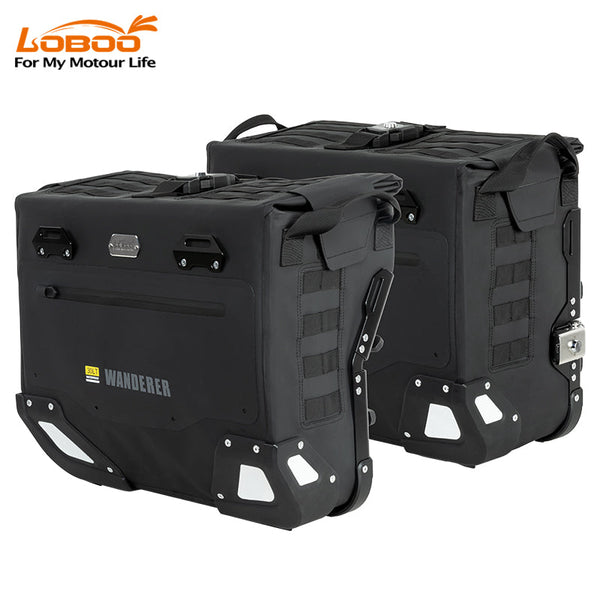
- Africa Twin Adventure Sports side panniers — complete aluminum kit with racks
- Africa Twin Adventure Sports pannier racks — if you already have the panniers
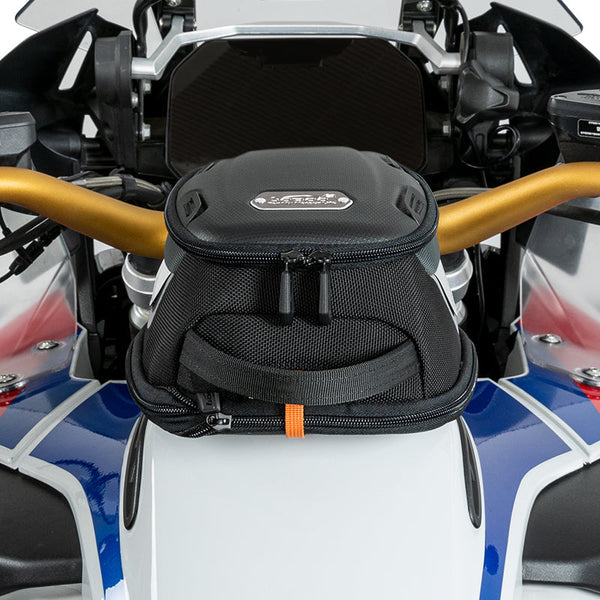
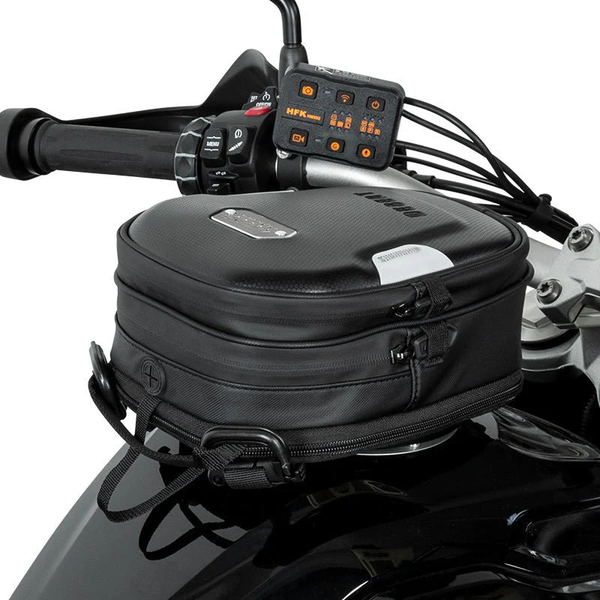
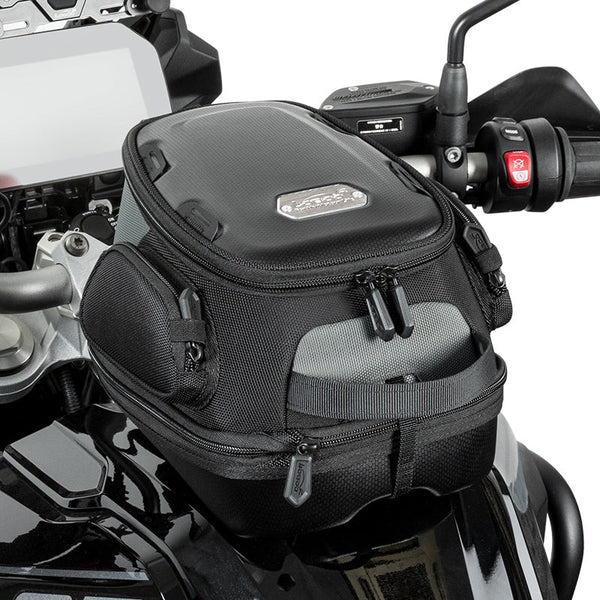
- 4.5-6.5 L tank bag — expandable, magnetic attachment
Africa Twin CRF1100L accessories → · Africa Twin Adventure Sports accessories →
Weight is the real price to pay
If you line up the numbers, the range tells a coherent story: every euro spent above the base model comes with extra kilos.
- Base → ES: +2 kg for the suspension electronics
- ES → DCT: +11 kg for the transmission
- Africa Twin → Adventure Sports: +12 kg for the tank and bodywork
At the extremes, between the base CRF1100L and the Adventure Sports DCT there are 22 kilos and €5,200. Twenty-two kilos on an already demanding motorcycle are the difference between a road-oriented enduro you can reasonably take onto a dirt road alone and a touring bike you would rather keep on asphalt.
Which version to choose
Three profiles, to keep it simple.
If you do serious off-roading, even if only for a few days a year: base CRF1100L Africa Twin, manual. It is the lightest in the entire range, has a 21-inch front wheel, 250 mm of ground clearance, and suspension that can be adjusted with a wrench - which in the middle of nowhere is an advantage, not a limitation. The €1,000 saved on the ES more than covers a proper skid plate and protective guards.
If you mostly ride on asphalt, often two-up, with luggage: Adventure Sports ES, manual or DCT depending on your preference. The extra six liters of fuel and lower seat make a huge difference on long transfers, and the 19-inch front wheel is the right size for how you will use the bike.
If the bike is your everyday transport and off-roading is more of a possibility than a plan: Africa Twin DCT ES. In the city and on transfers, the automatic transmission is what will make you smile every morning, and you will never notice the extra eleven kilos.
The Travel Editions are a separate matter: they cost about €2,800 more than the corresponding Adventure Sports and include the touring equipment. Before ordering one, it is worth putting on paper the cost of a set of panniers you choose yourself, because the package's value depends heavily on how closely that equipment matches what you would have bought anyway.
Summary: where the money goes
| Upgrade | Cost | What you get | What you lose |
|---|---|---|---|
| Base → ES | +€1,000 | Electronic suspension, 12V socket | 2 kg |
| ES → DCT ES | +€1,200 | Automatic transmission, parking brake | 11 kg, the quickshifter |
| Africa Twin → Adventure Sports | +€3,000 | 6-liter tank, lower seat, cornering lights | 12 kg, 30 mm of ground clearance, the 21-inch front wheel |
| Adventure Sports → Travel Edition | +€2,800 | Standard touring equipment | Freedom to choose your accessories |
Frequently asked questions
How much does the 2026 Honda Africa Twin cost in Italy?
Prices start at €15,490 excluding dealer fees for the base CRF1100L Africa Twin and reach €23,490 for the Adventure Sports DCT Travel Edition.
Does the base version have less power?
No. All versions have the same 1,084 cc parallel twin with 102 hp at 7,500 rpm and 112 Nm at 5,500 rpm.
What is the difference between the Africa Twin and Africa Twin ES?
The ES has Showa EERA electronically controlled suspension instead of mechanical suspension and comes with a 12V socket as standard. The suspension travel, wheels, brakes, and safety electronics are identical. It costs 1,000 euros more and weighs 2 kg more.
How much more does the DCT version weigh?
Eleven kilograms: 244 kg versus 233 for the manual ES, both with a full tank. On the Adventure Sports, the increase is of the same order, from 243 to 253 kg.
Is DCT worth it on the Africa Twin?
It depends on where you ride. On asphalt, in the city, and on trips, it is a convenience few people regret; in demanding off-road riding, the extra eleven kilos and inability to operate the clutch manually really matter. There is no answer that works for everyone.
Is the Adventure Sports just a more accessorized Africa Twin?
No, it is a different motorcycle. It has a 19-inch front wheel instead of 21 inches, reduced suspension travel, 30 mm less ground clearance, a 24.8-liter tank versus 18.8 liters, and a lower seat. It is geared toward touring, while the Africa Twin remains more enduro-oriented.
Which Africa Twin is best for off-road riding?
The base CRF1100L Africa Twin with a manual transmission: it is the lightest at 231 kg, has a 21-inch front wheel, 250 mm of ground clearance, and the longest suspension travel in the range.
Are the accessories interchangeable between the Africa Twin and Adventure Sports?
Generally, no. The two motorcycles have different bodywork, fuel tanks, and geometries, so pannier racks, protection, and engine guards are specific to each model. Compatibility with the exact version and year must always be checked.
Does the base version have traction control and cornering ABS?
Yes. The six-axis inertial measurement unit, HSTC, cornering ABS, wheelie control, and the five riding modes are standard on all versions.
Can the quickshifter be installed?
Yes, as an accessory, but only on versions with a manual transmission. It is not available on DCT models because the transmission is automatic.
Sources and further reading
- Honda Italia — official CRF1100L Africa Twin specifications and prices page, model year 2026
- Honda Italia — official CRF1100L Africa Twin Adventure Sports specifications and prices page, model year 2026
- Motorrad (Germany) — comparison of the CRF1100L Africa Twin versions, August 2026
Article updated on September 2, 2026. The prices shown are list prices, ex-dealer, and do not include on-the-road costs or registration. They may vary with dealer network promotions.