

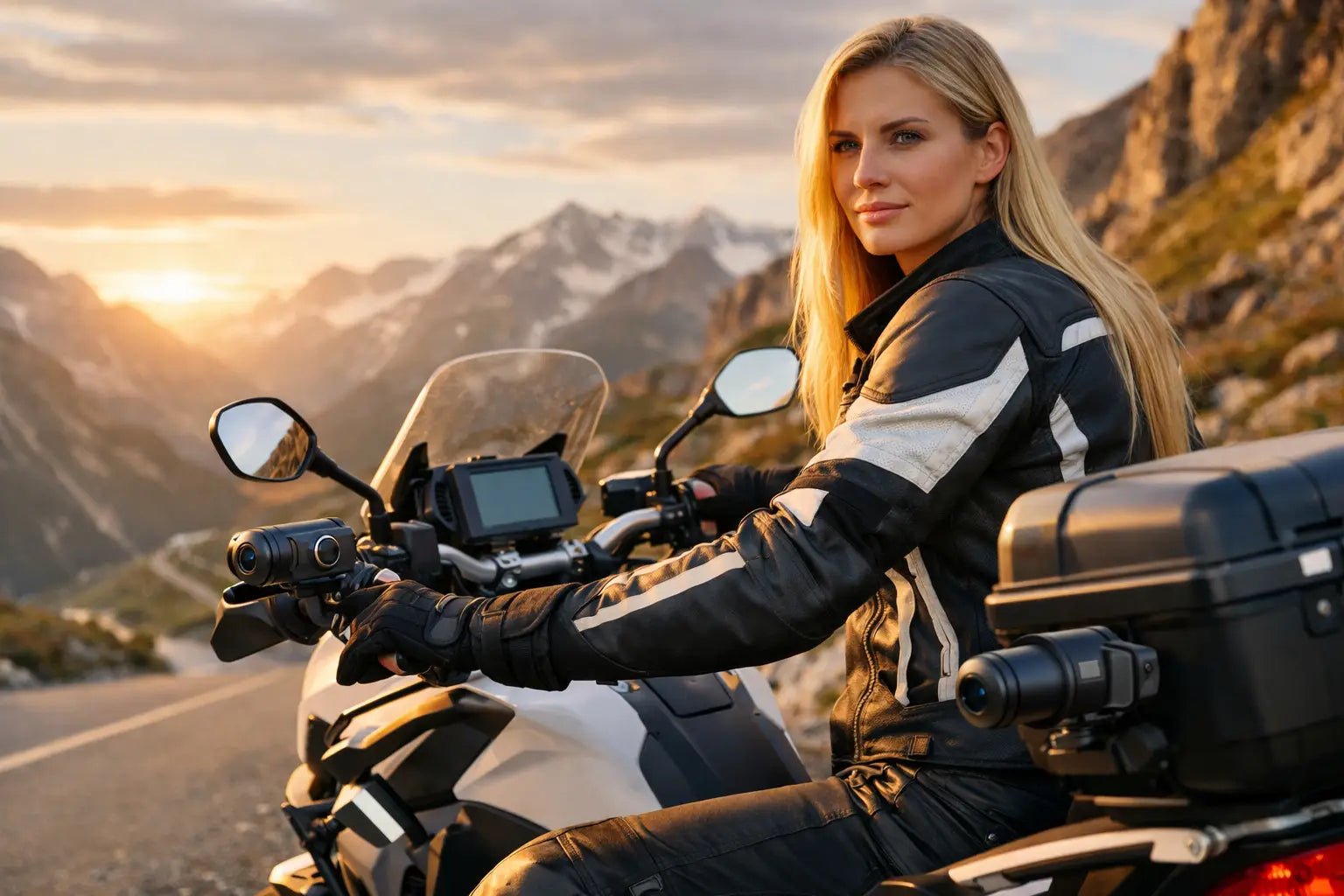
A premium motorcycle dashcam review only makes sense if you start with a specific question: do you need a camera that captures beautiful footage, or a system that keeps recording after hours of rain, vibrations, and long transfers? For those traveling on GS, Africa Twin, Ténéré, or KTM Adventure models, this is the key difference. A high-end motorcycle dashcam should not be judged by its promotional video, but by how it performs when the day gets longer, the light fades, and you still have 300 km ahead.
Premium motorcycle dashcam review: where to start
In the adventure and touring world, a dashcam is not a cosmetic accessory. It is used to document an accident, reconstruct a maneuver, record a critical section of dirt road, or simply keep track of a journey without having to manage action cameras, external batteries, and improvised mounts.
For this reason, a premium motorcycle dashcam review should assess continuous operation first and the technical specifications second. Resolution and field of view matter, of course, but they matter more if the system always switches on, saves files correctly, and does not force you to disassemble half the motorcycle to access a microSD card.
A well-designed dashcam works automatically. Turn the key, and it records. Switch off the motorcycle, and it closes the file. If this part is not reliable, the rest is worth little.
What really sets a premium dashcam apart
The real difference is not the word premium. It is how the product holds up in real-world use. On paper, many dashcams seem similar. On a BMW R 1250 GS loaded for two weeks, or on a Ténéré 700 also used on fast dirt roads, the details that make you spend wisely or spend twice begin to emerge.
System stability and file quality
The first point is electrical and software stability. A good dashcam must handle starts, shutdowns, vibrations, and temperature changes without corrupting files. It is less visible than 4K, but much more important if you need usable video after a problem on the road.
Loop recording also deserves careful attention. If the transition between files creates gaps or delays, you risk losing exactly the sequence you need. In the best units, this process is transparent. With less mature systems, you only notice it when you check the footage.
Camera body, wiring, control unit
On an adventure motorcycle, the system operates while exposed. Water, dust, washing, dried mud, and vibrations are unforgiving. This is where the quality of the seals, connectors, and wiring comes into play. It is not enough for the camera to be small. It must also be mountable cleanly, without weak points near the fork, subframes, or hot areas.
A separate control unit may seem bulky, but it often helps with cable management and better protects the memory and power supply. On the other hand, it requires real space on the motorcycle. Large adventure bikes with brackets, crash bars, and accessories usually have room. On slimmer or already heavily accessorized motorcycles, the installation needs more careful consideration.
Useful video, not just sharp video
Video quality matters when the footage remains readable in the worst situations: backlighting, tunnels, light rain, evening conditions, and moving license plates. An image that is highly detailed during the day but muddy at dusk is not enough for practical use.
Also pay attention to the viewing angle. Too narrow, and you lose context. Too wide, and you distort the scene, making distances and license plates harder to read. The right compromise depends on how you use the motorcycle. Riders who mainly tour on roads may prioritize readability and depth. Those who alternate between asphalt and dirt often prefer a wider field of view, because unexpected events can also come from the sides.
Mounting on an adventure motorcycle: the point that decides everything
A good dashcam mounted badly becomes a problem. It vibrates, points in the wrong direction, or deteriorates quickly. That is why mounting matters as much as the camera itself.
On the fairing of a Ducati DesertX or a Tiger 900, for example, the position and rigidity of the mount can greatly change the result. If the mount is attached to a part that is too exposed to resonance, the video loses readability precisely when the surface becomes uneven. On models such as the Africa Twin or 1290 Super Adventure, designed to cover a lot of ground over many hours, it is worth looking for a protected installation that does not compromise the framing.
Cable routing is just as decisive. If it remains tidy, away from the steering, heat, and pinch points, you have a more reliable system that is easier to inspect over time. If the wiring is adapted in a hurry, the risk is not only aesthetic. Over time, you may get false contacts, water ingress, or stressed connectors.
This is where the advantage of products selected for serious travel becomes immediately clear. Not because they promise to go everywhere, but because they are designed to be integrated into the motorcycle without improvisation.
Useful features and features to put into perspective
High-end dashcams often include Wi-Fi, a dedicated app, GPS, remote controls, and parking mode. Some are genuinely convenient, while others are only useful in theory.
Wi-Fi is useful if it lets you quickly download a file to your phone without removing anything. If the connection is slow or unstable, you will end up using the memory card anyway. GPS is valuable if you want to associate location and speed with a recorded event, but it is not essential for everyone. Riders who take long trips across multiple borders or want to keep a precise record of their route will appreciate it more.
Parking mode deserves separate consideration. It can be useful, but it depends on power consumption and on how the connection to the battery is designed. On a motorcycle used frequently, it is not necessarily a priority. On a motorcycle left fully loaded with luggage during long stops, it may make more sense, provided the power management is properly designed.
Finally, the app should simplify things. If changing a setting requires navigating unclear menus or dealing with poor translations, it will affect everyday use more than you might expect.
Who should spend more
A premium dashcam is not equally useful to everyone. If you take short rides in consistently good conditions and your priority is recording a few scenic sections, the benefits of the high-end segment will be less noticeable.
If, on the other hand, you use the motorcycle for long journeys, mountain passes, 600-800 km days, real rain, and secondary roads, the situation changes. In this context, you are paying less for the name and more for the likelihood that the system will do its job without demanding your constant attention.
Those who often travel two-up, with a loaded motorcycle and navigation already surrounded by accessories, should also carefully assess the installation's overall size. An excellent dashcam that is difficult to integrate can complicate a cockpit already occupied by a GPS, intercom, USB outlets, and auxiliary lights.
For those who alternate between asphalt and dirt, the issue is not just durability. It is the system's ability to keep recording through harsher vibrations and more invasive dirt. Here, the difference between a well-designed product and one that is merely well presented emerges quickly.
The most common mistakes in a premium motorcycle dashcam review
The first mistake is judging everything from a sample video viewed on a large screen, perhaps in broad daylight. The second is underestimating the installation. The third is confusing a dashcam with an action camera.
An action camera may offer more spectacular images, but it requires active management: batteries, memory, starting, stopping, and positioning. A dashcam is meant to take worries off your hands. If you choose it well, it works in the background for months.
Another frequent mistake is looking only at the front camera. For real-world road use, front and rear recording has much greater practical value. Not for the sake of a complete product catalog, but because many useful events to document come from behind or occur during overtaking and merging.
Compatibility must also be taken seriously. It is not enough to know that the kit can be mounted on a motorcycle. You need to understand whether it mounts properly on yours, with your accessories, your mounts, and your available space. This is where a technical retailer makes more of a difference than a generic specification sheet.
Is it worth it?
If the motorcycle is a genuine travel vehicle for you, the answer is often yes, but with one precise criterion: it must reduce problems, not add them. A premium dashcam makes sense when it offers continuous reliability, clean installation, and genuinely usable files. If any of these three points is missing, the high price weighs much more heavily.
The right choice is not the one with the most features, but the one that can handle the way you travel. If you ride Alpine passes in the rain, take long trips across Europe, or ride dirt roads that shake everything mounted on the motorcycle, it is better to think like a traveler rather than a spectator of specification sheets.
In the end, a good dashcam is almost never noticeable. And that is precisely the best sign: you focus on the road while it continues doing its job.



Share:
Inner tube or tubeless adventure: what's better
BMW GS 1250 travel setup: how to do it right