Starting off with good tires and a well-maintained chain is normal. Forgetting about the brakes, however, happens more often than one might admit. Yet, knowing when to change motorcycle brake pads for a trip makes the difference between a clean stop on a wet pass and a lever that extends right when the bike is loaded, the asphalt is dirty, and you have no margin for error.
On an adventure or touring bike, this issue carries even more weight. Luggage, a passenger, long descents, mixed asphalt-dirt sections, and hundreds of kilometers of transfers put the braking system under real load, not just a Sunday ride. That's why it's not enough to know that the pads "are still there": you need to understand how much material is left, how they are performing, and if they are suitable for the trip you're about to take.
When to change motorcycle brake pads for a trip before departure
The most cautious rule is simple: if you are close to the wear limit, change them before the trip, not after. Even if, on paper, they could still last a few thousand kilometers. The reason is not just safety. It's to avoid finding yourself halfway through your itinerary searching for a compatible spare part for your motorcycle, perhaps in an area where assistance is available but doesn't have the right material.
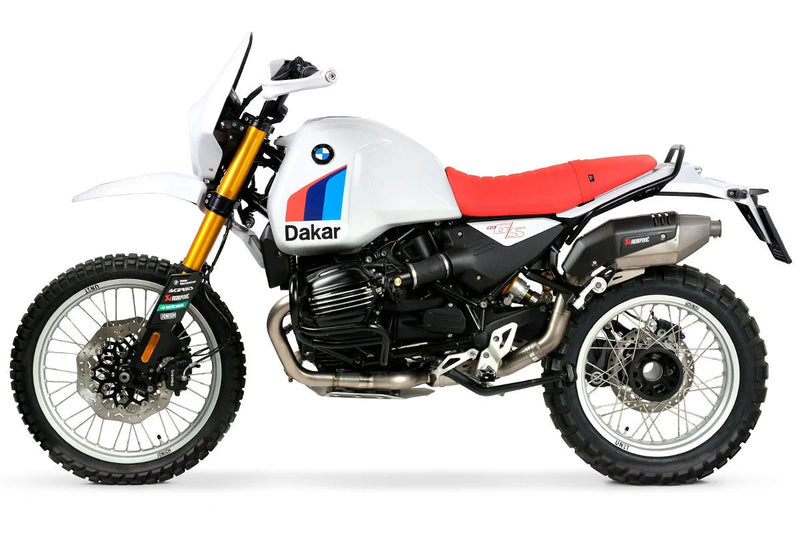
On models like BMW GS, Africa Twin, KTM Adventure, Tiger, or Ténéré, wear can vary greatly depending on the load, riding style, and type of route. An alpine trip with many descents and hairpin bends will consume more than a highway transfer. Fast off-roading with an abrasive surface and extensive use of the rear brake can noticeably accelerate rear wear.
In practice, if you see little friction material remaining before you leave, it's not worth being stingy. Brake pads cost less than a damaged disc, and much less than compromised braking in a real situation.
Minimum thickness: the data that really matters
The first check is the thickness of the friction material, not the metal backing plate. When that material drops to around 2 mm, you're already in the warning zone. Below that, replacement becomes a sensible choice without waiting for metal-on-metal.
Some manuals indicate specific values for the model, and that's always the best reference. If you don't have the precise data at hand, the practical criterion remains this: don't embark on a demanding trip with nearly worn-out pads, even if they would still have some life left for urban use.
On touring motorcycles, there's an aspect that many underestimate. With a full tank, luggage, and perhaps a passenger, the mass increases significantly. This means more energy to dissipate with each braking, leading to higher temperatures and increased wear. A pad at half-life in light use can reach its end much sooner than expected on vacation.
Pay attention to the rear
The rear often wears out faster than it seems, especially off-road or in slow sections where you use it to stabilize the bike. It's also the brake that many check less frequently. Before you leave, check both axles. Finding the front still good and the rear worn out is a common situation.
Signals not to ignore
Thickness remains the primary check, but the motorcycle also speaks to you in other ways. If you hear a metallic squeal, if braking becomes less responsive, if the lever requires more travel, or if you feel unusual vibrations, it's worth stopping and looking.
Not all noises mean worn-out pads. Dust, moisture, contamination, or a glazed surface can produce similar symptoms. But precisely for this reason, the point is not to guess; it's to check. A visual inspection takes only a few minutes and saves you from wrong assumptions.
Color and surface also matter. If the pad appears shiny and glazed, it may brake worse when hot. If the wear is not uniform between the inside and outside, there may be a caliper or sliding issue. In these cases, simply changing the material without understanding the cause may not solve much.
Quick garage check, done right
To know when to change motorcycle brake pads for a trip, you don't need to dismantle half the bike. In most cases, a flashlight and minimal access to the caliper are sufficient. You check how much compound is left, compare right and left, inside and outside, and verify if the wear is even.
If you see a lot of black dust, don't be alarmed by that alone. Dust is normal. What matters is whether there's still enough material and if the disc shows no deep grooves, discoloration from overheating, or abnormal edges. A scored or bluish disc deserves attention, especially if you've been using it intensely in the mountains.
If in doubt, the correct approach is conservative. Before a long trip, replacement is also for mechanical peace of mind. Not because "they might not hold up," but because you want to leave knowing that for the next few days, you won't have to think about it.
How long do they really last?
There is no universally reliable mileage. Some riders get 8,000 km from their rear pads, while others get 20,000 km. It depends on weight, road surface, braking style, electronics, route, and pad material.
A GS used two-up on mountain passes won't wear out pads like a Ténéré 700 ridden lightly on smooth roads. A KTM 890 Adventure ridden hard on mixed terrain and dirt will stress the brakes differently than a touring transfer on a Tiger 900. Looking for a precise number is not very useful. It's far more useful to check before every important ride.
Long trip or technical weekend
For a 500 km weekend, you can afford a narrower margin if you know exactly the state of the system. For a 3,000 km trip with passes, rain, and load, no. In that case, it's better to think in terms of safety margin, not theoretical remaining mileage.
Sintered or organic: this also changes things
When replacing brake pads, the choice of material is not secondary. On an adventure and touring motorcycle, sintered pads are often the most logical solution for road use and loaded travel. They handle heat better, offer more consistent braking, and tolerate rain and intense use well.
Organic pads can have a softer initial bite and be pleasant in certain contexts, but on long trips, with weight and temperature, they often show their limitations sooner. This doesn't mean one choice is always right and the other always wrong. It means you need to align the pad with your actual use.
If you do a lot of technical off-roading and seek modulation, you might consider a compromise. If you ride alpine passes fully loaded and do fast transfers, the priority changes. As with tires and luggage, here too, the right component is the one consistent with the trip you're actually taking.
After changing, bedding in is necessary
Installing new pads and leaving the next day for 700 km is not ideal. New pads need a short break-in period to bed in properly with the disc. In the first few braking applications, the response may be different from usual, sometimes less full.
For this reason, it's advisable to replace them with some anticipation and do a few rides or at least a series of progressive braking. No magic numbers: common sense counts. You want to arrive at your departure with stable braking already, not with newly installed components that still need to bed in.
When to change motorcycle brake pads for a trip without waiting for the symptom
Waiting for the noise is the classic mistake. When you clearly hear metal or braking significantly deteriorates, you're often already too late. Trip maintenance works better when it anticipates the problem.
The same applies if you have a remote itinerary planned or one with little logistical margin. If you're traveling through areas where finding the right spare part for your system isn't a given, preventive replacement makes even more sense. It's not preparation anxiety. It's removing an unnecessary variable from the trip.
For those who prepare their motorcycle methodically, brake checks should be given the same mental priority as tires, repair kits, and essential tools. It's not the most spectacular intervention, but it's one of those you really feel when needed.
A good practical reference is this: if you look at your pads and wonder if they're enough, the answer for a serious trip is probably no. It's better to leave with a well-maintained system and use your head on the road, instead of wasting attention on every long descent.