

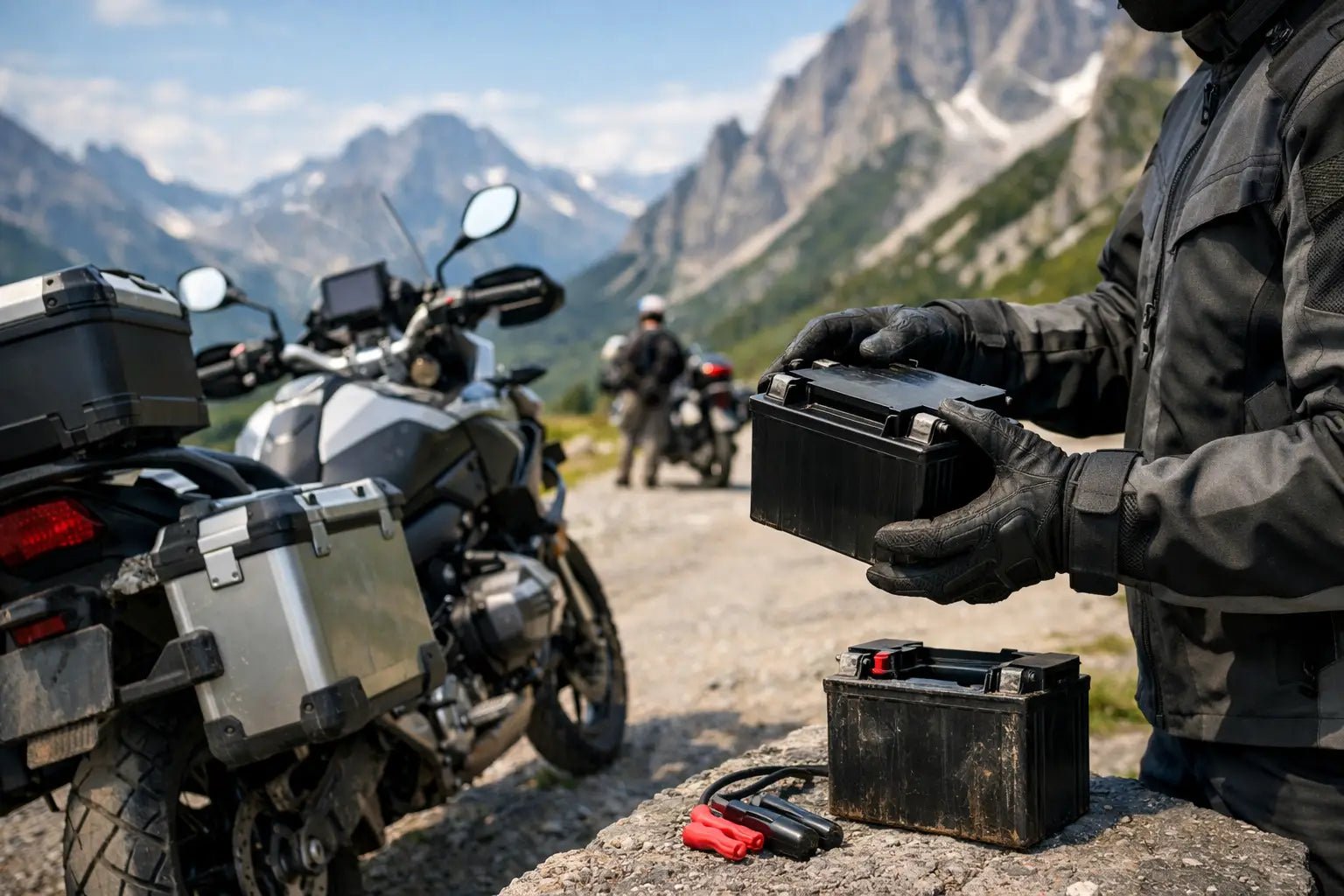
A failing battery does not always give plenty of warning. Often, the first sign appears at the worst possible moment: fully loaded motorcycle, GPS on, early-morning departure, and starting that is slower than usual. Understanding when to change a touring motorcycle battery means avoiding unnecessary stops, protecting the electrical system, and setting off with a real margin of reliability.
On a modern touring or adventure motorcycle, the battery is not only used to start the parallel-twin or boxer engine. It must power control units, ABS, TFT displays, heated grips, auxiliary lights, GPS, USB sockets, and, in many cases, accessories added over time. For this reason, the classic “as long as it starts, it’s fine” rule works poorly. A battery may still start the motorcycle today and leave you in trouble two weeks from now, perhaps after a cold night or a long stop with parasitic loads.
When to change a touring motorcycle battery: the real signs
The first sign to take seriously is starting performance. If the starter motor turns more slowly than usual, especially when the engine is cold, the battery is already losing useful capacity. It is not only a matter of whether the motorcycle starts. What matters is how much margin remains.
Another typical indication is a voltage drop under load. You may notice it when the display switches off and back on during starting, the clock resets, or some electronic systems show temporary errors. On motorcycles such as the BMW GS, Africa Twin, KTM Adventure, or Ténéré, where electronics are an integral part of the touring experience, these behaviors should not be dismissed as mere quirks.
Irregular charging is also a warning sign. If the motorcycle starts well after a long ride but feels weak again after sitting for two or three days, the battery may no longer be holding a charge as it should. In this case, the regulator or alternator is not always to blame. Often, the battery itself has lost internal efficiency.
Then there is the most obvious and most overlooked factor: age. If the battery is already more than 3-5 years old, it should be monitored much more closely. Not all batteries age in the same way, but on a motorcycle used for touring, with frequent charge and discharge cycles and perhaps long periods of winter storage, that range is realistic.
Average lifespan: how many years should you really expect?
Actual lifespan depends on technology, use, and environmental conditions. A good-quality AGM battery on a touring motorcycle used regularly can perform well for 4 years, sometimes even longer. A lithium battery can offer advantages in terms of weight, starting power, and self-discharge, but it requires greater attention to compatibility with the electrical system and to its behavior at low temperatures.
The key point is that there is no fixed expiration date that applies to everyone. A GS used every week for medium- to long-distance trips and maintained with a suitable charger may preserve its battery better than a motorcycle that remains parked for months in a garage and is started only occasionally. Prolonged periods of inactivity, more than mileage, are often the real enemy.
Accessories also have an impact. Auxiliary lights, navigation control units, satellite alarms, permanently powered sockets, and devices connected to the battery increase the overall load or create small parasitic draws when the motorcycle is switched off. On a motorcycle prepared for long-distance touring, this matters more than it does on a simple naked bike.
How to tell whether the time is right without waiting for a failure
The most reliable way to assess the battery is to measure the resting voltage and observe its behavior during starting. After the motorcycle has been stationary for a few hours, a healthy, fully charged battery should show a value consistent with its technology. If the readings remain consistently low even after proper charging, deterioration is already underway.
Even more useful is a load test. A battery may seem fine with no load and then collapse as soon as the starter motor demands current. If the voltage drops too far during starting, its cranking capacity is no longer adequate. This is the classic case of a battery that “seems alive” until the day it no longer is.
It is also worth checking its physical condition. Corroded terminals, loose connections, or poorly installed additional wiring can mimic a battery problem. Before replacing it, it is worth ruling out current leaks, charging problems, and unreliable contacts. On a touring motorcycle, the accessory wiring should always be considered part of the system.
Before a long trip, is it worth replacing the battery early?
Often, yes, but it depends on the circumstances. If the battery is 4 years old, starting is less immediate, and you are preparing for a trip involving remote stops, ferries, mountain passes, or changing temperatures, waiting for it to fail makes little sense. The cost of preventive replacement is almost always lower than the time lost, the logistical risk, and the stress of being stranded far from home.
The situation is different with a relatively recent battery that has been tested properly, has stable voltage, and is part of a sound electrical system. In that case, there is no need to replace it on principle. The right approach on a touring motorcycle is neither to replace it too early nor to push it too far. It is to assess how much margin you have compared with the type of use planned.
A two-day trip close to home allows more risk than a 4,000 km journey with luggage, a passenger, and many cold starts. The harder the motorcycle is used, the more electrical reliability stops being a minor detail.
Choosing the right battery for a touring motorcycle
When it is time to replace the battery, compatibility matters more than price and generic promises. You need the correct dimensions, the right polarity, adequate capacity, and, above all, starting power suited to the engine and the electrical system’s load. On models with advanced electronics or additional equipment, undersizing is a mistake.
AGM and lithium batteries are not automatically interchangeable. AGM batteries remain a very solid choice for touring, especially for riders seeking predictable reliability in changing conditions. Lithium can be interesting for setups focused on low weight and starting power, but it must be selected carefully, checking charging management and seasonal motorcycle use.
Build quality also matters. A battery designed for intensive use better withstands vibrations, repeated cycles, and the stresses typical of a fully loaded adventure bike on asphalt and gravel. On this point, it helps to think as you would with luggage, protection, or navigation mounts: the right component is the one compatible with the motorcycle and designed for real-world use, not merely one that fits in the battery compartment.
Common mistakes that shorten battery life
The most common is leaving the motorcycle parked for too long without a maintainer. Modern batteries suffer more from neglect than from regular use. Another mistake is connecting accessories directly to the terminals without properly managing the circuits and protection. Small continuous draws gradually drain the battery more than many people realize.
Overly short trips are also harmful. If you frequently start the motorcycle for journeys lasting only a few minutes, the system may not recover the energy used during starting, especially in winter or with many accessories active. The result is a slow but steady progressive discharge.
Then there is the wrong charger. Not all chargers are suitable for every technology. Using the correct maintainer, with a program specifically designed for AGM or lithium batteries, makes the difference between preserving the battery and unnecessarily stressing it.
When to change a touring motorcycle battery without hesitation
There are situations in which the answer is simple. If the motorcycle struggles to start even after a full charge, if the voltage drops too far during starting, if the battery loses charge within a few days, or if you have already ruled out problems with the regulator, stator, and wiring, replacement should not be postponed.
The same applies if you are preparing a motorcycle for an important trip and the battery is showing the first signs of fatigue. With a properly prepared touring setup, reliability is built before departure, not when the problem appears. It is the same logic used when choosing tires, protection, lighting, and load capacity.
If you use your motorcycle for real touring, the battery is not a detail to check only when it goes flat. It is a strategic component of your range and peace of mind on the road. Treating it that way means traveling better, with fewer surprises and greater confidence every time you set off again.
The most useful rule is this: do not wait until it is completely dead to make a decision. When the signs begin to add up, the battery is already telling you that its margin has narrowed. And on a motorcycle designed to go far, setting off with little margin is never a good idea.



Share:
Adventure Motorcycle Air Filter Guide: How to Choose
What accessories do you need for a motorcycle trip