A stone thrown up by the front wheel, a stationary fall on a technical section, an ill-judged landing in the mud: off-road, it doesn't take much for a minor detail to turn into serious damage. That's why a good off-road motorcycle protection guide doesn't start with aesthetics, but with a simple question: what do you really want to protect, and for what type of use?
On an adventure or dual-sport bike used on light gravel, easy trails, or mixed trips, the logic isn't to install everything indiscriminately. The right logic is to create a package consistent with the weight of the bike, the difficulty level of the routes, and the vulnerability of the components. Some protections are almost mandatory. Others only make sense in certain contexts.
Off-road motorcycle protection guide: where to start
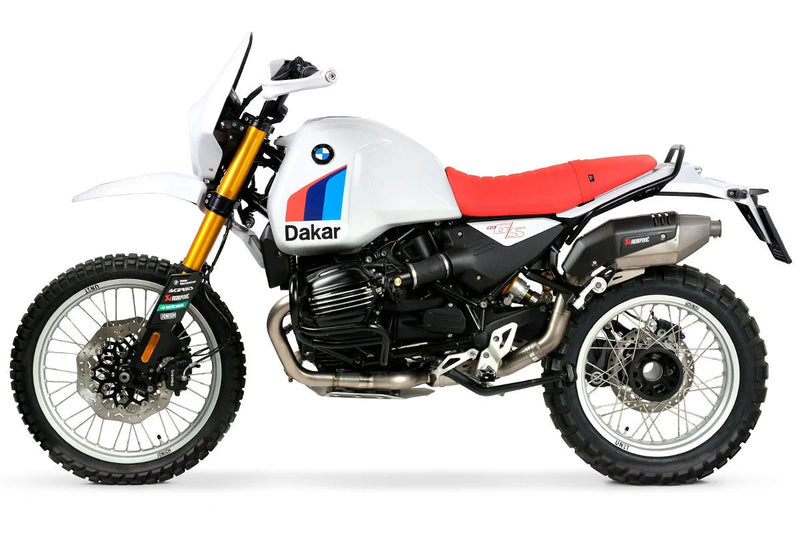
The first mistake is choosing protections as if all bikes had the same weak points. This is not the case. A BMW GS, a KTM Adventure, an Africa Twin, or a Ténéré have very different geometries, dimensions, and exposed components. The engine position changes, the radiators change, the headers, crankcases, levers, and subframe change.
Priority should be given to components that, if damaged, can stop you. Off-road, scratches matter less than damage that compromises movement. For this reason, in most cases, we start with three areas: the lower part of the engine, the side area of the bike, and control protection.
If you take long trips with luggage, the reasoning becomes even more concrete. A well-designed protection is not only useful in an actual fall but also in slow impacts, maneuvers with a full load, and repeated contact with stones, ruts, and steps.
Engine guard and skid plate: the real basis of protection
The skid plate is often the first component to install, and for good reason. Off-road, it protects the oil pan, headers, lower part of the engine, and, in some cases, even the linkages or the most exposed areas of the frame. On heavy, loaded motorcycles, an undersized skid plate risks being more aesthetic than functional.
Here, the material matters, but the design matters even more. Aluminum is widely used because it offers a good compromise between strength, weight, and impact absorption capacity. What really needs to be checked are the thickness, mounting points, and actual coverage. A wide plate that is poorly anchored can transmit impacts where it shouldn't.
The tubular engine guard works on another area. It protects the engine sides, side fairings, and, depending on the structure, also the radiator or the upper part of the motorcycle. In stationary or low-speed falls, it is often the difference between picking up the bike and continuing, or having to deal with more expensive and annoying damage.
The maximum level of available structure is not always necessary. If you mostly ride on gravel roads and easy dirt tracks, a well-sized protection may be sufficient. If, however, you tackle narrow passages, rocky sections, or routes with a lot of lateral exposure, a more extended structure makes sense, even at the cost of a few extra kilograms.
Pay attention to compatibility and bulk
On many adventure bikes, engine guards and skid plates must work together. Not all systems are compatible with each other, and not all leave sufficient space for maintenance, center stand, footpegs, or aftermarket headers. A well-made technical choice always considers the specific model of the motorcycle, not just the category.
Handguards and levers: small until the first impact
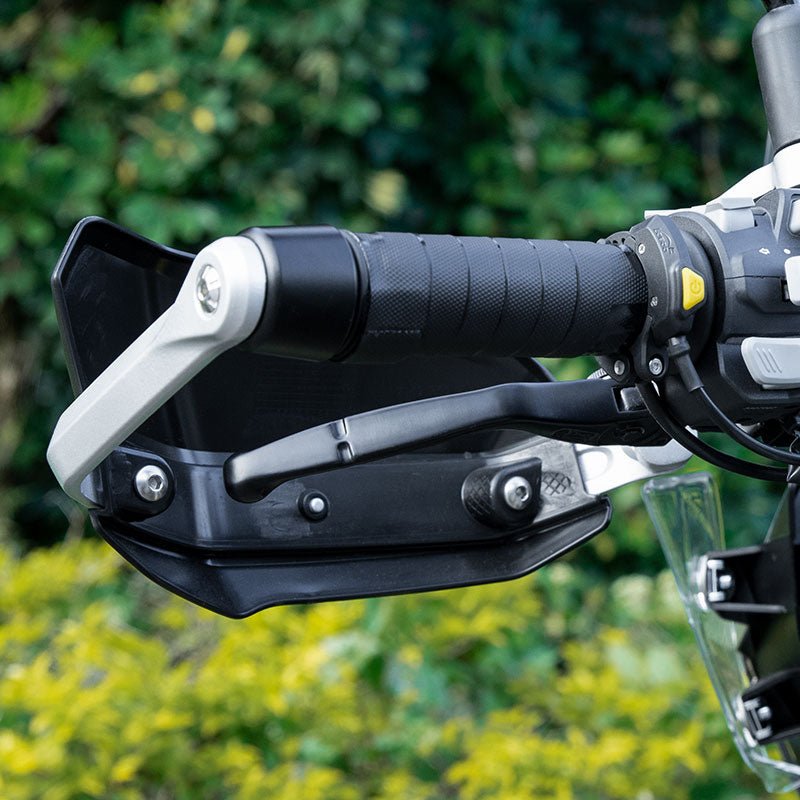
Those coming from asphalt riding tend to underestimate reinforced handguards. Off-road, however, they are among the most sensible protections. They protect hands from branches, rocks, and debris, but above all, they save brake and clutch levers in light falls. And a broken lever dozens of kilometers from the asphalt quickly changes the day.
Handguards with an aluminum core offer a significantly higher level of protection than plastic-only solutions. This does not mean that plastic is useless, but that the two products meet different needs. For serious mixed use and adventure travel, a rigid structure is usually the most logical choice.
However, the available space with windshields, enlarged tanks, heated grips, and original controls must be checked. On modern motorcycles, especially the more accessorized ones, integration is never a minor detail.
Crankcases, engine covers, and radiator: less visible, very useful protections
When it comes to off-road motorcycle protection, attention often focuses on large components. But much damage comes from localized impacts on clutch covers, alternator covers, or radiators. These are exposed areas, and in some cases very vulnerable even at low speeds.
Crankcase protectors are particularly useful on motorcycles that often fall on their side or are used on rocky terrain. A simple slide can scratch a cover, but a sharper impact can compromise its seal. On vehicles intended for long journeys, this is a vulnerability that should be seriously evaluated.
Radiator grilles and dedicated protections serve to defend a critical component from debris and frontal or lateral impacts. Here, the compromise is always between protection and airflow. A well-designed product protects without significantly penalizing cooling. A product chosen only because it seems solid can create more problems than it solves.
Protections that truly depend on your use
Not everything needs to be installed on every bike. Some protections become a priority only in specific scenarios. Headlight protectors, for example, are useful if you do a lot of fast gravel riding with loose stones or group trips on loose surfaces. Tank or fairing protectors can make sense on models with expensive and exposed plastics, especially if you often tackle slow and technical sections.
Even the protection of the linkage or the rear sensor depends on the type of route. On a light dual-sport, it makes little difference. On a heavy maxi enduro, used on rocky sections or steps, it can make the difference between passing and hitting a delicate area.
The point is not to add accessories. The point is to reduce the actual weak points of your setup.
How to choose based on the bike and weight
The heavier the motorcycle, the more the protections must manage significant impact energy and torsion. A stationary fall with an adventure bike weighing over 230 kg in running order has nothing to do with that of a light single-cylinder. The forces involved change, and the risk of deformation changes.
On motorcycles like GS, Africa Twin, or KTM Adventure, the quality of the fastening system is as crucial as the material. Brackets, anchoring points, and load distribution must be designed for that platform. A universal component rarely offers the same level of reliability as a solution designed for the specific model.
Your riding style also matters. If you travel heavily loaded and do adventure off-roading, you need durable protections that are easy to manage and compatible with maintenance and luggage. If you are looking for more technical passages, the coverage needs to be increased, but without turning the bike into a collection of useless weights.
Protect yes, weigh down no
Every accessory adds mass. And mass, off-road, is felt. It worsens inertia, affects balance at low speeds, and can change the bike's behavior during acceleration or changes of direction. That's why the best choice is not the most extreme, but the most consistent.
A well-prepared bike is a bike protected in the right places, without excesses. This is even more true if you do adventure touring and want to maintain maneuverability, mechanical accessibility, and long-term reliability.
Assembly and maintenance: protection works if it remains correct
Even the best component loses value if poorly installed. Incorrect torque settings, interference with other parts, screws that loosen after the first rides: these problems are more common than one might think. After every challenging outing, it is advisable to check fastenings, alignment, and the presence of impact marks that may have deformed brackets or supports.
Maintenance is especially important for the skid plate. Mud, gravel, and debris can accumulate, retain moisture, and make periodic checks more uncomfortable. Effective protection must also allow for practical handling of the motorcycle, not just withstand impacts.
For those who seriously prepare their bike, choosing premium components compatible with the specific model is the most sensible approach. This is why companies like Endurrad are a reference for those seeking solutions designed for real-world use, not generic accessories.
The right protection does not make the bike invincible. However, it gives you an extra margin when the terrain gets complicated, the journey gets longer, and mistakes are part of the process. And often, that margin is what allows you to continue to the next stage.