

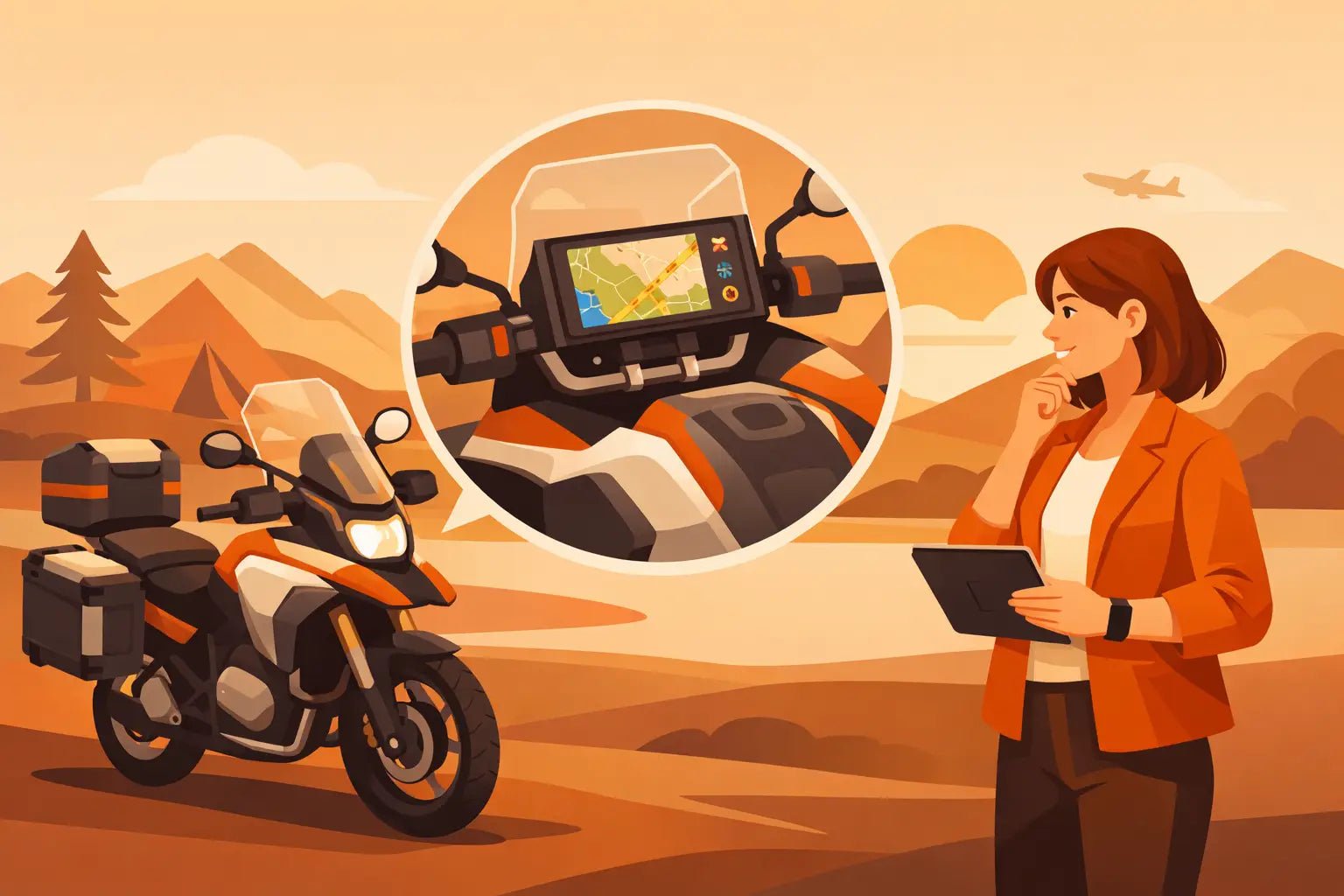
Anyone who truly rides a motorcycle knows: the problem is not having one more screen on the handlebars. The problem is having readable information, simple controls, and a reliable platform when rain, vibrations, and miles start to matter. In this scenario, the Jado Display for Adventure and Touring motorcycles fits into a very specific category: devices designed to improve navigation, connectivity, and practicality on motorcycles that cover highways, light off-road terrain, and long transfers.
It is not an accessory to evaluate solely by display size or the presence of CarPlay and Android Auto. On a BMW GS, KTM Adventure, Honda Africa Twin, or Triumph Tiger, the real difference comes from visibility in sunlight, mounting stability, touch response with gloves, power management, and long-term durability. If any of these points is overlooked, even the best list of features quickly loses its value.
Who really needs a Jado Display for Adventure and Touring motorcycles
A display of this type makes sense for motorcyclists who use their bikes actively. We are talking about people who alternate between commuting, long weekends, fully loaded touring, and mixed asphalt-and-gravel routes. In these cases, having a dedicated platform on the handlebars for maps, calls, music, and trip data reduces dependence on a smartphone mounted in view, with a tangible benefit in terms of readability and practicality.
However, not everyone needs one to the same extent. If you take short rides, already know the routes, and use your phone only occasionally, you may be fine with a simpler solution. If, on the other hand, you tackle long stretches, travel through unfamiliar areas, or want a tidier, more functional cockpit, the improvement is real.
The key point is this: for an Adventure or Touring motorcycle, the display should not add complications. It should reduce mental friction. Fewer stops to check your phone, fewer improvised cables, and fewer unreadable screens in backlight.
What really matters when choosing one
When evaluating a Jado display, the first temptation is to look at the number of features. That is understandable, but on a motorcycle, real-world use remains the priority. A large screen is useful only if it remains readable in bright sunlight and the interface stays responsive even with touring or adventure gloves.
Panel quality matters more than simple diagonal size. Between a smaller but brighter display and a larger but less visible one, the former almost always wins on the road. The same applies to the touchscreen: in the garage, they all seem responsive, but after hours of riding, with dust, rain, or cold, the differences emerge.
The power system also matters greatly. A good motorcycle device must integrate cleanly with the electrical system, avoid precarious solutions, and ensure stable startup. Anyone who prepares a motorcycle for long trips knows that electrical problems almost never originate in the most obvious components, but rather in details overlooked during installation.
Finally, there is the mount. On a large adventure bike or a heavy touring motorcycle, vibrations vary depending on the engine, speed, and road surface. An unstable mount can make the display difficult to read and, over time, compromise the system’s reliability. That is why the display should always be evaluated as part of a complete setup: bracket, mounting point, wiring, and position in the cockpit.
Jado in real-world use: touring, commuting, mixed riding
The value of a Jado Display for Adventure and Touring motorcycles emerges mainly in three situations.
On long-distance trips, the main advantage is the centralization of functions. Having clearly visible navigation, essential notifications, and quick access to key functions simplifies the riding day. It does not transform the motorcycle, but it makes the experience more organized.
For commuting, the benefit is speed and convenience. You set off, connect the system, follow the route, handle a call if necessary, and do not have to keep repositioning your phone or struggling with impractical mounts. For anyone who rides every day, it is an improvement you notice immediately.
On mixed asphalt and gravel roads, robustness and readability make the difference. Here, a device designed for motorcycle use has an advantage over a smartphone exposed directly to vibrations, dirt, and changing weather. This does not mean that every dual-sport ride requires a dedicated display, but for those who frequently use their motorcycle in a versatile way, it makes much more sense than it might seem.
Compatibility and mounting: the part that determines whether the purchase is right
In the adventure world, there is no truly perfect universal accessory. Even when a product is compatible with many motorcycles, available space, cockpit angle, the presence of a crossbar, adjustable windscreen, and accessories already installed can all vary. Some platforms offer plenty of room for installation, while others require millimeter-perfect positioning.
That is why checking compatibility remains essential. A BMW R 1250 GS with an OEM navigator, additional mounts, and an already crowded instrument cluster has different needs from a more minimalist Yamaha Ténéré 700. Likewise, a Honda Africa Twin prepared for touring with a tank bag, auxiliary lights, and electronic accessories requires an overall view of the cockpit.
Anyone building a motorcycle ready to set off would do well to consider the correct order for upgrades. First define protection, carrying capacity, and ergonomics, then complete the electronics. This is the same principle we explore in 10 mistakes to avoid when preparing a motorcycle: choosing an individual accessory only makes sense when it is part of a coherent setup.
Jado Display or smartphone on the handlebars?
It is the most common question, and the honest answer is: it depends on how you use your motorcycle.
A smartphone on the handlebars costs less if you already own a good phone and a reliable mount. For occasional rides, it may be enough. The problem is that it remains a compromise. It is more vulnerable to direct sunlight, overheating, rain, battery limitations, and mechanical stress caused by vibrations. In addition, using your phone as the sole hub for navigation and communication exposes it to greater risks precisely when you are far from home.
A dedicated display such as Jado, on the other hand, is designed with a specific purpose: to bring the main functions into the rider’s field of vision in a more stable way and in a format better suited to motorcycle use. It does not replace every instrument or eliminate the need for good trip planning, but it makes the cockpit more functional.
For an adventure or touring rider, the right comparison is not based solely on the initial price. Its long-term practical value must also be considered. If you ride 2,000 km a year, the benefit is limited. If you take long trips, ride frequently, and want a clean setup, a dedicated display better justifies the investment.
Integration with the rest of your equipment
A well-designed cockpit does not revolve around a single accessory. The display works best when it is part of a coherent system, together with auxiliary lighting, tidy power management, protection, and carefully selected electronic accessories.
If you are upgrading your motorcycle with touring in mind, it may also be useful to look at the broader range of available displays: the best smart displays for motorcycles with CarPlay and Android Auto help put the segment into perspective and understand which features really matter on the bike.
There is also an often-overlooked aspect: visibility at night and in difficult weather conditions. If you frequently use your motorcycle for transfers or on secondary roads, the display improves information management, but it does not replace good lighting. A well-functioning cockpit works best when every component has a clear role.
Limitations to consider before buying
A good technical article is not meant to push everything on everyone. It is meant to clarify whether a product is suitable for your needs.
The first limitation is simple: if your motorcycle already has a well-integrated navigation platform that you use without problems, an additional display could be redundant. The second concerns installation. If you have no space in the cockpit or do not want to modify the electrical system, integration may be less straightforward than expected.
There is also the matter of personal preference. Some motorcyclists prefer minimal instrumentation and fewer elements in front of their eyes. This is a legitimate choice, especially for those who ride extensively in technical off-road conditions or want to eliminate any unnecessary distraction. In these cases, even an excellent display may not be the ideal solution.
Finally, the most important rule in motorcycle touring applies: every accessory must earn the space it occupies. If it adds visual clutter, complexity, or weak points without genuinely improving the ride, it is not the right upgrade.
When a Jado Display makes the most sense
It makes the most sense on motorcycles that cover many miles, for riders who frequently use navigation and connectivity, and in setups where the cockpit is designed as a true touring workstation. In this context, the display is not a gadget. It is a functional component designed to go the distance with the motorcycle.
For anyone preparing a GS, Africa Twin, KTM Adventure, or Tiger with the intention of using it seriously, the right question is not whether the display looks impressive. The right question is whether it makes every day in the saddle simpler, more readable, and more reliable. If the answer is yes, then it makes perfect sense to include it in the setup for your next departure.


Share:
Eazi-Grip Tank Grips and Dash Protection
Loboo Motorcycle Adventure Accessories: what's worth buying