


In brief. For a motorcycle, a portable compressor is judged on four things: how long it takes to restore pressure to a deflated tire, where it gets its power, whether it stops automatically at the set pressure, and how much space it takes up in the bag. Maximum PSI matters little: a motorcycle tire operates at around 2-3 bar, not 10.
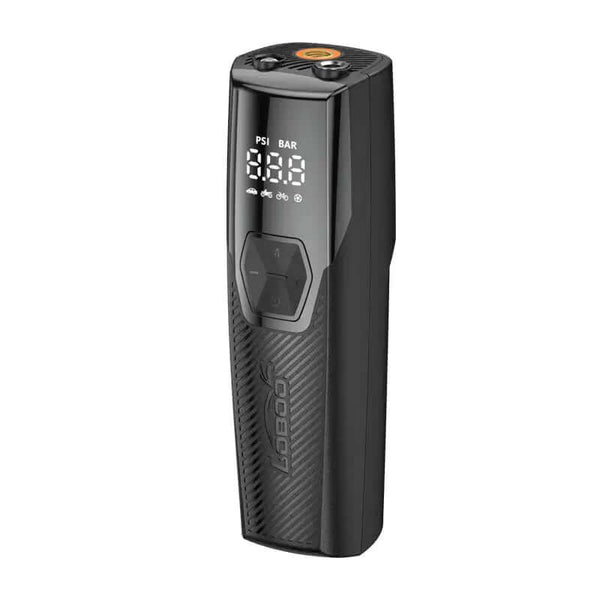
On Endurrad there is only one compressor, the LOBOO CP06: 294 g, 12V, automatic shutoff, motorcycle mode adjustable from 2 to 55 PSI. It works with any motorcycle with a 12V battery, has no internal battery, and does not repair punctures: it inflates. Here you will find the selection criteria and the stated and unstated limitations.
Last updated: October 1, 2026.

A motorcycle compressor is chosen based on five numbers, not the maximum PSI
Inflator product sheets flaunt 150 PSI because it is the highest number they can print. For a motorcycle tire, it is almost irrelevant.
A pressure of 2.5 bar is equivalent to approximately 36 PSI. The 150 PSI full scale (approximately 10.3 bar) applies only to the CP06's free mode, intended for balls and general-purpose use. The motorcycle mode starts at a default value of 2.5 bar (37.5 PSI) and can be adjusted from 2 to 55 PSI; the car mode reaches 65 PSI, the bicycle mode 120, and the ball mode 15. Five other parameters separate a useful compressor from one that stays at the bottom of the bag.
| Parameter | Why it matters on a trip | CP06 (LOBOO-stated data) |
|---|---|---|
| Flow rate | Determines how long you wait, often in the cold or rain | 35 liters per minute |
| Power supply | Without onboard power, the compressor is useless | 12V: cigarette lighter or battery clamps with cable and ring terminals, no internal battery |
| Automatic shutoff | Prevents overinflation while you are busy with the wheel | Yes, when the set value is reached; five modes (motorcycle, car, bicycle, balls, free) |
| Size and weight | If it is inconvenient, it stays at home | 294 g, 156.6 × 47.7 × 45.5 mm |
| Reading and accuracy | An incorrect pressure of 0.3 bar can be felt when cornering | PSI or bar, stated accuracy ±1 PSI |
A note on accuracy: ±1 PSI is approximately 0.07 bar. That is enough to restore a tire to the manual's specified pressure in an emergency, but for fine adjustment it is still advisable to check with a calibrated pressure gauge, as tire manufacturers also recommend.

The CP06 states that it takes four minutes to bring a deflated tire back to 2.5 bar
This is the test LOBOO chose to publish and it should be read for what it is: a manufacturer's test, not an independent measurement.
In LOBOO's timed test on a 150/70 R17 tire from 0 to 2.5 bar, the CP06 takes approximately four minutes. The two comparison inflators take approximately 6 minutes and 50 seconds (a model identified as «peer inflator pump 1S») and approximately 4 minutes and 45 seconds (a cigarette lighter model). We do not know the competitors' brands and models, so the comparison says little about which is better on the market and a lot about what to expect: a few minutes, not seconds.

The manufacturer also states that the hose remains cooler after inflation (46.7 °C versus 62.6 °C for a standard hose, measured with a thermal camera on a completely deflated motorcycle tire inflated to 2.5 bar) and that noise is below 75 dB at one meter. These figures are useful for understanding whether you will be able to touch the hose without burning yourself, not as criteria for choosing one.

It works with my motorcycle: it only needs a 12V battery, not a dedicated connection
Since there is no installation, there is only one question: where does it get power from?
The CP06 can be connected in two ways: to the cigarette lighter socket (or the standard 12V socket, if your motorcycle has one) or directly to the battery's positive and negative terminals using the supplied ring-terminal cable. The second option is the one to keep in mind for motorcycles without a socket. On adventure motorcycles with the battery under the seat or behind a panel, it is worth trying access once at home, not in the dark after a puncture.
The procedure has four steps: connect the power (the compressor enters standby), screw the hose onto the valve, select the mode with the M button and set the pressure, then start with a touch: it stops automatically at the set value.

- With the motorcycle's 12V socket: check the maximum capacity of the socket in your motorcycle's manual, because the CP06's power draw is not listed in the specifications.
- With the clamps: the ring-terminal cable should be connected only when in use, observing positive and negative polarity.
- Engine running, whenever possible: this is our precautionary advice, not a manufacturer's instruction, to avoid putting strain on the battery at the end of the day.
- Battery: if the motorcycle has been sitting for a while and the engine is slow to start, the compressor is not the priority. Here you can find out how to maintain the battery and about the C20Pro mini charger.
The compressor completes the puncture repair kit, but does not replace it
Inflating a tire that is losing air does not mean you have repaired it.
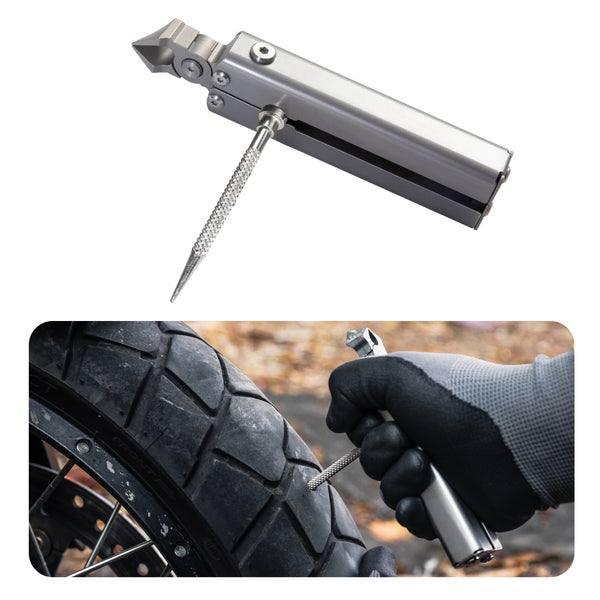
With a tubeless tire, the most common puncture (a nail or screw in the tread) is temporarily repaired with strings or fluid, and the tire is then reinflated: that is where the compressor is needed. With an inner tube, everything changes: the compressor is used at the end of the repair, after removing and replacing the tube. To understand which system is right for you, read inner tube or tubeless on an adventure bike.
One point needs to be stated clearly: on-site repair is temporary. In its FAQs, Pirelli recommends replacing the tire whenever it sustains damage and mentions repair kits as a solution for specialized retailers. Use the compressor to reach a workshop, not to continue your journey with a temporarily repaired tire.
At the roadside in the evening, light also matters: the CP06 has an integrated LED with steady and SOS modes, activated by pressing and holding the button.

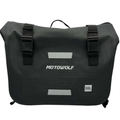
The LOBOO tubeless repair kit listed in the catalogue, along with its refills, is currently out of stock: for updated availability, see the LOBOO products. If you want to know what to pack in addition to the compressor, the motorcycle tool kit guide and the LOBOO roll-up tool bag are the starting point.
What you receive, and when it makes sense to choose something else
The CP06 costs €49.00 in the catalogue (price and availability as of October 1, 2026, 2 units).

| Item | Detail |
|---|---|
| Included | Adapters for Schrader and Presta valves, ball needle, ring-terminal cable for battery clamps |
| Pressure | Motorcycle mode 2-55 PSI (default 2.5 bar); free mode 2-150 PSI; reading in PSI or bar |
| Light | Emergency LED, steady or SOS flashing |
| Declared markings | CE, FCC, RoHS; built according to GB4706.1 |
| Not included | Internal battery, repair kit, separate pressure gauge |

Choose something else if you do not want to depend on the motorcycle’s battery, such as a hand pump or a compressor with its own battery: these solutions are slower or bulkier, and Endurrad does not carry them. If instead you want to know the pressure of every tire without stopping, a compressor is not enough: continuous monitoring is the job of TPMS sensors.
Check tire pressure when cold, and more often than you might think
Michelin recommends checking tire pressure when the tire is cold, meaning it has been stationary for at least two hours or has been ridden for less than 3 km at low speed, every two weeks and before long trips. If you measure it hot, it suggests adding about 0.3 bar to the cold value. Pirelli refers to the motorcycle manufacturer’s recommended values listed in the motorcycle manual, without proposing universal figures.
The practical rule is therefore simple: use the value from the manual, measure when cold, and adjust with the compressor. A small compressor does not change these rules; it simply makes them applicable anywhere.
Frequently asked questions about portable motorcycle compressors
What compressor do you need for an adventure motorcycle?
A 12V model that can bring a 2-3 bar tire back up to pressure in a few minutes, stops automatically, and fits in a side pannier. The maximum 150 PSI matters little. The CP06 claims about 4 minutes from flat to 2.5 bar on a 150/70 R17 tire.
How many bar or PSI should I inflate the tire to?
The values in your motorcycle’s manual, measured when cold. Pirelli refers to the motorcycle manufacturer’s recommended values; Michelin suggests adding about 0.3 bar to the cold value if you measure with the tire hot. 1 bar is approximately 14.5 PSI.
Does the CP06 work without starting the motorcycle?
Yes, as long as the battery holds up: it has no built-in battery and draws 12V from the socket or battery clamps. To avoid putting a strain on starting power at the end of the day, we cautiously recommend doing this with the engine running whenever possible; this is not a manufacturer's instruction.
How long does it take to inflate a motorcycle tire?
LOBOO states approximately 4 minutes to inflate a 150/70 R17 from 0 to 2.5 bar. This is the manufacturer's test: the time is shorter for a front tire and longer for a car tire.
Does it stop automatically at the set pressure?
Yes, according to the manufacturer. There are five modes (motorcycle, car, bicycle, balls, and free) with a preset value and adjustable range: for motorcycles, from 2 to 55 PSI, with a default of 2.5 bar.
Is it suitable for car tires?
It is suitable for motorcycles and cars (car mode up to 65 PSI), but it is a small device: it takes longer on a car tire. For everyday use in a car, a larger compressor is more convenient.
Can a compressor repair a puncture?
No. It restores pressure. A tubeless repair is done with plugs or sealant and remains temporary: Pirelli recommends replacing the tire after damage.
Is a compressor better than a hand pump?
The compressor is faster and requires less effort, but it depends on the motorcycle's battery. A hand pump depends on nothing but takes time and effort on a flat motorcycle tire. If you often travel far from repair shops, the compressor wins.
Which valves does it support?
The package includes fittings for Schrader and Presta valves, plus a needle for inflating balls.
Where should I keep it on the motorcycle?
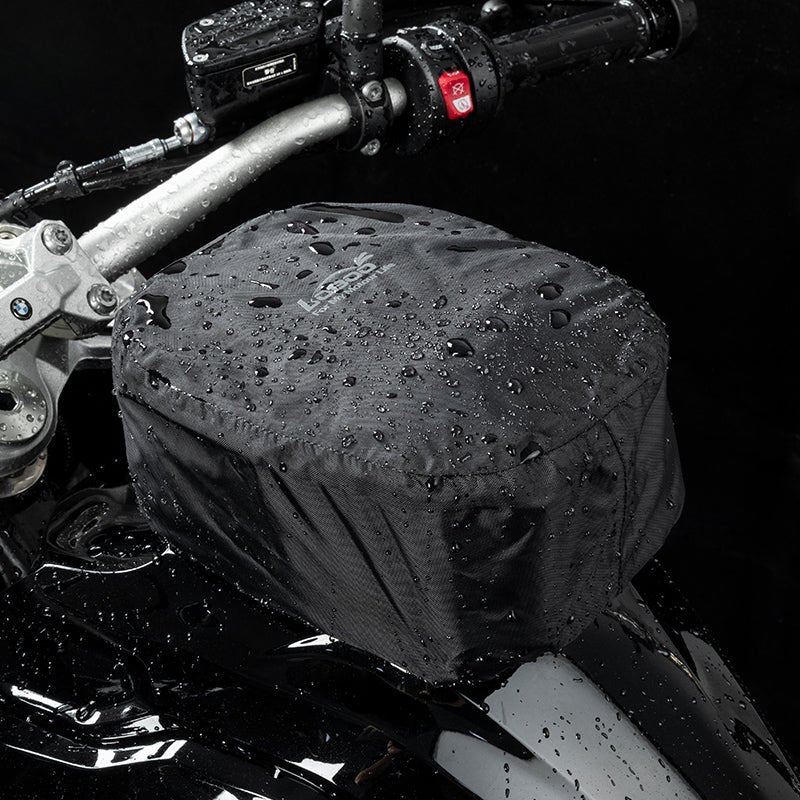
It measures 156.6 × 47.7 × 45.5 mm and weighs 294 g: it fits in a pannier, under the seat or in a tool bag such as the LOBOO roll-up tool bag.
Is it noisy?
LOBOO states less than 75 dB at one meter. This is the manufacturer's figure and should be understood as an approximate indication.
Compressor or TPMS sensors: which do you need first?
They're two different things. The compressor restores pressure, while the sensors show it continuously. Riders traveling with a fully loaded motorcycle benefit more from using both, but the compressor is the first purchase when you have no inflation equipment.
Prepare your puncture repair kit before setting off
If you're preparing your motorcycle for a trip, the compressor is one piece of the puzzle: add a repair kit, a tool bag and, if you want to monitor pressure while riding, the sensors. Tell us the motorcycle's model and year and we'll tell you what you really need to carry.
More information: inner tube or tubeless · motorcycle tool kit · TPMS sensors for motorcycles