

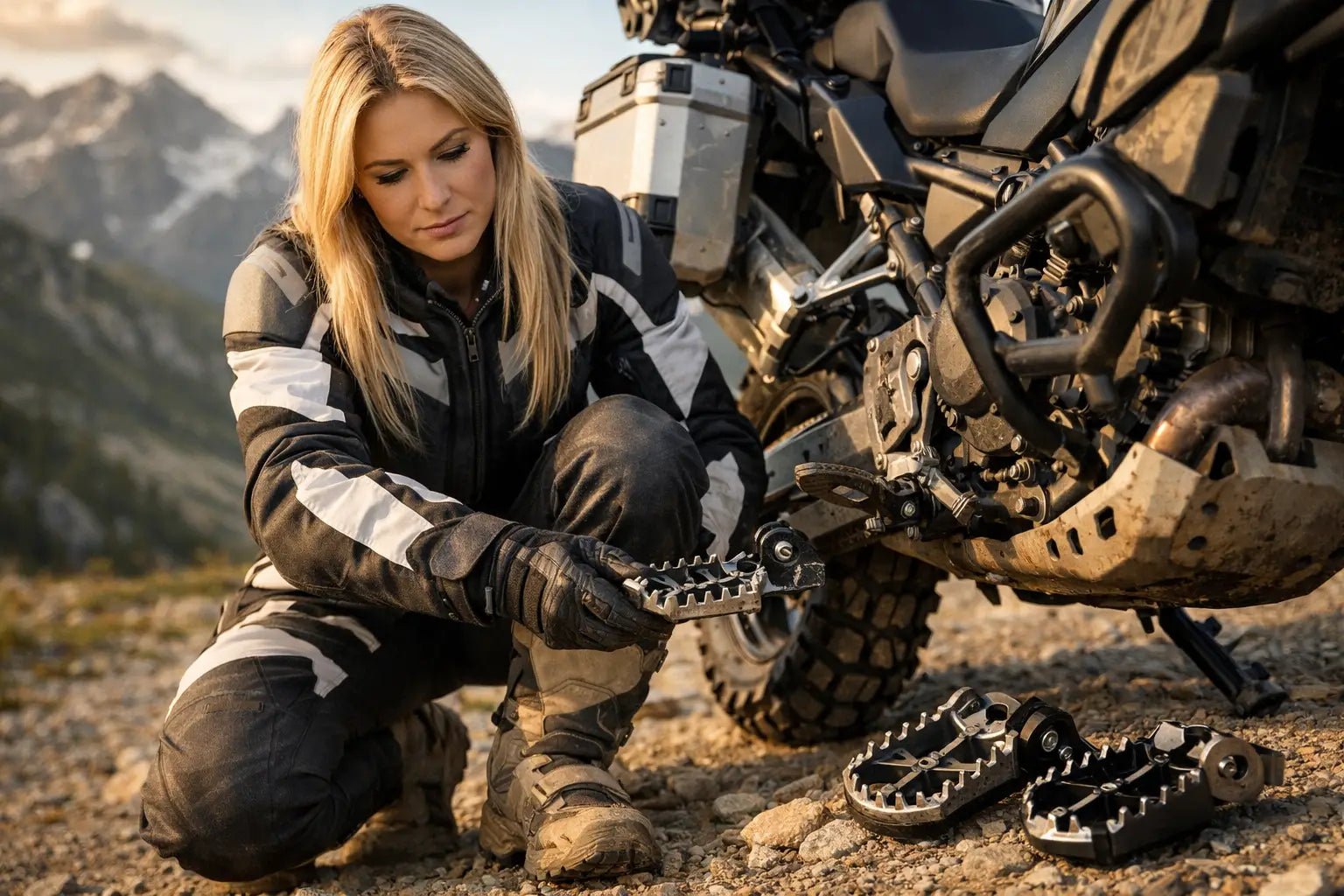
If after two hours standing on rocky ground you feel your feet slipping away, or after a day of riding your ankles and knees are more fatigued than expected, the problem often isn't your technique. It's the footpegs. Understanding how to choose adventure motorcycle footpegs means improving control, posture, and endurance, especially when you alternate between asphalt, dirt roads, and technical sections with luggage on board.
Footpegs are one of those components that seem simple until you really start using them. On long trips, they make a difference to comfort. In light or medium off-road riding, they affect how much you can load the front, how stable you remain while standing, and how well you feel the motorcycle beneath your boots. That's why it's not enough to look at aesthetics or choose the "widest" model: what matters is how you use the motorcycle, which boots you wear, and what kind of platform you need.
How to choose adventure motorcycle footpegs based on use
The first useful question isn't which footpeg to buy, but where you spend most of your time. If you mainly tour on asphalt with occasional dirt roads, the priority is a stable but not extreme platform, capable of supporting your foot well without transmitting too much vibration. If, on the other hand, you also ride a KTM 890 Adventure, a Ténéré 700, or an Africa Twin on rougher dirt roads, you need more support, more grip, and a shape that helps when you frequently ride standing up.
This is where the first compromise comes in. A very aggressive footpeg, with pronounced teeth and a wide surface, improves control and security in mud, water, or dust. However, it can be less forgiving on long stretches, especially with less rigid touring boots. Conversely, a more road-oriented footpeg reduces fatigue on long rides but offers less support when you need to shift your weight precisely.
If you ride mixed terrain, the right choice is usually a true adventure footpeg, not a pure enduro footpeg. It should give you enough support when standing, without turning every highway section into continuous pressure beneath the soles of your feet.
Platform width, length, and shape
Size matters more than it may seem. A wider platform distributes weight better and causes less fatigue when you remain standing for long periods. You notice the benefit immediately on uneven dirt roads or tracks where you remain lifted off the seat for several minutes at a time.
However, wider doesn't automatically mean better. If you go too far with the surface area, you may lose sensitivity in fine movements, especially if you have a smaller build or ride a less bulky motorcycle such as an F 850 GS, a Himalayan, or a Ténéré 700. In addition, a very large footpeg can interfere with how quickly you move your foot toward the gear lever or rear brake pedal.
Shape is equally important. Some footpegs support the foot well at the center, while others provide more support toward the outside and heel. If you often ride standing up, you'll appreciate a platform that doesn't force you to keep searching for the right position. If you do a lot of touring, a well-balanced surface that supports the foot without creating sharp pressure points may be more useful.
Grip: how aggressive should it really be?
Grip isn't only useful in mud. It also matters in the rain, with wet soles, when you stand up after hours of riding, or when you need to correct your line on loose gravel. Good teeth hold the boot securely and let you load the motorcycle without that feeling of uncertain support.
Here too, there's a balance to find. Very pronounced teeth are a logical choice if you use rigid off-road or adventure boots and regularly ride real dirt terrain. But with more touring-oriented boots, they can feel intrusive and, over time, wear the sole more quickly. If your use is 70% asphalt and 30% dirt roads, a firm but not extreme level of grip is often the best choice.
When evaluating a footpeg, ask yourself this: do I need to stay locked to the motorcycle on uneven ground, or do I prefer secure support that allows a small amount of micro-movement on long stretches? The answer affects your choice more than the finish or the brand.
Materials: steel or aluminum?
When it comes to materials, it's worth being practical. Steel generally prioritizes strength and impact tolerance. If the motorcycle often falls over at a standstill or lands awkwardly on rocks and ruts, it's a sensible solution for riders who aren't overly concerned with aesthetics. It usually adds some weight, but in the adventure category, the gain in durability can make sense.
Aluminum works well when you want to keep weight down while maintaining precise construction. On a motorcycle already loaded with crash protection, luggage, and accessories, saving mass in the parts you touch and move isn't insignificant. However, project and manufacturing quality matter more than the material alone. A lightweight component that is poorly designed can't compensate for a platform that flexes or teeth that wear out quickly.
More useful than theory is to think about your riding. Long trips, lots of asphalt, and a focus on weight? Aluminum may make sense. Harsh riding, frequent impacts, and mechanical durability as the priority? Steel remains a very rational choice.
Height and position: real ergonomics, not a minor detail
One of the least considered questions when discussing how to choose adventure motorcycle footpegs concerns their position. Some footpegs retain the original height, while others slightly change the height or offset. This affects knee angle, hip opening, and how easily you transition from sitting to standing.
If you're tall, or if on motorcycles such as the BMW R 1250 GS, R 1300 GS, Tiger 1200, or Africa Twin your legs feel too cramped on long rides, a slightly lower position can reduce fatigue. But there's a downside: lowering the footpegs too much can increase the risk of contact when cornering on asphalt or change your relationship with the gear lever and brake pedal.
If, on the other hand, you ride off-road and want to spend a lot of time standing, don't look only at legroom. It also matters how naturally you can position yourself over the front end. A well-positioned footpeg makes you feel more centered and less "seated even when you're standing." It's a subtle difference on paper, but very clear as soon as you tackle a rough descent or a slow technical section.
Model compatibility: this isn't something to guess
On adventure motorcycles, compatibility isn't an administrative detail. It's part of the functionality. Mounts, springs, dimensions, and interference with stands, linkages, or protection parts can vary significantly from one platform to another. A footpeg designed for a Ducati DesertX shouldn't be treated as interchangeable with one for a KTM 1290 Super Adventure. The same applies between the R 1250 GS and F 850 GS, or between the Tiger 900 and Tiger 1200.
There's also the matter of the controls. A wider or lower footpeg may require adjustments to the gear lever and rear brake. If you wear boots with thick soles or bulky toes, this aspect matters even more. A technically compatible footpeg that isn't properly integrated with your riding position can ultimately make the experience worse.
That's why browsing by model isn't just a catalog gimmick. It's the most reliable way to avoid purchases that are correct on paper but wrong in practice.
The boots you ride in change the choice
A footpeg never works alone. It works with your boot sole. With a rigid adventure boot offering good torsional protection, you can take advantage of wider surfaces and more pronounced teeth without sacrificing too much comfort. With a more touring-oriented or travel boot, the same footpeg may become more tiring after many hours.
Foot size also matters. Riders with smaller feet often prefer platforms that provide control without requiring large movements to reach the controls. Riders with larger feet, especially on loaded motorcycles, benefit from greater support to avoid "floating" on the footpeg when riding standing up.
If you've recently changed boots and the motorcycle feels less natural, don't immediately blame the seat or handlebar. Sometimes the real issue is the interface between the sole and the footpeg.
When is it really worth replacing the stock footpegs?
Not always immediately. Stock footpegs may be perfectly adequate if you do relaxed touring and don't feel any clear limitations. But replacement makes sense when you recognize one of these real situations: you lose grip in rain or mud, you often ride standing and feel insufficient support, you have localized pain beneath your foot, or your position with your boots doesn't let you operate the gear lever and brake effectively.
On many mid- and large-displacement adventure motorcycles, changing the footpegs is one of the ergonomic modifications you notice most quickly. Not because it transforms the motorcycle, but because it improves a constant point of contact. And when a component works for hours under weight, vibration, and constant position corrections, a few millimeters and a different shape can make more difference than many more conspicuous accessories.
In the end, the right choice is the one that disappears while you ride. It doesn't make you think about your feet, doesn't force you to adapt, and doesn't make you lose precision when the surface gets worse. If a footpeg leaves you with more energy after 500 km and more control when the asphalt ends, you're looking in the right direction.


Share:
How to adjust touring motorcycle ergonomics
Inner tube or tubeless adventure: what's better