


In brief. On the BMW R 1250 GS with RDC tire pressure monitoring, the angled valve is already there: BMW fits it as standard together with the sensor, and the service documentation specifically calls it an “angled inflation valve.” Buying an angled valve makes the most sense on GS models without RDC, when changing tires, choosing it based on the hole diameter rather than the “motorcycle model.” The 90° screw-on adapter should be used only when stationary for inflation: the manufacturers themselves warn against riding with the adapter installed.
Here you will find how to identify the valve you have, what differs between cast and spoked wheels, which TPMS sensors can be added, and how to install a valve without leaks. We always distinguish between official BMW information, manufacturer-stated information, and workshop experience.
On the R 1250 GS with RDC, the angled valve is already factory-fitted
Many guides recommend “switching to angled valves” without mentioning that, on GS models with the RDC option, BMW already uses an angled valve integrated into the sensor.
What BMW documentation says
The service bulletin SIB 36 01 20 dated April 1, 2020 concerns K51 GS Adventure models with optional equipment 530 RDC: on some units, the wrong gasket had been installed on the “angled inflation valve,” potentially causing leaks between the valve and the rim. The specified solution is the RDC angled valve repair kit, BMW part number 36 31 8 388 689, one per wheel. BMW states that motorcycles have been produced without the defect since February 20, 2020.
The useful information for buyers is this: with RDC, the sensor and the valve form a single assembly. The valve cannot be replaced with just any aftermarket valve; it is repaired with the BMW kit (valve body, gasket, and nut) or the entire sensor is replaced.

A straight valve, an angled valve, and a 90° adapter are three different things
The old text on this page treated them as the same thing. They are not: installation, loads, and safety differ.
| Solution | How it is installed | Pros | Limitations | For those who |
|---|---|---|---|---|
| Straight metal valve | In the rim hole, with nut, with the tire removed | Robust, inexpensive, standard | Awkward connector near discs and calipers | Those who check the pressure rarely |
| Metal angled valve | In the rim hole, with nut and gasket, with the tire removed | Head already oriented outward, for quick inflation | Requires changing the tires for installation; gasket must be checked | GS without RDC, touring use and frequent checks |
| BMW RDC angled valve | Standard, attached to the internal sensor | Integrated, pressure reading on the TFT | Can only be repaired with a BMW kit or a complete sensor | GS with optional 530 RDC |
| 90° screw-on adapter | Screws onto the existing valve | Costs a few euros, no disassembly | Remove before riding: leverage on the valve | Those who just want to inflate conveniently while stationary |
| Flexible extension | Hose that screws onto the valve when inflating | No permanent load on the valve | One more accessory to carry | Those with RDC who do not want to touch the valve |
- you keep it in your bag and use it only when stationary
- the valve thread is long enough to screw it on fully
- you want to inflate with compressors with a short hose
- does not replace a genuine angled valve
- must not be left installed while riding
- must not be screwed permanently onto an RDC valve
On alloy and cross-spoke wheels, the valve is located in different places, and it matters
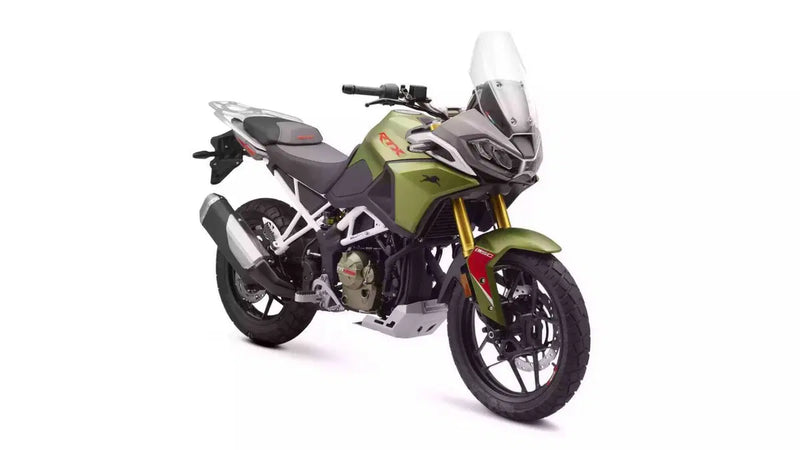
The R 1250 GS (produced from 2018 to 2023 and replaced by the R 1300 GS) is fitted with 120/70 R19 front and 170/60 R17 rear tires, on standard alloy or tubeless cross-spoke wheels depending on the trim and options.
Alloy wheels
On the GS's alloy wheels, the valve emerges next to a spoke: this is one reason access with a straight connector is awkward, with the front brake disc and caliper limiting the available space. An angled valve makes the biggest difference here.
Cross-spoke wheels
BMW cross-spoke wheels are tubeless: the spokes are anchored to the outer edge of the rim, and the rim channel remains airtight. The valve is therefore a standard tubeless valve, not the type used on inner-tube wheels. There is more space between the spokes for the connector, but the problem of its orientation toward the brake disc remains.

If the GS does not have RDC, you can add a TPMS, but you have to choose between an internal sensor and a cap-mounted sensor
On a GS without RDC, pressure monitoring is added with aftermarket systems. There are two architectures, and they affect the choice of valve.
| System | Sensor location | Valve | Reading | Notes |
|---|---|---|---|---|
| BMW RDC (optional 530) | Inside the wheel, at the base of the valve | Angled, integrated | Factory TFT | Duplicating it with another TPMS is unnecessary |
| Chigee internal sensor | Inside the wheel, on the valve | Straight metal valve, included | Chigee AIO-5 Lite, AIO-5 Play, AIO-5 Play BMW, XR-2 display | Installed with the tire removed; replaces the existing valve |
| Cap-mounted sensors (Chigee, JADO) | In place of the valve cap | The one you have | Display from the same brand | No disassembly; adds weight to the valve stem |
The practical point: if you choose the internal sensor, the valve becomes the one belonging to the sensor (straight, in the case of Chigee), and the aftermarket angled valve is no longer needed. If you choose the caps, you can keep the valve you prefer, but on an angled valve the cap sticks out sideways, and you must check that it does not touch the disc or caliper as the wheel rotates.

- Type
- Internal sensor with a straight valve
- Measurement range
- 0-8 bar (specifications sheet), 0-9 bar (label)
- Accuracy
- 0,01 bar
- Frequency
- 433,92 MHz FSK (label)
- Battery
- 2-3 years, not replaceable
- Overall dimensions
- 25 × 25 × 49,5 mm
- Compatibility
- Chigee AIO-5 Lite, AIO-5 Play, AIO-5 Play BMW, XR-2
- Price
- 60 €

Before buying an angled valve, five checks are needed - not the motorcycle's name
Economical and high-quality angled valves look similar in photos. The differences lie in dimensions, seals, and the machining of the valve seat.
- RDC or not. With RDC, do not replace the valve with an aftermarket one: repair it with the BMW kit or use an extension for inflation.
- Hole diameter. Measured with calipers, usually 8.3 or 11.3 mm on motorcycle rims. A valve for a different hole size will not seal, even with thicker seals.
- Angle and orientation. The head must point outward without facing the disc, caliper or spokes; an adjustable model that can be oriented before tightening is preferable.
- Seals and nut. Inner and outer seals included, with a nut and washer. The BMW bulletin was issued precisely because of an incorrect seal.
- Valve cap with seal. On a motorcycle exposed to water, mud and salt, the cap is the first barrier for the valve core: it should always be fitted.
Brass, aluminum or steel
Tubeless metal valves are available in nickel-plated brass, anodized aluminum and steel. Aluminum is light but more susceptible to galvanic corrosion when in contact with other metals and to salt; brass is heavier but is the traditional material for valve cores. More than the material, the precision of the seat and the quality of the seal matter: that is where slow leaks start.
An angled valve can only be fitted with the tire removed, preferably during a tire change.
The tubeless valve seals from inside the rim: replacing it requires breaking the bead and removing the tire. Doing it when changing the tire avoids a second removal and a second balancing.
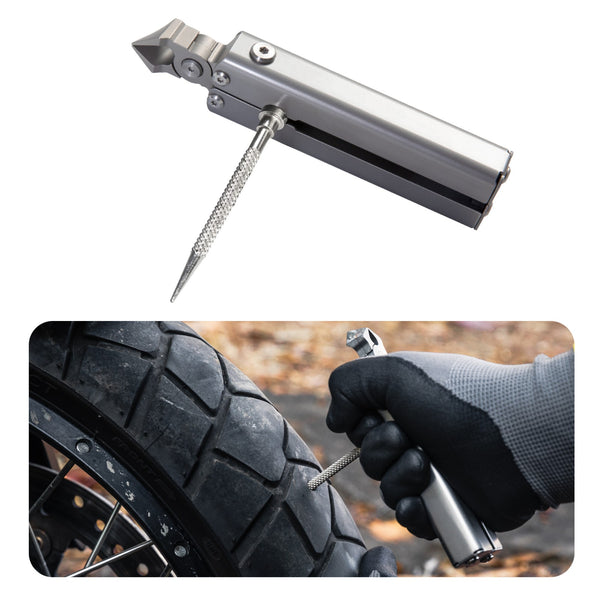
- Check the RDC. If the motorcycle has RDC, the tire fitter must know: the bead breaker works close to the sensor, which must be protected. In this case, use the BMW kit, not a generic valve.
- Measure the hole. After removing the old valve, check the diameter and clean the seat of oxidation and rubber residue.
- Fit the correct seals. Inner seal against the wheel rim, outer seal and washer under the nut.
- Orient it before tightening. Turn the head outward, away from the disc and caliper; then tighten the nut to the torque specified by the valve manufacturer, without overtightening.
- Reinstall, inflate, balance. A metal valve weighs more than a rubber one: the wheel must be balanced again after the tire is fitted anyway.
- Leak test. Apply soapy water to the valve base and the valve core; recheck the pressure when cold after the first few days and after the first 100-200 km.
On a trip, the compressor and checking the pressure when cold matter more than the valve's shape.
The angled valve makes the action convenient; safety comes from checking the pressure regularly and having a way to restore it on board.
Correct pressure and RDC reading
The reference values are shown on the motorcycle's label and in the owner's manual, with separate figures for riding alone and with a passenger or luggage. On GS models with RDC, owners report that the value on the TFT is temperature-compensated and may differ from the gauge reading: to correct it, measure with the tire cold and adjust according to the gauge, using the TFT to notice changes.

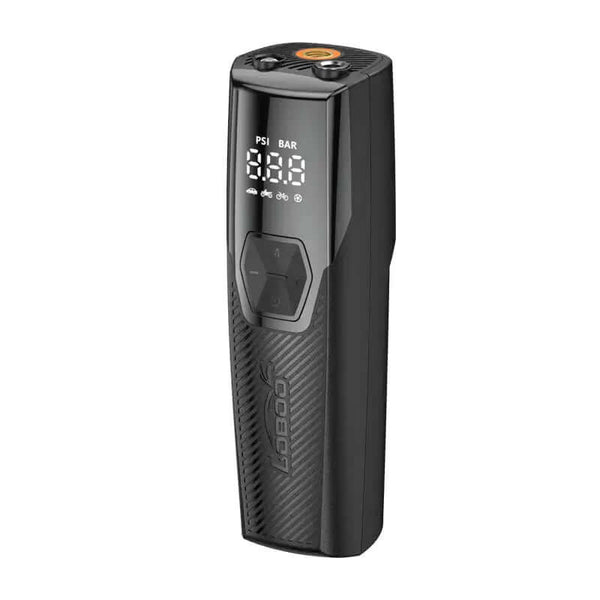
- Pressure
- 2-150 PSI, automatic shutoff
- Flow rate
- 35 L/min
- Weight
- 294 g
- Dimensions
- 156.6 × 47.7 × 45.5 mm
- Power supply
- 12 V, socket or battery clamps
- Fittings
- American (Schrader) and French valves
- Accuracy
- ±1 PSI stated
- Price
- 50 €
The CP06 American valve fitting connects to both the GS's straight and angled valves because the valve core is the Schrader standard. With the angled valve, the connection is direct; with the straight valve and the disc nearby, an extension may be needed. For choosing an inflator, read the guide to the 12 V portable motorcycle compressor; for the rest of the equipment, see the guide to the motorcycle tool kit to take on a trip.

Frequently asked questions about the R 1250 GS angled valves
Does the BMW R 1250 GS come with angled valves as standard?
Can I install an aftermarket angled valve on a GS with RDC?
Can I ride with a 90° adapter screwed onto the valve?
What is the diameter of the valve hole on the GS rims?
Do the R 1250 GS spoked wheels use an inner tube?
Does the tire need to be removed to replace the valve?
Is an aluminum or brass valve better?
What is the difference between an internal TPMS and a cap-style one?
Do Chigee sensors work with the BMW TFT?
Why is the pressure on the TFT different from the gauge reading?
How long does the RDC sensor last?
Is an angled valve more fragile off-road?
What kind of compressor do you need for the GS's valves?
Getting your GS ready?
Tell us the make, model, and year of your motorcycle and whether it has RDC: we'll tell you which accessories are compatible with your R 1250 GS, from pressure monitoring to luggage. You can find everything in the dedicated collection and in the Endurrad App for iPhone.
Download the Endurrad App for iPhone · R 1250 GS Adventure accessories · Contact us
Sources. BMW Motorrad, Service Information Bulletin SIB 36 01 20 «Check angled valve, replace if necessary» (1/4/2020, published by NHTSA, document MC-10175295); MOTORRAD (motorradonline.de), R 1250 GS technical data: 120/70 R19 and 170/60 R17 tires, alloy wheels; Chigee (MFP0018 TPMS sensors) and LOBOO (CP06) product sheets and manuals from the Endurrad catalog; usage warning for a 90° adapter from a BMW specialist retailer; GS owner forums (gs-forum.eu, ukgser.com, BMW MOA) for valve position on alloy wheels, seal lifespan, and RDC readings, cited in the text as user experiences rather than official data. Prices and availability verified on 10/12/2026.