


In brief. You're ready for your first big motorcycle trip when you've already ridden for at least three days in a row with your bike loaded, not when you've finished reading the guides. For your first trip, aim for 5-6 hours in the saddle each day, which on highways and secondary roads means roughly 250-330 km, with a proper break every two hours and a day off for every four or five days on the road. Pre-trip anxiety is normal and, within limits, makes you more attentive: manage it by reducing the unknowns, not ignoring them.
This guide explains the method we use at Endurrad for first-time travelers: how to tell if you're ready, how many kilometers to plan, how to choose a route with “escape routes,” which test rides to take in spring, and what essential gear to bring. L'winter is the best time to get ready.
You're ready when you've already done three days in a row, not when you've read enough
A first big motorcycle trip is scary more because of what you don't know than because of its actual difficulty. The most honest test of your preparedness is simple: have you already ridden for three consecutive days, with a loaded bike, sleeping away from home?

What we mean by a “first big trip”
Not a Sunday ride, and not a weekend at the lake either. We're talking about a trip of at least 5-7 days, with a different stop each evening, full luggage, and at least part of the route on unfamiliar roads, perhaps abroad. It's the point when the bike stops being a way to go for a ride and becomes the way you spend a week.
- you've already done at least one 300 km day ride without ending the day exhausted
- you can maneuver from a standstill and on a slope with the bike loaded and a passenger, if there will be one
- you recognize your signs of fatigue and stop before they turn into mistakes
- you can check tire pressure, the chain, and fluid levels without looking for a tutorial
- you've ridden in the rain at least once and in the dark at least once
- your longest ride is under 150 km
- you’ve never ridden your motorcycle with the panniers fitted
- you’ve only been riding for a few months and are already planning stages of 500 km
- your first trip coincides with your first time riding your new motorcycle
- you have no idea what to do if you get a flat tire
L’anxiety before setting off is normal and, in the right amount, makes you more alert
Restless nights, lists rewritten three times, the temptation to put it off: anyone who has planned an important trip knows it well. It’s not a sign that the trip is a bad idea; it’s how your mind prepares for a new situation.
A little tension helps; too much doesn’t
The link between arousal and performance has been studied for over a century. The so-called Yerkes-Dodson law comes from a 1908 experiment on learning in rats and is now used, in simplified form, to describe a bell-shaped curve: with low arousal, you’re distracted; at a moderate level, you perform at your best; with too much anxiety, performance declines. On a motorcycle, this is a familiar experience: a little tension when setting off makes you pay closer attention to the road, while excessive agitation stiffens your arms and shoulders and makes your riding worse.
This is a general psychological model, not a study of motorcyclists: we use it as a way to understand things, not as data.
The most common fears and what to do
- “What if the motorcycle breaks down?” Have it serviced at least three weeks beforehand, not the day before: that way, you’ll have time to find out if anything is wrong after the work. Check the roadside assistance coverage on your insurance policy or from the manufacturer.
- “What if I crash or get hurt far from home?” Save the European emergency number 112 on your phone, bring your health insurance card, which is valid for healthcare in EU countries, and share your location with someone at home. If you’re afraid of falling itself, read our guide on how to manage fear when cornering.
- “What if I can’t find anywhere to sleep?” For your first trip, book the first two nights and the last one. You can leave the rest open: it’s a compromise that gives you peace of mind without taking away the joy of discovery.
- “What if I can’t handle the fatigue?” Plan short stages and a day of rest. For the signs to watch for, see our guide to motorcycle fatigue on long trips.
Why motorcycle trips are worth the effort
A study of motorcycle tourism in Wales (Cater, Tourism Management, 2017, 156 motorcyclists interviewed) confirms what every motorcyclist knows: the route matters more than the destination. For 84% of respondents, road quality influences their choice of destination; for 76%, scenic spots to stop at matter. It’s a good principle for your first trip too: choose beautiful roads, not just famous destinations.
The right mileage is measured in hours in the saddle, not kilometers
L’the most common mistake on a first trip is planning with the navigation set to “fastest” and then discovering that 450 km on main roads is a full day of riding, with no time to stop and look at what you set out to see.
| Route type | Real average, including stops | Km in 6 hours of riding | Suitable for your first trip? |
|---|---|---|---|
| Motorway / expressway | 90-100 km/h | 540-600 km | Only for transfers; it’s the most boring and tiring part |
| Flatland main roads and country roads | 55-65 km/h | 330-390 km | Yes, allowing for crossings through towns |
| Hills and scenic roads | 45-55 km/h | 270-330 km | Yes, it’s the ideal format |
| Alpine passes and mountains | 35-45 km/h | 210-270 km | Yes, with shorter stages and an early start |
| Easy unpaved roads | 20-30 km/h | 120-180 km | Short stretches only, if you’ve tried them before |
Breaks every two hours: where the rule comes from
There is no legal limit on riding hours for motorcyclists traveling for pleasure. The most frequently cited reference is the UK Highway Code (Highway Code, Rule 91), which recommends a break of at least 15 minutes every two hours of driving. On a motorcycle, with wind, vibrations, and temperature taking their toll, that’s a minimum, not a maximum. Stop, take off your helmet, and drink: stopping while astride the bike with the engine running doesn’t count.
For your first time, a loop route with escape routes is best
The perfect route for your first trip isn’t the most spectacular one of all: it’s the one you can shorten at any time without ruining your vacation.

| Format | How it works | Pros | Cons |
|---|---|---|---|
| Loop | Set off and return home without retracing the same route | You can always head home early | Requires a little planning |
| One base with loop rides | One accommodation for 3-4 nights, with day rides and no luggage | Light bike, no repacking panniers every evening | Less of a sense of adventure |
| Straight there and back | Ride to a distant destination and back | Easy to organize | The return is often a long haul on the motorway |
| Ferry + ride | Ferry out, then a loop at your destination | Skip the boring transfers | Fixed dates, higher costs, less flexibility |
Three criteria for choosing your destination
- Stay within 600-700 km of home. If something goes wrong, you can be home after a day on the motorway.
- Familiar language and rules, or nearly so. Italy, Austria, Slovenia, Switzerland, and southern France are classic choices for riders setting off from the north; Sicily, Sardinia, Puglia, and Calabria for those living in central and southern Italy. Before you set off, check the country's toll stickers, tolls, and requirements.
- Make the season work for you. Late May-June and September offer long days and less traffic. The highest Alpine passes usually open between late May and June: always check that they're open before setting off, as we explain in our guide to Alpine passes by motorcycle.
If the idea of setting off alone is holding you back, read our guides to motorcycle travel alone, as a couple or in a group: for your first trip, a more experienced friend makes a great companion.
Three spring test rides are worth more than any checklist
Test rides turn unknowns into things you've already experienced. Each has a specific goal, and what you discover changes how you prepare for the real trip.

- The long day out (March-April). 300 km in one day, half on roads you don't know, with the bike set up for touring. Goal: find out after how many hours your concentration drops and where you start to hurt (neck, wrists, back, seat).
- The load test (April). Install the panniers, tail bag and tank bag, load them with the actual weight and take a ride with tight turns, a climb with a stop, a sloping parking spot and an easy gravel road. Adjust the preload and tire pressure as indicated in the owner’s manual for a full load.
- The long weekend (May). Two nights away, 250-300 km stages, full luggage. The goal: see whether the «pack, ride, unpack» routine wears you down and what you didn’t use.
- The debrief. When you get home, empty the bags onto the floor: anything you haven’t touched in two days is a candidate to stay at home.
You’ll take half the luggage on your second trip
First-time travelers almost always pack too much. The load affects how the bike handles, the height of its center of gravity, and the time wasted repacking the bags every evening.
The three-volume rule
- Tank bag: what you need during the day (documents, glasses, charger, lightweight rain gear, snacks).
- Tail bag or panniers: everything you only open in the evening. Divide it into bags: overnight, clean clothes, toiletries.
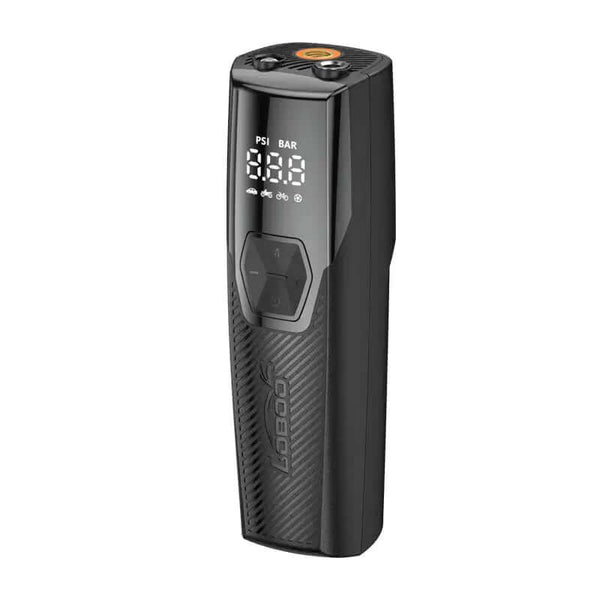
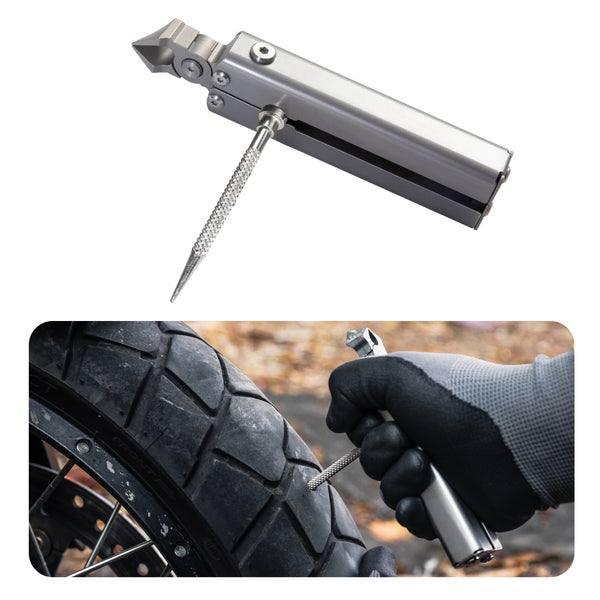
- An emergency compartment: tire repair kit, compressor, basic tools, first-aid kit, always in the same place and within reach without unpacking everything.
To choose between tank, tail, side and crash bar bags, find all the differences in our motorcycle luggage guide. For the bike's technical preparation (tires, brakes, chain, servicing), see our guide on how to prepare your bike for a long trip.

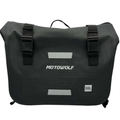
- Volume
- 4.5 L closed · 6.5 L expanded
- Attachment
- 4-point magnetic attachment to tank ring
- Adjustment
- Slides along an 11 cm track
- Material
- 2520D ballistic nylon
- Weight / dimensions
- 700 g · 260 × 160 × 120 mm
- Rain
- Rain cover included

- Volume
- 50 L
- Water resistance
- IPX6 main compartment (not for immersion)
- Fabric
- 840D composite TPU, 0.65 mm
- Closure
- Magnetic roll-top + air valve
- Construction
- Removable U-shaped plate
- Extras
- Shoulder straps, MOLLE, reflective strips
If your motorcycle already has frames and panniers, also check out the rear and seat bags and the aluminum and semi-rigid side cases in the catalog.
Punctures, rain, and fatigue: prepare your Plan B at home
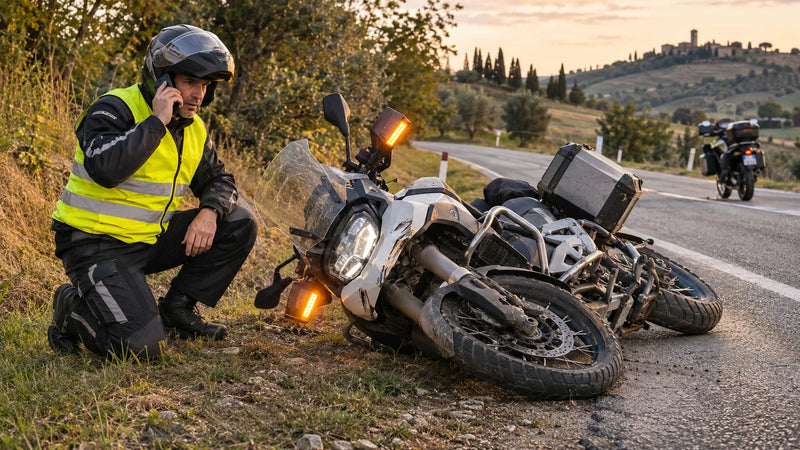
Almost nothing that goes wrong on your first trip is serious. It becomes a problem when it catches you without a plan: that's why it's worth deciding at home what you'll do in the three most common situations.
| Unexpected event | What to bring | Plan B |
|---|---|---|
| Puncture | Tubeless repair kit or inner tubes and tire levers, 12 V compressor | Temporary repair, moderate speed until you reach the nearest tire shop |
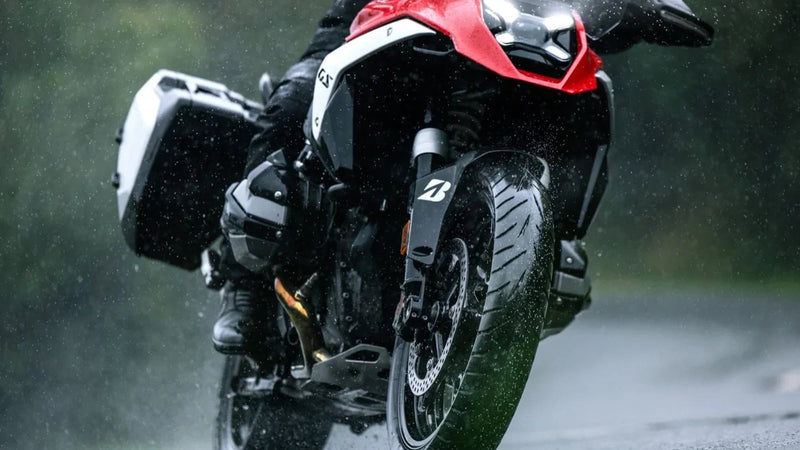
| Rain all day | Rain gear, spare gloves, dry bags for clothes | Shorten the day's ride; stop before you arrive soaked and tired |
| Fatigue or loss of concentration | Water, scheduled breaks, accommodations not too far apart | Take a rest day or halve the day's ride, without feeling guilty |
| Motorcycle breakdown | Roadside assistance number, basic tools, photo of the vehicle registration | Call roadside assistance; keep the train or rental option open |
| Dead phone | Motorcycle USB port, spare cable, offline maps | Navigate using maps downloaded before setting off |

- Tool
- Pliers with interchangeable heads and T-handle
- Folded dimensions
- 147 × 32 mm
- Material
- Martensitic steel
- Case
- Rigid waterproof, 174 × 71 × 34 mm
- Kit weight
- approx. 312 g
- Warning
- Strips and glue not included

- Pressure
- 2-150 PSI, automatic shutoff
- Flow rate
- 35 L/min
- Weight
- 294 g
- Dimensions
- 156.6 × 47.7 × 45.5 mm
- Power supply
- 12 V from outlet or battery terminals
- LOBOO test
- 150/70 R17 from flat to 2.5 bar in about 4 min
L'winter is the right season to plan a spring trip
With the motorcycle parked or barely in use, the cold months are perfect for decisions that need careful thought: destination, dates, budget, and accessories to install ahead of time.
| When | What to do | Why now |
|---|---|---|
| December-January | Choose a destination, trip format and dates; set a budget | Time off must be requested early, and ferries cost less when booked in advance |
| January-February | Choose luggage and accessories, order them and install them | You’ll have time to try them out and return anything that doesn’t work |
| February-March | Plot the route and stages in hours of riding | You need time to compare roads and accommodation |
| March-April | Full day and load test | The first sunny days make it possible to test without the cold |
| May | Service, tires, test run over a long weekend | At least three weeks before departure |
| June or September | Departure | Longer days, less heat and traffic than in August |

Plan your trip with the Endurrad app
With the Endurrad app for iPhone, add your motorcycle to the Garage to find compatible accessories, including a travel kit with the total price and weight: useful for knowing in advance how much extra load you’ll be carrying.
Frequently asked questions about your first motorcycle trip
How many kilometers per day on your first motorcycle trip?
Plan in hours, not kilometers: 5-6 hours of riding per day. On highways and hilly roads, that’s roughly 250-330 km; in the mountains, 210-270 km. These are Endurrad estimates: traffic and weather can reduce them.
How often should you stop during a motorcycle trip?
At least every two hours, with a break of 15 minutes or more. That’s the guidance in the UK Highway Code (rule 91), and on a motorcycle it should be considered a minimum. Stop sooner if you notice reduced alertness, feel cold, or have aches and pains.
How can I tell if I’m ready for a long motorcycle trip?
The most reliable indicator is having already ridden for two or three consecutive days with your motorcycle loaded without ending up exhausted. If your longest ride is under 150 km or you’ve never ridden with panniers, start with some test rides.
Is it normal to feel anxious before a motorcycle trip?
Yes, it’s very common, especially the first time. A moderate level of tension can increase alertness; if it becomes excessive, it helps to reduce unknowns: get the motorcycle serviced in good time, book the first few nights, and have a Plan B for breakdowns and bad weather.
Is it better to travel alone or with someone on my first trip?
For your first trip, traveling with a more experienced companion is an advantage: they can help with decisions and unexpected situations. Traveling alone is possible, but requires more preparation around staying reachable and having a Plan B.
How long should my first big motorcycle trip be?
A week is a good length: long enough to get into the rhythm of traveling, but not so long that fatigue becomes a problem. Include a rest day every four or five days on the road.
What route should I choose for my first motorcycle trip?
A loop within 600-700 km of home, so you can shorten it at any time. Alternatively, stay in one place and take day trips without luggage. For your first trip, avoid long highway rides and challenging off-road sections.
Do I need to book all my accommodation before setting off?
Not necessarily. A good compromise is to book the first two nights and the last night, and leave the rest open. During peak season and in tourist areas, it’s best to book more.
What luggage do I need for a week-long motorcycle trip?
Usually, a tank bag for daily essentials, a 40-50 L tail bag or two panniers, and a space for emergency gear including a puncture repair kit and compressor are enough. After your test weekend, leave at home anything you didn’t use.
What should I bring to deal with a flat tire on a trip?
For tubeless tires, take a string plug repair kit and a 12 V compressor; for inner tubes, spare tubes, tire levers, and a pump. The repair is temporary: it will get you to a tire shop at moderate speed.
When should I get the motorcycle serviced before a trip?
At least three weeks before departure. That gives you time to ride the motorcycle after the service and notice any problems, rather than discovering them on the first day of the trip.
When is the best time for your first motorcycle trip?
Late May, June, and September: long days, manageable temperatures, and less traffic than in August. If you want to ride alpine passes, check that they are open beforehand, as the higher ones usually open between late May and June.
Which number should you call in an emergency abroad?
112, the single European emergency number, is free to call in all European Union countries. Also bring your European Health Insurance Card, which gives you access to public healthcare in EU countries.
Read before you leave
Planning your first big trip?
Tell us your motorcycle's make, model, and year: we'll help you choose compatible bags, cases, and accessories so you can travel light and avoid surprises. In the Endurrad catalog, you'll find tank bags, rear bags, and navigation and electronics for touring motorcycles.
Discover travel bags