

Riding a motorcycle in the dark, starting Sunday, October 25, becomes the norm for the journey home from work: with the return to standard time, the sun sets in Milan at around 17:20, about an hour earlier than on Saturday the 24th. The main danger is not the road surface, but the driver who fails to see you. In 2025, 802 motorcyclists died, and nearly half (47.3%) died in a collision with a car.
Here you'll find what the data really says, what Article 152 requires regarding lights, how to see and be seen better, and which checks to carry out before setting off in the evening.
In brief
- Standard time 2026: the night between October 24 and 25. In Milan, sunset shifts from around 18:22 to around 17:20.
- 2025 ISTAT data: 802 motorcyclists died (-3.4% compared with 2024, +14.9% compared with 2019), 1.6 deaths per 100 crashes compared with 0.6 for cars.
- The key issue is visibility: in the European MAIDS study, the other driver's perception error is the most frequent primary factor (37% of cases).
- Lights: for motorcycles and mopeds, dipped-beam headlights must always be on, including in cities (Art. 152 of the Highway Code).
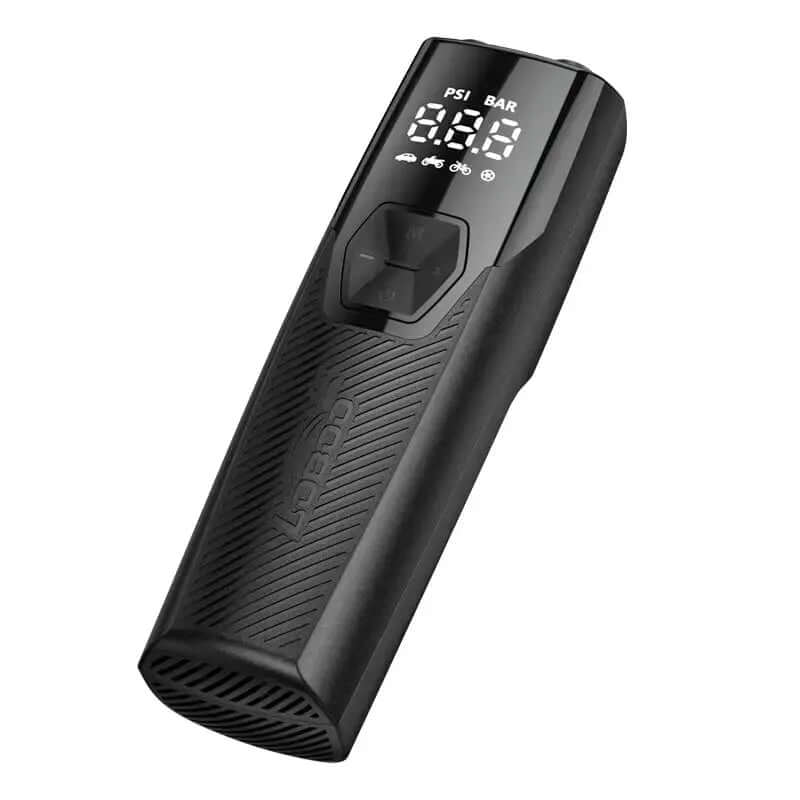
- Tires: cold weather lowers pressure; check it when the tire is cold, at least twice a month.
From October 25, sunset comes before 17:30
The time change moves the clocks back sixty minutes, but the effect on your day is more brutal: the journey home from work, which until Saturday took place in daylight, becomes an evening commute.
On the night between Saturday, October 24, and Sunday, October 25, 2026, at 3:00 the clocks go back to 2:00. The European Union has been discussing abolishing the seasonal time change for years, but for now there is no definitive rule and the change remains in force. The table below shows times calculated with a standard astronomical algorithm for three cities; the difference is a couple of minutes, so for your municipality, rely on data from a local weather service.
| City | Sunset on October 25 | End of civil twilight on October 25 | Sunset on November 15 | Sunset on December 15 |
|---|---|---|---|---|
| Milan | 17:20 | 17:51 | 16:52 | 16:40 |
| Rome | 17:13 | 17:42 | 16:48 | 16:39 |
| Palermo | 17:15 | 17:42 | 16:54 | 16:47 |
Times in standard time (CET), calculated by Endurrad: estimated, unofficial data. The day before the change, October 24, sunset in Milan is at 18:22 daylight saving time.
What changes in practice
For someone leaving at 6:00 p.m., the return journey already takes place after sunset, and by mid-November complete darkness arrives at around 5:30 p.m. The worst moment is twilight: natural light is low, car headlights are on but contrast is limited, and the motorcycle, with a single headlight and a narrow silhouette, blends into the background.
The 2025 ISTAT figures show where people die, not when
The ISTAT report on road accidents in 2025, published on July 24, 2026, is the most robust source we have. It should be read for what it contains, and also for what it leaves out.
The table breaks down motorcyclist deaths by type of collision. Nearly half of the deaths occur in collisions with a car, and nearly one-third without involving other vehicles.
| Type of crash | Motorcyclists killed in 2025 | Share of total |
|---|---|---|
| Against passenger cars | 379 | 47,3% |
| Single-vehicle crash (without other vehicles) | 248 | 30,9% |
| Against trucks under 3.5 t | 56 | 7,0% |
| Against other motorcycles | 45 | 5,6% |
| Against heavy vehicles | 44 | 5,5% |
Source: ISTAT, Road Accidents Report 2025 (July 24, 2026), pp. 8 and 12. The rows do not add up to 802 because the report includes other categories.
The problem is being seen: what MAIDS and the BMJ study say
Two studies, one European and one from New Zealand, explain why visibility matters more than the power of the headlights you use to see.
MAIDS: the other driver's perception error
The MAIDS (Motorcycle Accident In-Depth Study), coordinated by the European motorcycle manufacturers' association ACEM and published in 2009, analyzed 921 crashes involving mopeds and motorcycles, 100 of them fatal. The other driver's perception or vision error was the most frequent primary factor: 37% of cases, accounting for 72% of the errors made by drivers of other vehicles. For fairness, the same study attributes a primary error to the motorcyclist in 37% of crashes: visibility matters, and the caution of the person riding the motorcycle matters just as much.
BMJ 2004: reflective clothing, light-colored helmet, headlight on
The case-control study by Wells and colleagues (BMJ 2004) compared 463 crash-involved motorcyclists with 1,233 controls in Auckland.
| Item | Associated risk | Odds ratio (95% CI) | Robustness |
|---|---|---|---|
| Reflective or fluorescent clothing | -37% | 0,63 (0,42-0,94) | Significant |
| White helmet versus black | -24% | 0,76 (0,57-0,99) | Borderline |
| Headlight on during the day | -27% | 0,73 (0,53-1,00) | Borderline |
| Light-colored helmet versus dark (self-reported) | -19% | 0,81 (0,64-1,01) | Not significant |
Lights: what Article 152 requires and what auxiliary lights add
A motorcycle's lights have two different purposes: helping you see and helping others see you. The legal requirement concerns the first.
Article 152 of the Highway Code requires motorcycles and mopeds to use position lights and low-beam headlights while riding in built-up areas as well. Instead of low beam, daytime running lights may be used if the vehicle is equipped with them and in the cases indicated by Article 153, paragraph 1. The violation is punishable by an administrative fine; for the updated amount and any recent changes, the current text is available at normattiva.it. If you want an overview of the changes to the Highway Code, see the article on the new Highway Code and motorcycles.

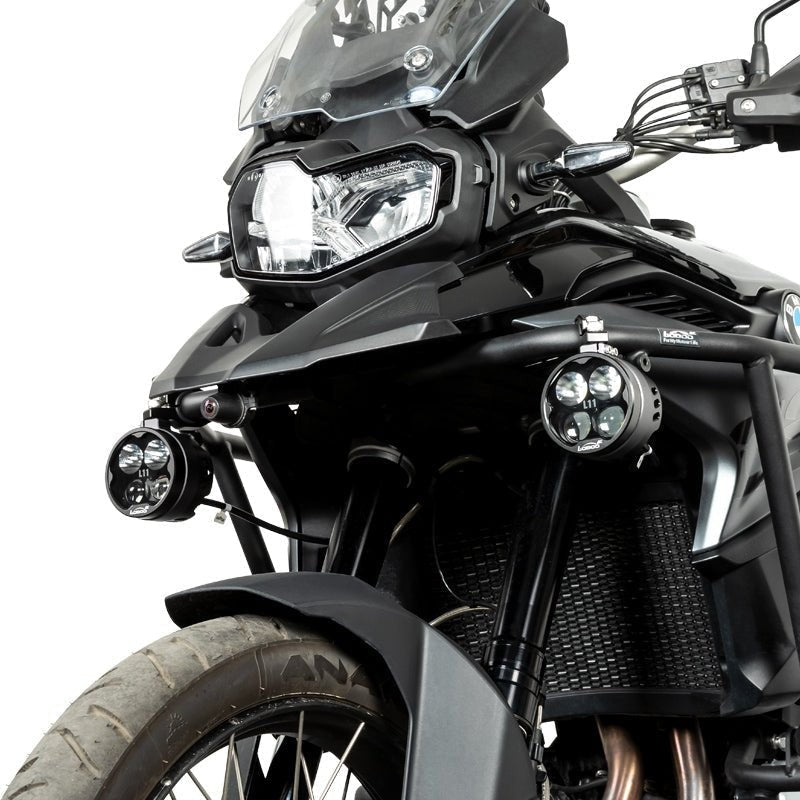
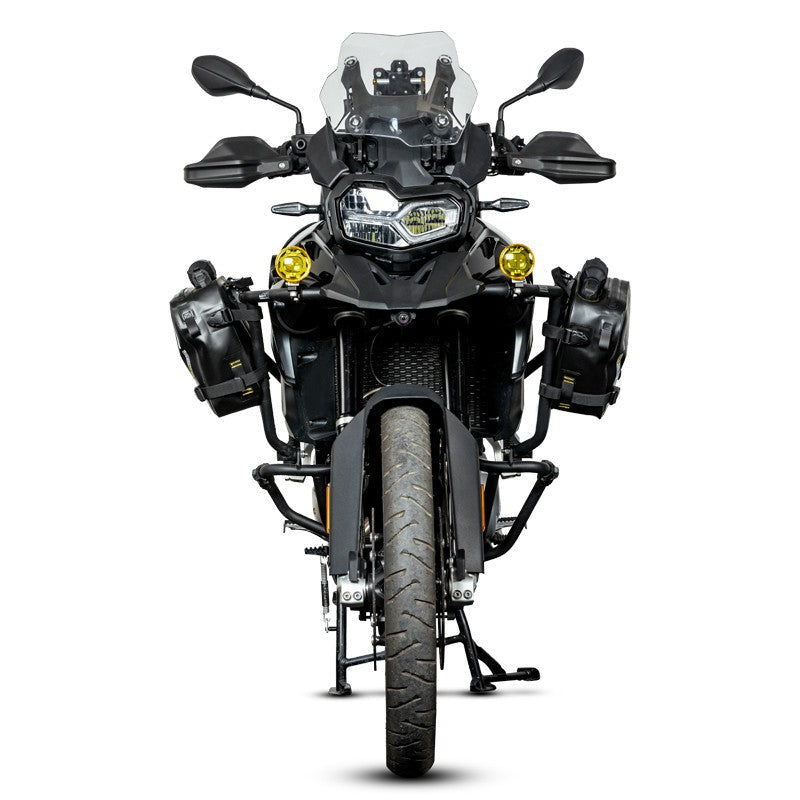
Supplementary lights are not mandatory, and neither of the two studies cited demonstrates that they reduce accidents. They make sense for two practical reasons: they widen the beam on the road ahead, and give the motorcycle a three-point light signature that a driver recognizes more easily than a single headlight. The latter is an editorial opinion, not research data.

- you ride on dark rural roads, with curves or wild animals
- the beam is approved, has a defined cutoff line, and you can adjust it without dazzling others
- the electrical system can handle the additional load (calculate the wattage, control unit, or relay)
- does not make you visible from behind or from the side
- does not compensate for a scratched visor, cold tires, or excessive speed
- does not authorize you to use high beams: in the city, keep it at the lowest level or switch them off


- Homologation
- ECE R149.00, E57*149R00/06*1186
- Maximum output
- 15,000 lumens per pair
- Adjustment
- 8 brightness levels
- Sealing
- IP68, CNC aluminum housing
- List price
- 455 €
As of October 14, 2026, the product page shows only one piece in stock. If it is sold out, you can find alternatives in the LOBOO lighting collection and in motorcycle lighting and electrical. Homologation and light output are figures declared by the manufacturer: to read an ECE certificate and understand what is actually compliant, see the guide to approved auxiliary lights; for a comparison of models, see the best motorcycle auxiliary lights of 2026. Before adding loads to the electrical system, also read how a motorcycle power distribution unit works.
Visor, cold, and clothing: the details that matter at 5:30 p.m.
At night, the visor matters as much as the headlights, and a cold body matters more than people admit.
The visor: clean, clear, and scratch-free
A scratch that goes unnoticed during the day scatters the light from oncoming headlights at night, leaving you with a halo in front of your eyes. It’s a practical rule, not a study: if the visor is visibly scratched, replacing it costs less than an accident. At night, use a clear visor or a clear internal lens system, not a tinted one. Autumn humidity causes fogging easily: an anti-fog treatment or a dedicated insert, checked before setting off, prevents the worst moment.
The body: cold and concentration
Cold hands and chest make you tired and distracted, especially at the end of the day. That’s why dressing in layers and protecting your hands isn’t a traveler’s affectation: it’s a matter of attentiveness. If you return every evening when temperatures are below ten degrees, heated motorcycle clothing: where to start explains what to warm first, while the heated motorcycle clothing collection gathers what’s in the catalog.
The contrast: reflective inserts
Based on the BMJ study, a jacket or vest with large reflective or fluorescent areas is the visibility investment with the best ratio of cost to available evidence. Look at the panels on the back and sleeves: these are the surfaces the car behind you sees first.
Cold tires, wet leaves: checks before setting off
In cold weather, the air in the tires contracts, pressure drops, and grip decreases just when the asphalt is wet and covered with leaves.
A common rule of thumb is about 1 psi per 10 degrees Fahrenheit, that is, roughly one-tenth of a bar per 10 degrees Celsius. This is an estimate, not a manufacturer's specification: what matters is measuring with the tire cold, after the motorcycle has been stationary for at least a couple of hours. Insella recommends checking at least twice a month, preferably every week; with the motorcycle fully loaded, with luggage and a passenger, the usual recommendation is to increase pressure by 0.2-0.3 bar, but the correct values are in your motorcycle's manual.

- Range
- 0-8 bar
- Stated accuracy
- 0.01 bar
- Battery
- 2-3 years, non-replaceable
- Dimensions
- 25 x 25 x 49,5 mm
- Compatible with
- Chigee AIO-5 Lite, AIO-5 Play, AIO-5 Play BMW Edition, XR-2
- List price
- 60 €
Five checks before going out in the evening
- Cold-tire pressure. Use a pressure gauge, follow the manual's values, and adjust them if you are carrying a load.
- Lights. Low beam, brake light, turn signals and, if you have them, auxiliary lights: also check the beam height, which must not reach the eyes of oncoming road users.
- Visor. Clean inside and out, scratch-free, with active anti-fog treatment.
- Battery and electrical system. Cold weather strains weak batteries, and loads left on for hours of darkness put them under stress: see how to maintain your battery in winter.
- Route. Choose well-lit roads where possible and allow more time: evening hurry is the worst adviser.
Five habits that change evening riding
These are common-sense and driving-school guidelines, not the findings of a single study: we present them as an editorial opinion.
- Reduce your speed compared with daytime. In low light, you see obstacles later: auxiliary lights do not change the physics of stopping distance.
- Increase your following distance. In the dark, visual references are lost and the car ahead's brake lights are harder to read.
- Position yourself where you can be seen. Avoid staying in the blind spot or hiding behind a car that is about to turn: at an intersection, the risk is a car cutting you off.
- Look toward the edge, not at the headlights. If an approaching car dazzles you, shift your gaze toward the right edge of your lane.
- Take a break if you are tired. Cold and darkness reduce your stamina: ten minutes in a café cost less than one moment of distraction.
Wet leaves and a damp road surface are a constant companion this season: grip decreases, and braking must be applied more progressively. There is no data that allows us to give a precise measure, so the rule is simple: if the asphalt is shining, slow down.
Frequently asked questions about riding a motorcycle in the dark
The most frequently asked questions, with the sources listed in the notes.
When does standard time return in 2026?
What time does it get dark on a motorcycle after the time change?
Do I have to keep my motorcycle lights on during the day too?
How many motorcyclists were killed on Italian roads in 2025?
Are more people killed on motorcycles in the evening and at night?
Does reflective or fluorescent clothing really help?
Do white helmets make you more visible?
Are auxiliary lights mandatory?
How much pressure do motorcycle tires lose in cold weather?
How often should tire pressure be checked?
Is a TPMS pressure sensor worth the expense?
How can you avoid being dazzled by oncoming cars?
What should I wear to ride home in the evening at 8 degrees?
Read next
Prepare your motorcycle for the dark
On Endurrad you'll find lighting, electrical and heated clothing accessories to get home safely even when the sun sets at five. Start with the motorcycle lighting and electrical collection, check out the LOBOO spotlights and, if you have a Chigee display, the tire pressure sensors.
Always take Endurrad with you: download the Endurrad app for iPhone.
ISTAT, 2025 road accidents report (July 24, 2026), pp. 8, 12 and 13.
ACEM, MAIDS, presentation of the results (2009).
Wells S. et al., Motorcycle rider conspicuity and crash related injury: case-control study, BMJ 2004; 328:857.
Italian Highway Code, art. 152, text consulted via SicurAUTO; verify the current text at normattiva.it.
Return to standard time in 2026: QuiFinanza. Sunset times: Endurrad calculation, unofficial estimate.
Tire pressure: Insella; 1 psi for every 10 degrees Fahrenheit rule: Master Strategy Group, educational estimate.
LOBOO L11 and Chigee product sheets: Endurrad catalog, data declared by manufacturers, verified on October 14, 2026.


Share:
New Highway Code and motorcycles: what is already law, what is only a draft, and what to do now
Motorcycle tax 2027: who doesn’t have to pay it, how the exemption works, and when the motorcycle still has to pay it