

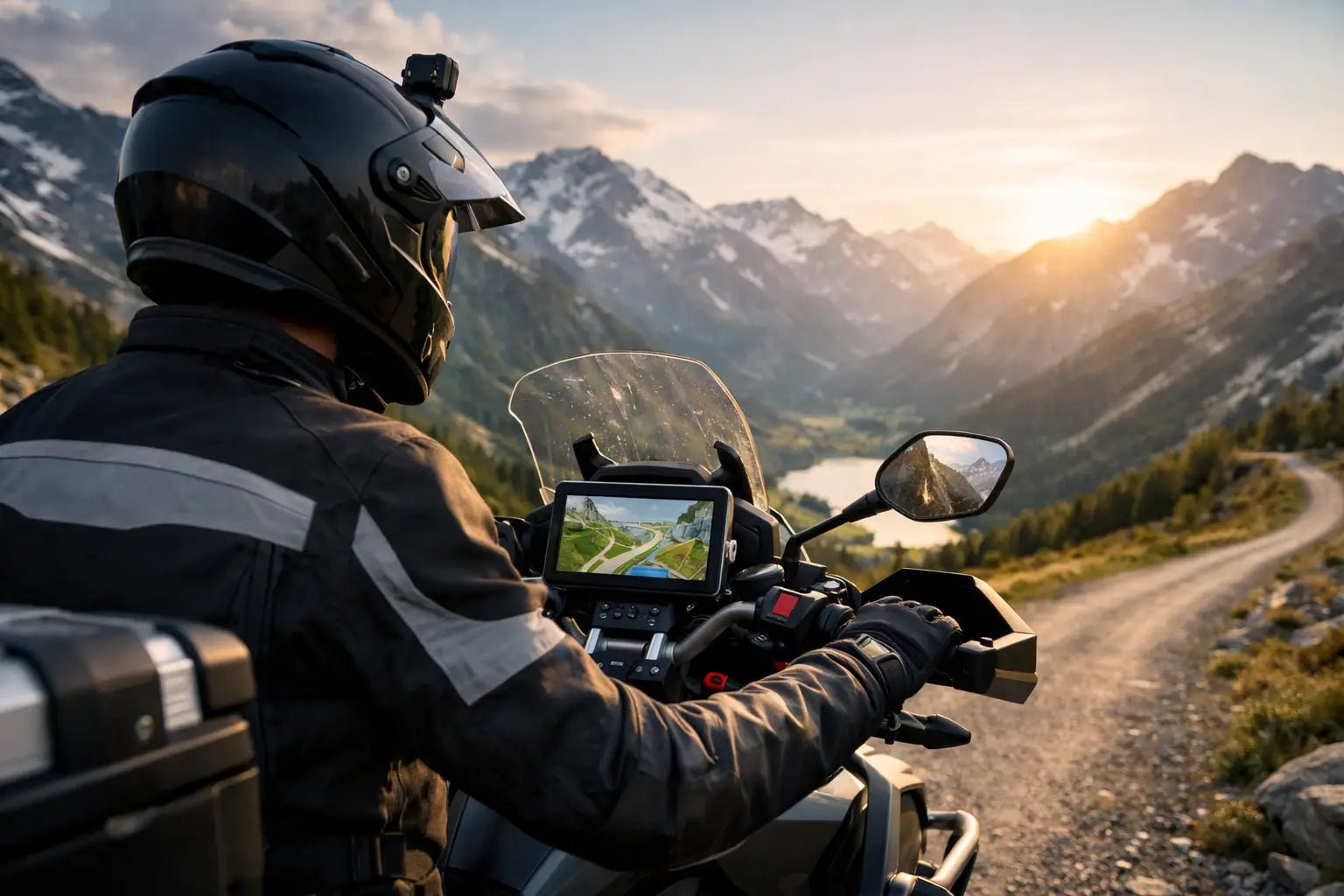
Anyone who prepares a motorcycle for real trips knows this: a navigator is not only useful for finding a road. It helps reduce errors, manage detours, read the terrain in advance, and stay focused when the pace picks up. This is why the future of connected motorcycle navigation is of particular interest to those who use their motorcycle for long-distance touring, mixed asphalt-dirt, and stages where reliability and practicality matter more than any special effects.
The real question is not whether navigation will become more advanced. That has already happened. The useful question is another: which functions will truly improve the riding experience and which will remain secondary, or worse, a source of distraction? For an adventure motorcyclist, the answer always comes down to four concrete criteria: readability, continuous operation, compatibility with the motorcycle, and easy management even with gloves, vibrations, and complicated weather.
Where the Future of Connected Motorcycle Navigation is Heading
In recent years, the difference between smartphones, dedicated GPS devices, and standard TFT displays has narrowed, but it has not disappeared. The future will not be dominated by a single device. Rather, it will be an ecosystem where multiple components work together: navigation unit, phone, intercom, motorcycle ECU, and stable mounting brackets.
For those who truly travel, this integration only makes sense if it reduces steps. There's no need for ten screens and fifty notifications. What's needed is to start a route in a few seconds, receive clear directions, correct a track on the fly, and continue riding without losing attention. The best connected navigation will be the least intrusive.
A key point will be the synchronization between planning and actual use. Today, many motorcyclists prepare itineraries on computers or dedicated apps, then export them, correct them, and re-upload them. Tomorrow, this process will be more streamlined. GPX tracks, waypoints, points of interest, and route variations will be managed more fluidly across different platforms. For those traveling with a BMW GS, a KTM Adventure, or an Africa Twin, this means less time lost in setup and more time riding.
More Data Is Not Enough; Filtering the Right Data Is Needed
Connectivity promises real-time traffic, weather, alerts, road conditions, hazard warnings, and vehicle status. All useful, in theory. In practice, the problem is prioritization. On a motorcycle, you cannot read and interpret too much information as you would in a car.
This is why the most important step forward will not be the quantity of available data, but their intelligent selection. A valid system will need to understand what to display based on the context: a relevant detour, a dirt section after a thunderstorm, a useful gas station relative to actual range, a closure that truly impacts the route. The rest must remain in the background.
For those undertaking long transfers or mixed rides, this difference is enormous. A clean interface and a well-designed alert logic help more than any "smart" function on paper. If a navigator forces you to look at it too often, it's already working poorly.
Safety Also Comes from Simplicity
In the future of connected motorcycle navigation, safety will not only depend on route accuracy. It will depend on how information reaches the rider. More reliable voice commands, better intercom integration, and essential but legible directions will be much more relevant than elaborate graphics.
Those who use motorcycles for travel are well aware of the problem: low sun, rain, dirty visor, winter gloves, vibrations on dirt roads. In these conditions, hardware remains crucial. A bright screen, glove-friendly touch, physical buttons where truly needed, stable support, and reliable power still make the difference. Connectivity improves the system, but does not replace a solid technical foundation.
Smartphone, Dedicated GPS, or Hybrid System?
This is where the topic becomes concrete. Many believe that smartphones will eventually replace everything. For some uses, this is already the case, especially on roads and for simple journeys. But as vibrations, heat, rain, required autonomy, and the need to read off-road tracks increase, limitations emerge.
A modern smartphone has updated maps, excellent connectivity, and advanced apps. However, it suffers from overheating, not always stable power management, sensitivity to vibrations, and variable readability under the sun. For urban or light touring use, it may be sufficient. For a multi-day crossing with dirt roads, rain, and long stages, it depends on how it is mounted, powered, and protected.
Dedicated GPS continues to maintain clear advantages: greater durability, an interface designed for riding, compatibility with complex tracks, and more predictable operation in difficult conditions. However, it has higher costs and, in some cases, slower software ecosystems than smartphones.
The most credible system for the coming years is therefore hybrid. Advanced planning from an app or cloud platform, automatic synchronization, and use on a device truly designed for motorcycle use. Not necessarily just traditional GPS. Some motorcycle displays and dedicated units are also moving in that direction.
Real Motorcycle Compatibility: The Detail That Decides Everything
In the adventure and touring world, there is no truly valid universal solution. The position of the fairing, the type of crossbar, the space above the dashboard, the presence of TFTs, the management of the power socket, and riding ergonomics change significantly between a Ténéré, a GS, and a KTM Adventure.
For this reason, when talking about the future of connected motorcycle navigation, one must also talk about mounting. A system that is excellent on paper can become uncomfortable if it forces you to look away, vibrates too much, or interferes with your vision while standing on the footpegs. Conversely, a good model-specific support, with the correct angle and stable attachment, significantly improves the user experience.
The same applies to power. Connectivity requires continuous and reliable energy. Improvised cables, exposed sockets, or poorly protected connections are not compatible with serious use. Those who travel far must think of navigation as a system composed of device, support, power, and protection, not as a single accessory.
Integration with the Motorcycle Will Be Deeper, But Not Always Useful
We will see increasing interaction between navigation and vehicle data: remaining range, consumption, riding modes, maintenance, tire pressure, suspension status where available. On some platforms, this will bring real benefits. On others, it risks adding complexity without improving riding.
The aspect to evaluate is simple: does the function help you make better decisions during the trip or does it just add information? Having fuel suggested based on the route, actual consumption, and useful distance is a concrete function. Receiving secondary data while riding on rough terrain, much less so.
Off-road and Minor Roads: Here Will Be the True Evolution
On main asphalt roads, navigation is already mature. The most interesting leap will come in the management of tracks, secondary roads, and mixed routes. Adventure motorcyclists are not just looking for the fastest route. They seek control over the route, credible alternatives, and the ability to adapt the day based on the terrain.
The best platforms will start to distinguish more precisely between broken asphalt, smooth dirt roads, challenging terrain, and seasonal sections. It won't be an exact science, because conditions change quickly, but the quality of the data will improve. User sharing could also play a role, if well filtered. Without control, the risk is filling the map with useless or inaccurate information.
For the experienced motorcyclist, this means a very practical thing: less improvisation where it's not needed and more freedom where it makes sense to choose. A good system should help you change roads when the context changes, not force you to follow a line planned elsewhere.
What Will Really Matter in the Choice
In the coming years, the difference will not be made by the device with the most functions, but by the one most consistent with actual use. For long journeys, mounting stability, screen visibility, weather resistance, simple track management, reliable power, and compatibility with your motorcycle matter. Everything else comes after.
Anyone who prepares their motorcycle seriously already knows this: every accessory must have a specific purpose. Navigation is no exception. If the system is designed to go anywhere, it must work well on the highway in the sun, on a bumpy provincial road, and on a dirt road where you ride standing up and the weather changes in ten minutes. Endurrad operates precisely with this technical logic: choosing components that make sense on a trip, not just on the spec sheet.
The future of connected motorcycle navigation will therefore be more useful, but not automatically better. It will only be better when it manages to reduce friction between rider, motorcycle, and route. Fewer unnecessary steps, more reliability, more clarity. For those who truly travel, this is the innovation that matters: not a system that does more things, but a system that allows you to think less about technology and more about the road ahead.








Share:
Anti-vibration smartphone mount review
Best waterproof motorcycle panniers