

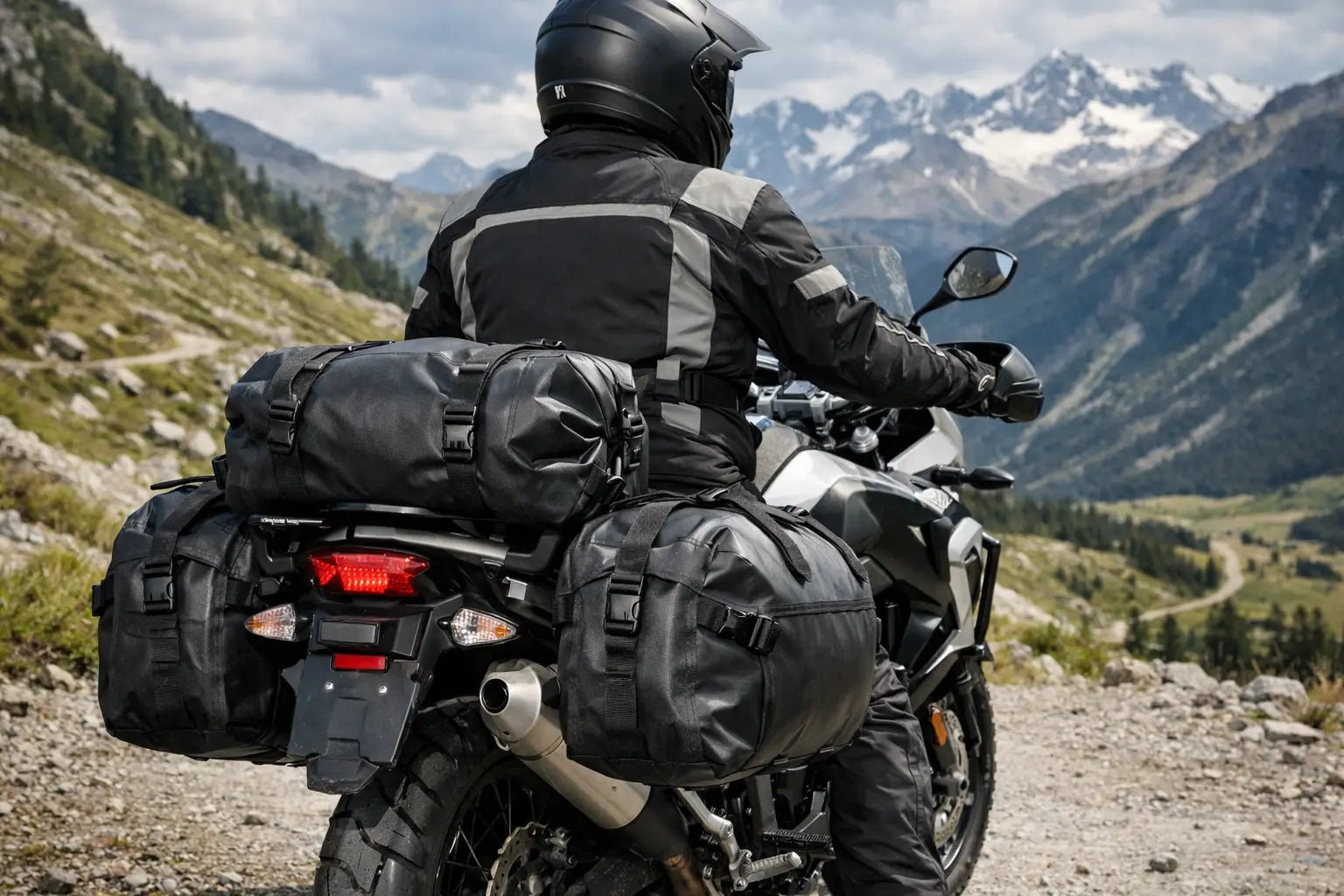
If you've already faced a truly rainy day, you know that keeping your clothes dry isn't the only problem. The point is to reach the end of the stage with usable gear, electronics, and spare parts. That's why waterproof motorcycle tail bags are not a secondary accessory: they are a technical choice that affects load, stability, and travel reliability.
On an adventure or touring motorcycle, the tail bag works in a precise area of the chassis. It sits behind the rider, often over the passenger seat or on the luggage rack, so it affects the center of gravity less than tall and narrow panniers, but it can worsen the rear end's movements if it's too large, too soft, or poorly secured. This is where the difference lies between a tidy setup and one that starts to move, rub, or give way after 200 km.
When waterproof motorcycle tail bags are the right choice
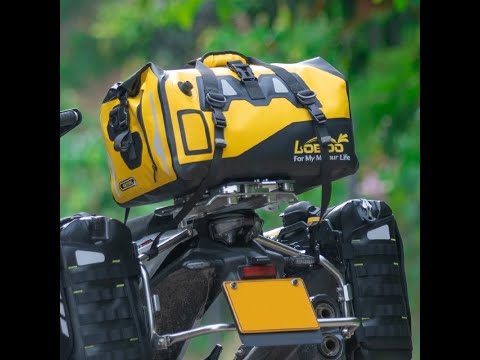
You don't always need a complete set of side panniers. In many cases, a waterproof tail bag is the most rational solution. For a long weekend, for light travel, for mixed asphalt-gravel use, or for those who want to keep the bike narrower and more maneuverable, the tail bag offers a good compromise between volume, accessibility, and ease of installation.
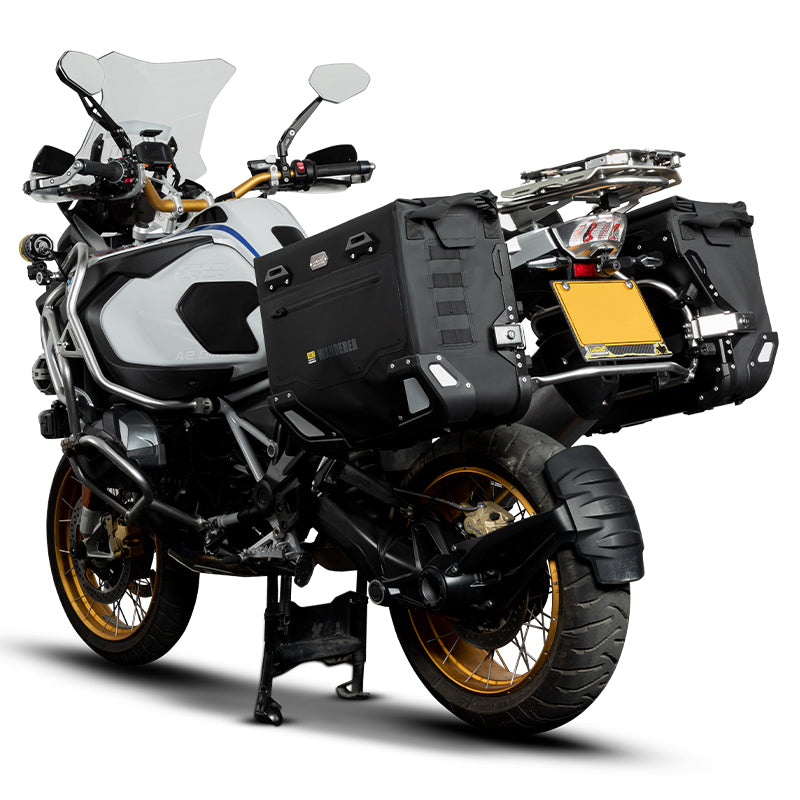
On models like BMW GS, KTM Adventure, Honda Africa Twin, or Yamaha Ténéré, this configuration works well, especially when you want to carry clothing, a compact tent, a sleeping bag, or personal kit without weighing down the sides of the bike. In light and medium off-road, reducing lateral bulk also helps. Fewer protrusions mean less risk in narrow passages and less exposed mass in case of a low-speed tip-over or slide.
That said, it's not a universal solution. If you're traveling two-up or need quick and organized access to a lot of gear, a tail bag alone can become limiting. As often happens in the travel world, it depends on the duration of the trip, the type of route, and how disciplined you are in packing.
What distinguishes a truly waterproof bag from one that is merely water-resistant
In commercial language, the terms are often confused, but in real use, the difference is clear. A water-resistant bag tolerates light rain or splashes. A truly waterproof bag is designed to prevent water entry even under intense and prolonged rain, with adequate closures and properly welded or bonded materials.
The first element to look at is the construction. The most reliable materials are generally technical PVC, TPU, or high-tenacity fabrics with waterproof coatings and welded seams. Traditional seams, even when well made, remain a critical point if not treated correctly. The roll-top closure, if well executed and properly compressed, continues to be one of the most effective solutions for adventure travel.
The shape also matters a lot. A well-designed bag must not only keep water out but also do so while maintaining stable volume, solid anchor points, and an outer surface that doesn't excessively retain dirt and mud. Those who travel on gravel roads or in mixed conditions immediately notice this: when the material is good, cleaning is easier, and wear remains under control for longer.
Capacity, bulk, and load distribution
The ideal capacity is not chosen in abstract liters. It is chosen based on what you carry, where you put it, and how it changes the bike's behavior. A 20 to 30-liter bag is often sufficient for short trips or as an addition to panniers. Between 40 and 50 liters is the most versatile range for motorcycle touring. Beyond that, more attention is needed for fastening and the overall height of the load.
The critical point is to avoid the "tower effect." A very tall bag shifts weight upwards and backward, and this is felt in maneuvers from a standstill, in load transfers, and in acceleration on uneven surfaces. On a maxi enduro, the margin is greater than on a more compact bike, but the principle remains the same.
Better a well-compressed volume that is as wide as needed, rather than an overloaded bag that deforms. If the load is soft, uniform, and well secured, the bike remains more precise. If there are rigid objects inside left free to move, the behavior worsens, and stress on the fastening points also increases.
Fastening: the detail that changes everything
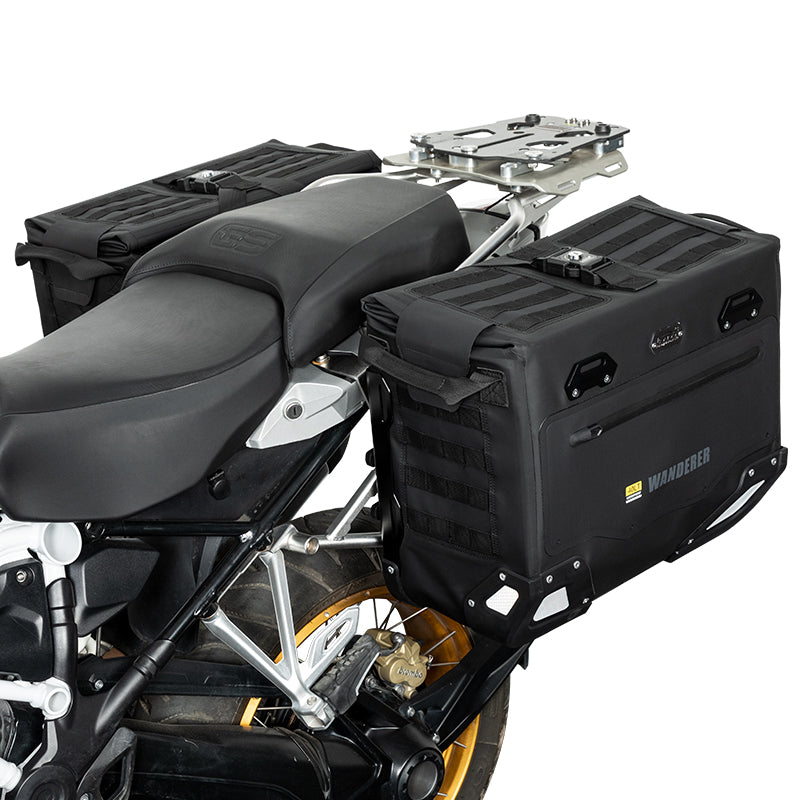
One of the most concrete differences between a reliable setup and an improvised one lies in the anchoring system. The best waterproof motorcycle tail bags use dedicated straps, reinforced loops, and traction points designed to remain stable even with vibrations, rain, and gravel.
The fastening must do three things: prevent longitudinal movement, block lateral movement, and keep the bag compressed on the support. If one of these three aspects is missing, sooner or later the load will move. And when it moves, it can damage the seat, touch hot parts, interfere with the rider, or stress the luggage rack.
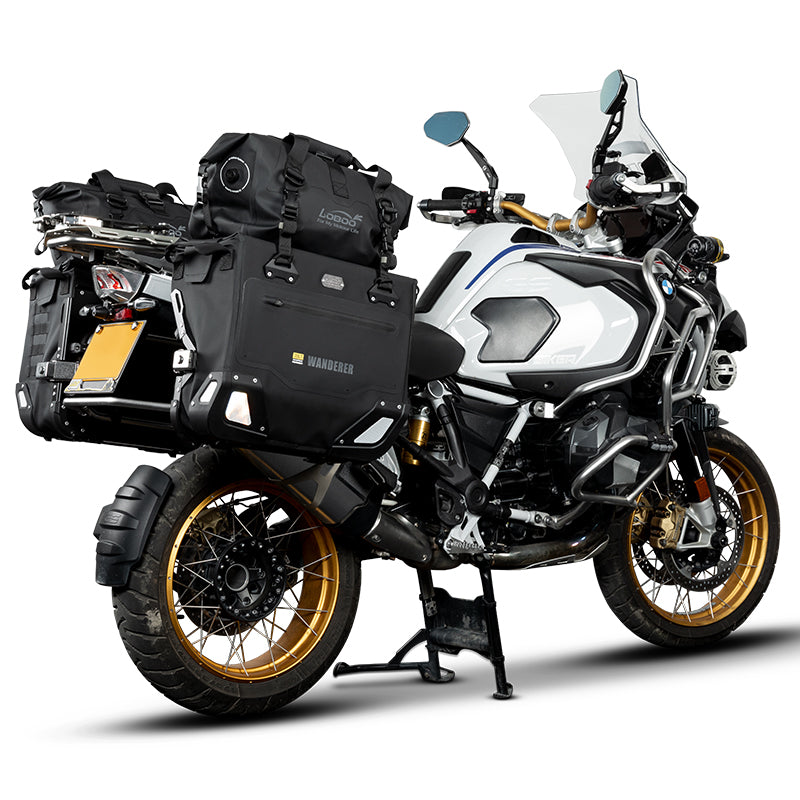
Mounting over the passenger seat is often the most stable, as it brings the weight closer to the center of the bike. On the luggage rack, it works well if the plate is robust and proportionate to the bag's base. In both cases, it is always advisable to check the distance from the exhaust, freedom of movement when getting on and off the bike, and compatibility with any existing handles or top racks.
Beware of exhaust and abrasion
A quality waterproof bag can withstand a lot, but not continuous contact with direct exhaust heat or sharp edges of the frame. If the motorcycle has a high exhaust, precise clearance and protection must be checked. Even simple rubbing on a metal bracket, after thousands of kilometers, can create a weak point.
That's why external reinforcements, abrasion-resistant panels, and a well-controlled shape matter almost as much as waterproofing.
Motorcycle compatibility: not all solutions work the same way
In the premium segment, compatibility is not a commercial detail, but a guarantee of functionality. The same bag can perform very well on a GS with a large, flat luggage rack, and much less well on a bike with a narrow tail, protruding handles, or an inclined seat.
On a BMW GS or an Africa Twin, for example, the rear volume is often well managed thanks to the rear frame structure and available accessories. On a Ténéré, which is more focused on lightness, or on slimmer configurations, it is even more important to keep the load compact and close to the rider. On some KTM Adventures, finally, the issue of heat and the sporty rear setup requires more attention in choosing the shape and positioning.
That's why it makes sense to start with the motorcycle model and not just the stated capacity. A truly suitable accessory must integrate with the geometry of the vehicle and the intended use, not just physically sit on the luggage rack.
How to choose waterproof motorcycle tail bags based on use
If you primarily tour on asphalt, you can prioritize accessibility, capacity, and modularity. A bag with quick access, well-protected external pockets, and a regular shape is very practical for frequent stops. If, on the other hand, you alternate between asphalt and gravel, it is advisable to prioritize compactness, very stable fastening, and abrasion resistance.
For advanced commuting or 2-3 day trips, a medium capacity is often the smartest. For longer expeditions, the tail bag performs best as part of a system: soft main luggage behind, heavier gear lower down, quick-access items in a dedicated position.
Soft bag or top case?
It depends on the objective. A top case offers urban practicality, rigid closure, and immediate access. However, a waterproof tail bag is often lighter, more forgiving on gravel, and less penalizing when the terrain gets tricky. It also tends to transmit less inertia upwards, especially if well loaded.
For adventure travel, many experienced motorcyclists prefer a soft solution precisely to reduce rigidity, bulk, and structural stress. For daily use or fast commuting, a top case remains convenient. There is no absolute answer: the type of route and the balance between practicality and motorcycle control matter.
The details that make a difference over time
There are aspects that go unnoticed on the bench and then become decisive after months of use. Buckles must be solid and easy to operate even with gloves. Excess straps must be able to be tidied up, otherwise they flap and wear out. Handles must actually be useful when moving a loaded bag from the bike to the campsite or hotel.
The ability to compress the volume is also important. A semi-empty but well-compressed bag performs better than a large, loose sack. The same applies to cleaning: mud, dust, and rain should not turn every return into long and inconvenient maintenance.
Those who prepare their motorcycle carefully look at precisely these details. This is the approach that makes the difference between an accessory mounted to fill space and a component chosen to work well, stage after stage.
When evaluating a waterproof tail bag, think less about the isolated technical specifications and more about your actual setup: bike, route, duration, volume, loading method. The right choice is the one that remains stable, truly protects the contents, and allows you to ride without having to think about your luggage every ten kilometers. Your next adventure also starts here.




Share:
Motorcycle mechanical cruise control: is it really necessary?
Accessories for Triumph Tiger 900: what you need